Bitcoin Ten-Year Price History
The 2008 financial crisis erupted in full force. That same year, Satoshi Nakamoto published a paper titled "Bitcoin: A Peer-to-Peer Electronic Cash System" on the mailing list of the "metzdowd.com (Cypherpunks)" website, known as the "Bitcoin Whitepaper," marking the birth of the Bitcoin concept.
On January 3, 2009, the first Bitcoin block, the "Genesis Block," was mined, marking the launch of the Bitcoin network and the beginning of the crypto assets and blockchain movement. It should be noted that during the first two years, Bitcoin was not traded on the market but circulated in the form of gifts and rewards among programmers.
(1) Bitcoin Ten-Year Price Fluctuations
The landmark event marking Bitcoin's first trade was in May 2010, when a programmer used 10,000 Bitcoin to buy two pizzas worth $25—this is the famous "Bitcoin Pizza" event in Bitcoin history. By calculation, Bitcoin's price at this time was $0.0025.

From $0.0025 to $60,000—how did Bitcoin get to where it is today, and where is it headed? Let us take this opportunity to review Bitcoin's price movements over the years, analyze the reasons for its rises and falls, and extract some patterns to serve as a reference for predicting Bitcoin's future price trajectory.
1. Bitcoin's First Major Rally
After the purchase of two pizzas with 10,000 Bitcoin, Bitcoin's price began to rise. Data shows that by July 18, 2010, Bitcoin's price had reached $0.06, a 23-fold increase from $0.0025.
As Bitcoin's price climbed, Bitcoin exchanges sprouted like mushrooms. At the time, the world's largest exchange was Mt. Gox. In November 2010, Bitcoin's price briefly reached $0.5, nearly 200 times the pizza price.
From April to June 2011, Bitcoin rose from $0.68 to around $30 in just two months. Major media outlets such as TIME and Forbes published articles about Bitcoin one after another.
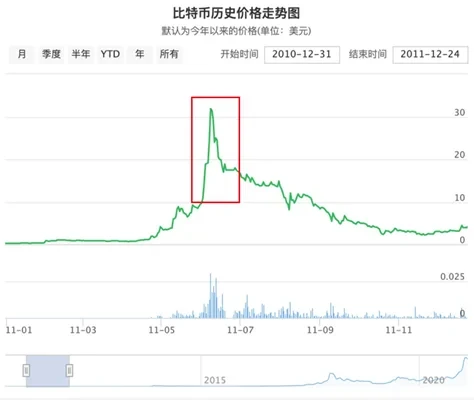
However, the good times did not last. Mt. Gox suffered a hacker attack, and with insufficient market depth at the time, a few sell orders were enough to collapse the price. From June to November 2011, Bitcoin fell from a high of $32 to $2—a decline of 94%. Although this major Bitcoin oscillation deterred some people, it also led more investors who recognized its value to discover Bitcoin's potential and strengthened their resolve to continue investing.
2. Bitcoin's Second Major Rally
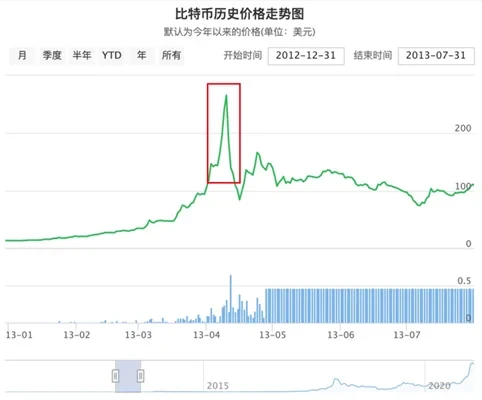
After more than a year of lying low, Bitcoin broke through $30 again in February 2013. The year 2013 holds a special place in Bitcoin's history, as it was the year that Bitcoin's "safe-haven asset"属性 was discovered, marking the beginning of Bitcoin's second bull run.
In 2013, a severe debt crisis erupted in Cyprus. To cope with the crisis, the Cypriot government ultimately decided to sacrifice the interests of uninsured depositors to secure bailout funds and froze deposits exceeding 100,000 euros to address the debt issue.
The government's misguided actions caused widespread panic among the public and intense skepticism about bank safety. At this point, some Cypriot citizens discovered Bitcoin, which was independent of sovereign currencies and was in a price uptrend. Due to Bitcoin's "decentralized" and "fixed total supply" attributes, many citizens believed Bitcoin might be the perfect solution to this crisis, so they rushed to buy Bitcoin. From March 1 to April 9, within just over a month, Bitcoin's price rose from $33 to a staggering $235. Unfortunately, this price level did not hold for long, and Bitcoin subsequently fell back to around $80.
However, this event brought more users to recognize Bitcoin's value. At the end of 2013, Bitcoin finally welcomed an even larger rally, soaring from $106 to a high of $1,177—the first time in history that the price of one Bitcoin exceeded the price of one ounce of gold. Bitcoin opened a new chapter.
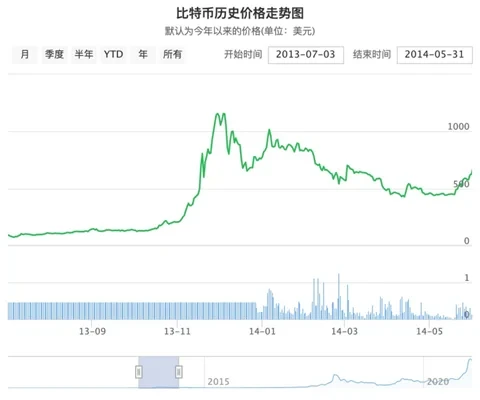
However, after Mt. Gox was hacked for a large amount of Bitcoin and declared bankruptcy, panic spread throughout the market. Coupled with some negative policy developments, Bitcoin oscillated downward, and the market entered a prolonged bear market once again. From 2013 to 2015, Bitcoin's price dropped by as much as 90%.
3. Bitcoin's Third Rally
Time is the best medicine. After two years of adjustment, Bitcoin's trading market gradually recovered. In 2016, Bitcoin experienced its second halving. Coupled with the rise of Ethereum, the blockchain industry once again drew public attention. The number of investors increased significantly, and Bitcoin embarked on its third upward trajectory.
Even though it experienced Bitcoin's first fork and the 9/4 crash during this period, investors' enthusiasm remained undiminished. Starting from November 2017, Bitcoin surged relentlessly, with its price soaring to a historical high of nearly $20,000. Looking back on that year, Bitcoin's price rose from $789 to nearly $20,000, a maximum increase of 24 times. Bitcoin entered the ranks of trillion-dollar market cap assets and gained more attention from mainstream financial markets and media.
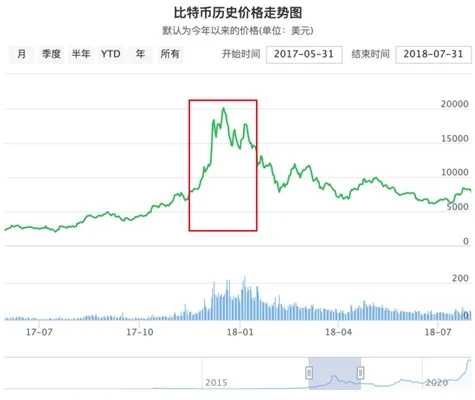
However, due to insufficient follow-up bullish catalysts, with blockchain applications only remaining at an early stage and not yet scaled widely, combined with an imperfect market and limited investment tools, Bitcoin shifted from bull to bear, entering a two-year period of volatile decline, bottoming at $3,000—a decline of approximately 83% from its all-time high.
4. Bitcoin's Fourth Rally
In 2019, the market warmed up and Bitcoin was gradually recognized by institutions and the public. By 2020, the COVID-19 pandemic swept the globe, introducing renewed uncertainty into the global market economy. U.S. stocks triggered circuit breakers multiple times, the economy was weak, and central banks in Europe, the U.S., and other countries adopted loose monetary policies to stimulate the economy. Faced with concerns about inflation and the potential weakening of the U.S. dollar's purchasing power, investors once again turned their attention to Bitcoin, which is known for its inflation resistance.
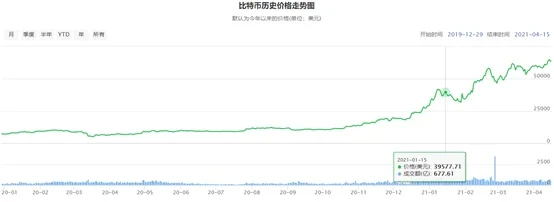
Unlike previous cycles, the driving force behind this Bitcoin bull run was no longer retail investors but institutions. After the Grayscale Bitcoin Trust launched its "buy, buy, buy" mode, Bitcoin's price kept climbing. With major listed companies joining in and investment tools becoming increasingly sophisticated, Bitcoin's trading price kept rising, easily surpassing the 2017 high and reaching around $60,000. Although Bitcoin is currently in a high-price consolidation zone, most investors believe the bull market will continue.
(2) Characteristics of Bitcoin's Ten-Year Price History
The development of new things is always tortuous but also invincible. In Bitcoin's short 12-year history, it has gone through a cycle of being doubted—then accepted—given new hope—disappointed—then accepted again. Each time this cycle resets and rebuilds, Bitcoin becomes more resilient. This recognition, reflected in Bitcoin's price and market cap, manifests as ever-higher highs and an increasingly massive scale.
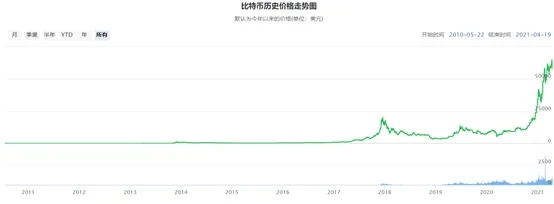
Looking back at Bitcoin's historical price changes, we find that its trajectory has the following characteristics:
1. Bitcoin Is an Asset Worth Long-Term Investment
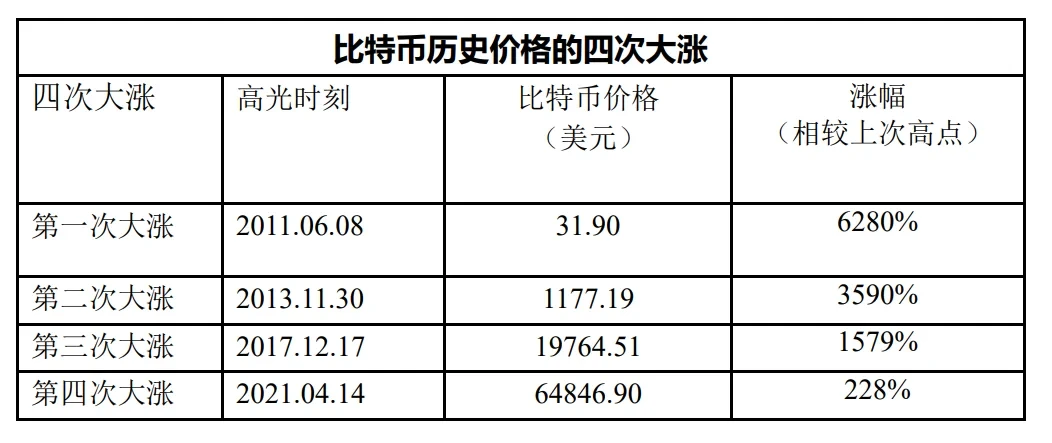
If we extend the time horizon and look at Bitcoin's price on an annual basis, we can see that Bitcoin's historical price has been in an uptrend. Observing Bitcoin's historical prices reveals four major rallies. The first rally peaked at $31.90, a staggering 6,280% increase from the prior high of $0.50. The second rally's highlight reached $1,177.19, a 3,590% rise from $31.90. During the third rally, Bitcoin's price hit $19,764.51, a 1,579% increase from the prior peak. The fourth bull market is still unfolding—if we use the current all-time high of $64,846.90, it represents a 228% increase from the previous peak.
Although Bitcoin has experienced several significant price swings throughout its history, when you zoom out and look at the bigger picture, you will find that these fluctuations are relatively minor in the grand scheme of history. In fact, if we connect Bitcoin's historical highs, long-term holding remains profitable. Bitcoin has ridden the waves, been tested by the market, doubted, and repaired itself. Its price keeps reaching new highs and刷新着人们的认知.
2. Compared with Other Asset Classes, Bitcoin Offers Higher Investment Returns
The reason Bitcoin is worth long-term investment, beyond its upward historical price trend, is that we can compare Bitcoin's trajectory with the S&P 500, Dow Jones Index, gold, silver, and crude oil in terms of investment returns.
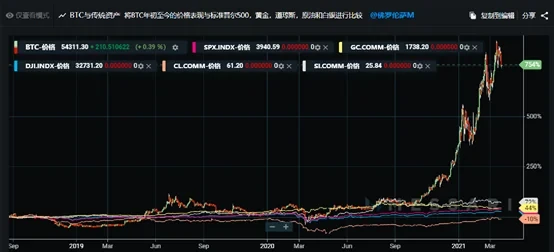
As shown in the chart above, from early 2021 to mid-March, crude oil fell 10%, while gold and silver rose 44% and 72% respectively—but Bitcoin surged 754% during this period. Its returns were staggering, leaving all other asset classes far behind.
In an environment of global economic uncertainty, Bitcoin leveraged its intrinsic value advantage to carve out its own unique market performance. The OKX official platform shows Bitcoin's highest spot price reached $64,846.9, giving people a renewed understanding of its value and once again showcasing the allure of Bitcoin investment.
(3) Lessons from Bitcoin's Ten-Year Price History for Investors
History is a guide! Reviewing history is about better predicting the future. Bitcoin's past time cycles and price fluctuations are important references investors can draw from. Discovering and summarizing the patterns within can play a role in guiding investors' future decisions.
Lesson One: When you extend the time horizon, Bitcoin's price continues to rise. Although short-term price fluctuations exist, many investors who recognize its value choose to hold for the long term.
Lesson Two: Bitcoin experiences drawdowns after sharp rallies. Investors can manage risk by referring to Bitcoin's historical price cycles.
Lesson Three: If an investor bought at Bitcoin's spot price peak, there is no need to worry excessively. Based on Bitcoin's price trajectory, waiting patiently for the next all-time high will bring clear skies after the clouds part.
As mentioned above, what distinguishes this Bitcoin bull market from previous ones is that the main drivers are no longer retail investors but traditional financial institutions and well-known investors, all of whom hold a positive outlook on Bitcoin's future.
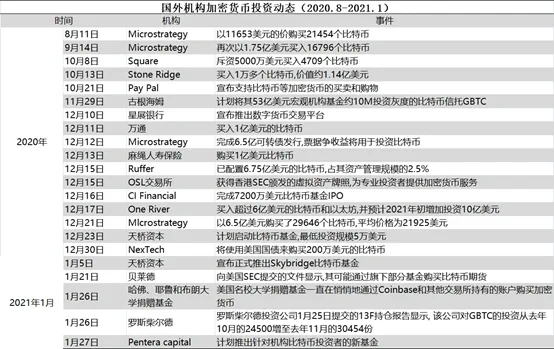
Statistics show that 33 institutions currently hold Bitcoin, including approximately 17 listed companies, 4 private companies, and 12 funds. Additionally, several international internet giants such as Microsoft, PayPal, Overstock, and Mastercard have already enabled Bitcoin payments, and these forces continue to grow.
Investing in Bitcoin may be an excellent choice!
The development of all things is a unity of progress and曲折性. By reviewing Bitcoin's historical price trajectory, the crypto space has moved beyond its initial phase of浮躁盲目, the crypto assets investment environment is becoming increasingly regulated, investment tools are improving day by day, and listed companies and large institutions are entering the market in droves. We have reason to believe that Bitcoin is moving steadily toward the mainstream. History often repeats itself in striking ways, but it never truly recycles the same chapter. With proper strategies, one can achieve investment returns far exceeding those of traditional stock markets—this is the amazing development potential and allure that a new investment market demonstrates!
We have every reason to believe that Bitcoin's next decade will be even more spectacular!
Disclaimer
This article may contain product-related content not applicable to your region. This article is intended to provide general information only and does not accept responsibility for any factual errors or omissions. This article represents the author's personal views only and does not constitute the views of OKX. This article is not intended to provide any advice, including but not limited to: (i) investment advice or investment recommendations; (ii) offers or solicitations to buy, sell, or hold digital assets; or (iii) financial, accounting, legal, or tax advice. Holding digital assets (including stablecoins) involves a high degree of risk, may fluctuate significantly, and may even become worthless. You should carefully consider whether trading or holding digital assets is suitable for you based on your financial situation. For questions about your specific circumstances, please consult your legal/tax/investment professional. The information in this article (including market data and statistics, where applicable) is provided for general reference purposes only. Although all reasonable precautions have been taken in preparing this data and these charts, we accept no responsibility for any factual errors or omissions expressed herein. © 2025 OKX. This article may be reproduced or distributed in its entirety, and excerpts of 100 words or less may be used, provided that such use is non-commercial. Any reproduction or distribution of the full article must prominently state: "This article is copyrighted © 2025 OKX, used with permission." Permitted excerpts must cite the article title and include attribution, for example, "Article title, [author name (if applicable)], © 2025 OKX." Some content may have been generated or assisted by artificial intelligence (AI) tools. Derivative works and other uses of this article are not permitted.
Show More
Recommended Reading
How to Unfreeze Your OKX Account: Required Documents and Step-by-Step Guide
# How to Unfreeze Your OKX Account: Required Documents and Step-by-Step Guide Being locked out of your OKX account can be stressful, but recovery is possible with the right documents and steps. If you're facing the OKX account verification process or looking for the documents needed to unfreeze your OKX account, you've come to the right place. This guide will explain what causes account freezes, what documents you'll need, and a step-by-step plan to regain access. We'll cover the main reasons
March 10, 2026
How to Resolve OKX Withdrawal Freezes: Step-by-Step Troubleshooting
# How to Resolve OKX Withdrawal Freezes: Step-by-Step Troubleshooting You're trying to withdraw from OKX—but your funds are frozen or stuck. This can be extremely stressful, especially when you need quick access to your crypto assets. Fortunately, there are clear steps that can help you resolve OKX withdrawal freezes. This guide covers why withdrawals get frozen, how to troubleshoot the issues, and how to prevent future problems. We'll go over the main causes
March 10, 2026
How Long Does an OKX Withdrawal Take? Processing Times, Fees, and Troubleshooting
# How Long Does an OKX Withdrawal Take? Processing Times, Fees, and Troubleshooting Many crypto traders worry about how quickly they can access their funds—withdrawal speed is critical. If you're wondering how long OKX withdrawal processing typically takes, you're not alone. This guide provides a detailed breakdown of how long OKX withdrawals usually take, what factors affect timelines, and how to avoid delays. You'll also learn about OKX withdrawal fees, common troubleshooting
March 10, 2026
OKX Withdrawal Blocked Due to KYC Verification: Causes and Solutions
# OKX Withdrawal Blocked Due to KYC Verification: Causes and Solutions Many OKX users encounter sudden withdrawal blocks related to KYC verification—this article explains why and how to resolve them. If you've experienced an OKX withdrawal blocked by KYC verification, you're not alone. This guide explains why OKX enforces these restrictions, how its KYC process works, and how to resolve the
March 10, 2026
OKX Withdrawal Pending: Causes, Solutions, and Support Guide
# OKX Withdrawal Pending: Causes, Solutions, and Support Guide Still waiting for your OKX withdrawal to complete? You're not alone—withdrawal delays are a common concern among cryptocurrency users. Seeing a status of "OKX withdrawal pending" can be stressful, but most delays have simple explanations and solutions. This guide covers in detail the reasons why an OKX withdrawal may be pending, the most common issues, and how long withdrawals typically
March 10, 2026
How to Contact OKX Support for Withdrawal Issues: Step-by-Step Guide
# How to Contact OKX Support for Withdrawal Issues: Step-by-Step Guide Is your crypto withdrawal stuck? You're not alone. Many OKX users occasionally experience withdrawal delays or issues, and knowing how to contact OKX support is essential for quickly resolving withdrawal problems. In this guide, you'll learn how to reach OKX support, troubleshoot withdrawal issues, and get your funds flowing again. We'll walk you through the most common issues, show you
March 10, 2026