What Crypto Assets Do Institutions Invest In? What Reference Value and Significance Does This Hold for New Investors?
Introduction: With the rich variety and quantity of crypto assets, investors often feel overwhelmed when making selections. At such times, the investment methods of certain institutions for crypto assets naturally become market indicators. Many retail investors like to follow institutional investments—that is, selecting crypto assets based on institutional behavior. So what kind of crypto assets easily gain institutional favor, and what reference significance do institutional investment methods hold for new investors?
What Is Institutional Investment, and What's the Difference Between Retail and Institutional Investment?
Whether in traditional investment markets or crypto assets, two types of participants are indispensable: retail investors and institutional investors.
The subjects of institutional investment are typically legal entities with large amounts of funds, such as companies, financial institutions, governments, or securities institutions. They participate heavily in Trading and exert enormous influence on market trends, usually being considered experienced and sophisticated investors.
For example, this round of Bitcoin's bull market has been called an institutional bull market—traditional financial investment institutions pouring into the cryptocurrency market, driving up coin prices while triggering FOMO emotions among more institutions and retail investors, thereby pushing Bitcoin prices higher again and bringing about a bull market.
Among them, Grayscale is a very well-known institution in the crypto industry. At that time, compliance channels for traditional funds investing in Bitcoin were limited, so Grayscale's Bitcoin Trust became the top choice for traditional institutions to enter the market. That's why we frequently saw news about Grayscale increasing its Bitcoin holdings in the early stages of the bull market.
Statistics from OK Link show that the total market value of crypto asset trust funds currently managed by Grayscale has reached $47.665 billion, covering more than a dozen crypto assets including BTC, ETH, LTC, BCH, etc.
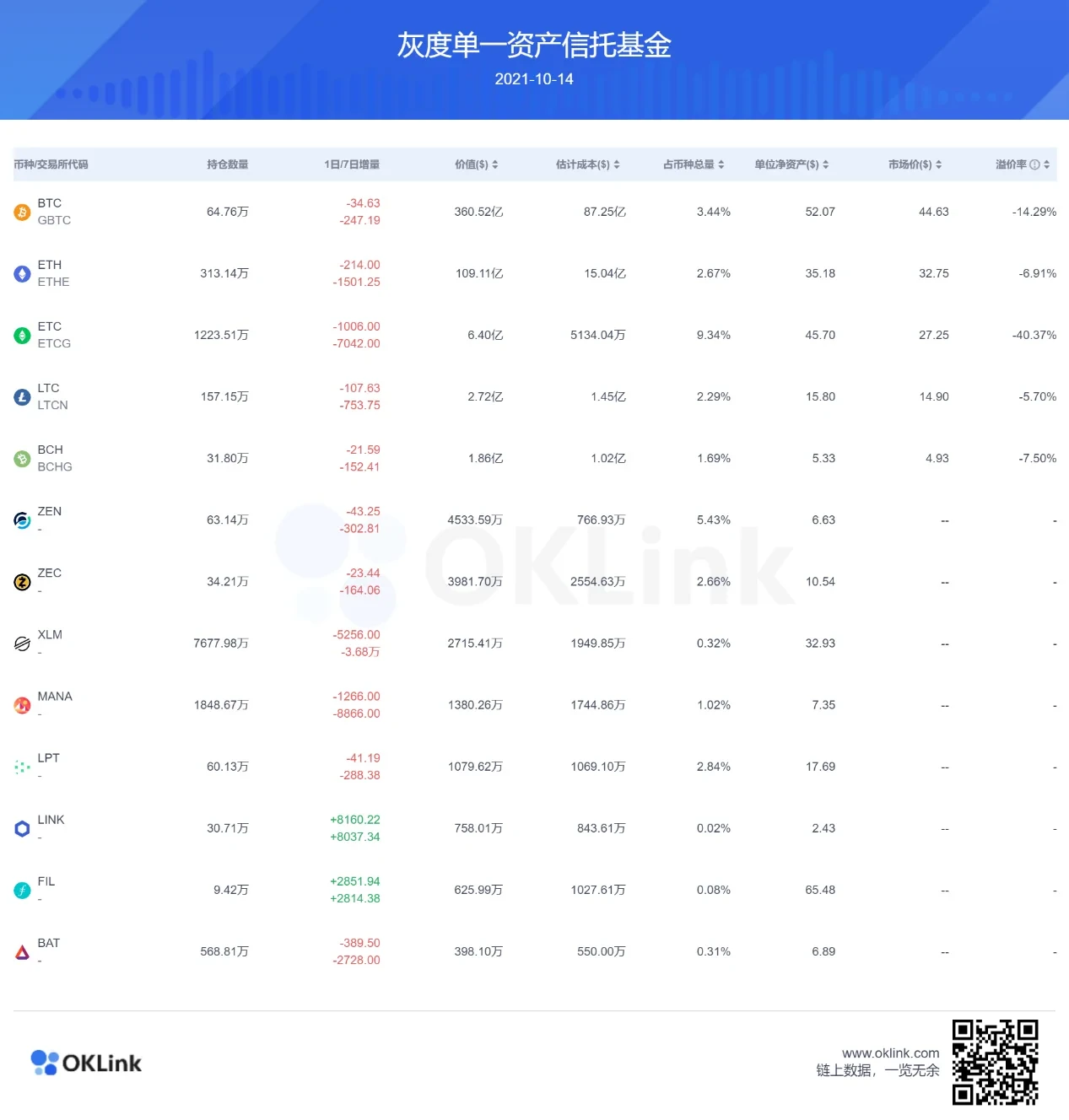
Taking GBTC, the largest fund under Grayscale, as an example: GBTC's current total holdings reach $32.8 billion, of which $1.042 billion is held by dozens of institutions, while the remaining $31 billion-plus in shares were sold to retail investors through the secondary market. From this, we can glimpse the differences between institutional investors and retail investors.
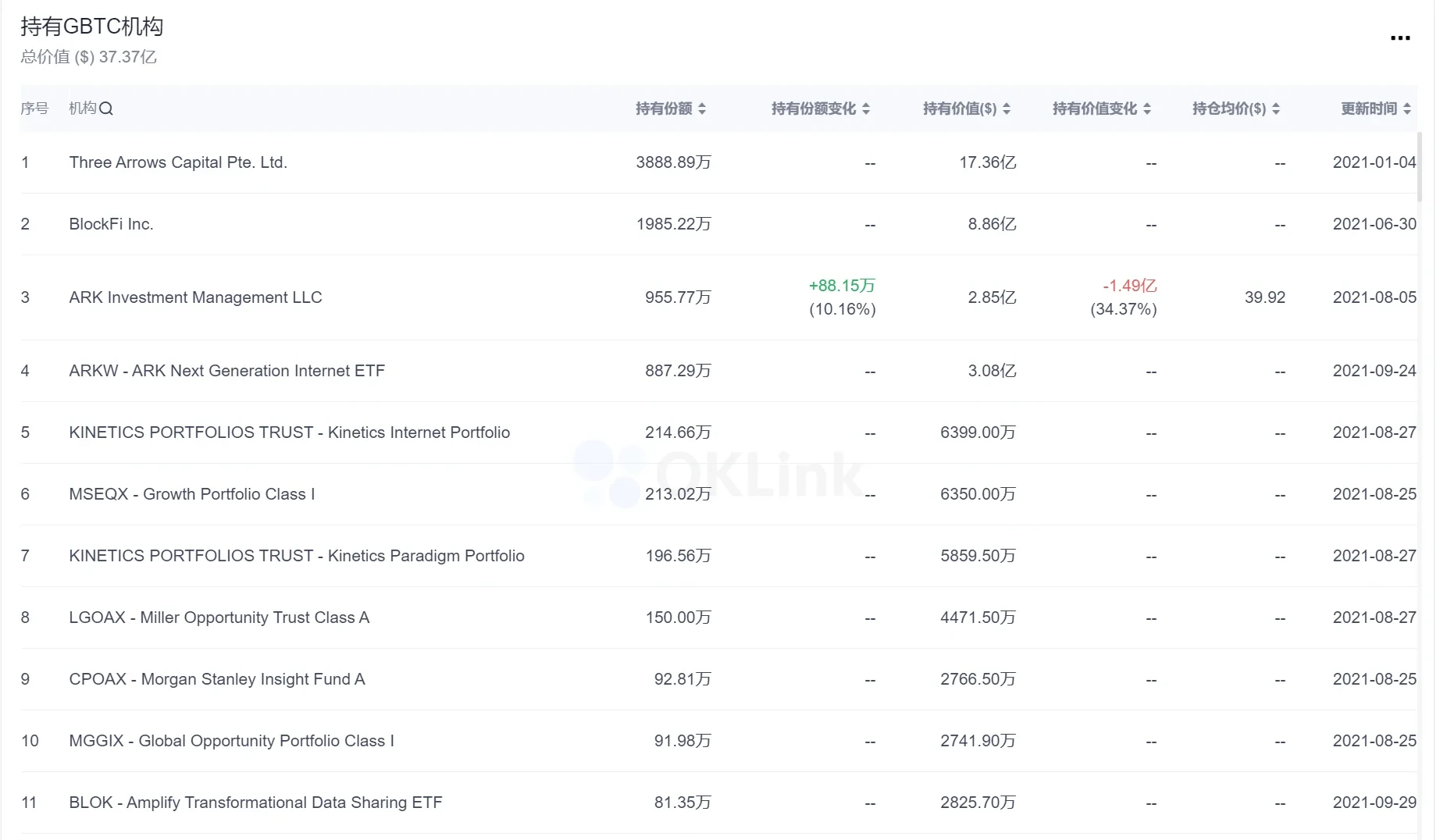
Retail investors generally engage in small-amount trading, with relatively scattered funds, usually as unorganized individual investors. Although individual retail investors have limited financial strength, they excel in numbers and broad membership, including wage earners, retirees, students, self-employed individuals, etc., covering almost every industry, so their overall funds should not be underestimated.
Typically, we consider institutional investors' investment methods to be more rational, and they surpass retail investors in risk awareness and asset management. Retail investors, by contrast, are more significantly influenced by market sentiment, more obviously following herd behavior, and are easily affected by news reports, institutional strategies, or market analysis when selecting investments.
What Crypto Assets Do Institutions Invest In?
Since the second half of 2020, institutions have continuously laid out in crypto assets and expanded investment channels. Grayscale Investments, MicroStrategy, PayPal, Goldman Sachs, Meitu, and others have successively entered the crypto industry. So, which crypto assets have these swarming institutions actually invested in?
Taking early entrant Grayscale as an example:
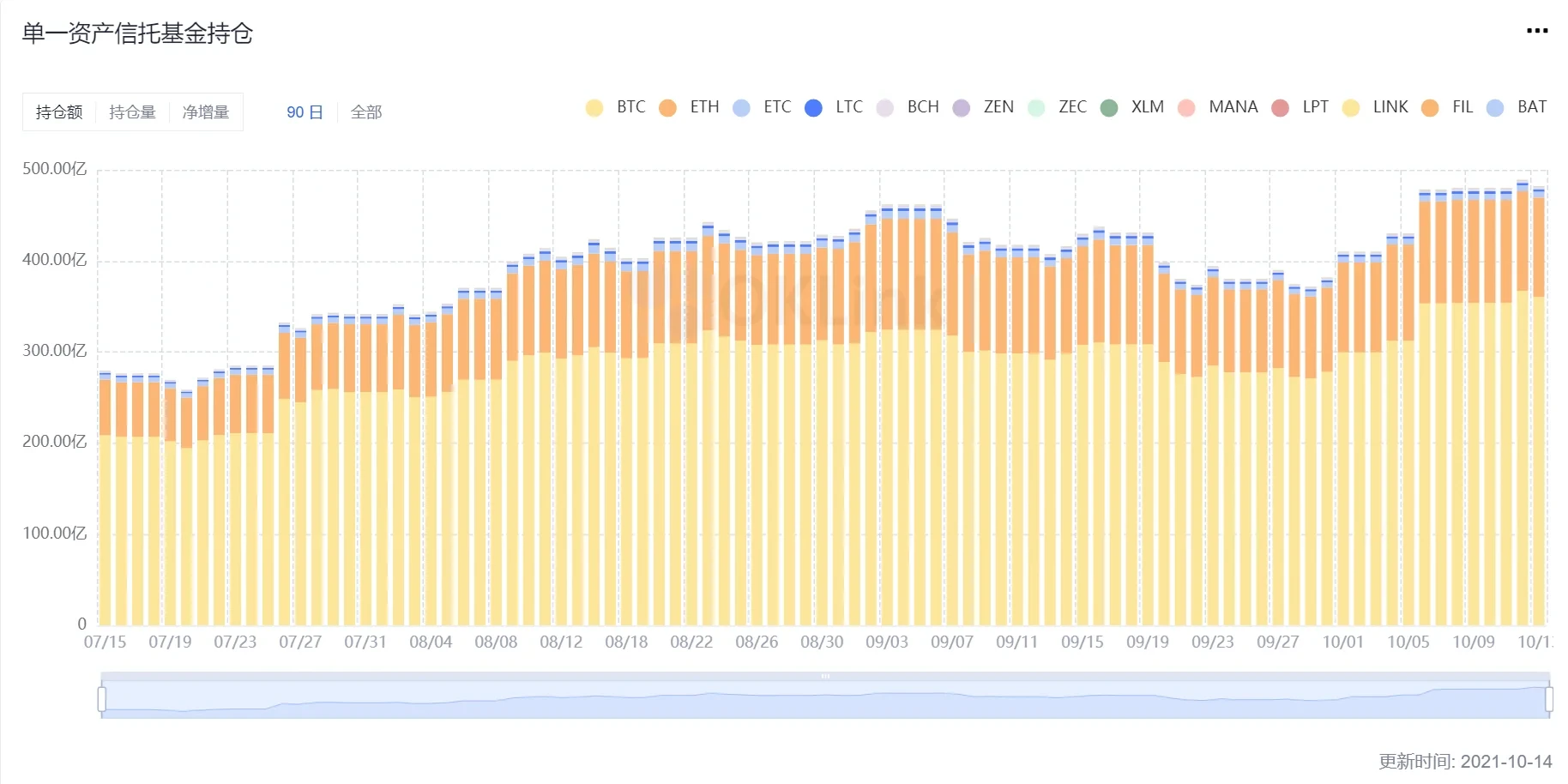
We can see that the crypto assets managed by Grayscale are primarily Bitcoin (BTC), Ethereum (ETH), Bitcoin Cash (BCH), Litecoin (LTC), and other mainstream coins, plus ZEN, Zcash, etc. This March, Grayscale also announced adding five new trust funds: BAT, LINK, MANA, FIL, and LPT.
Bitcoin is institutional investors' first choice. First, as the first-born crypto asset, Bitcoin has a longer history, and its "wealth creation story" is the most "mainstream"—institutions learn about cryptocurrency starting with Bitcoin. Second, Bitcoin has the largest market capitalization and best liquidity, able to accommodate institutions' large fund volumes. Software company MicroStrategy is currently the publicly traded company holding the most Bitcoin; social platform Twitter and mobile payment giant Square are also Bitcoin supporters; when Meitu entered the crypto market, Bitcoin was also its first choice.
After Bitcoin come mainstream crypto assets with relatively high market capitalizations like Ethereum. Institutional investors' selection of crypto asset categories is generally relatively steady and conservative. Even though DeFi and NFT fields are extremely hot, institutions are very cautious about participating in these hotspots, while retail investors' style is more aggressive.
How Can New Investors Refer to and Grasp the Indicators Led by Institutions?
As a new investor, how to balance steadiness and aggression? Staying rational is key. If we understand relatively little about some highly volatile hot areas, we can first observe overall market conditions, estimate future trends, then make selections based on recent news and institutional dynamics, because institutional investors usually have a relatively mature crypto asset selection strategy.
Take the Grayscale example we mentioned: after it announced on March 17 the launch of five new trust funds—BAT, LINK, MANA, FIL, and LPT—BAT rose 45%, LINK gained 9% in half an hour, MANA rose 29%, FIL increased 42%, and LPT's rise was most astounding, reaching 300%.

Thus, institutional investors often play a leading role in investments. When new investors face many crypto assets and don't know how to start, they might as well use these mainstream investment institutions as reference.
It's worth mentioning that referencing institutional investment shouldn't mean blindly following trends. After all, institutional investors focus more on projects' long-term value. Even when building positions, they don't do it all at once but in batches, so short-term fluctuations have smaller impact on them. However, for retail investors, short-term price fluctuations greatly affect their operations. As we mentioned with BAT, LINK, etc., when Grayscale launched on the 17th, they saw a big surge, but after the 18th's heat passed, they experienced another plunge. New investors who don't grasp the rhythm well easily chase highs and kill lows.
How Can New Investors Avoid Pitfalls When Following Institutional Investment?
Actually, for retail investors, the biggest enemy in market games isn't institutions, but investors' own greed and fear. If you want to stand firm in investing, you must:
① Conduct risk assessment before investing, and make choices based on your own capacity.
② Examine the value support of crypto assets, avoid types with poor track records. If you doubt the project itself, it will inevitably affect investment confidence.
③ Formulate long-term/short-term investment plans. If doing long-term, don't look at temporary gains and losses; if doing short-term, don't be greedy for quick success and rush ahead. If you operate arbitrarily and recklessly without any method, you'll easily lose in volatile markets.
In OKX's Beginner Academy tutorials, there's a series of professional courses designed for new investors, meeting learning needs from understanding crypto assets, reading K-lines, to getting in-depth industry information. Welcome to come learn.

④ Diversify investments, don't put all eggs in one basket, manage crypto asset positions well.
⑤ Cultivate patience, maintain a good mindset, don't be disturbed by market emotions.
Conclusion: Institutional investors often play a leading role in crypto asset investment, while retail investors have a certain time lag when following institutions in making decisions. Therefore, new investors need to always maintain keen instincts, pay more attention to capital movements, plan their investment strategies well, abandon some typical greedy thinking, remember to take profits and stop losses in time, and avoid emotional and impulsive investment.
Disclaimer
This article may contain content about products not available in your region. This article is intended only to provide general information and is not responsible for any factual errors or omissions herein. This article represents only the author's personal views and does not represent OKX's views. This article is not intended to provide any of the following advice, including but not limited to: (i) investment advice or investment recommendations; (ii) offers or solicitations to buy, sell, or hold digital assets; or (iii) financial, accounting, legal, or tax advice. Holding digital assets (including stablecoins) involves high risk, may fluctuate significantly, and even become worthless. You should carefully consider whether trading or holding digital assets is suitable for you based on your financial situation. For questions about your specific situation, please consult your legal/tax/investment professional. Information appearing in this article (including market data and statistics, if any) is for general reference only. Although we have taken all reasonable precautions in preparing these data and charts, we assume no responsibility for any factual errors or omissions expressed herein. © 2025 OKX. This article may be reproduced or distributed in full, or excerpts of 100 words or less from this article may be used, provided such use is non-commercial. Any reproduction or distribution of the entire article must also prominently state: "Copyright © 2025 OKX. Used with permission." Permitted excerpts must cite the article title and include attribution, such as "Article Title, [Author Name (if applicable)], © 2025 OKX". Some content may be generated or assisted by artificial intelligence (AI) tools. Derivative works or other uses of this article are not permitted.
Show More
Recommended Reading
How to Unfreeze Your OKX Account: Documents and Steps Explained
# How to Unfreeze Your OKX Account: Documents and Steps Explained Being locked out of your OKX account can be stressful, but with the right documents and steps, recovery is possible. If you're facing the OKX account verification process, or looking for documents needed to unfreeze your OKX account, you've come to the right place. This guide will explain the reasons for account freezes, what documents you need, and a step-by-step plan to regain access. We'll cover
March 10, 2026
How to Resolve OKX Withdrawal Freeze Issues: Step-by-Step Troubleshooting
# How to Resolve OKX Withdrawal Freeze Issues: Step-by-Step Troubleshooting You try to withdraw from OKX—but your funds are frozen or stuck. This can be stressful, especially when you need quick access to your crypto assets. Fortunately, there are clear steps that can help you resolve OKX withdrawal freeze issues. This guide will cover why withdrawals get frozen, how to troubleshoot, and how to prevent future problems. We'll cover the main reasons
March 10, 2026
How Long Do OKX Withdrawals Take? Processing Times, Fees, and Troubleshooting
# How Long Do OKX Withdrawals Take? Processing Times, Fees, and Troubleshooting Many crypto traders worry about how quickly they can access their funds—withdrawal speed is crucial. If you're wondering about OKX withdrawal processing times, you're not alone. This guide will detail how long OKX withdrawals typically take, factors affecting timelines, and how to avoid delays. You'll also learn about OKX withdrawal fees, common troubleshooting
March 10, 2026
OKX Withdrawal Blocked Due to KYC Verification: Causes and Solutions
# OKX Withdrawal Blocked Due to KYC Verification: Causes and Solutions Many OKX users face sudden withdrawal blocks related to KYC verification—this article will explain why and how to resolve it. If you've encountered OKX withdrawals blocked due to KYC verification, you're not alone. This guide will explain why OKX enforces these restrictions, how their KYC process works, and how to resolve the issue
March 10, 2026
OKX Withdrawal Pending: Causes, Solutions, and Support Guide
# OKX Withdrawal Pending: Causes, Solutions, and Support Guide Still waiting for your OKX withdrawal to complete? You're not alone—withdrawal delays are a common concern for cryptocurrency users. If you see an "OKX withdrawal pending" status, it can be stressful, but most delays have simple explanations and solutions. This guide will detail why OKX withdrawals may be pending, the most common issues, and how long withdrawals typically take
March 10, 2026
How to Contact OKX Support for Withdrawal Issues: Step-by-Step Guide
# How to Contact OKX Support for Withdrawal Issues: Step-by-Step Guide Is your crypto withdrawal stuck? You're not alone. Many OKX users occasionally encounter withdrawal delays or issues, and knowing how to contact OKX support is crucial for quickly resolving withdrawal problems. In this guide, you'll learn how to contact OKX support, troubleshoot withdrawal issues, and get your funds moving again. We'll walk you through the most common issues and show you
March 10, 2026