Biden's $6 Trillion Fiscal Year Budget, Weak Dollar, Gold Rises, How Will Bitcoin Perform?
On May 28 local time, U.S. President Biden submitted to Congress a total of $6 trillion in fiscal year 2022 budget, requesting significant investments in infrastructure, education, addressing climate change, and other areas, for the period from October 1, 2021 to September 30, 2022. Affected by this, the three major U.S. stock indices all closed higher, with weekly gains recording positive figures. The Dow rose 0.19%, gaining 0.94% for the week; the Nasdaq rose 0.09%, gaining 2.06% for the week; the S&P 500 index rose 0.08%, gaining 1.17% for the week. Based on the massive fiscal budget or rising inflation expectations, spot gold again broke through $1,900, with a weekly gain of 1.19%.
After experiencing two consecutive weeks of declines at the weekly level, especially the week of "5·19" which recorded a weekly decline of 30.17%, the largest weekly decline since "3·12" last year, Bitcoin saw a small rebound last week, rising 6.51% to close at $35,488.
The market believes that the 1,700-plus page budget report demonstrates the Biden administration's ambition, aiming to use government power to boost the U.S. economy and continue to strengthen and consolidate America's international competitiveness. However, the budget report's characteristics of high deficit and high taxes have also drawn strong opposition from many people. They believe that the $6 trillion "money-spending" plan will undoubtedly drive up global inflation. Moreover, on the same day Biden submitted the budget, the U.S. April Personal Consumption Expenditures Price Index (PCE) rose 3.6% year-on-year, a significant increase from the previous value of 2.3%, marking the fastest growth since 2008, far exceeding the Federal Reserve's official inflation target of 2%. Previously, the U.S. April Consumer Price Index (CPI) rose 4.2% year-on-year, the fastest growth since September 2008, and April CPI rose 0.8% month-on-month, also marking a nearly 10-year high. Inflation expectations are heating up.
Biden Says Economy Needs Further Stimulus, But U.S. Inflation Is Rising
On May 28 local time in the United States, Biden submitted his first budget proposal of his term, requesting $6 trillion in spending for the new fiscal year. According to reports, of this $6 trillion budget expenditure, approximately $1.52 trillion is discretionary spending, with the rest being mandatory spending in areas such as social security and healthcare. The budget also includes two signature proposals previously put forward by Biden: the "Jobs Plan" and the "Families Plan."
The $6 trillion budget brings U.S. federal government spending to its highest level since World War II, while deficits will exceed $1.3 trillion over the next decade. To fill the funding gap, Biden plans to reduce deficits by raising taxes on corporations and high-income earners. Government officials say that over the next 15 years, increased tax revenue will completely offset the deficit impact of this plan. It is worth noting that by 2024, debt as a share of the economy will reach the highest level in U.S. history, exceeding World War II levels, and debt will continue to rise in the coming years, reaching 117% of GDP by 2031.
Reports indicate that although against the backdrop of the global pandemic, successive large-scale economic stimulus plans have already brought significant fiscal pressure to the United States, and the U.S. itself faces the drawback of high fiscal deficits, the Biden administration's approach is to shift focus to controlling interest payments on government debt rather than eliminating deficits over the next decade. Although total debt will rise to historically high levels, they expect net interest costs to hover around 2% of GDP over the next decade, which is seen as a prudent threshold.
U.S. Treasury Secretary Yellen believes that from a fiscal perspective, Biden's budget proposal is a responsible plan, with the measure being the proportion of interest generated by government borrowing in the overall economy. Clearly, this budget does not yet exceed America's financial capacity. Yellen stated that Biden's budget will drive faster growth in the coming years while increasing the economy's supply capacity and not causing inflation.
Of course, while supporters are cheering, opposition voices are also strengthening. Some Republicans accuse Biden of spending too much and too quickly, an approach that will exacerbate inflation risk. Senate Republican Leader Mitch McConnell strongly mocked the plan, saying "President Biden's proposal will drown American families in debt, deficits, and inflation," and warned Democrats to "abandon socialist daydreams and partisan obstinacy." Indiana Senator Mike Braun called the plan crazy and incredible. Former U.S. Treasury Secretary Lawrence Summers also issued a warning that America's current aggressive fiscal policy will expose the U.S. to serious inflation risk. Given that there are currently divisions both within the Democratic Party and between Democrats and Republicans, the passage of this budget faces certain difficulties.
On the same day Biden submitted his fiscal year budget to Congress, the latest data released by the U.S. Department of Commerce showed that the April PCE price index rose 3.6% year-on-year, exceeding the expected increase of 3.5% and significantly higher than the previous value of 2.3%, marking the fastest growth since 2008. After excluding volatile food and energy prices, the core PCE price index rose 3.1% year-on-year, significantly higher than the previous value of 1.8%, marking the highest level since 1992. It should be noted that core PCE is a key indicator for measuring U.S. inflation levels. Previously released April data showed that both overall CPI and core CPI exceeded market expectations, triggering market concerns about the Federal Reserve tightening monetary policy earlier than expected.
Weak Dollar, Gold Rises, Will Bitcoin Crash Again?
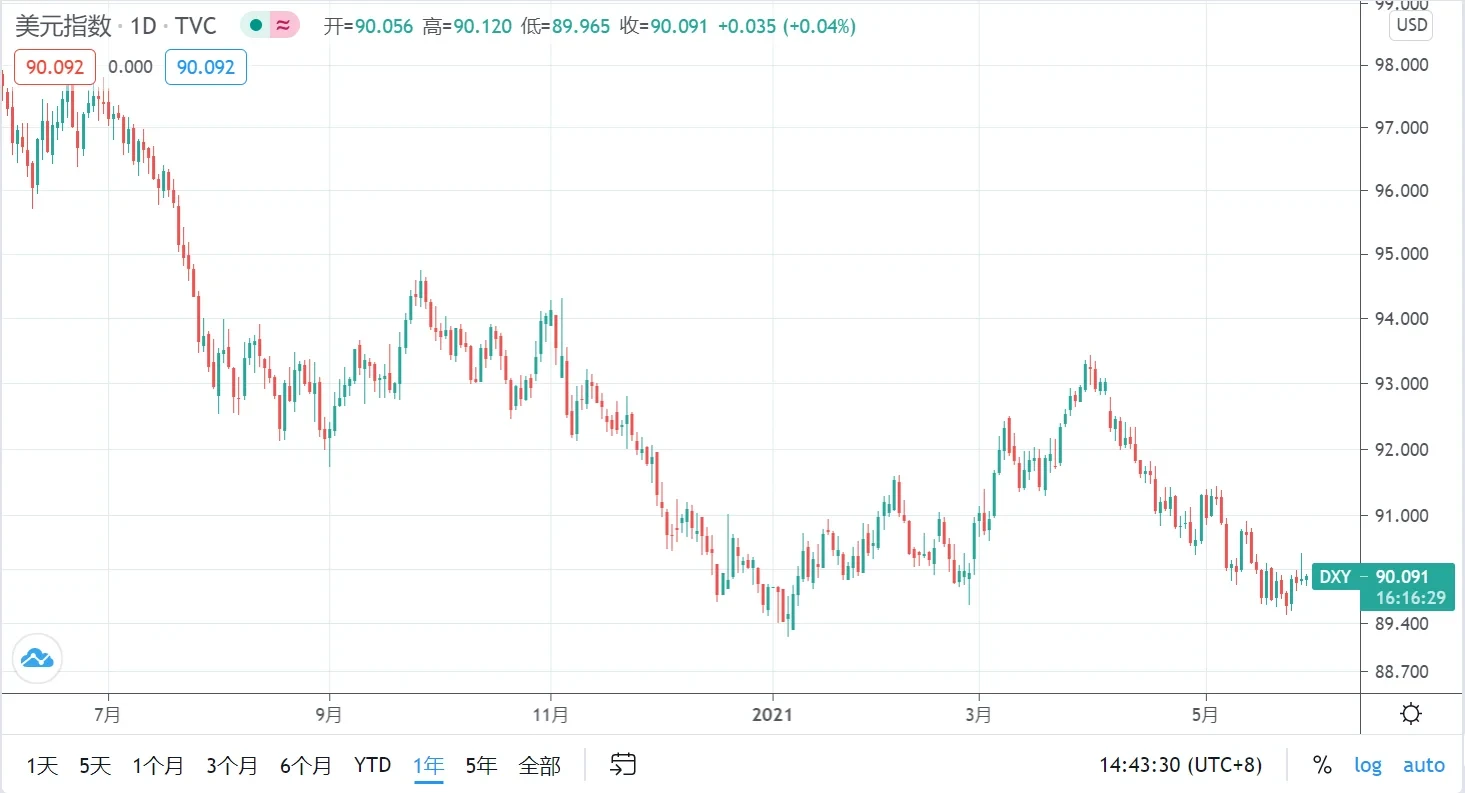
Since April this year, the U.S. dollar index has continued to weaken. TradingView data shows that on May 25, DXY fell as low as 89.535 and has now rebounded to 90.091. The weakening dollar is clearly affected by fundamental factors such as money supply and budget deficits. Going forward, if Biden's $6 trillion fiscal expenditure budget is passed, the direct impact will be further depreciation of the dollar.
Affected by rising inflation expectations and the announcement of Biden's $6 trillion budget plan, combined with the worsening pandemic in Southeast Asia, with India, the Philippines, Nepal, Thailand, Malaysia, and others successively falling, some safe-haven funds have also entered the gold market, forming strong support for gold prices. After spot gold touched its yearly low of $1,676.91 in March, it began an upward trend. As of writing, it is temporarily reported at $1,905.69, having risen 17.22%, with a gain of 9.64% in the past 3 months.
While gold has surged significantly, Bitcoin, hailed as "digital gold," has performed somewhat poorly in the past 3 months. OKX market data shows that Bitcoin has fallen 35.97% in the past 3 months.
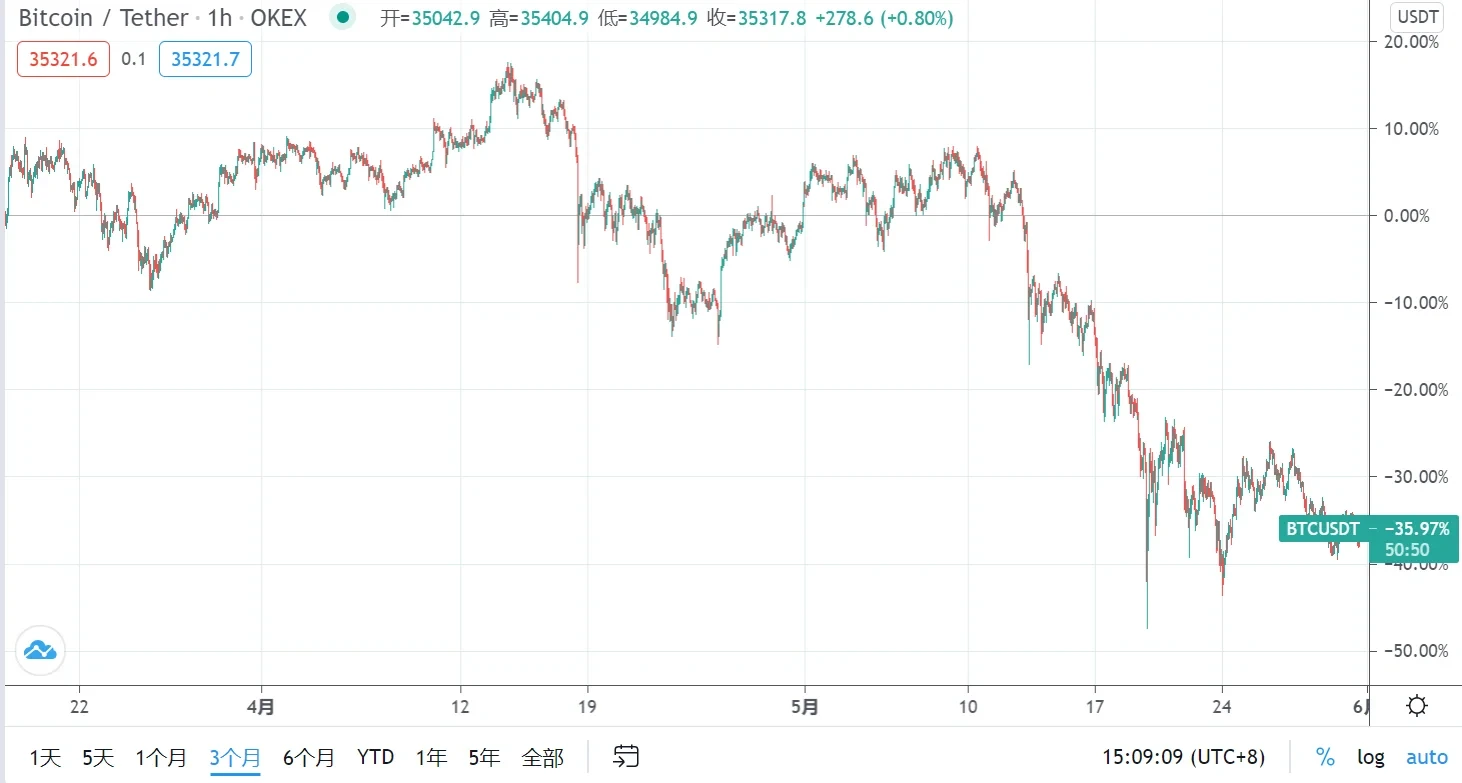
Market views suggest that this is because Bitcoin's previous gains were too large, prices were already at high levels, making it difficult for ordinary investors or speculators to continue chasing the rally. The market will enter a consolidation period until a new consensus is reached.
OKX investment research analysis shows that this weekend Bitcoin first rebounded to near resistance at 37,300 before falling under pressure. Prices fell to near 33,500 before stabilizing and rebounding, but Sunday's rebound high only touched resistance at the 36,500 level before pulling back again. As of now, short-term trends have not shown signs of stabilizing, and there is a trend of testing the previous bottom at 33,500 for a second time. Bitcoin market sentiment has been slow to recover because the rebound has consistently failed to meet expectations, which is also reflected in the recently continued low trading volume. Some institutions and large holders are gradually cashing out and transferring funds to other undervalued assets, while retail investors who already hold panic sentiment have no intention to go long. As the $40,000 mark remains unbroken for a long time, large long positions can only choose to sell and exit, further suppressing coin prices. With trends showing the possibility of another bottom test, this means there will be strong expectations to buy the dip near 29,000 or even 30,000. Therefore, under the premise that the decline is not accompanied by continuous volume expansion, the probability of stabilizing at the previous bottom and starting a rebound is relatively high.
Originally, the market was concerned that under high inflation data, the Federal Reserve might adjust monetary policy. Once the market faces tightened liquidity, the cryptocurrency market, which has benefited from dollar money-printing, will also face contraction. However, from a short-term perspective, loose policy will remain unchanged for three reasons.
First, changes in monetary policy are based on comprehensive judgments. Besides inflation and GDP, employment data must also be considered. U.S. April non-farm data was far below previous values and expectations. April unemployment rose to 6.1%, with non-farm payroll employment increasing by 266,000, lower than March's 770,000, reaching only one-quarter of market expectations, with an employment gap of over 8.2 million people. Second, Federal Reserve rate hikes are a lengthy process, and before actually raising rates, they will release multiple signals to the market until they believe the market is fully prepared, in their words "managing market expectations." Before raising rates, the Federal Reserve will have discussions and taper bond purchases. Only when tapering begins or the tapering schedule is determined will it significantly suppress various asset prices. Finally, the Federal Reserve previously expected inflation to remain at high levels for a long time. Their recent rhetoric such as inflation being temporary, and focusing more on maintaining policies that support economic recovery until employment recovery is on track, means that single-month data changes are unlikely to shake their stance. The market still needs to closely monitor the trends of upcoming inflation and employment data. If they continue to strengthen for several months, the Federal Reserve may begin to consider adjusting monetary policy.
With loose policy still continuing, it is also difficult for Bitcoin to maintain a long-term decline. A rebound is the general trend. Last Monday, Bridgewater Associates founder Ray Dalio said that the dollar is depreciating, thereby creating an environment that makes Bitcoin more attractive. In an interview on May 6, he announced that he holds some Bitcoin. In the context of inflation, Dalio stated "Personally, I would rather hold Bitcoin than bonds."
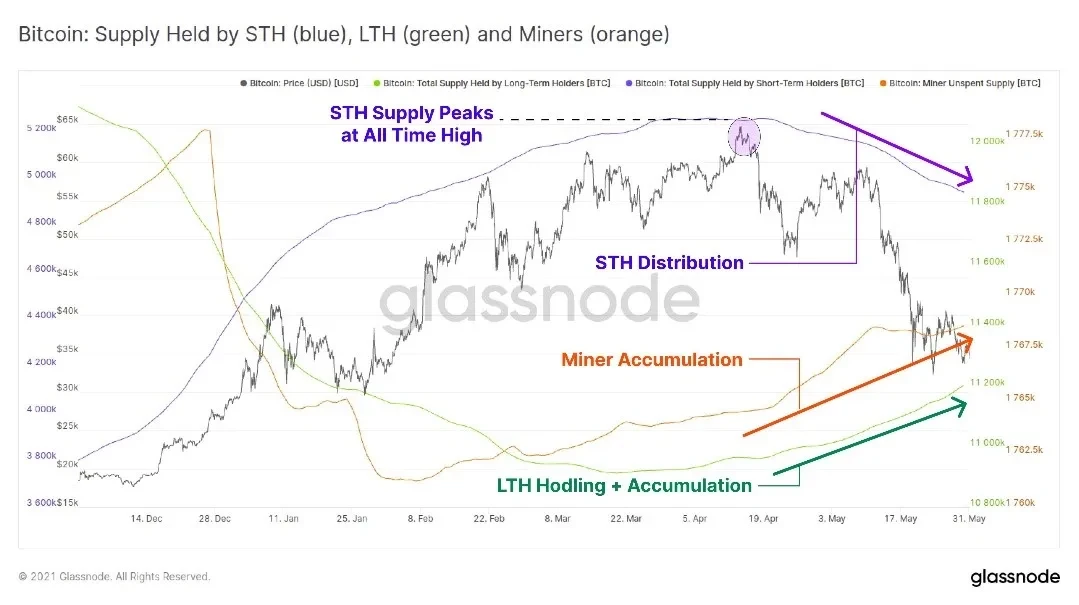
Crypto data analytics platform Glassnode tweeted that currently there are 3 supply trends in the Bitcoin market: short-term holders are selling, long-term holders are holding/accumulating, and miners are also accumulating.
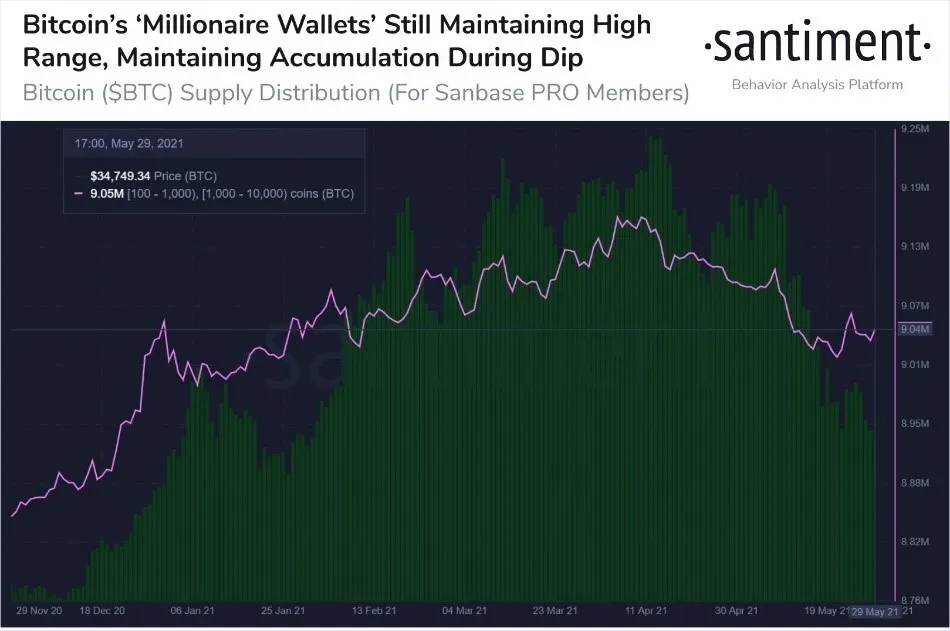
Another crypto analytics firm Santiment stated that in the past week, addresses holding 100-10,000 Bitcoin have accumulated approximately 30,000 Bitcoin.
"According to the NVT indicator, Bitcoin is severely undervalued." Lex Moskovski, CIO of Moskovski Capital, stated that Bitcoin is severely undervalued compared to its economic throughput, just as it was undervalued in the March 2020 crash. The core idea of NVT originates from the price-to-earnings (PE) ratio in traditional finance companies, which is the ratio of market capitalization to on-chain trading volume denominated in dollars.
Currently, Bitcoin's short-term trend remains constrained by strong regulatory influence. Without clear formal policies, the market is unlikely to have upward momentum. The crypto market has experienced a rising trend for most of the year, accumulating significant profit-taking positions. When the market shows weakness in upward movement, these profit-taking positions will be the first to exit and transfer to other undervalued assets. For example, JPMorgan pointed out that major investment institutions are recently exiting Bitcoin and turning to gold, which will further suppress market bullish forces. Of course, affected by Bitcoin's sharp decline in the previous two weeks, Bitcoin has fallen 36.76% since early May. Market divergence has further increased, and the unification of consensus and market recovery also requires time. However, under the expectations of dollar depreciation, disappointing employment data, the Federal Reserve not initiating tapering in the short term, and the proposal of Biden's $6 trillion plan, some funds will inevitably spill into the capital market, and Bitcoin may experience a reversal.
Disclaimer
This article may contain product-related content not applicable to your region. This article is intended to provide general information only and does not assume responsibility for any factual errors or omissions herein. This article represents only the author's personal views and does not represent the views of OKX. This article is not intended to provide any advice, including but not limited to: (i) investment advice or investment recommendations; (ii) offers or solicitations to buy, sell, or hold digital assets; or (iii) financial, accounting, legal, or tax advice. Holding digital assets (including stablecoins) involves high risk, may fluctuate significantly, and even become worthless. You should carefully consider whether trading or holding digital assets is suitable for you based on your financial situation. For questions about your specific situation, please consult your legal/tax/investment professional. The information appearing in this article (including market data and statistics, if any) is for general reference only. Although we have taken all reasonable precautions in preparing these data and charts, we assume no responsibility for any factual errors or omissions expressed herein. © 2025 OKX. This article may be reproduced or distributed in its entirety, or excerpts of 100 words or less from this article may be used, provided that such use is non-commercial. Any reproduction or distribution of the entire article must also prominently state: "Copyright © 2025 OKX. Used with permission." Permitted excerpts must cite the article name and include attribution, for example "Article Name, [Author Name (if applicable)], © 2025 OKX". Some content may be generated or assisted by artificial intelligence (AI) tools. Derivative works or other uses of this article are not permitted.
Show More
Recommended Reading

OKX Pay: Opening a New Era of Next-Generation Crypto Payments
The choice of tens of millions of users. Register with OKX to enjoy the ultimate trading experience and diverse wealth management products. A letter from OKX CEO Star: Today, we are officially launching the first version of OKX Pay to over 100 million global users. As the industry's first payment application to truly achieve non-custodial and compliant integration, OKX Pay will be embedded in the OKX App, currently open to select markets, expected to fully launch within months
March 22, 2026

New Chapter: Building Next-Generation Financial Infrastructure Together
The partnership between OKX and Intercontinental Exchange (ICE) is an important moment for OKX and equally significant for the evolution of the entire digital assets market. ICE establishes and operates the world's most important financial infrastructure, including the New York Stock Exchange as well as global derivatives and clearing platforms. This ICE strategic investment in OKX and joining our board reflects both parties' shared belief—digital assets technology will play a crucial role in financial markets
March 10, 2026

Tribute to Another Year of Forging Ahead
As OKX's CEO, and also a builder who remains true to our original mission, I am proud to look back on the remarkable growth and progress OKX has achieved this year. Despite numerous challenges, 2024 was a year filled with focus, innovation, and resilience. We not only expanded and optimized our products, but also made important progress in launching transparent and regulatory-compliant localized businesses, while further strengthening our global management team. Notably, after experiencing
January 29, 2026

2025: Steady Progress Toward Financial Freedom Together
— Annual letter from OKX Founder and CEO Star to global users "Financial freedom" is often misunderstood. It does not mean the absence of rules, but rather the right to choose when rules exist—and when the system is truly tested, it remains reliable and effective. This is exactly what we have focused on throughout 2025. First, I want to extend my sincere gratitude to our global clients, partners, and regulatory authorities
January 16, 2026

OKX Officially Launches in Germany and Poland
Author: Erald Ghoos, CEO of OKX Europe Today is significant for OKX—and also for crypto users across Europe. We have officially launched fully compliant centralized cryptocurrency trading platforms in Germany and Poland! For us, this is not just a geographic expansion, but a commitment to building the cryptocurrency future the right way: secure, transparent, and meeting local needs. If you are in Germany
October 21, 2025

Partnership Upgrade! OKX Partners with Standard Chartered to Expand European Market
On October 15, OKX Europe CEO Erald Ghoos stated that OKX is expanding its strategic partnership with Standard Chartered to the European Economic Area (EEA). Earlier this year, OKX first partnered with Standard Chartered in the UAE to launch the collateral mirroring program—a
October 15, 2025