The Surge Ends, Bitcoin's "Slow Bull" Begins?
Recently, Bitcoin's consecutive declines have prompted some investors to review how the market has developed. Throughout this review process, two questions have attracted the most attention: First, is the bull market still intact after the crash? Second, if the bull market logic still holds, what form will the next bull market take?
Bitcoin: The Evolution from "Wild Bull" to "Slow Bull"
After Bitcoin broke through its all-time high last month, the call for a slow bull market was already growing. Proponents of this view argue that due to Bitcoin's increasing size and institutional participation, dramatic surges will become increasingly rare going forward. Instead, we can expect steady, gradual climbs, with bull market durations extending accordingly. This slow-and-long bull market pattern may reshape the overall development of the crypto market.
The concept of a "slow bull" first emerged following Bitcoin's "May 12" halving last year, though at that time Bitcoin's market cap was insufficient to truly provide "rock-solid stability." It wasn't until after the "May 19" crash this year that Bitcoin appeared to have matured past its adolescent phase, rarely making sudden surges anymore. Looking at the broader timeline, Bitcoin has been steadily evolving from a "wild bull" to a "slow bull." This shift can be seen most directly in Bitcoin's daily percentage gains.
We pulled Bitcoin data from the third-party data site TradingView and conducted a filtered analysis, with the results as follows:
During Bitcoin's first halving cycle, from November 28, 2012 to July 9, 2016, Bitcoin rebounded from a low of $11 to a market cycle peak of $1,169, a gain of 10,500%. During this cycle, Bitcoin posted single-day gains exceeding 10% on 42 occasions, exceeded 15% on 15 occasions, with the largest single-day gain reaching 55.2%.
During Bitcoin's second halving cycle, from July 10, 2016 to May 11, 2020, Bitcoin rebounded from a low of $650 to a market cycle peak of $19,800, a gain of 2,950%. During this cycle, Bitcoin posted single-day gains exceeding 10% on 34 occasions, exceeded 15% on 6 occasions, with the largest single-day gain reaching 26.7%.
During Bitcoin's third halving cycle, from May 12, 2020 to present (November 27, 2021), Bitcoin has rebounded from a low of $8,200 to the current market cycle peak of $69,040 (2021/11/10), a gain of 742%. During this cycle, Bitcoin has posted single-day gains exceeding 10% on 8 occasions, exceeding 15% on just 1 occasion, with the largest single-day gain reaching 19.4%.
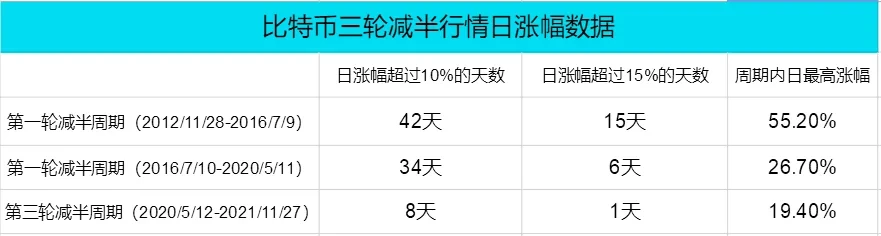
Bitcoin Three-Cycle Halving Performance: Daily Gain Data (Created by OKX Academy)
As the above shows, across Bitcoin's three halving cycles, the number of days with gains exceeding 10% and 15% has progressively declined, with the rate of decline accelerating over time. The peak single-day gains have also shrunk considerably.
Of course, the third halving cycle is not yet complete, with approximately two and a half years remaining. If we calculate proportionally by time, the number of days with gains exceeding 10% during the third halving cycle would increase to around 20, and days exceeding 15% would rise to approximately 3. These figures would still be far below the second halving cycle data. Furthermore, as Bitcoin's market capitalization continues to grow, the likelihood of dramatic surges will only diminish further.
Based on the above analysis, we can draw a clear conclusion: The era of Bitcoin's dramatic surges is coming to an end, and a slow bull market is beginning.
Bitcoin: Exploring the Drivers Behind the Slow Bull
From a general perspective, Bitcoin's evolution from wild bull to slow bull aligns with the fundamental development patterns seen in any investment market. As any investment market matures, it tends to exhibit higher levels of institutionalization and more conservative investment styles.
However, Bitcoin's transition to a slow bull market did not happen overnight, and the underlying reasons are worth examining closely.
First, there is Bitcoin's own development trajectory. Since Satoshi Nakamoto mined the first Bitcoin on January 3, 2009, Bitcoin's market cap, user base, and on-chain metrics have all experienced exponential growth.
Looking at market capitalization, Bitcoin did not surpass $10 billion until early 2014 and did not break through $100 billion until October 2017. By that point, Bitcoin had already undergone two halvings, yet the market remained relatively small. Even modest inflows of significant capital could trigger massive rallies of tens of times, with dramatic surges and crashes characterizing the market's development.
In this current halving cycle, Bitcoin's market cap has grown from $158.1 billion on "May 12" to a peak of $1,278.7 billion. With a trillion-dollar market cap, another 10x or even 100x surge is essentially impossible. Even doubling in value requires tremendous effort. Today, relying on hundreds of millions or billions in "safe-haven" or "asset allocation" funds to drive Bitcoin higher is no longer feasible.
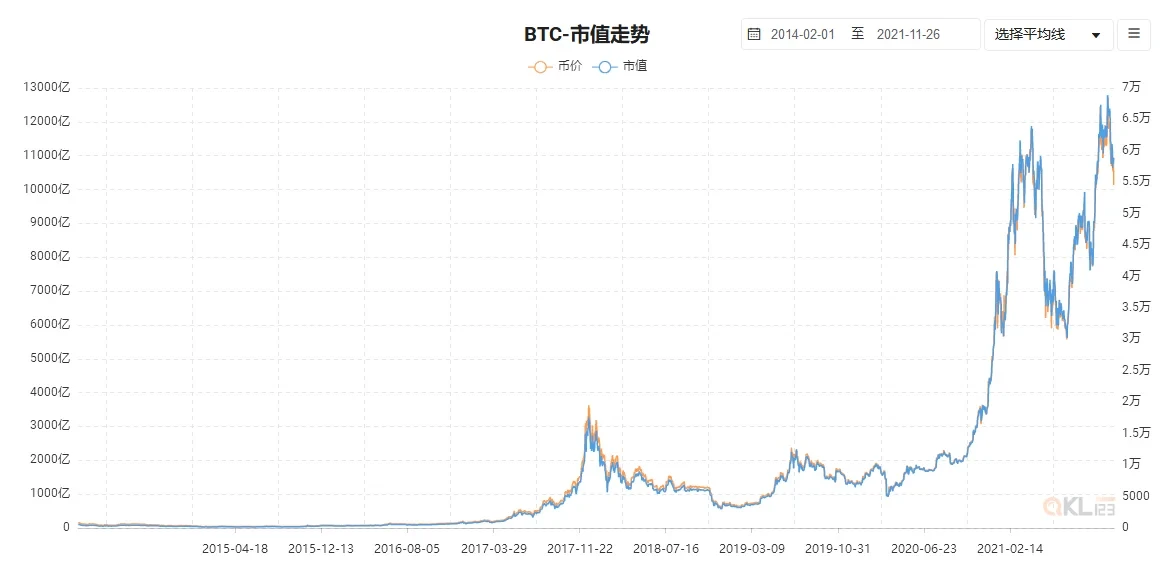
Bitcoin Market Cap Chart (Source: qkl123)
The most critical on-chain metric is new address growth. According to data from third-party site qkl123, Bitcoin's daily new addresses have grown from 5,000–6,000 per day in early 2012 to approximately 400,000 per day currently. The number of holding addresses has reached 39,217,385 (Tokenview data). This exponential growth in users has made Bitcoin genuinely "decentralized," making it difficult for any single consensus-driven narrative to produce one-directional market moves.
Second, the Bitcoin market now exhibits clear signs of institutionalization. Numerous articles have covered how institutions entered the Bitcoin market, so here we will focus on the effects of institutionalization: The most notable change institutional entry has brought is the gradual concentration of筹码 (chips/positions), with market influence shifting toward institutional hands, while retail investors' proportion and impact have steadily declined. The Bitcoin market has increasingly developed a "80/20" pricing structure, which prevents stampedes or FOMO-driven behavior triggered by price fluctuations.
Of course, this does not mean institutions are inherently more rational than retail investors. The key difference lies in their profit models: retail investors chase quick, short-term returns, while institutions simply need steady performance to collect management fees. Institutional investors do tend to favor longer-cycle markets, and more long-term Bitcoin holders seeking sustained returns have entered the space — this undoubtedly facilitates Bitcoin's trajectory toward a slow, long-duration bull market.
The final factor influencing Bitcoin's slow bull market is how nations around the world view and regulate Bitcoin. As Wall Street institutions and major European and American companies such as JPMorgan and Facebook enter the crypto market, the space will receive significantly more attention. The market may see a "trading time for space" dynamic emerge, making a slow bull market a natural outcome. This, of course, is positive for the long-term, healthy development of the broader market.
Bitcoin: Analyzing the Impact of the Slow Bull on Future Markets
The formation and establishment of Bitcoin's slow bull market pattern will profoundly impact all participants in the crypto market — from investors' strategy choices to project teams' development and operations — and will shape the industry's ecosystem construction and growth trajectory. This is analogous to how Earth's climate, whether warm or cold, directly determines the form and prosperity of its organisms.
For investors, the establishment of Bitcoin's slow bull market pattern means that investment strategies and mindsets must adapt to changing conditions. Bitcoin can no longer surge dramatically as it did in the previous two halving cycles. Investors will need to adjust their return expectations, trading strategies and methods, asset selection, and capital allocation accordingly. Most importantly, they must cultivate patience — patience is the true dividing line in wealth creation.
For project teams, the establishment of Bitcoin's slow bull market pattern means bull market durations will extend accordingly. This gives more projects and concepts time to grow, evolve, and mature. Much like how warmer periods on Earth — when longer — foster greater biodiversity, more prosperous ecosystems, and the potential emergence of more advanced life forms. Conversely, projects lacking long-term planning that still chase short-term plays may be "cleansed" by the market.
For the broader crypto market, a slow bull provides time for the development of institutional frameworks and regulations. A slow bull sustains positive market momentum, allowing quality projects to emerge successfully during most of the cycle. The slow bull pattern minimizes the likelihood of bubble formation, supporting the market's steady development. It strengthens investor confidence in the industry, attracts more participants, and advances the overall blockchain sector.
The slow bull market is like the lower reaches of a river — only when the water flow slows does it no longer merely skim the surface, allowing it to deposit alluvial soil, enrich the land, and enable human settlement and agricultural civilization to flourish and continuously evolve. The establishment of the slow bull pattern may extend this Bitcoin halving cycle well beyond what many anticipate. However, during certain phases of the slow bull, the market may experience frustrating, grinding conditions that make it feel neither like a bull market nor inspire belief in one for most observers.
At this point, the market will diverge. A defining characteristic of the slow bull is differentiation: different digital assets will diverge, concept sectors will diverge, and investor behavior patterns will diverge. This differentiation will be a prolonged process, not achieved overnight. It will generate greater disruption across the market while pushing Bitcoin to entirely new heights, establishing it as an even more mature asset.
Finally, this article is for reference only and does not constitute investment advice. The market carries risk — invest with caution.
Disclaimer
This article may contain product-related content not applicable to your region. This article is provided for general informational purposes only, and no factual errors or omissions are warranted. This article represents the author's personal views and does not reflect OKX's position. This article is not intended to provide any advice, including but not limited to: (i) investment advice or investment recommendations; (ii) offers or solicitations to buy, sell, or hold digital assets; or (iii) financial, accounting, legal, or tax advice. Holding digital assets (including stablecoins) involves high risk and prices may fluctuate significantly or even become worthless. You should carefully consider whether trading or holding digital assets is appropriate for you based on your financial situation. For questions specific to your circumstances, please consult your legal/tax/investment professional. Information provided in this article (including market data and statistics, where applicable) is for general reference only. Although we have taken all reasonable precautions in preparing such data and charts, we accept no responsibility for any factual errors or omissions expressed herein. © 2025 OKX. This article may be reproduced or distributed in its entirety, or excerpts of 100 words or less may be used, provided that such use is non-commercial in nature. Any reproduction or distribution of the full article must prominently state: "© 2025 OKX, used with permission." Permitted excerpts must cite the article title and include attribution, e.g., "Article title, [author name (if applicable)], © 2025 OKX." Some content may be generated or assisted by artificial intelligence (AI) tools. Derivative works and other uses of this article are not permitted.
Show More
Recommended Reading

OKX Pay: Ushering in the Next Generation of Crypto Payments
The choice of tens of millions of users — register with OKX and enjoy an exceptional trading experience alongside diverse wealth management products. A letter from OKX CEO Star: Today, we are officially launching the first version of OKX Pay to over 100 million global users. As the industry's first payment app to truly achieve non-custodial and compliant integration, OKX Pay will be embedded within the OKX App, currently available in select markets with a full global rollout expected within months.
March 22, 2026

A New Chapter: Building the Next Generation of Financial Infrastructure Together
The partnership between OKX and the Intercontinental Exchange (ICE) marks a significant milestone for OKX — and carries equally profound implications for the evolution of the entire digital assets market. ICE builds and operates the world's most critical financial infrastructure, including the New York Stock Exchange and global derivatives and clearing platforms. ICE's strategic investment in OKX and joining our board reflects our shared conviction that digital assets technology will transform financial markets.
March 10, 2026

Reflecting on Another Year of Building
As OKX's CEO and a builder who has never forgotten the original mission, I take great pride in looking back on the extraordinary growth and progress OKX has achieved this year. Despite significant challenges, 2024 was a year defined by focus, innovation, and resilience. We not only expanded and refined our product offerings but also made major strides in launching transparent, regulation-compliant localized businesses, while further strengthening our global management team. It is worth noting that after going through
January 29, 2026

2025: Steady Progress Toward Financial Freedom
— Year-End Letter to Global Users from Star, OKX Founder and CEO "Financial freedom" is often misunderstood. It does not mean the absence of rules, but rather having the freedom to choose even in the presence of rules — and, when the system is truly put to the test, that it remains reliable and effective. This has been our unwavering focus throughout 2025. First, I would like to express my sincere gratitude to our global customers, partners, and regulators for
January 16, 2026

OKX Officially Launches in Germany and Poland
By Erald Ghoos, CEO of OKX Europe. Today marks a significant milestone for OKX — and for crypto users across Europe. We have officially launched our fully compliant centralized cryptocurrency trading platform in Germany and Poland! For us, this is more than a geographic expansion — it is a commitment to building the future of cryptocurrency the right way: secure, transparent, and tailored to local needs. If you are based in Germany
October 21, 2025

Partnership Upgrade! OKX and Standard Chartered Bank Expand into Europe
On October 15, Erald Ghoos, CEO of OKX Europe, stated that OKX is expanding its strategic partnership with Standard Chartered to the European Economic Area (EEA). Earlier this year, OKX first partnered with Standard Chartered in the UAE to launch a collateral mirroring program — an initiative that
October 15, 2025