Bitcoin Price Surges to New High Then Quickly Retreats — How to Spot the Telltale Signs of What's Next
On November 3, 2021 local time, the U.S. Federal Reserve released the statement from its November FOMC meeting, announcing it would begin reducing its monthly asset purchases by $15 billion starting later that month, with the pace of reduction subject to adjustment based on conditions. The Fed also announced it would maintain the federal funds rate target range at 0 to 0.25%. The outcome of this meeting was in line with market expectations. Following the release of the FOMC statement, the market responded optimistically — the S&P 500 turned positive after the Fed's announcement, with both the S&P 500 and the Nasdaq Composite Index reaching all-time highs, gaining 0.6% and 1.0% respectively. In another emerging investment sector, the digital assets market exhibited a similar scene — driven by the aforementioned accommodative monetary policy, over the following week, the two leading assets in the digital assets market, Bitcoin and Ethereum, both surged to new highs, pushing the total market capitalization of the digital assets market above the $3 trillion mark.
Bitcoin and Ethereum Prices Both Hit New All-Time Highs
According to the latest quotes on the OKX platform, on the evening of November 10, 2021 (Hong Kong time), Bitcoin's price reached $69,040, surpassing the previous high of $66,999 set on October 20. This was also the second time Bitcoin broke a record within a month since April 2021 — and at the same time, Bitcoin's total market capitalization also reached a new all-time high of $1.293 trillion.
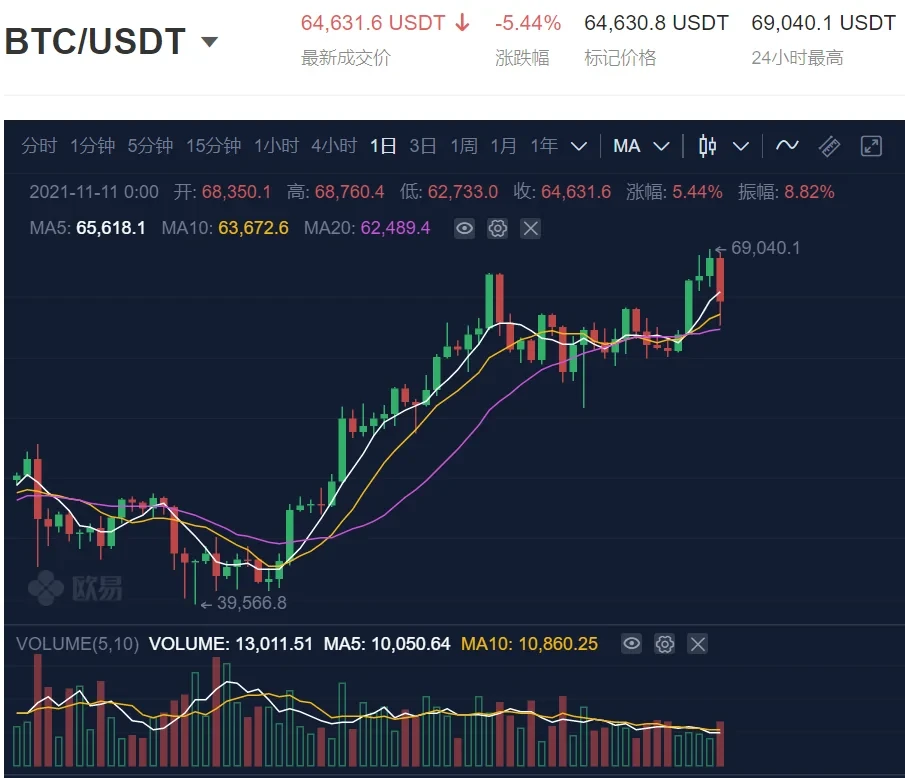
Bitcoin recent price trend, data source OKX
Looking at Ethereum's price movement, also on the evening of November 10, 2021 (Hong Kong time), Ethereum's price broke through $4,800, reaching $4,871.42, while its circulating market cap briefly approached $550 billion, and its share of the digital assets market also rose to 19.82%, gradually narrowing the gap with Bitcoin's market share dominance (44.1%).
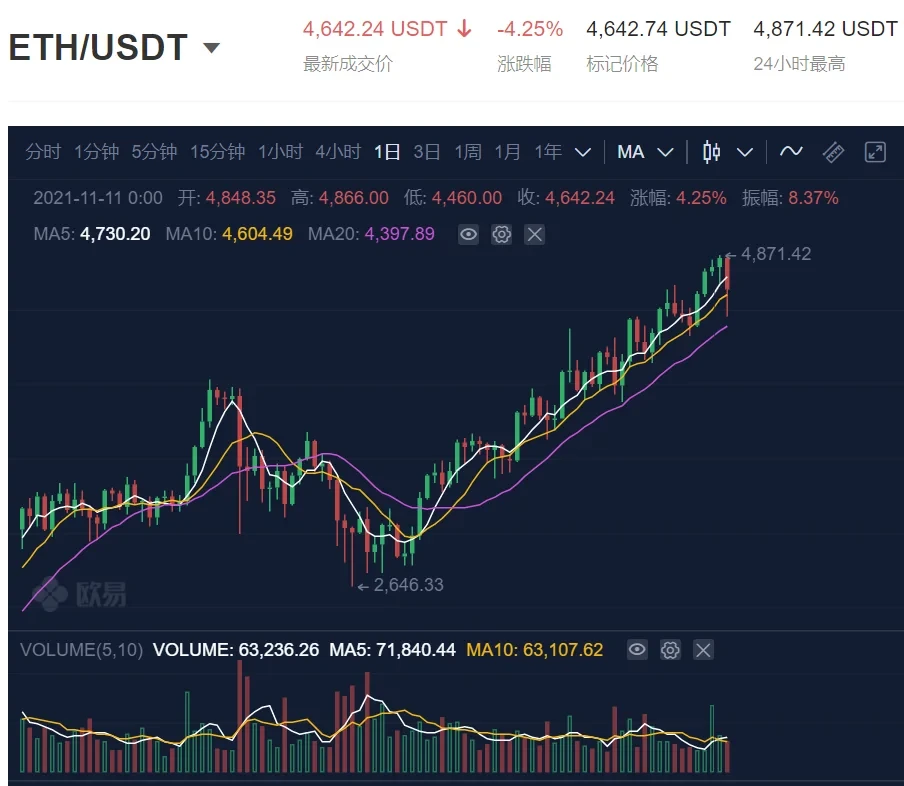
Ethereum recent price trend, data source OKX
Looking at the ETH/BTC exchange rate that we have been tracking, some converging patterns can also be observed. Referring to OKX platform quotes, starting from October 20, the ETH/BTC rate rose from 0.05932 to a high of 0.07505 on November 4. As of the time of writing, the ETH/BTC exchange rate stands at approximately 0.072, at a high level for the year.
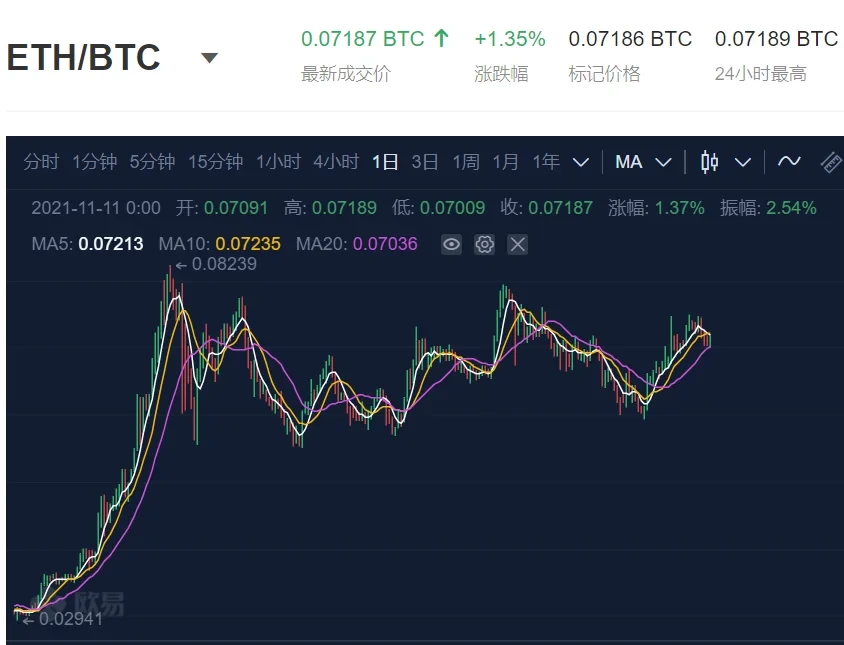
Recent ETH/BTC exchange rate changes, data source OKX
The Swift Retreat After the New Highs
However, shortly after Bitcoin and Ethereum prices both hit new highs, just as many crypto investors were hoping Bitcoin would break through the $70,000 mark, within just a few hours — starting from 2:00 AM on November 11 (Hong Kong time) — most digital assets led by Bitcoin saw a sudden sharp pullback. Bitcoin's price dropped from its peak of $69,040 to a low of $62,733, while Ethereum fell from $4,871.42 to $4,460, with maximum declines of 9.92% and 9.85% respectively. Among the top 10 digital assets by market cap, DOT saw the largest decline at 19%.
In the digital assets derivatives market, losses from these price swings were amplified several times over. According to data from third-party monitoring site Coinglass, in the past 24 hours, 171,977 contract positions were liquidated, with total liquidated assets valued at $694 million. In just the most recent 12 hours, liquidated assets exceeded $545 million, making it the largest single-day liquidation amount in nearly two months, second only to October 27.
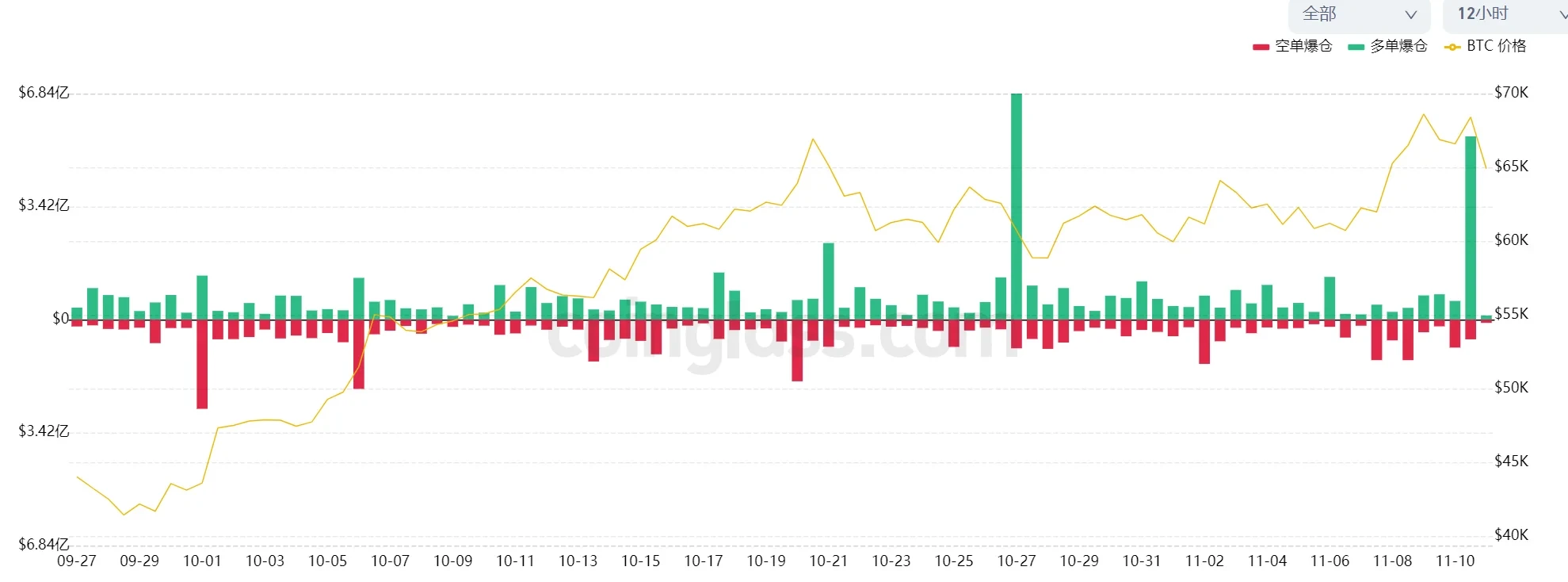
Digital assets derivatives market liquidation amounts in the past two months, data source Coinglass
Regarding this night's pullback, although the magnitude and duration (up to the time of writing) were far smaller than the corrections on April 18, May 19, or even September 7, the cause of the decline remains somewhat elusive. In other words, that same age-old question resurfaces: why did it drop this time? As pointed out in the article "Bitcoin Price Flash Crash Revisited — Is It Really Without Reason?" first published by OKX Academy in September, one core principle applies to the vast majority of freely traded investment assets, including digital assets: the only fundamental explanation for a price decline is that it was simply time for it to fall. Following the logic laid out in that previous article, let's revisit what happened — since Bitcoin launched from below $40,000 in late September on its climb to $69,000, there was hardly any single-day drop exceeding 10%. Only on October 21, 27, and 29 did three instances of near-10% volatility occur, yet the market ultimately recovered some losses by close, even turning positive on the 29th with a gain. A quick calculation reveals that over the past two months, Bitcoin's price surged more than 72.5%, while Ethereum同期 simultaneously rose 75.1%. Meme coins led by SHIB, metaverse-related digital assets represented by MANA, and exchange tokens led by OKB all delivered investment returns that outperformed Bitcoin and Ethereum during this period. This means there were significant profits sitting in the market, and investors who wanted to lock in gains would inevitably trigger a broader market retreat. As trading activity continues to intensify, such pullbacks may become even more frequent. That said, we should also recognize that as the digital assets market expands in size and matures in professionalism and regulation, the severity of price swings may gradually diminish.
What Other Trading Information Is Worth Paying Attention To?
While market fluctuations are unpredictable and difficult to anticipate with precision, investors still have access to a number of valuable trading indicators that can serve as supplementary tools for investment decisions. In two previously published articles by OKX Academy — "10 Indicators Every Crypto Professional Must Know (Part 1)" and "10 Indicators Every Crypto Analyst Must Know (Part 2)" — we systematically introduced 10 key indicators for the digital assets industry, including Bitcoin UTXO age distribution, Bitcoin Rainbow Chart Index, S2F price model, arh999 dollar-cost averaging index, and the Altseason Index. Readers interested can click the links to review the full details. Here, we will revisit a few indicators such as exchange Bitcoin wallet balances and perpetual contract funding rates.
Changes in exchange Bitcoin wallet balances are often interpreted as an important indicator of whether holders are selling or holding tight. Generally speaking, when exchange Bitcoin wallet balances rise significantly, it likely means holders have a strong motivation to sell and cash out. When exchange Bitcoin wallet balances decrease, it suggests holders are transferring Bitcoin from exchanges to their own wallets or to DeFi and other wealth management products, indicating a stronger sentiment to hold.
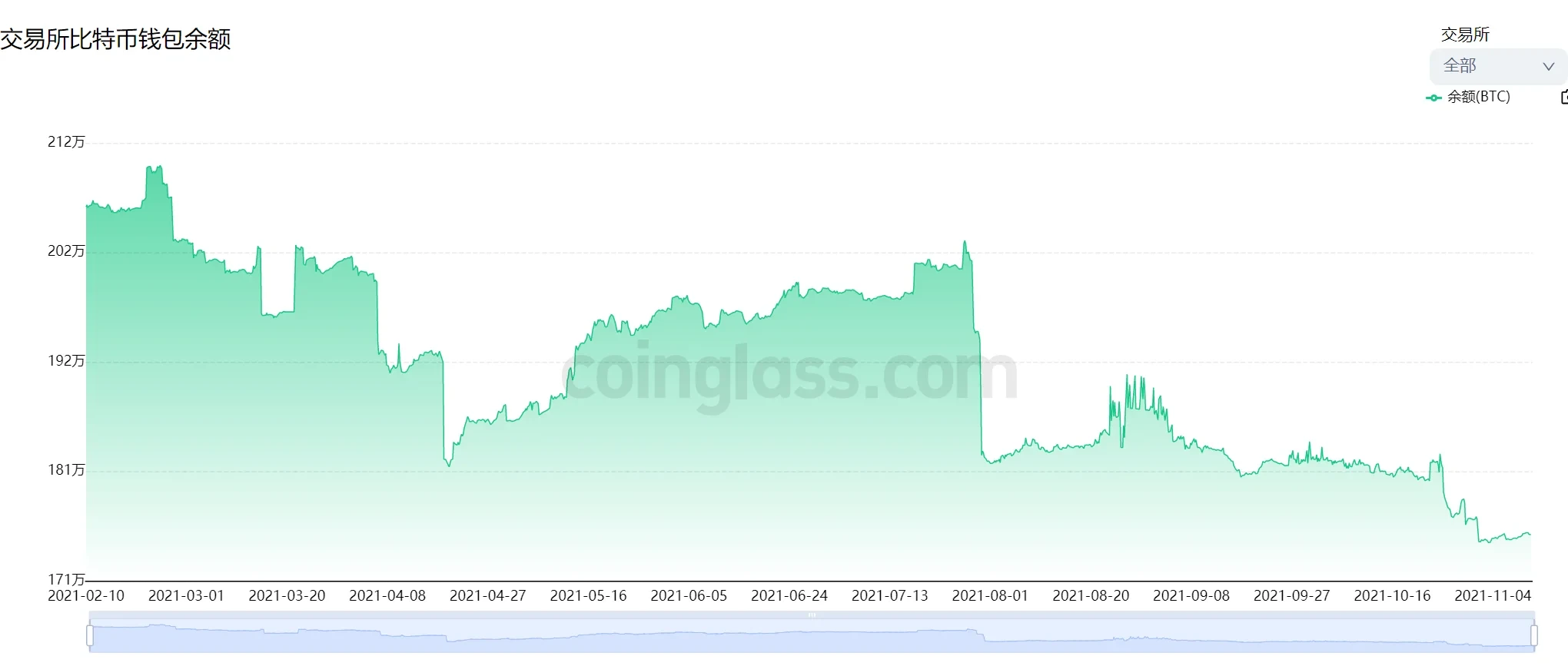
Exchange Bitcoin wallet balance changes since February this year, data source Coinglass
According to Coinglass data, exchange Bitcoin wallet balances have continued to decline since August 2021. On November 10, only about 1.75 million coins were held on exchanges — a figure that appears to corroborate Bitcoin's price trend during the same period.
Regarding perpetual contract funding rates, since they reflect the cost dynamics between long and short positions in perpetual contracts, and perpetual contract trading volume accounts for an increasingly significant share of digital assets derivatives trading, changes in perpetual contract funding rates are becoming increasingly important to monitor.
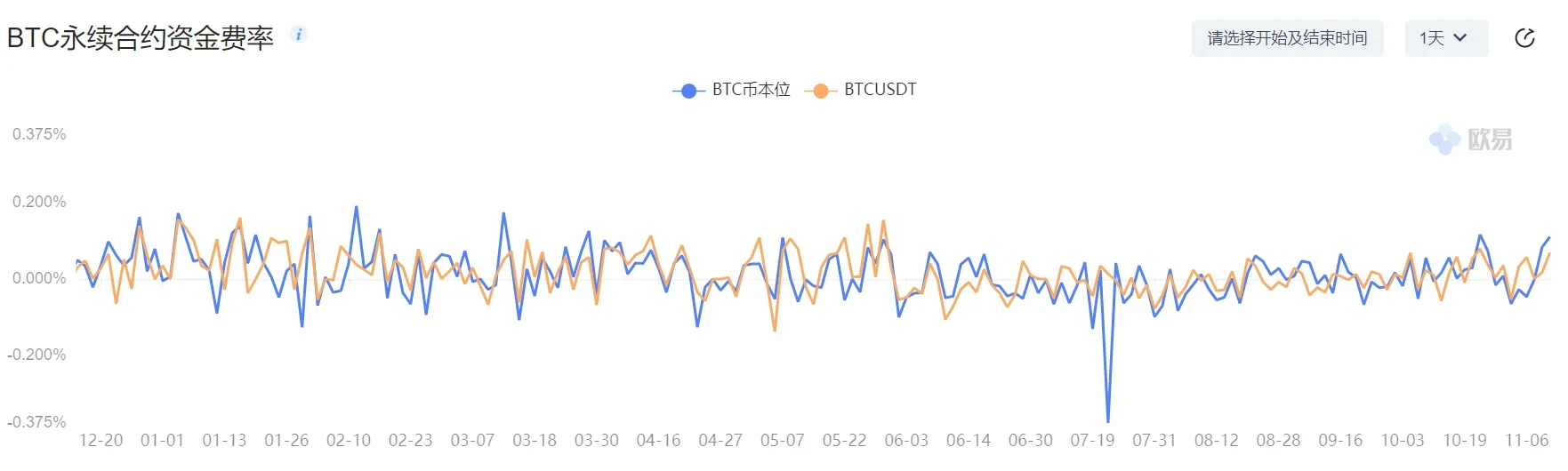
Bitcoin perpetual contract funding rates, data source OKX
As shown in the chart above, for most of the period from 10:00 AM on November 8 to 2:00 AM on November 11, funding rates remained above 0.04%. At midnight on November 10, the funding rates for Bitcoin coin-margined and USDT-margined perpetual contracts on OKX reached 0.11% and 0.069% respectively. This means that if an investor held a long Bitcoin perpetual contract position during the aforementioned period, the funding fees alone paid to the counterparty would account for 0.069%–0.11% of their position — far above the normal value of 0.01%. This can also be interpreted as a risk signal.
Of course, as we have consistently emphasized, any on-chain data or trading information can only serve as a supplementary tool for investors making investment decisions. In actual investment processes, in addition to the factors mentioned above, it is necessary to comprehensively gather market information from a broader perspective, process and analyze it, and then make more reliable investment decisions.
Disclaimer
This article may contain product-related content not applicable to your region. This article is intended solely to provide general information and does not accept responsibility for any factual errors or omissions. This article represents the author's personal views and does not constitute the views of OKX. This article is not intended to provide any advice, including but not limited to: (i) investment advice or investment recommendations; (ii) offers or solicitations to purchase, sell, or hold digital assets; or (iii) financial, accounting, legal, or tax advice. Holdings in digital assets (including stablecoins) involve a high level of risk, may be subject to significant volatility, and may even become worthless. You should carefully consider whether trading or holding digital assets is appropriate for you based on your financial situation. For questions about your specific circumstances, please consult your legal/tax/investment professional. The information contained in this article (including market data and statistics, where applicable) is provided for general reference purposes only. Although all reasonable precautions have been taken in the preparation of such data and charts, we assume no responsibility for any factual errors or omissions expressed herein. © 2025 OKX. This article may be reproduced or distributed in its entirety, and excerpts of 100 words or fewer may be used, provided that such use is non-commercial. Any reproduction or distribution of the full article must prominently state: "This article is copyrighted © 2025 OKX, used with permission." Permitted excerpts must cite the article title and include attribution, for example, "Article title, [author name (if applicable)], © 2025 OKX." Some content may have been generated or assisted by artificial intelligence (AI) tools. Derivative works and other uses of this article are not permitted.
Show More
Recommended Reading
OKX Pay: Ushering in the Next Generation of Crypto Payments
Preferred by tens of millions of users — register with OKX to enjoy an exceptional trading experience and a wide range of wealth management products. A letter from OKX CEO Star: Today, we are officially launching the first version of OKX Pay to our global user base of over 100 million. As the industry's first truly non-custodial and compliant payment application, OKX Pay will be embedded directly within the OKX App, currently available in select markets with a full global rollout expected in the coming months.
March 22, 2026

A New Chapter: Building the Next Generation of Financial Infrastructure Together
The partnership between OKX and the Intercontinental Exchange (ICE) represents a significant milestone for OKX — and carries equally profound implications for the evolution of the entire digital assets market. ICE builds and operates the world's most critical financial infrastructure, including the New York Stock Exchange and global derivatives and clearing platforms. This investment by ICE in OKX through its ICE Select initiative, and its joining of our Board of Directors, reflects our shared conviction that digital assets technology will transform financial markets.
March 10, 2026

To Another Year of Building
As OKX's CEO and a builder who has never forgotten why we started, I am proud to look back on the extraordinary growth and progress OKX has achieved this year. Despite the challenges, 2024 was a year defined by focus, innovation, and resilience. We not only expanded and improved our products, but also made significant strides in launching transparent and regulation-compliant localized businesses, while further strengthening our global management team. It is worth noting that after going through
January 29, 2026

2025: A Steady Progression Toward Financial Freedom
— Year-End Letter to Global Users from OKX Founder & CEO Star "Financial freedom" is often misunderstood. It does not mean an absence of rules — rather, it means having the freedom to choose even when rules exist — and that when the system is truly put to the test, it remains reliable and effective. This is precisely what we focused on throughout 2025. First and foremost, I would like to extend my sincere gratitude to our global customers, partners, and regulators.
January 16, 2026

OKX Officially Launches in Germany and Poland
By Erald Ghoos, CEO of OKX Europe Today is a significant day for OKX — and for crypto users across Europe. We have officially launched a fully compliant centralized cryptocurrency exchange in Germany and Poland! For us, this is more than a geographic expansion — it is a commitment to building the future of cryptocurrency the right way: secure, transparent, and tailored to local needs. If you are in Germany
October 21, 2025

Partnership Upgrade! OKX and Standard Chartered Bank Expand into Europe
On October 15, Erald Ghoos, CEO of OKX Europe, stated that OKX is expanding its strategic partnership with Standard Chartered to the European Economic Area (EEA). Earlier this year, OKX partnered with Standard Chartered in the UAE, launching a collateral mirroring program — a
October 15, 2025