Bitcoin Price Flash Crash Again — Is It Really Without Reason?
Around 10:00 PM Hong Kong Time on September 7, 2021, Bitcoin prices once again experienced a flash crash. According to OKX market data, over the two hours from 10:00 PM on the 7th to midnight on the 8th, Bitcoin's price dropped from a high of $50,790 to a low of $42,619. Based on the intraday high of $52,920, the maximum decline for the day reached 19.96%. Not just Bitcoin — among the top 10 crypto assets by market cap, with the exception of SOL, the maximum declines of ETH, ADA, and XRP all exceeded 20%, with some approaching 40%.
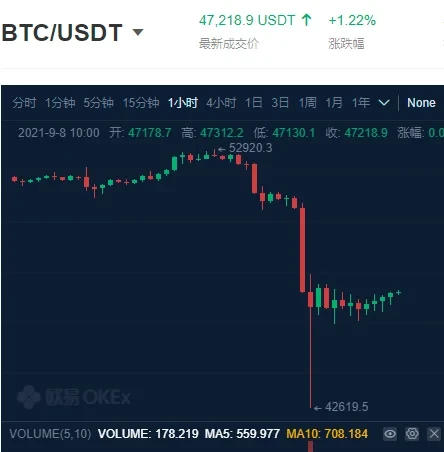
Recent Bitcoin price action, Source: OKX
Following last night's flash crash, the derivatives market was in dire straits. According to Bybit data, over the past 24 hours, more than 350,000 futures positions were liquidated across the market, with total liquidation value approaching $4.2 billion. Bitcoin futures alone saw $1.59 billion in liquidations, accounting for approximately 37.8% of all liquidations; Ethereum futures came second, with liquidation value of around $1.05 billion.
After the market plunge, "Why did it drop?" predictably became the hottest topic in the crypto community. In this article, using this sharp decline as our main reference point, we will briefly explore the logic behind major selloffs in the crypto market. If there are any errors or omissions, or if readers would like to discuss further, feel free to join the OKX community.
Why Did Bitcoin Drop 20% So Sharply?
Many investors in the crypto community wanted to find a convincing reason for last night's sharp decline. However, unlike the extreme volatility of March 12 last year or May 19 this year, yesterday's price action seemed to lack major news drivers and showed few technical signals in advance. So was this decline really without reason? Of course not. First and foremost, what we intuitively perceive as price increases or decreases is largely information gleaned from candlestick chart movements on the charts. What deserves attention is that candlestick charts are the concentrated reflection of all factors that can affect the crypto market. Simply put, candlestick charts are the effect, while Bitcoin's intrinsic value logic is the cause. Changes in investor sentiment and various information stimuli merely serve as catalysts. Therefore, here is our preliminary view: for a price drop of this magnitude in Bitcoin, there is only one most reasonable explanation — it was simply time for it to fall. Sounds like a trite platitude? Don't worry, let us break it down further.
In the long run, since Bitcoin's birth in January 2009, its price has been advancing along its own path, never influenced by information from any quarter. Rather, when Bitcoin's development reached a point where real-world organizations could no longer ignore it, these entities — motivated by their own interests — would passively take measures, whether restrictions or support, which would then react upon Bitcoin, ultimately causing price fluctuations and forming candlestick charts. Whether it is policies from major economies like the US, Japan, or Russia, moves by Wall Street giants like Goldman Sachs or Morgan Stanley, or statements from multinational corporations like Tesla or Meta — all follow this same logic.
As a supra-sovereign asset, Bitcoin differs fundamentally from fiat currencies that rely on a nation's sovereign backing for their value. Its core value lies in the broad consensus established by people worldwide who accept and use Bitcoin — and this is precisely why Bitcoin's price has climbed steadily over the past 11 years. However, it is important to note that this process of consensus-building is not linear. In reality, it tends to exhibit distinct cyclical characteristics influenced by overall market sentiment. Consider a vivid analogy: when you apply force evenly to a spring, the opposing force increases at a uniform rate. But when force is applied explosively, the opposing force is also magnified instantaneously. Within the elastic deformation range, maintaining the spring at its maximum extension requires the greatest force, and at that point the spring is also at its most fragile — any misstep and it snaps back to its original state.
By analogy, Bitcoin's price appreciation can be seen as the spring expanding under force. The difference is that Bitcoin's price rises driven by capital inflow, whereas a spring expands driven by external force — but there is essentially no difference. The higher Bitcoin's price climbs, the larger the capital base required. From another angle, the faster the price rises in the short term, the greater the capital base required as well. At this point, maintaining the status quo or pushing higher would both require a larger pool of capital than before. What happens if subsequent incremental capital fails to materialize? Simply put, it can only develop in the opposite direction — a decline begins. This is the concept frequently cited in investment markets: "Opportunities are born from declines, and risks are born from rallies." Because capital is profit-seeking, the market will naturally move in the direction of least resistance.
With all that said, let us return to yesterday's Bitcoin flash crash. On July 20, Bitcoin's price hit a low of $29,263. On September 7, it reached a high of $52,920 — a gain of 80.8% in under two months. During the same period, Ethereum's maximum gain was 134.5%, DOT's peak gain was 243.9%, and SOL's peak gain was a staggering 784.2%, following a remarkable uptrend after May 19. Therefore, this rally inevitably generated substantial profit-taking. The accumulation of these profits is precisely the process by which this capital plans when to "secure gains." This mirrors the two opposing forces acting on a spring during expansion. When the critical point is reached, the liquidation of these profit-taking positions inevitably triggers a flash crash in prices. What is predictable is that as prices rally to a certain stage, some early profit-takers will inevitably choose to cash out. What is unpredictable is whether they will choose to exit on the 7th, 8th, or 9th. It is worth noting that by comparing the timing and magnitude of yesterday's crypto market selloff with the decline from May 11 to 19, it is not difficult to see that in the short term, investors still have markedly divergent views on this uptrend that began in late July — is the bull market continuing, or is this a mid-cycle dip in a longer-term decline? Therefore, for future market developments, investors must still rigorously implement risk control measures.
Are There Any Practical Indicators for Anticipating Risk in Advance?
All the above discussion remains largely theoretical and may not be particularly actionable for most ordinary investors. So are there any practical, relatively reliable indicators that market participants can use as risk warning signals?
The Trading data product launched by OKX is a noteworthy tool currently available in the market. For instance, changes in funding rates for BTC perpetual contracts — as we know, within the current crypto market, derivatives trading volume is several times that of the spot market, and perpetual contracts, with their unique product advantages, account for a significant share of the derivatives market. Therefore, monitoring changes in perpetual contract funding rates can accurately gauge shifts in investor sentiment within the market.
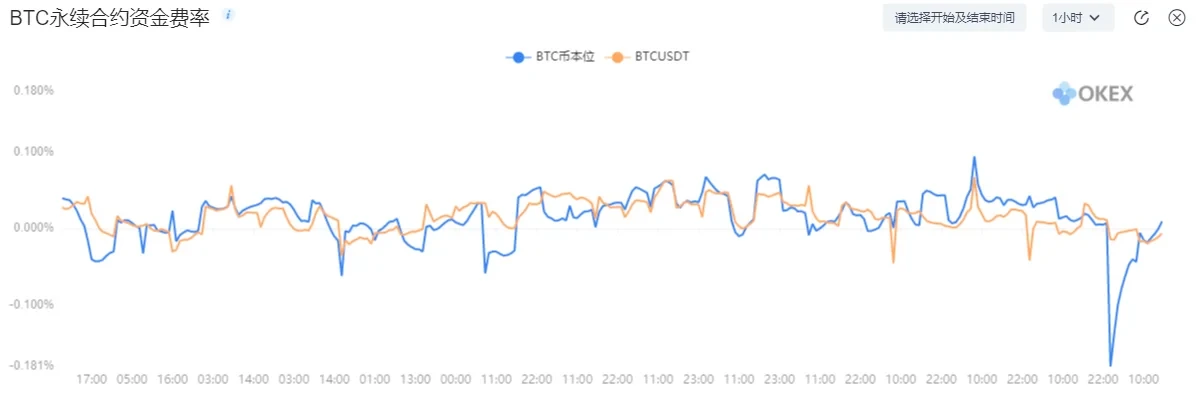
Changes in OKX BTC Perpetual Contract Funding Rate Over the Past Half Month, Source: OKX
As shown in the chart above, at 8:00 AM on September 6, the funding rates for Bitcoin coin-margined and USDT-margined perpetual contracts on OKX reached 0.095% and 0.067% respectively, hitting high levels over the preceding half month. Particularly for coin-margined contracts, from 8:00 AM on September 6 to 7:00 AM on September 7, the funding rate remained above 0.04% for most of the period. This means that if an investor held a long Bitcoin perpetual position during the above period, the funding fees paid to the counterparty alone would account for 0.04% to 0.095% of their position — far above the normal value of 0.01%. This can actually be interpreted as a risk signal.
Additionally, changes in open interest on exchanges are also an indicator worth watching, as they often signal an escalation in the tug-of-war between bulls and bears. According to Bybit statistics, on September 7, BTC futures open interest on exchanges reached $19.406 billion — the highest since May 13 — while ETH futures open interest hit a record high of $11.621 billion. By September 8, exchange BTC futures open interest had dropped to $15.275 billion, a decline of 21.3% in a single day, and ETH futures open interest fell to $9.016 billion, down 22.5%.
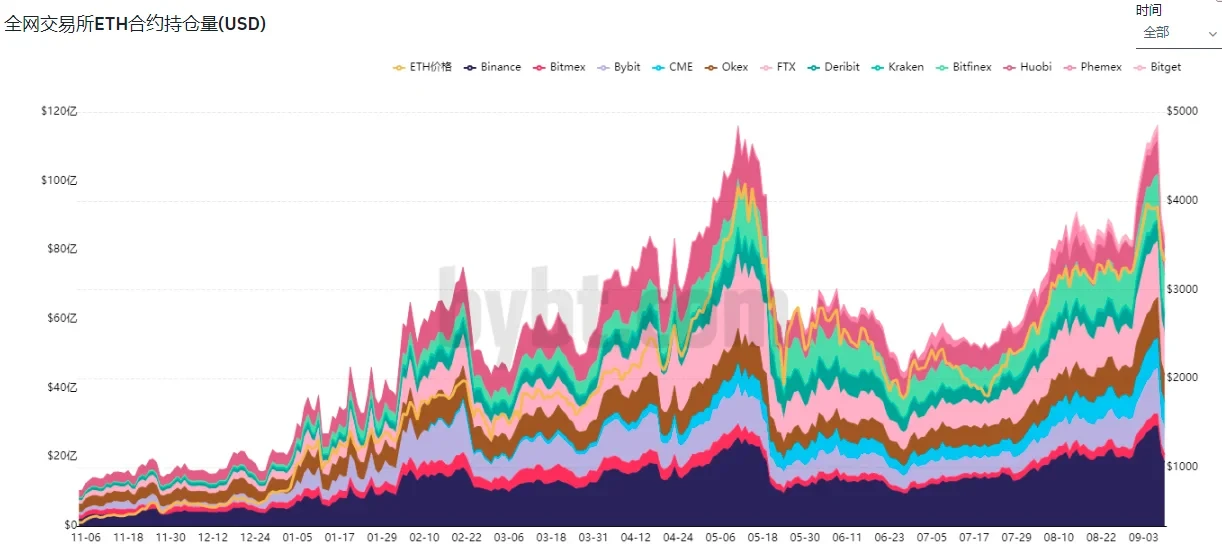
Network-wide ETH Futures Open Interest Since November 2020, Source: Bybit
Looking back at the two major selloffs this year — April 18 and May 12–19 — both show that when futures open interest reaches a cyclical high, risk increases commensurately. Both serve as signals that investors should heed.
Beyond those, you can also monitor OKX Trading data for changes in quarterly contract basis, spot margin long/short ratios, and shifts in Bitcoin and Ethereum balances in centralized exchange wallets to get a comprehensive picture of market participant behavior. However, it is important to emphasize that in actual investing, you should not be rigidly bound to the indicators mentioned above. For various reasons, market indicators inevitably exhibit errors and lag. The best risk control measure is to develop sound trading habits, such as maintaining reasonable position sizing and rigorously adhering to trading discipline.
Disclaimer
This article may contain product-related content not applicable to your region. This article is intended to provide general information only and makes no representation as to the accuracy or completeness of any information herein. This article represents the author's personal views and does not reflect the views of OKX. This article is not intended to provide, and should not be relied upon as, legal, tax, investment, financial or other advice, including (without limitation): (i) investment advice or investment recommendations; (ii) offers or solicitations to buy, sell or hold digital assets; or (iii) financial, accounting, legal or tax advice. Holding digital assets (including stablecoins) involves a high degree of risk and may result in significant price fluctuations or even a total loss of value. You should carefully consider whether trading or holding digital assets is appropriate for you in light of your financial situation. Please consult your legal/tax/investment professional for questions regarding your specific circumstances. The information contained in this article (including market data and statistics, if applicable) is provided for general reference purposes only. While we have taken all reasonable precautions in preparing this data and these charts, we make no representation as to the adequacy, accuracy, or completeness thereof and expressly disclaim liability for any errors or omissions in this regard. © 2025 OKX. This article may be reproduced or distributed in its entirety, and brief excerpts of 100 words or less may be used, provided such use is non-commercial in nature. Any reproduction or distribution of the full article must include prominent attribution: "This article is copyrighted © 2025 OKX, used with permission." Permitted excerpts must cite the article name and include attribution, e.g., "Article name, [author name (if applicable)], © 2025 OKX." Some content may have been generated or assisted by artificial intelligence (AI) tools. Derivative works and other uses of this article are not permitted.
Show More
Recommended Reading
OKX Pay: Ushering in a New Era of Next-Generation Crypto Payments
The choice of tens of millions of users. Register with OKX for an exceptional trading experience and a diverse range of wealth management products. A letter from OKX CEO Star: Today, we are officially launching the first version of OKX Pay to over 100 million global users. As the industry's first payment application to truly integrate non-custodial and compliant solutions, OKX Pay will be embedded directly within the OKX App, currently available in select markets with a full global rollout expected within months.
March 22, 2026

A New Chapter: Building the Next Generation of Financial Infrastructure Together
The partnership between OKX and the Intercontinental Exchange (ICE) marks a significant milestone for OKX and carries profound implications for the evolution of the broader digital assets market. ICE operates and powers some of the world's most critical financial infrastructure, including the New York Stock Exchange and global derivatives and clearing platforms. ICE's decision to invest in OKX and join our board of directors reflects our shared conviction — that digital assets technology will transform financial markets.
March 10, 2026

Reflecting on Another Year of Resilient Building
As CEO of OKX and a builder who has never forgotten his original mission, I take great pride in looking back on the extraordinary growth and progress OKX has achieved this year. Despite formidable challenges, 2024 was a year defined by focus, innovation, and resilience. We not only expanded and refined our product suite, but also made significant strides in launching transparent and regulation-ready localized businesses, while further strengthening our global management team. It is worth noting that after going through.
January 29, 2026

2025: Steady Progress Toward Financial Freedom
— An End-of-Year Letter to Global Users from Star, OKX Founder and CEO "Financial freedom" is often misunderstood. It does not mean the absence of rules, but rather having the freedom to choose — even when those rules exist — and knowing that the system remains reliable and effective when truly put to the test. This is precisely what we have remained focused on throughout 2025. First and foremost, I want to extend my sincere gratitude to our global customers, partners, and regulators.
January 16, 2026

OKX Officially Launches in Germany and Poland
By Erald Ghoos, CEO of OKX Europe. Today is a momentous day for OKX — and for crypto users across Europe. We have officially launched our fully compliant centralized cryptocurrency exchange in Germany and Poland! For us, this is more than a geographic expansion — it is a commitment to building the future of cryptocurrency the right way: safe, transparent, and tailored to local needs. If you are in Germany.
October 21, 2025

Partnership Upgrade! OKX and Standard Chartered Expand into Europe
On October 15, Erald Ghoos, CEO of OKX Europe, stated that OKX is expanding its strategic partnership with Standard Chartered to the European Economic Area (EEA). Earlier this year, OKX first partnered with Standard Chartered in the UAE, launching the collateral mirroring program — a.
October 15, 2025