Bitcoin Enters a New Consolidation Phase: What About the Low-Key Miners?
Recently, two reports of large-scale overseas mining facility purchases of mining equipment have caught media attention. First, Core Scientific, North America's largest crypto mining giant, purchased 112,800 ASIC Bitcoin miners from Bitmain. Second, Canaan Creative entered into a long-term strategic partnership with crypto mining enterprise Genesis Digital Assets, signing an order worth $93.63 million for Avalon A1246 miners.
On the other hand, let's look at Bitcoin's price action. According to OKX Investment Research analysis, as the DeFi narrative on Ethereum continues to divert capital from BTC, BTC's recent trading volume has been relatively subdued, with a weak trend structure. In the early hours of the 30th, it once broke below the 53,000 support level on heavy volume, and after touching 52,300, it stabilized and rebounded. As of now, the rebound strength remains limited.
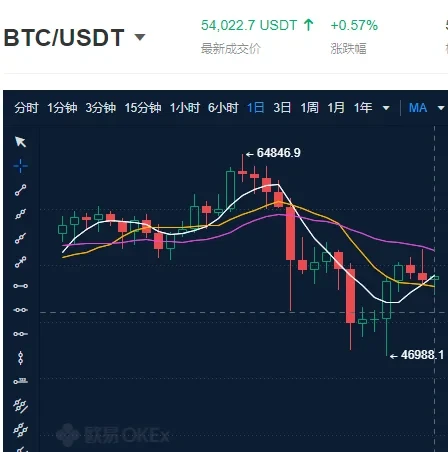
Bitcoin price chart, Source: OKX
Since the second half of 2020, the crypto market has experienced a spectacular bull run. Amid the heart-pounding gains and losses of various crypto assets, and the massive buying sprees by institutional investors like Grayscale combined with regulatory developments, another indispensable player in this market—the mining pools and miners—seems to have received little attention, remaining characteristically low-key. In fact, as Bitcoin's price has surged, miners have already been raking in substantial profits. Describing them as "making fortunes quietly" would be an understatement.
How Are Miners Faring Currently?
We know that Bitcoin operates on a PoW (Proof of Work) mechanism. To put it simply, Bitcoin mining is the process by which miners use specialized data processors (such as early CPU/GPU systems, and today's mining rigs) to convert electrical energy into Bitcoin according to predefined rules. During this process, the data processor repeatedly performs hash operations—each hash operation serves as both a guess and a vote—until finally solving a cryptographic puzzle and receiving the block reward—namely, Bitcoin.
Now that we understand the basics of how Bitcoin is mined, let's examine the current mining capacity of today's miners. This brings us to the first important concept—Hashrate. Hashrate refers to the total computing power on a blockchain dedicated to mining and processing transactions under the PoW algorithm. Hashrate reflects the speed at which mining hardware can solve a cryptographic puzzle. In Bitcoin mining, solving a cryptographic puzzle requires finding the corresponding mathematical solution, and for any given hash value within a range, the solution can only be found through auto-generated random numbers. Therefore, how many solutions a mining rig can compute per second represents its hashrate, measured in Hash/s (i.e., one hash computed per second). When evaluating the network-wide hashrate, due to its enormous scale, we typically use EH/s (Exa-hashes per Second, i.e., quintillion hashes per second) as the unit.
According to data from BTC.com, the current network hashrate stands at 159.09 EH/s.
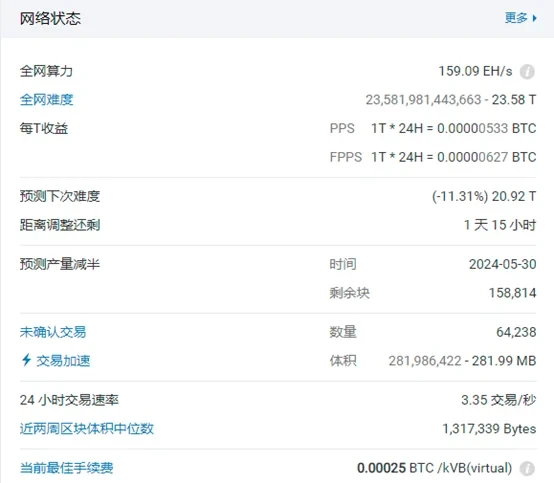
Current Bitcoin network hashrate, Source: BTC.com
A static number alone may not convey much, so let's examine the changes in network hashrate over the past few years.
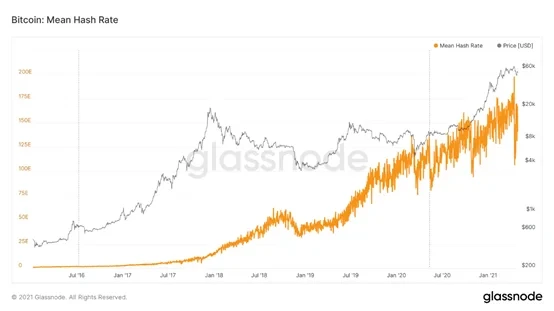
Bitcoin network hashrate changes since 2016, Source: Glassnode
As shown in the chart above, during the peak of the previous Bitcoin bull market in December 2017, the Bitcoin network hashrate was only 13 EH/s—an increase of 1,123% in less than four years.
How Are Miners' Returns?
For Bitcoin miners, their returns come from two main sources: first, block rewards earned through mining, which are relatively fixed. Since the third Bitcoin halving in May 2020, and until the next halving event, miners receive approximately 6.25 BTC for each block they mine. Second, transaction fees collected on-chain, which fluctuate significantly and are closely tied to the trading activity of investors on-chain.
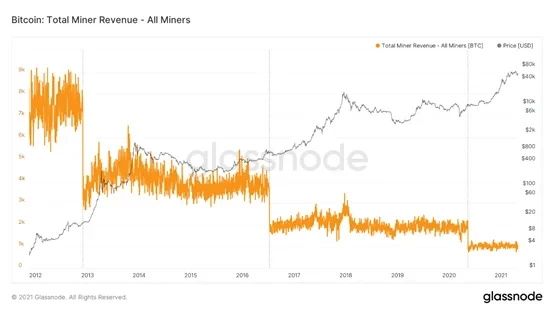
Overall Bitcoin miner revenue, Source: Glassnode
The chart above shows the total revenue of all Bitcoin miners since 2012. It can be observed that since the third Bitcoin block reward halving in May 2020, daily miner revenue has fluctuated between approximately 730 BTC and 1,300 BTC. By factoring in both the Bitcoin amount miners earned and the daily Bitcoin price during this period, we find that the highest-revenue day was April 15, 2021, when miners earned 1,230 BTC (Bitcoin price at $63,285), totaling $77.84 million. The lowest-revenue day was May 17, 2020, when miners earned 738 BTC (Bitcoin price at $9,670), totaling $7.14 million. Using a simple average calculation, miners' average daily revenue since May 2020 has been approximately $40 million. Of course, if Bitcoin's price continues to rise, this figure will increase accordingly—a point supported by historical price action.
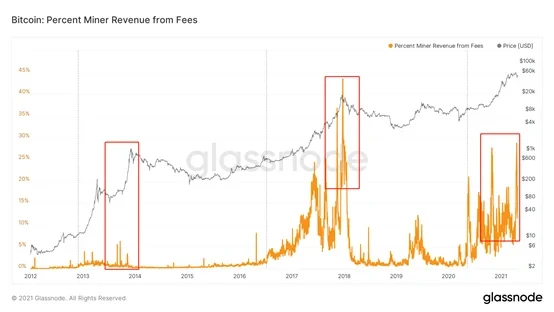
Bitcoin miner fee revenue, Source: Glassnode
The chart above displays the fee revenue earned by Bitcoin miners since 2012. We can clearly see that during the previous two bull markets, as Bitcoin's price rose, miners' fee revenue also increased substantially. It is important to note that whether it's block rewards or fee revenue, miners receive Bitcoin. Therefore, two key insights can be drawn from this chart: First, during a sustained uptrend, as many new investors enter the market, on-chain trading becomes increasingly active, and miners' fee revenue grows correspondingly. Second, the dual returns from Bitcoin's price appreciation and increased fee revenue mean that miners' returns inevitably rise in fiat terms.
Of course, this raises the next question: what do miners do with their earnings—i.e., their Bitcoin? As we all know, for miners, besides purchasing mining equipment, equipment depreciation costs, and pool maintenance expenses, electricity costs represent another major expense. Additionally, the potential risk of Bitcoin price declines is another factor miners must consider. Therefore, a very practical question faces miners: Should they sell the Bitcoin they've received? And if so, how?
How Do Miners Handle Their Bitcoin?
Based on the issues raised above, since miners' income is entirely in Bitcoin, selling Bitcoin becomes part of their routine operations to cover electricity costs and daily maintenance expenses. The amount they sell can reflect the miner community's outlook on the market—if they are pessimistic about future prospects, they will sell as much of their daily Bitcoin earnings as possible; if they are bullish, they will reduce sales.
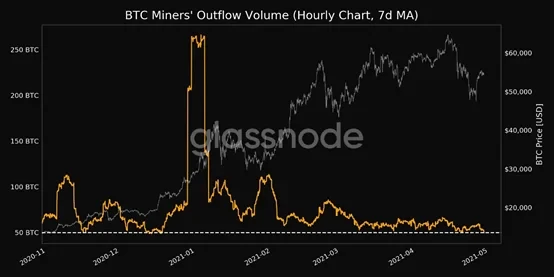
Therefore, observing the amount of Bitcoin miners transfer to exchanges can provide a preliminary answer. According to Glassnode's team, which regularly publishes updates via social media, the amount of Bitcoin that miners transferred to cryptocurrency trading platforms over a 7-day period has reached a 4-month low, currently totaling 49.9 BTC. Compared to early 2021, the current amount of Bitcoin miners are transferring to trading platforms has decreased significantly, which can also be interpreted as miners accumulating Bitcoin.
Finally, let's bring our focus back to the market. According to OKX Investment Research analysis, although over the past two weeks, Ethereum-based crypto assets led by DeFi have attracted significant attention from capital within the market, resulting in Bitcoin's recent weak performance, as the altcoin sector enters profit-taking territory, Bitcoin will very likely resume its strength. This prediction seems to align with miners' recent behavior. However, whether Bitcoin can make a strong comeback in the short term still depends on market signals.
Disclaimer
This article may contain product-related content not applicable to your region. This article is only intended to provide general information and makes no representation as to the accuracy or completeness of any facts. The views expressed herein are those of the author and do not reflect the views of OKX. This article is not intended to provide, and should not be construed as, any recommendations or advice, including but not limited to: (i) investment advice or investment recommendations; (ii) offers or solicitations to buy, sell, or hold digital assets; or (iii) financial, accounting, legal, or tax advice. Holding digital assets (including stablecoins) involves a high degree of risk and may fluctuate significantly or even become worthless. You should carefully consider whether trading or holding digital assets is appropriate for you based on your financial situation. For questions specific to your circumstances, please consult your legal/tax/investment professional. Any information provided in this article (including market data and statistics, if applicable) is for general reference purposes only. Although we have taken all reasonable precautions in preparing such data and charts, we accept no responsibility for any factual errors or omissions expressed herein. © 2025 OKX. This article may be reproduced or distributed in its entirety, or excerpted in passages of 100 words or less, provided such use is non-commercial. Any reproduction or distribution of the entire article must prominently state: "© 2025 OKX, used with permission." Permitted excerpts must cite the article title and include attribution, for example, "Article title, [author name if applicable], © 2025 OKX." Some content may have been generated or assisted by artificial intelligence (AI) tools. Derivative works and other uses of this article are not permitted.
Show More
Recommended Reading
OKX Pay: Ushering in a New Era of Next-Gen Crypto Payments
The choice of tens of millions of users. Register with OKX to enjoy an exceptional trading experience and a wide range of wealth management products. A letter from OKX CEO Star: Today, we officially launch the first version of OKX Pay for over 100 million global users. As the industry's first truly non-custodial and compliant payment application, OKX Pay will be embedded within the OKX App, currently available in select markets with a full global rollout expected in the coming months.
March 22, 2026

A New Chapter: Building the Next Generation of Financial Infrastructure Together
OKX's partnership with the Intercontinental Exchange (ICE) represents a significant milestone for OKX and is equally profound for the evolution of the entire digital assets market. ICE builds and operates some of the world's most critical financial infrastructure, including the New York Stock Exchange and global derivatives and clearing platforms. This investment by ICE in OKX through ICE Select and its addition to our Board of Directors reflects our shared conviction that digital assets technology will transform financial markets.
March 10, 2026
Celebrating Another Year of Resilience and Progress
As OKX's CEO and a builder who stays true to the mission, I take great pride in reflecting on the extraordinary growth and progress OKX has achieved this year. Despite the challenges, 2024 was a year defined by focus, innovation, and resilience. We not only expanded and optimized our products, but also made significant strides in launching transparent and regulatorily compliant localized businesses, while further strengthening our global management team. Notably, after experiencing the.
January 29, 2026

2025: Steady Progress Toward Financial Freedom
— An Open Letter to Global Users from Star, Founder and CEO of OKX. "Financial freedom" is often misunderstood. It doesn't mean an absence of rules, but rather the freedom to choose even when rules exist—and that the system remains reliable and effective when truly put to the test. This has been our unwavering focus throughout 2025. First and foremost, I would like to extend my sincere gratitude to our global customers, partners, and regulators.
January 16, 2026

OKX Officially Launches in Germany and Poland
By Erald Ghoos, CEO of OKX Europe. Today is a momentous day for OKX—and for crypto users across Europe. We have officially launched our fully compliant centralized cryptocurrency trading platform in Germany and Poland! For us, this is more than a geographic expansion; it is a commitment to building the future of cryptocurrency the right way: secure, transparent, and tailored to local needs. If you are in Germany.
October 21, 2025

Partnership Upgrade! OKX Joins Forces with Standard Chartered to Expand into Europe
On October 15th, Erald Ghoos, CEO of OKX Europe, stated that OKX is expanding its strategic partnership with Standard Chartered into the European Economic Area (EEA). Earlier this year, OKX first partnered with Standard Chartered in the UAE to launch the Collateral Mirroring program—a.
October 15, 2025