Bitcoin "Americanization": Will the Bull-Bear Boundary Gradually Blur?
In the final days of 2021, Bitcoin began to gradually emerge from its downward shadow, successfully reclaiming the $50,000 psychological level yesterday. Led by Bitcoin, the entire crypto market has seen some recovery, giving investors a renewed sense of confidence.
However, due to the consecutive 40-plus days of declining prices that began in mid-to-late November, many investors have lost patience. In surveys on bull and bear markets conducted by some media and industry veterans, over 50% of respondents believe the bull market has ended and a bear market has arrived. It can be said that as the third Bitcoin halving cycle progresses, the entire market has begun to diverge, with debates about bull and bear markets heating up once again — it seems the market has reached another inflection point for a potential bull-to-bear transition.
Will the future trend be bullish or bearish? This is a fundamental question, but things in this world are rarely black and white. After more than a decade of development, Bitcoin has reached considerable heights in terms of its own scale, public recognition, holder composition, and the overall ecosystem of the industry. Bitcoin itself is gradually becoming a globally recognized mature asset. Using the old clear-cut bull-bear framework to evaluate Bitcoin today seems somewhat inadequate. So, what perspective should we adopt to view the future performance of Bitcoin and the crypto market? What form will the overall market take?
Bitcoin Is "Americanizing," What Form Will the Market Take?
Starting from the "May 12" Bitcoin halving last year, this halving cycle has already passed the one-and-a-half-year mark. The pattern exhibited by Bitcoin and the broader crypto market during this halving cycle shows a notable difference from the previous two halving cycles. In particular, the "May 19" crash clearly divided this cycle into two halves: if the first half before May 19 could still be compared to the previous two halving cycles, then the second half after May 19 presents a completely different pattern from previous market movements.
Simply put, Bitcoin will no longer experience the sharp bull-bear alternations of the past. The bull market may extend and slow down, much like what we have observed over the past six months: rising slowly, then crashing, followed by a lengthy recovery, then slowly climbing again before another crash. A deep bear market like those seen in the previous two halving cycles is unlikely to recur.
This situation bears some resemblance to the U.S. stock market — or rather, Bitcoin is undergoing "Americanization." The defining characteristic of U.S. stocks is a long-term, slow-moving bull market: from the low point caused by the 2008 financial crisis, U.S. stocks have experienced over a decade of sustained gains; from the low point of the 2001 internet bubble burst, U.S. stocks ``` Here's the translated HTML:
have seen 18 years of long-term growth; from the 1987 U.S. stock crash, U.S. stocks have maintained a 32-year bull market... Over these decades, the pattern of U.S. stocks can be simply summarized as "slow rise → crash → slow rise → crash." There is no clear boundary between bull and bear markets, and each crash is followed by a period of accumulation before new highs are reached.
In fact, the idea of Bitcoin "Americanizing" has been proposed before, but only now has Bitcoin gained the conditions necessary for this transformation.
There are many reasons behind the slow, long-term bull markets of U.S. stocks, such as margin trading systems and the growth of the U.S. economy. Here, we focus on three reasons that can be compared to Bitcoin: market institutionalization, investors primarily adopting "HODL" strategies with a focus on long-term returns, and the Federal Reserve's sustained money printing to release liquidity.
First, Bitcoin's institutionalization — this has been widely discussed. Here, we focus on how institutionalization affects Bitcoin's development of a slow bull market. When the majority of Bitcoin is held by institutions, or as the "HODL" community represented by institutions continues to grow, the amount of Bitcoin circulating in the market decreases. Although Bitcoin may still experience crashes due to "excessive gains," because the major holders are not selling their Bitcoin, these crashes are unlikely to evolve into deep bear markets. Much like U.S. stocks, each crash will be followed by a period of accumulation before new highs are reached.
Another effect of Bitcoin's institutionalization is a massive increase in "absorbing capacity." Every panic-driven dip is met with strong institutional buyers stepping in. This buying power is simply unmatched by markets previously dominated by retail investors.
Second, as Bitcoin gains recognition worldwide, both institutions and "whales" are increasingly adopting a buy-and-hold strategy, no longer concerned with short-term price fluctuations. This is undoubtedly a fundamental positive for Bitcoin's price stability.
Finally, the Federal Reserve's sustained money printing and liquidity release can be said to be one of the fundamental reasons behind Bitcoin's and U.S. stocks' bull markets. Although the "safe-haven asset" attribute is now being questioned, Bitcoin can indeed avoid the risk of inflation, especially over periods exceeding four years. It can be said that Bitcoin's value is a mirror of the real world's money overprinting, primarily by the Federal Reserve. As long as the Federal Reserve continues to print money (which is almost certain), Bitcoin's value will continue to rise.
In summary, with institutions entering and mainstream capital coming in, the digital assets field represented by Bitcoin has already become a mainstream financial product. It has not only begun to form a synergistic effect with global capital markets represented by U.S. stocks, but will also increasingly exhibit similar patterns.
Future Bitcoin may experience declines due to external factors and interest rate hikes, but taking a longer view, Bitcoin's long-term bull market and slow bull pattern will become increasingly apparent. The days of "distinct bull and bear markets" that many people remember, where bull markets came to an abrupt end and "when the tree falls, the monkeys scatter," may not return. The boundary between bull and bear markets will gradually blur. Reduced volatility, shorter bear markets and longer bull markets, Bitcoin's "Americanization" — this may be the path Bitcoin will take in the future.
The principle of development perspective tells us: everything is in constant motion, change, and development. In the face of change, what we need to do is make our own judgments and actively adjust ourselves to embrace change.
Let the data speak: Where is the market heading?
In our original article "Why do bull markets have many crashes? How to anticipate market crashes?", we listed some data indicators to more accurately judge market conditions. Now, let's look at where these data indicators stand.
Below
Data is primarily sourced from third-party data websites, such as: QKL123, lookintobitcoin, tokenview, etc.
1. Bitcoin 60-day cumulative return: -18.83%. (Above 80% indicates a high-risk bubble; the higher the data, the greater the risk.)
2. AHR999x top-indicator: 1.62. (Below 0.45 indicates a bull market top or a cyclical top.)
3. MVRV ratio: 1.92. (The higher the indicator, the more severely the price is overvalued and the higher the risk; above 3.5 indicates an excessive bubble.)
4. Fear & Greed Index: 39, Fear. (The higher the value, the closer to 100, the more greedy the market; the longer greed persists, the greater the risk of a sharp decline.)
5. Bitcoin-related data:
- Bitcoin market cap dominance: 41.93%. (The lower the dominance, the closer to a bull market top; generally reaching 30%-40% indicates high risk)
- Holdings over 1 year: 56%. (Below 45% is a high-risk zone.)
6. ETH 60-day cumulative return: 1.69%.
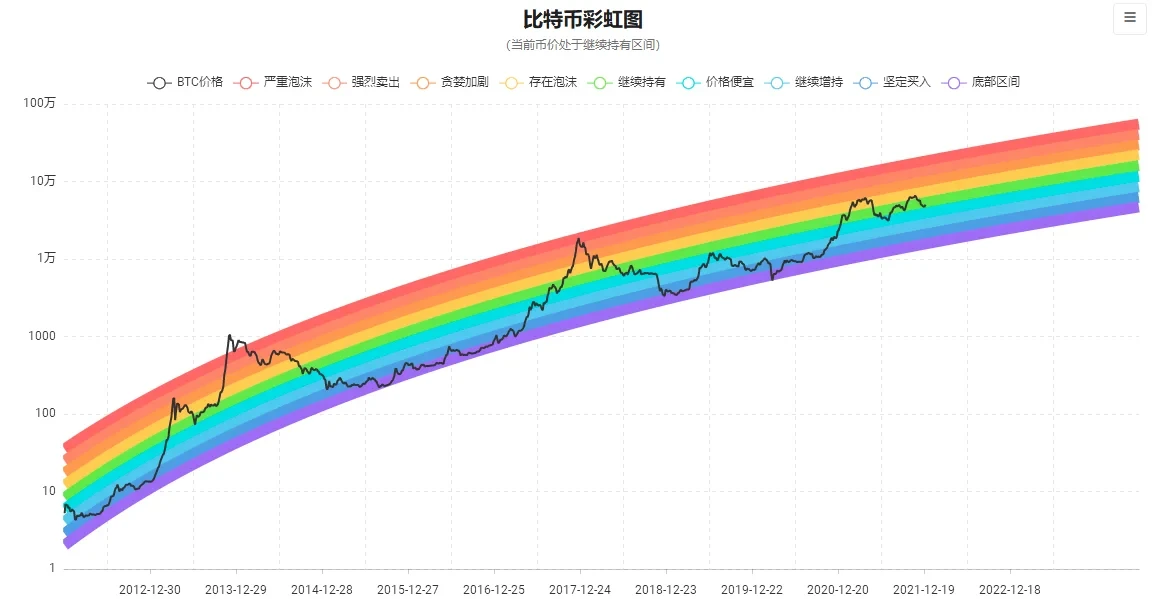
7. Bitcoin Rainbow Chart: Continue holding phase, as shown below:
8. Puell Multiple indicator: 1.07. (Explores market cycles from the perspective of mining revenue; values in the 4-10.5 zone indicate current market sentiment is relatively greedy, possibly in the late bull stage.)
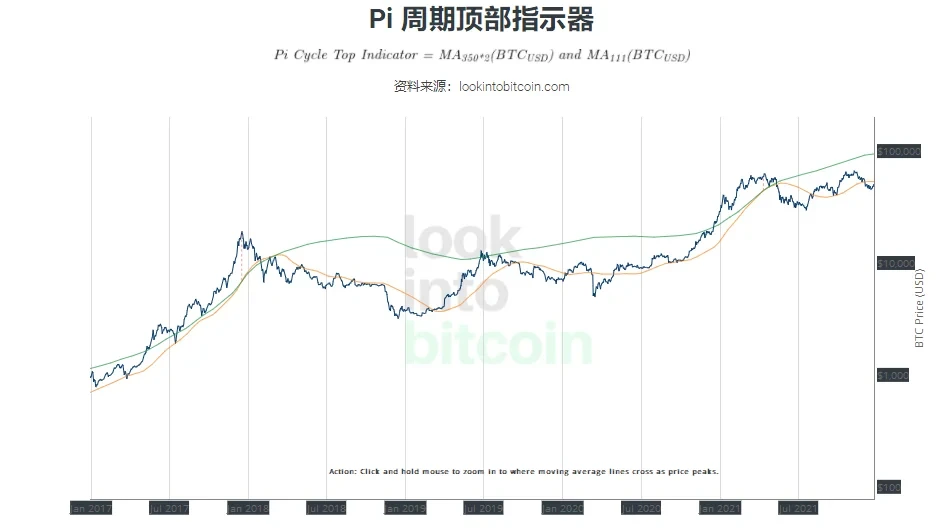
9. Pi Cycle indicator: Not yet crossed, as shown below: (When 111DMA moves upward and crosses 350DMA x 2, it signals the cycle top.)
10. RHODL ratio: 4916.75. (When the indicator enters the red band, it means the market is approaching a cycle top.)
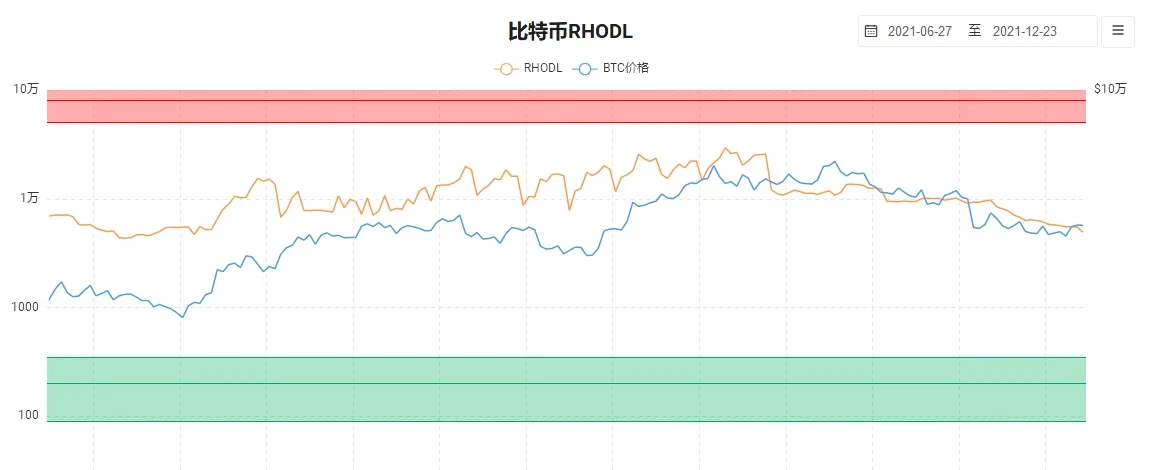
**Summary: ** Most of the 10 data indicators above are favorable, and several indicators signaling a bull market top—such as RHODL ratio, Pi Cycle indicator, Bitcoin Rainbow Chart, etc.—have not shown bull market peak signals. From the perspective of data indicators, the bull market has not ended, and the market is currently in a recovery phase following consecutive declines.
Finally, this article is for reference only and does not constitute investment advice. The market involves risks; please exercise caution when entering the market.
Disclaimer
This article may contain product-related content not applicable to your region. This article is intended to provide general information only and does not assume responsibility for any factual errors or omissions therein. This article represents the author's personal views only and does not represent OKX's views. This article is not intended to provide any of the following advice, including but not limited to: (i) investment advice or investment recommendations; (ii) offers or solicitations to buy, sell, or hold digital assets; or (iii) financial, accounting, legal, or tax advice. Holding digital assets (including stablecoins) involves high risk, may fluctuate significantly, and may even become worthless. You should carefully consider whether trading or holding digital assets is suitable for you based on your financial situation. For questions regarding your specific situation, please consult your legal/tax/investment professional. The information appearing in this article (including market data and statistics, if any) is for general reference only. Although we have taken all reasonable precautions in preparing these data and charts, we assume no responsibility for any factual errors or omissions expressed herein. © 2025 OKX. This article may be reproduced or distributed in full, or excerpts of 100 words or less from this article may be used, provided such use is non-commercial. Any reproduction or distribution of the entire article must prominently state: "© 2025 OKX, used with permission." Permitted excerpts must cite the article name and include attribution, for example "Article Name, [Author Name (if applicable)], © 2025 OKX". Some content may be generated or assisted by artificial intelligence (AI) tools. Derivative works or other uses of this article are not permitted.
Show More
Recommended Reading

OKX Pay: Opening a New Era of Next-Generation Crypto Payments
The choice of tens of millions of users. Register for OKX to enjoy the ultimate trading experience and diverse wealth management products. A letter from OKX CEO Star: Today, we are officially launching the first version of OKX Pay to over 100 million global users. As the industry's first payment app to truly achieve non-custodial and compliant integration, OKX Pay will be embedded in the OKX App, currently available in select markets, and expected to fully roll out within months
March 22, 2026

New Chapter: Building Next-Generation Financial Infrastructure Together
OKX and Intercontinental Exchan
The partnership with Intercontinental Exchange (ICE) marks a significant moment for OKX, and holds equally profound significance for the evolution of the entire digital assets market. ICE establishes and operates the world's most critical financial infrastructure, including the New York Stock Exchange as well as global derivatives and clearing platforms. This ICE Select investment in OKX and joining our board reflects our shared belief—that digital assets technology will transform financial markets
March 10, 2026

Tribute to Another Year of Forging Ahead
As OKX's CEO, and also a builder who stays true to our original mission, I am proud to look back on the extraordinary growth and progress OKX has achieved this year. Despite numerous challenges, 2024 remained a year filled with focus, innovation, and resilience. We not only expanded and optimized our products, but also made significant progress in launching transparent and regulatory-compliant localized operations, while further strengthening our global management team. Notably, after experiencing
January 29, 2026

2025: Steady Progress Toward Financial Freedom Together
—— A year-end letter from Star, Founder and CEO of OKX, to global users "Financial freedom" is often misunderstood. It doesn't mean the absence of rules, but rather having the right to choose within the framework of rules—and when the system is truly tested, it remains reliable and effective. This is precisely the direction we have remained focused on throughout 2025. First, I want to extend my sincere gratitude to our global clients, partners, and regulatory bodies
January 16, 2026

OKX Officially Launches in Germany and Poland
Author: Erald Ghoos, CEO of OKX Europe Today is a momentous day for OKX—and for crypto users across Europe. We have officially launched our fully compliant centralized cryptocurrency trading platform in Germany and Poland! For us, this is more than just geographic expansion; it's a commitment to building the future of cryptocurrency the right way: secure, transparent, and responsive to local needs. If you're in Germany
October 21, 2025

Partnership Elevated! OKX Partners with Standard Chartered to Expand European Market
On October 15, Erald Ghoos, CEO of OKX Europe, announced that OKX is expanding its strategic partnership with Standard Chartered to the European Economic Area (EEA). Earlier this year, OKX first partnered with Standard Chartered in the UAE to launch the collateral mirroring program—an initiative
October 15, 2025