Bitcoin Loses Absolute Dominance — Has the Bull Market Run Its Course?
More than a third of the first month of 2022 has already passed, yet the trend of volatile decline that began in mid-November last year shows no sign of reversing. At this point, many are beginning to worry about entering a prolonged bear market.
It has been over a year and a half since Bitcoin kicked off its third halving cycle on "May 12th, 2020." Over this period, the crypto market itself and the broader external environment have witnessed numerous events and changes worthy of historical record — events and changes that have made the entire crypto market unlike what it was before.
The fundamental conditions of the crypto market have changed dramatically. This difference is not only reflected in Bitcoin's dominance being continuously challenged and weakened, but also in the flourishing Ethereum ecosystem alongside the breakout popularity of concepts like the metaverse, Web3, and more — drawing in traditional giants and "Old Money," and fundamentally shifting both who participates in the market and how tightly the market is intertwined with the traditional world.
These factors will have a profound impact on the bull-bear cycles and market behavior of the crypto market, both now and in the future. Simply put: the world of crypto has changed — and this change is one of quantitative accumulation leading to qualitative transformation.
Bitcoin's Leadership Role Fades, Losing Absolute Dominance?
As is well known, Bitcoin existed before the crypto market as we know it. One could say that since the birth of the crypto market, Bitcoin has been the undisputed protagonist and leader — commanding absolute dominance in market capitalization, brand recognition, ability to attract new funds, and influence over market movements. Particularly during the first two halving cycles, Bitcoin stood alone at the top, with no rival worthy of comparison.
In terms of market capitalization, Bitcoin has consistently held over 60%, even exceeding 90%, of the total crypto market — to the point where some people only knew of Bitcoin and were unaware of the broader crypto market. Moreover, new funds flowing in from outside the crypto space largely entered through Bitcoin, and the rallies of other digital assets were primarily driven by fund overflow effects from Bitcoin.
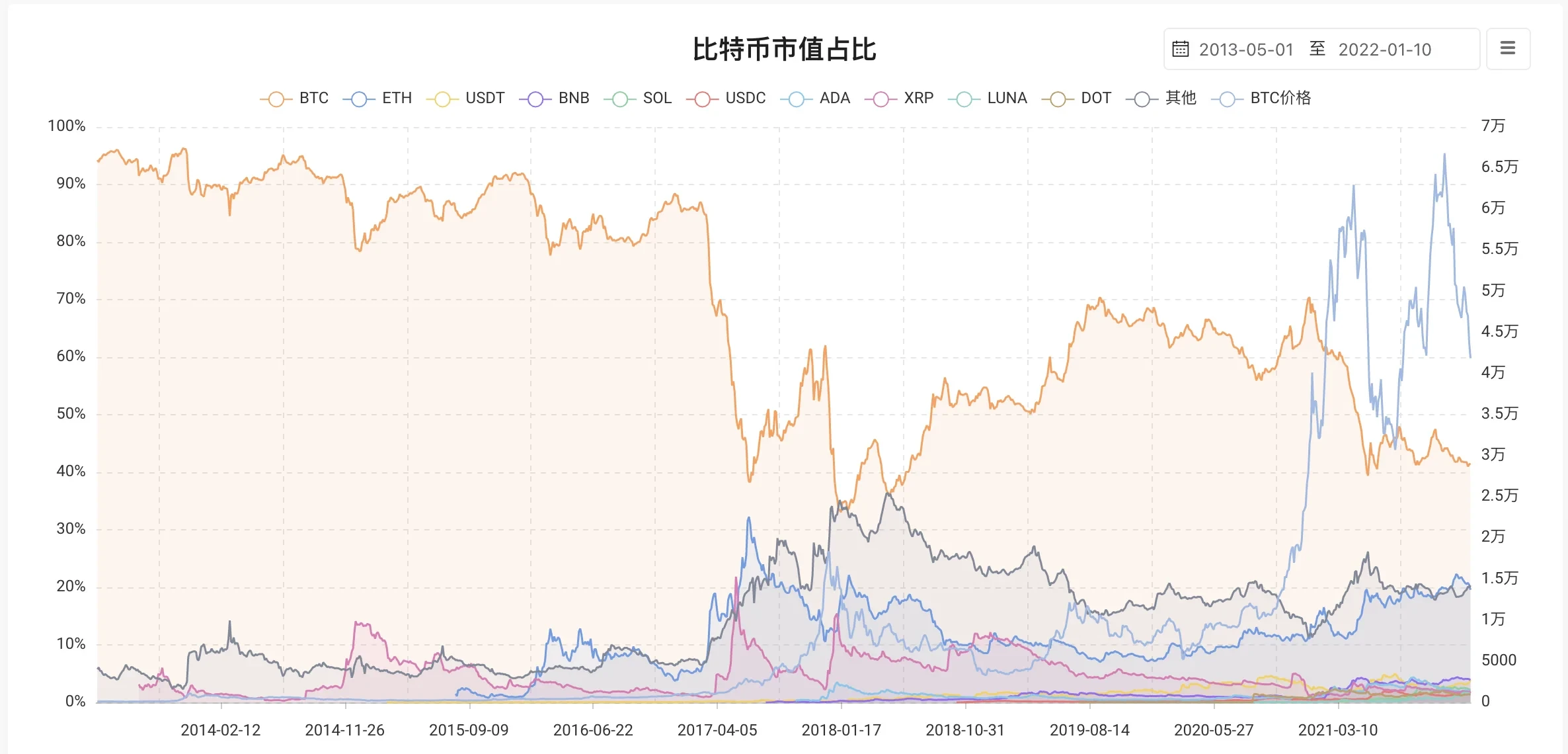
Bitcoin Market Dominance (Source: QKL123)
Therefore, the crypto market's upswings and downturns frequently followed this pattern: Bitcoin would lead the charge upward, Ethereum and other major digital assets would follow, then high-quality smaller-cap assets would go parabolic, followed by a broad market rally — and finally, Bitcoin's decline would drag everything down. After a period of consolidation, the cycle would repeat.
However, after this halving cycle began — particularly following the "May 19th" crash last year — astute observers have already noticed that the phenomenon described above has gradually ceased to hold. In this halving cycle, the market has undergone many changes. Compared to the 2013 and 2017 cycles, Bitcoin's dominance has been declining markedly, which can be seen clearly in the Bitcoin market dominance chart above.
In terms of market share, Bitcoin now accounts for roughly 40%, Ethereum around 20%, and the remaining 40% is split among others. Not only is Ethereum's market influence steadily growing, showing a trend toward bipolarization, but with the broader ecosystem development of the market, projects representing other concepts have risen rapidly as well.
For example, NFTs breaking into the mainstream drew a large number of outside users into the crypto market; the explosive growth of DeFi and GameFi attracted countless users to become digital asset holders; and the development of concepts like the metaverse and Web3 drew traditional giants such as Facebook, Google, and Tencent into the fray……
From Bitcoin's own perspective, the entry of institutional players led by Wall Street, while gradually reducing its volatility and providing a solid foundation for price stability, has also diminished Bitcoin's fund flow activity. Institutions primarily hold for the long term, meaning funds in Bitcoin have begun to settle and accumulate rather than serving as the main gateway for new capital into the crypto market — previously, when Bitcoin was full, excess funds would overflow to nourish other digital assets.
In summary, Bitcoin's role going forward will increasingly resemble that of real gold — becoming the bedrock of the crypto market, a store of value, and even a form of general equivalent. Whether it is new funds and new users entering the market, or the continued development of the crypto market, Bitcoin's dominance will gradually weaken, and its influence over market movements and bull-bear transitions will likewise diminish. Like Emperor Qianlong who "retired to become the Grand Emperor" — gradually ceding power, becoming a symbol of the entire empire, but increasingly unable to keep pace with day-to-day affairs.
Can the Flourishing Ethereum Ecosystem Retain Market Funds?
If we analyze the causes behind previous crypto bull-bear transitions, we can see that the inflow and outflow of market funds largely determined the trajectory and form of each cycle. During the first two halving cycles, the scale and duration of Bitcoin's ability to attract and retain funds determined the size and length of the bull market.
However, the biggest variable in this halving cycle is the development and prosperity of Ethereum and its ecosystem, which has ended Bitcoin's monopoly on glory. The growth of the Ethereum ecosystem has also rapidly spurred the rise of new public chains — particularly high-performance ones. These fast, low-fee public chains, together with Ethereum, have absorbed a massive influx of innovation and projects. Large amounts of risk capital have begun flowing in, new funds have poured in continuously, energizing the entire crypto market and breaking Bitcoin's dominance as the sole gateway for new capital.
The most significant impact of this phenomenon is that it has objectively prolonged the duration and scale of the bull market. For instance, the development of DeFi projects built on Ethereum and other public chains has greatly improved capital efficiency — even when the market is not rising, there are still ways to make money. Moreover, new asset categories continue to emerge — NFTs being a prime example — and as more new assets come to market, different sector themes attract more new funds while giving existing "old money" reasons not to exit.
The Ethereum ecosystem has become a key focus of attention and investment for capital both inside and outside the crypto space. It accommodates a vast amount of innovation: NFTs, GameFi, DAO, Layer2, and other concepts emerge in an endless stream. This innovative momentum is not only unmatched anywhere else in the crypto market but stands as one of the most innovation-rich environments in the entire startup landscape. The Ethereum ecosystem will continue to attract significant capital into the crypto market.
Of course, beyond the Ethereum ecosystem, the ecosystems of other quality public chain projects are also developing rapidly. Looking at the TVL (Total Value Locked) of public chain projects alone, the total value of digital assets staked by all network users stands at $292.6 billion — having grown continuously since the DeFi explosion of 2021, with even the "May 19th" crash and the recent two months of decline failing to halt TVL's continued growth. As shown below:
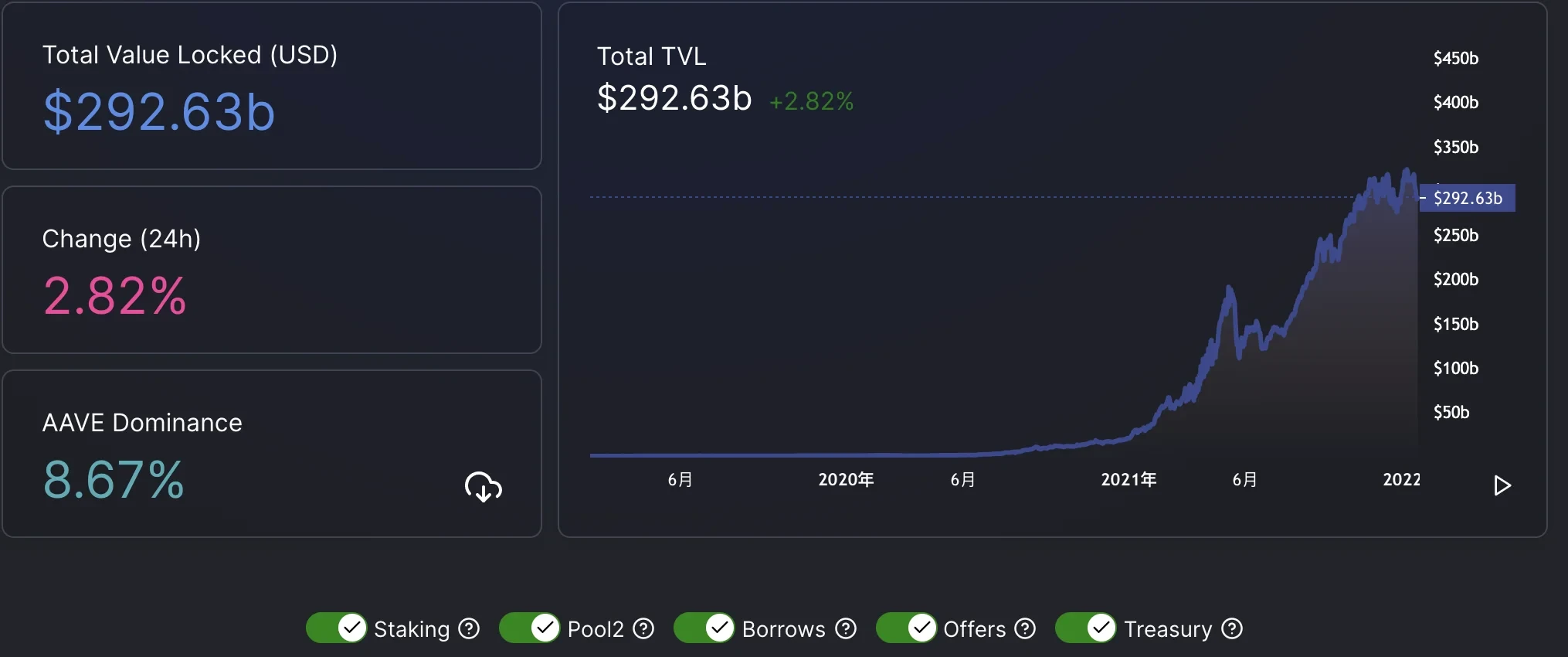
Total Network TVL (Data Source: defillama)
This has meant that while Bitcoin continued to underperform in the second half of 2021, the total market capitalization of the entire crypto market reached a new all-time high of $3 trillion at the end of last year — demonstrating powerful vitality and strong momentum.
Under this trend, will Ethereum's market capitalization overtake Bitcoin this cycle? This question may have different answers from different people, but the fact that Ethereum's influence on the market is growing is undeniable. Bitcoin's single-pole dominance over the market has become bipolar. Just as the world once had only the United States as a superpower, and now China has grown increasingly strong. The same applies to Ethereum — it will become the biggest variable in the overall market structure.
One could say that the continued development and prosperity of the public chain ecosystem — with the Ethereum ecosystem as its representative — has made it a force in attracting new funds that is second to none, rivaling even Bitcoin. Furthermore, it provides a much richer array of destinations for market funds, greatly extending how long capital remains within the crypto market. This represents the greatest variable of this cycle and will have a significant and far-reaching impact on the bull-bear patterns and future performance of the crypto market.
Market Fundamentals Have Changed Dramatically — The Four-Year Bull-Bear Cycle Is Likely to Be Broken
As mentioned above, the market's fundamental conditions have changed dramatically in this halving cycle. Beyond Bitcoin's fading leadership role and the rise of the Ethereum ecosystem, there are other fundamental changes that should not be underestimated.
Looking at Bitcoin itself, the structure of its holders has also shifted noticeably. Large institutions, nations, and publicly listed companies have begun adding Bitcoin to their own investment portfolios as part of their assets.
The foundational dynamics of fund flows in and out of — and retention within — the market have also diverged from the 2013 and 2017 cycles. In those halving cycles, the market started with only Bitcoin, later seeing the emergence of various public chain tokens represented by Ethereum and numerous "altcoin projects." If the market turned sluggish with no profit opportunities, funds had no choice but to exit. But now there are DeFi, NFT, GameFi, Web3, and various other concepts and projects, along with a large supply of stablecoins and financial products — meaning that even in a downturn, funds have places to earn returns without exiting. This will greatly extend the duration of bull markets.
From the perspective of policies and regulations, the landscape is no longer as murky and hard to define. Instead, laws and regulations are being introduced on a continuous basis: According to Forbes, in 2021, the U.S. Congress introduced 35 bills related to crypto policy, covering cryptocurrency regulation, blockchain technology applications, and central bank cryptocurrencies. At the same time, other major economies around the world have also introduced corresponding crypto policies. In the long run, having clear legal frameworks will benefit the sustainable and healthy development of the crypto market.
From the perspective of the broader industry environment, the traditional internet can no longer accommodate innovation — every sector is already dominated by large leading companies, leaving little room for new opportunities. Therefore, a wave of traditional giants are entering blockchain and going "all-in" on the crypto market. Not only did Facebook rebranded to Meta, but Sequoia Capital even changed its signature for a period, stating it would invest in the next great DAO rather than a company. More and more traditional giants entering the space will undoubtedly extend the overall bull market. As long as new capital — especially large institutional capital — continues to pour into the market, there will be new concepts, new themes, and new innovations emerging, giving investors different things to put their money into.
It can be said that the overall market fundamentals have undergone tremendous change. If we still view the market structure and patterns through a Bitcoin-dominated lens, we are no longer keeping pace with the times. Accordingly, the four-year bull-bear cycle may also be broken.
The crypto market has become far more complex than before — whether in terms of participants, structure, or form — which is precisely why there are so many debates in the market. So, where does the market go from here? What form will it take?
Addressing this question, the renowned research firm Messari offered an in-depth exploration in its 2022 crypto market report published in December 2021. It predicted three possible scenarios: 1) The market will surge again in Q1 this year, then enter a prolonged bear market lasting 2 to 3 years; 2) 2022 will be a bull market for the entire year, followed by the bubble bursting into a genuine bear market; 3) The supercycle theory — the crypto market follows a slow and steady trajectory of gradual upward movement, long-term being a major bull market, but with numerous smaller bear markets interspersed throughout.
All three predictions are possible, and different people have different perspectives. I personally find the third supercycle theory most convincing. The specific reasoning and views were covered in detail in my previous article "The Explosive Rally Is Over — Has Bitcoin's 'Slow Bull' Begun?". Here, I will primarily discuss the perspectives behind the first two scenarios.
The first viewpoint still assumes Bitcoin's dominance and judges the cycle based on past timeframes, yet the market's fundamental conditions in this cycle have changed dramatically. The second viewpoint contradicts the current macroeconomic environment — with expectations of Fed rate hikes, the gradual control of the pandemic, and the economy beginning to recover, the likelihood of a狂暴 bull market lasting an entire year is far too small.
The third viewpoint — the supercycle theory — best aligns with both the changed market conditions and the macroeconomic environment. The market gradually oscillates upward, avoiding extreme booms and busts. Like U.S. stocks of the past, it is a bull market in the long run, but will experience individual smaller bear markets due to internal and external factors. However, these will not be as extreme in duration or depth as those of the past — like the minor bear market after "May 19th," lasting perhaps two to three or four to five months. Painful as they may be, they are far less terrifying and unbearable than the long, deep bear markets of the past.
Predicting the future is an extraordinarily difficult task. We can only observe the market, perceive some of the changes, feel them — like a perpetually thirsty sponge, constantly learning, learning, learning — embrace change at all times, then put it into practice, summarize, and修正, and most importantly, do not exit the market.
Finally, this article is for reference only and does not constitute investment advice. The market carries risk — proceed with caution.
Disclaimer
This article may contain product-related content not applicable to your region. This article is intended solely to provide general information and makes no responsibility for any factual errors or omissions. This article represents the author's personal views only and does not constitute the views of OKX. This article is not intended to provide any advice, including but not limited to: (i) investment advice or investment recommendations; (ii) offers or solicitations to buy, sell, or hold digital assets; or (iii) financial, accounting, legal, or tax advice. Holdings of digital assets (including stablecoins) involve a high degree of risk and may fluctuate significantly, or even become worthless. You should carefully consider whether trading or holding digital assets is appropriate for you based on your financial situation. For questions specific to your circumstances, please consult your legal/tax/investment professional. The information contained in this article (including market data and statistical information, where applicable) is provided for general reference purposes only. Although we have taken all reasonable precautions in preparing such data and charts, we assume no responsibility for any factual errors or omissions expressed herein. © 2025 OKX. This article may be reproduced or distributed in its entirety, and excerpts of 100 words or less may be used, provided that such use is non-commercial in nature. Any reproduction or distribution of the full article must prominently state: "This article is copyrighted © 2025 OKX, used with permission." Permitted excerpts must cite the article title and include attribution, e.g., "Article title, [author name (if applicable)], © 2025 OKX." Some content may have been generated or assisted by artificial intelligence (AI) tools. Derivative works and other uses of this article are not permitted.
Show More
Recommended Reading
OKX Pay: Ushering in the Next Generation of Crypto Payments
Join tens of millions of users. Register with OKX and enjoy an exceptional trading experience and a full suite of wealth management products. A letter from OKX CEO Star: Today, we officially launch the first version of OKX Pay to over a hundred million global users. As the industry's first truly non-custodial and compliant payments application, OKX Pay will be embedded directly within the OKX App, currently available in select markets with a full global rollout expected within months.
March 22, 2026

A New Chapter: Building the Next Generation of Financial Infrastructure Together
The partnership between OKX and the Intercontinental Exchange (ICE) marks a significant moment for OKX and is equally meaningful for the evolution of the entire digital assets market. ICE builds and operates the world's most critical financial infrastructure, including the New York Stock Exchange and global derivatives and clearing platforms. This investment by ICE Select in OKX and its addition to our Board of Directors reflects our shared belief — that digital assets technology will transform financial markets.
March 10, 2026

To Another Year of Building
As CEO of OKX and a builder who stays true to the original mission, I look back with great pride at the extraordinary growth and progress OKX has made this year. Despite formidable challenges, 2024 was a year defined by focus, innovation, and resilience. We not only expanded and optimized our product offerings, but also made significant strides in launching transparent and regulation-compliant localized businesses, while further strengthening our global management team. It is worth noting that after going through.
January 29, 2026

2025: Steady Progress Toward Financial Freedom
— An End-of-Year Letter to Global Users from Star, Founder and CEO of OKX "Financial freedom" is often misunderstood. It does not mean the absence of rules, but rather having the freedom to choose — even when rules exist — and more importantly, that the system remains reliable and effective when truly put to the test. This has been our unwavering focus throughout 2025. First and foremost, I would like to extend my sincere gratitude to our global customers, partners, and regulators.
January 16, 2026

OKX Officially Launches in Germany and Poland
By Erald Ghoos, CEO of OKX Europe. Today is a significant day for OKX — and for all crypto users across Europe. We have officially launched our fully compliant centralized cryptocurrency trading platform in Germany and Poland! For us, this is more than just geographic expansion — it is a commitment to building the future of cryptocurrency the right way: safe, transparent, and tailored to local needs. If you are in Germany.
October 21, 2025

Partnership Upgrade! OKX and Standard Chartered Expand Into Europe
On October 15th, Erald Ghoos, CEO of OKX Europe, stated that OKX is expanding its strategic partnership with Standard Chartered to the European Economic Area (EEA). Earlier this year, OKX first partnered with Standard Chartered in the UAE to launch the collateral mirroring program — which.
October 15, 2025