Institutions Are Buying Amid the Market Crash: Where Will the Market Go From Here?
Since mid-November, Bitcoin has seen three consecutive weekly declines, a situation that has never occurred during this halving cycle. Even during the "5.19" crash, there were only two consecutive weekly declines. Bitcoin's price fell from a high of $69,040 to a low of $41,241, a maximum drop of 40.2% (OKX platform data), and other digital assets also followed suit with significant declines, with some even dropping lower than during the "5.19" crash.
Such a prolonged decline with such depth has made many investors feel uneasy, and many even believe the bull market has ended and have left the market in disappointment. This includes some "veterans" who have been in the market for a long time. Meanwhile, numerous institutions continue to increase their positions, not only constantly buying Bitcoin and other digital assets in the secondary market but also making investments in quality projects in the primary market.
However, despite institutions continuously increasing their positions, the market has not stabilized and rebounded. Why? Where will the market go from here, and what form will it take?
Investment is the realization of your knowledge. Only by continuously improving your understanding can you truly earn returns through skill. K-line charts are a fundamental tool for investment analysis and an essential skill for investors. K-line charts are intuitive, three-dimensional, and information-rich, making them the most commonly used and basic tool for investment trend analysis. We have prepared 3 K-line basics for you, including: common K-line patterns, common bullish K-line pattern combinations, and common bearish K-line pattern combinations.
Institutions Are Buying, Why Is Bitcoin Falling?
During this period when Bitcoin has led the entire crypto market in continuous decline, numerous investors have chosen to leave the market or "lie flat" and no longer engage in trading. In sharp contrast, institutional investors continue to buy.
According to Coin Voice: On December 7, the third-largest BTC whale purchased over 2,700 BTC in a single day, with an average purchase price of $50,621. In the past two weeks, they have accumulated over 5,600 BTC. Calculated at an average price of $50,000, this is worth $2.531 billion. Meanwhile, Grayscale has also increased its holdings of MANA (GameFi concept) and SOL (public chain project) in the past half month, accumulating 30,399 MANA and 1,467 SOL.
Looking at Bitcoin UTXO age distribution, since Bitcoin began falling in mid-November, the percentage of Bitcoin holdings with UTXO age greater than 5 years increased from 22.91% to 22.99%, an increase of 15,117 Bitcoin, with an average daily increase of nearly 800, almost equivalent to Bitcoin's current daily production. In other words, during Bitcoin's three consecutive weekly declines, early Bitcoin holders have been continuously purchasing Bitcoin.
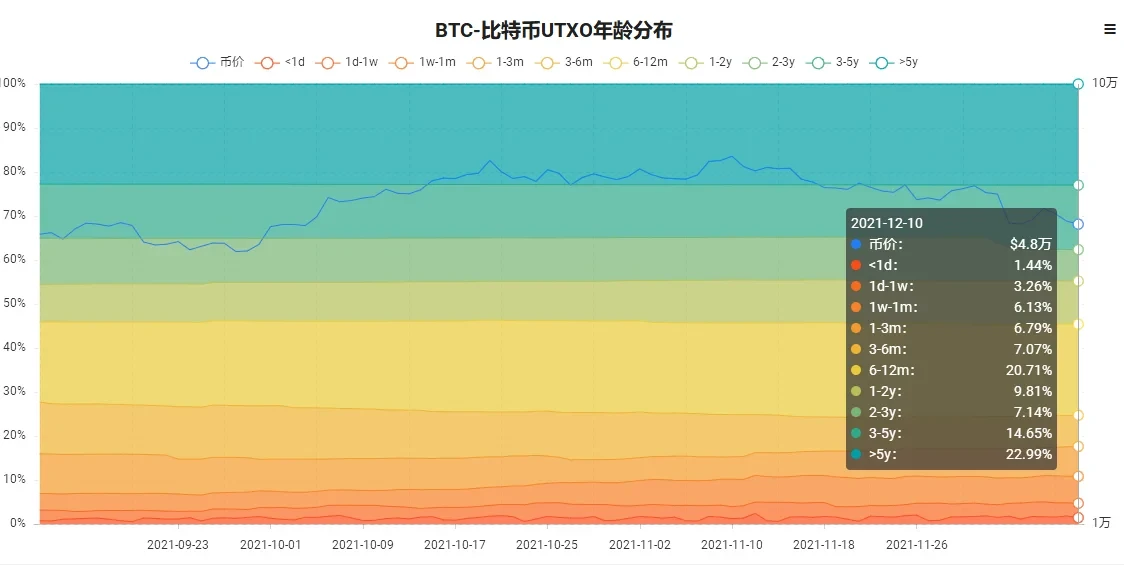
Bitcoin UTXO Age Distribution (Source: qkl123)
According to Grayscale's latest research released this Tuesday, the percentage of Americans owning Bitcoin increased from 23% in 2020 to 26% in 2021. Compared to previous years, they are less concerned about systemic risks such as cyberattacks, volatility, and regulation. Grayscale's survey found that in the past 12 months, 55% of surveyed investors were investing in Bitcoin for the first time and believe Bitcoin is a long-term investment suitable for an overall investment strategy.
Regarding the total amount of Bitcoin held by institutions, data from buybitcoin shows that combining ETFs, countries, listed companies, etc., institutions now hold 1,494,922 Bitcoin, an increase of 5,639 from 1,489,283 in early November. Although the rate of increase has slowed, overall holdings continue to rise.
Looking at the primary market, according to the "Global Blockchain Industry Development Monthly Report (November 2021)" released by 01 Blockchain in collaboration with Zero One Think Tank and Hengqin Digital Chain Digital Finance Research Institute: The global blockchain investment and financing market saw an explosion in November 2021, with 157 financing events in a single month, raising $7.089 billion, a significant increase from the previous two months. Million-level financing was prominent, accounting for 63%. In November's blockchain investment and financing track, digital asset-related deals reached 48, accounting for 31%, with blockchain games, NFTs, and other application scenarios being hot.
In many investors' understanding, the capital volume brought by institutional entry is unmatched by ordinary investors. With institutions buying so much, Bitcoin prices should be pushed to soar continuously and never look back. However, the reality is that despite institutions continuously increasing their positions, the market continues to decline. Why?
First is the issue of institutional buying methods. When institutions buy Bitcoin and other digital assets, regardless of the capital volume, they try to do so without causing price fluctuations in Bitcoin. For example, using iceberg orders to split large orders and place them in batches, which neither causes excessive market volatility nor reduces their own purchasing costs.
Second is that institutions' buying purpose differs from ordinary investors. Institutions focus more on medium-to-long-term returns, or even not so much on returns themselves, but on Bitcoin's risk hedging function as part of asset allocation, or on earning management fees. This makes institutions less active in trading, and their impact on short-term price fluctuations is not as significant as imagined.
Finally, institutions' thinking when investing in an asset differs from that of ordinary investors. Institutions invest based on market asset correlation performance, establishing asset portfolios without accepting or rejecting related investment targets based on personal preferences. Once institutions determine whether to invest in a target and formulate investment scale and other frameworks, they hand it over to specific traders to execute. During this process, institutions don't care whether they take other investors to the moon or crash them to the ground when executing established deployments, but only consider whether goals are completed.
In summary, institutional buying is indeed positive for Bitcoin, but for short-term trends, one shouldn't be too superstitious about institutions. Institutions' influence is more on market fundamentals and will slowly manifest over a longer period.
Market Diversification, End of Universal Rise: Is This an Atypical Bull Market?
Although institutions' buying has less short-term impact on market prices than imagined, their continuous buying will fundamentally reshape the basic form of the crypto market. This is mainly manifested in two aspects: First, the overall form of the crypto market begins a slow bull trend; second, the market begins to gradually diversify, universal rise situations gradually end, quality projects become stronger, while other projects not favored by institutions may gradually be eliminated.
Regarding Bitcoin's slow bull trend, we've already covered this in detail in our previous article "Explosive Rise Ends, Bitcoin's 'Slow Bull' Begins?", so here we'll mainly explain the basic manifestations of the slow bull from an institutional perspective.
Institutional entry will indeed drive Bitcoin prices higher, but this process takes time and will slowly manifest. To put it simply, the period from institutional entry to ordinary investor entry will be a slow bull process.
One of the biggest characteristics of a slow bull is: Many people don't think this is a bull market. This can be understood as: Because Bitcoin's future trend may表现为 taking three steps forward and two steps back, and the process of taking three steps is like a snail climbing a slope, while the process of retreating two steps is like a waterfall, causing many to lose confidence and patience, thereby weakening bull market calls and strengthening bear market calls. When most people again recognize the bull market and enter, the bull market may be ending.
Bitcoin may not even see the "crazy bull rush to the top" of the previous two halving cycles, perhaps taking a slow climbing form. Even if a top appears, it may be a rounded top. In the rounded top pattern, coin prices rise in an arc, with tops continuously rising but each high point slightly retreating after a small rise, first showing new highs, then recovery points slightly lower than previous points. As shown below:
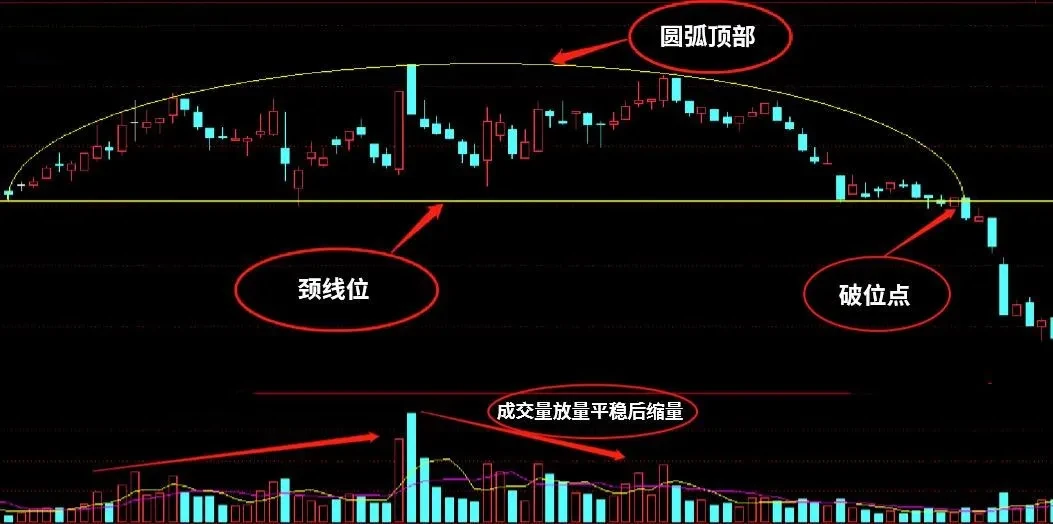
Basic Rounded Top Pattern
Institutions' impact on this halving cycle is much greater than before. The bull market started by institutions may last longer, like a mini version of the US stock market over the past decade.
Another phenomenon from institutional entry is that the market will gradually diversify, and universal rises will end. Institutional capital is mainly concentrated on mainstream and hot digital assets. As mentioned above, because most institutions don't pursue short-term interests, they focus more on long-term returns with a store-of-value orientation. As more institutions make such allocations and hold increasing amounts of Bitcoin, their style will become the market's style.
As above, due to the "inertia" of institutional capital, the previous situation where Bitcoin would rise and then have a spillover effect leading other digital assets to rise universally may become less common, because institutional capital will settle in mainstream digital assets represented by Bitcoin for longer periods without circulating in the short term, making the strong stronger and the weak weaker.
In fact, this crypto market rally since October has already reflected this phenomenon: While Bitcoin and Ethereum broke historical highs, most digital assets didn't show much performance, instead following this decline and falling even harder, even lower than the "5.19" low point.
The current market, after continuous decline, has begun to oscillate and recover. For the future market, it's hard to predict how it will go. But with central banks represented by the Federal Reserve still printing money, digital assets represented by Bitcoin are gaining increasing recognition and acceptance from the world, and the entire industry's ecosystem is becoming more complete and rich with the prosperity of DeFi, the breakout of NFTs, the explosion of metaverse, etc. These are all reasons for us to remain cautiously optimistic about the future.
Finally, this article is for reference only and does not constitute investment advice. The market involves risks, so please be cautious when entering.
Conclusion
Where will the market go from here? In what form will it appear? Different people may have different views, but the key is to have your own specific logic, and the generation of this logic requires specific and effective technical analysis and data indicators. Among these, K-line knowledge is the most fundamental means of investment analysis and a skill that every ambitious investor must master.
Disclaimer
This article may contain product-related content not applicable to your region. This article is intended only to provide general information and is not responsible for any factual errors or omissions herein. This article represents only the author's personal views and does not represent OKX's views. This article is not intended to provide any advice, including but not limited to: (i) investment advice or investment recommendations; (ii) offers or solicitations to buy, sell, or hold digital assets; or (iii) financial, accounting, legal, or tax advice. Holding digital assets (including stablecoins) involves high risk, may fluctuate significantly, and even become worthless. You should carefully consider whether trading or holding digital assets is suitable for you based on your financial situation. For questions about your specific situation, please consult your legal/tax/investment professional. The information appearing in this article (including market data and statistics, if any) is for general reference only. Although we have taken all reasonable precautions in preparing these data and charts, we assume no responsibility for any factual errors or omissions expressed herein. © 2025 OKX. This article may be reproduced or distributed in its entirety, or excerpts of 100 words or less from this article may be used, provided such use is non-commercial. Any reproduction or distribution of the entire article must also prominently state: "Copyright © 2025 OKX, used with permission." Permitted excerpts must cite the article title and include attribution, such as "Article Name, [Author Name (if applicable)], © 2025 OKX". Some content may be generated or assisted by artificial intelligence (AI) tools. Derivative works or other uses of this article are not permitted.
Show More
Recommended Reading
OKX Pay: Opening a New Era of Next-Generation Crypto Payments
The choice of tens of millions of users. Register with OKX to enjoy the ultimate trading experience and diverse wealth management products. A letter from OKX CEO Star: Today, we are officially launching the first version of OKX Pay to over 100 million global users. As the industry's first payment application to truly achieve non-custodial and compliant integration, OKX Pay will be embedded in the OKX App, currently available to some markets, and expected to fully launch within
March 22, 2026

New Chapter: Building Next-Generation Financial Infrastructure Together
OKX's partnership with Intercontinental Exchange (ICE) is an important moment for OKX and equally significant for the evolution of the entire digital asset market. ICE establishes and operates the world's most important financial infrastructure, including the New York Stock Exchange and global derivatives and clearing platforms. ICE's strategic investment in OKX and joining our board reflects both parties' shared belief—digital asset technology will play a crucial role in financial markets
March 10, 2026

Tribute to Another Year of Forging Ahead
As OKX's CEO and also a builder who never forgets the original intention, I proudly review OKX's extraordinary growth and progress this year. Despite many challenges, 2024 was a year filled with focus, innovation, and resilience. We not only expanded and optimized our products but also made important progress in launching transparent and compliant localized businesses, while further strengthening our global management team. Notably, after experiencing
January 29, 2026

2025: Steady Progress Toward Financial Freedom Together
— Annual letter from OKX Founder and CEO Star to global users "Financial freedom" is often misunderstood. It doesn't mean no rules, but rather having the right to choose even when rules exist—and when the system is truly tested, it remains reliable and effective. This is exactly what we've focused on throughout 2025. First, I want to extend my sincere gratitude to global customers, partners, and regulatory authorities
January 16, 2026

OKX Officially Launches in Germany and Poland
Author: Erald Ghoos, CEO of OKX Europe Today is significant for OKX—and equally for crypto users across Europe. We have officially launched our fully compliant centralized cryptocurrency trading platform in Germany and Poland! For us, this is not just a geographic expansion, but a commitment to building the cryptocurrency future the right way: secure, transparent, and meeting local needs. If you're in Germany
October 21, 2025

Partnership Upgrade! OKX Partners with Standard Chartered to Expand European Market
On October 15, OKX Europe CEO Erald Ghoos stated that OKX is expanding its strategic partnership with Standard Chartered to the European Economic Area (EEA). Earlier this year, OKX first partnered with Standard Chartered in the UAE to launch the collateral mirroring program—a
October 15, 2025