Who Is Selling Bitcoin Amid the Continued Weak Market Conditions?
As 2021 approaches its halfway point, the crypto market has experienced a rollercoaster of dramatic ups and downs over the past six months. Taking Bitcoin as an example, its price rose from $28,000 at the beginning of the year to a peak of $64,800, then retraced to a low of $29,000 over the course of just over a month. It is now trading above $36,000, representing a gain of approximately 28% since the start of the year, with a maximum amplitude of 131.4%. Correspondingly, Bitcoin's total market capitalization has fallen from $1.18 trillion to around $680 billion today, while Bitcoin's market dominance has dropped from a high of 77.11% to approximately 40%.
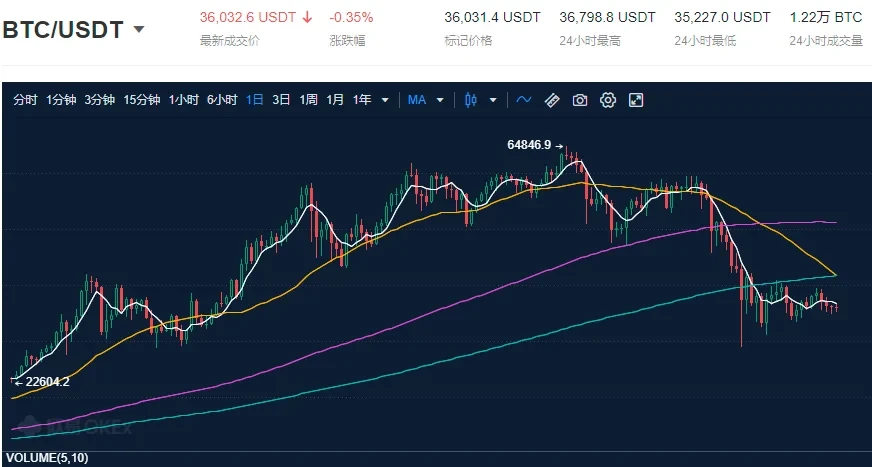
Bitcoin Price Trend Since 2021, Source OKX
When we focus on all this trading information, we often overlook the deeper market behaviors that drive these changes—the shifts in supply and demand (Note: In this article, supply and demand primarily refers to sellers and buyers in the secondary market, with mining output considered part of the supply). Simply put, it is the ebb and flow of power between buyers and sellers. Whether viewed as a crypto asset or as a commodity, Bitcoin's price movements are governed by the principles of supply and demand in economics. When supply exceeds demand, prices fall; when demand exceeds supply, prices rise. The greater the disparity between the two forces, the larger the price fluctuations.
If we apply the principles of supply and demand to look back at Bitcoin's sustained decline over the past month or so, a reasonable explanation is that a significant surplus of supply emerged during this period, while demand did not grow correspondingly. The next question is: where did this sudden increase in supply come from? In other words, who is selling Bitcoin?
In investment markets, traders decide to sell their holdings for three main reasons: first, they have accumulated substantial unrealized gains and choose to take profits when their psychological targets are met; second, when they perceive that downside risks outweigh opportunities, they choose to temporarily exit to preserve capital, switching to other hedging trades or waiting on the sidelines; third, when significant profit-taking exits cause sharp price volatility, latecomers are forced to sell to cut losses.
So, following this framework, let's examine which investors have been selling Bitcoin over the past six months?
First and foremost, Tesla deserves attention. Tesla CEO Elon Musk has undoubtedly been the most prominent "KOL" in the crypto market this year. With just a few tweets, he has been able to move Bitcoin prices by thousands of dollars—truly achieving both "fame" and "fortune."
On February 8 this year, Tesla mentioned in a filing with the U.S. SEC that it "planned to purchase $1.5 billion worth of Bitcoin." Following this announcement, Bitcoin's price surged from $38,800 to $48,200 that day, successfully setting a new all-time high. A month later, on March 24, Tesla's U.S. website announced support for Bitcoin payments, and Bitcoin rose over 10% again that day. However, Musk quickly "changed sides." On May 12, Musk posted on Twitter that Tesla was suspending its plan to accept Bitcoin payments, citing "Bitcoin mining is not environmentally friendly" as his reason for rejection. Within two hours, Bitcoin's price plummeted by nearly $10,000.
Musk's reversal was not without warning. Just half a month before announcing Tesla's suspension of Bitcoin payments, on April 27, Tesla CFO Zachary Kirkhorn stated that the company had sold 10% of its Bitcoin holdings in Q1, generating $272 million in revenue and realizing a profit of $101 million from the trade. According to calculations by Odaily, Tesla's average cost basis for Bitcoin was approximately $34,239. After selling 10% of its holdings, Tesla still held 38,873 Bitcoin. As for whether Tesla sold any Bitcoin in Q2, unless Musk voluntarily discloses this information, we will have to wait for Tesla's Q2 earnings report to find out.
Besides Tesla, UK asset management firm Ruffer is another institutional investor that recently proactively disclosed its Bitcoin sale. According to The Times, the company believes that pandemic lockdowns are ending and young people will not spend as much time trading Bitcoin, leading them to choose to sell. Ruffer's Investment Director Hamish Baillie stated that the firm invested approximately $600 million in Bitcoin in November 2020. "In December and early January, when Bitcoin's price doubled, we made some profits for our clients. We actively managed our position, and by April when we sold our final Bitcoin holdings, total profits were slightly above $1.1 billion."
Another representative institutional investor is Grayscale. The Grayscale Bitcoin Trust (GBTC) was the first crypto asset trust company to report to the U.S. SEC and one of the few companies providing compliant channels for hedge funds, endowments, pension funds, and family wealth management offices to invest in Bitcoin. Therefore, the amount of capital flowing into GBTC serves as an indicator of institutional interest in the crypto market. When capital inflows decrease, it reflects institutional divestment. According to Glassnode data, GBTC's attractiveness to incremental funds began to decline significantly after February 2021.
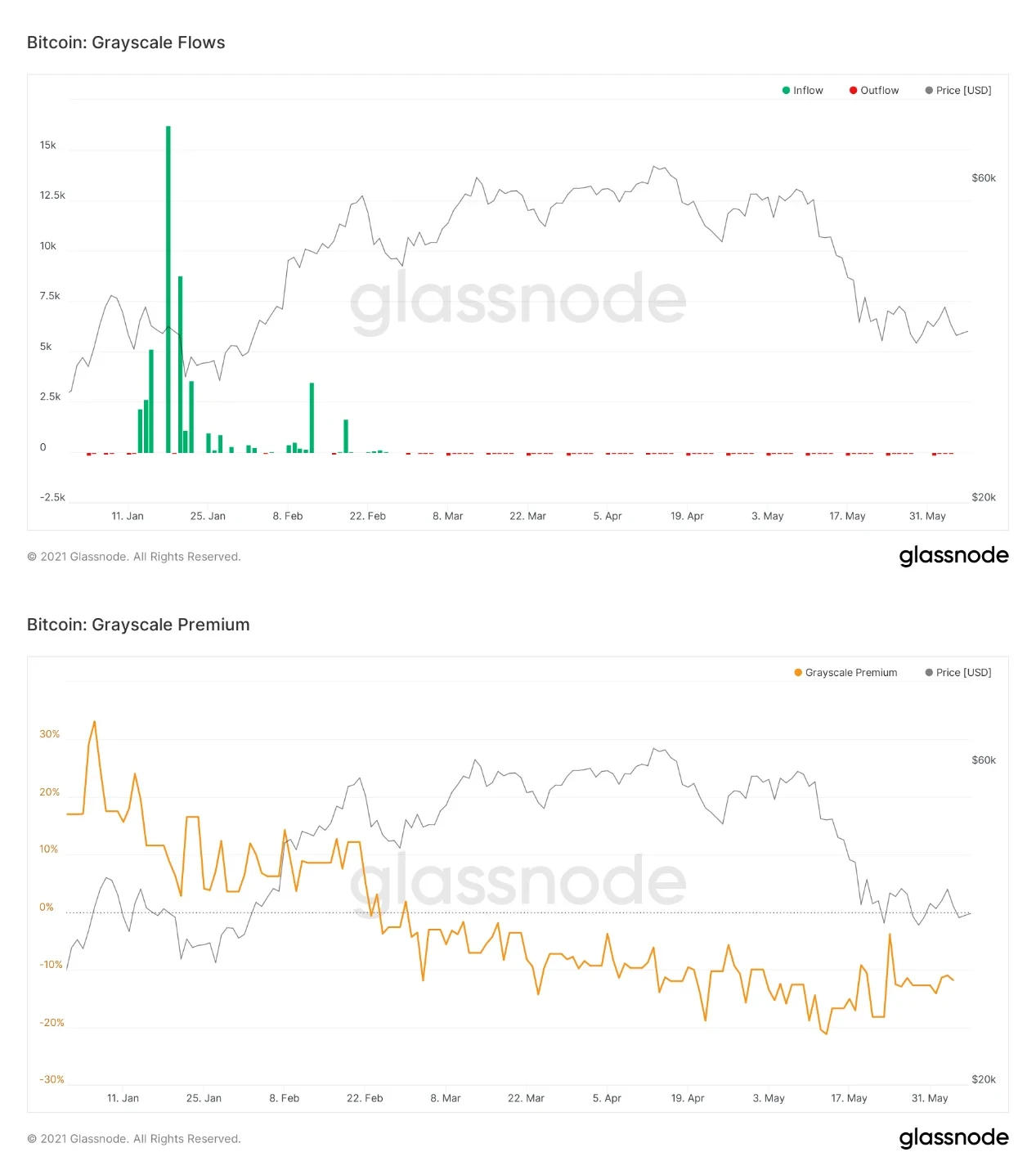
GBTC Fund Inflows and Premium in 2021, Source Glassnode
Generally, when GBTC begins trading at a negative premium to its net asset value (NAV), capital inflows stop. As can be seen from the chart above, GBTC's premium was as high as 30% at the beginning of this year, but the latest Glassnode chart shows the current GBTC premium at -11.40%. This indicates that a significant portion of early institutional investors holding GBTC shares have chosen to sell after their GBTC positions unlocked.
In addition to these institutional investors who have already reaped substantial profits, there are also signs of retail investors selling Bitcoin recently. On May 24, Morgan Creek founder Anthony Pompliano tweeted: "On-chain metrics overwhelmingly show that smaller, risk-averse Bitcoin holders are selling to those who have been in the Bitcoin space for years. Weak newcomers are selling Bitcoin to strong long-term buyers."
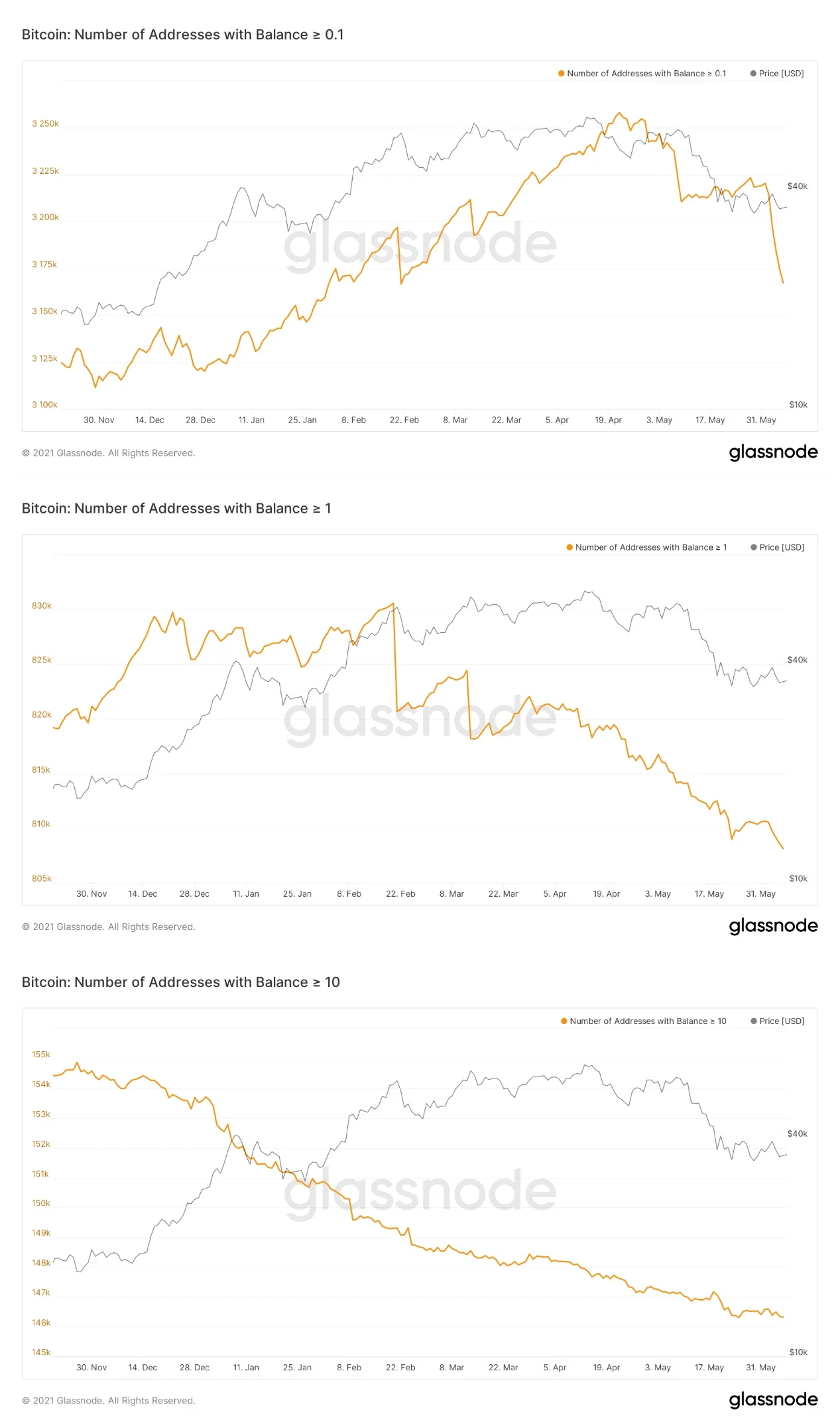
Changes in Addresses Holding >0.1/1/10 BTC in 2021, Source Glassnode
Glassnode's data on the number of addresses holding more than 0.1/1/10 BTC also appears to support Anthony Pompliano's view. As can be seen from the chart above, the number of addresses holding more than 0.1 BTC reached a peak of 3.25 million on April 22 and has since declined to 3.16 million today, returning to February levels. The number of addresses holding more than 1 BTC currently stands at only 808,000, well below the 820,000 at the beginning of the year. The number of addresses holding more than 10 BTC has shown a consistent downward trend in 2021, currently at only 146,000, a decrease of approximately 10,000 from the beginning of the year.
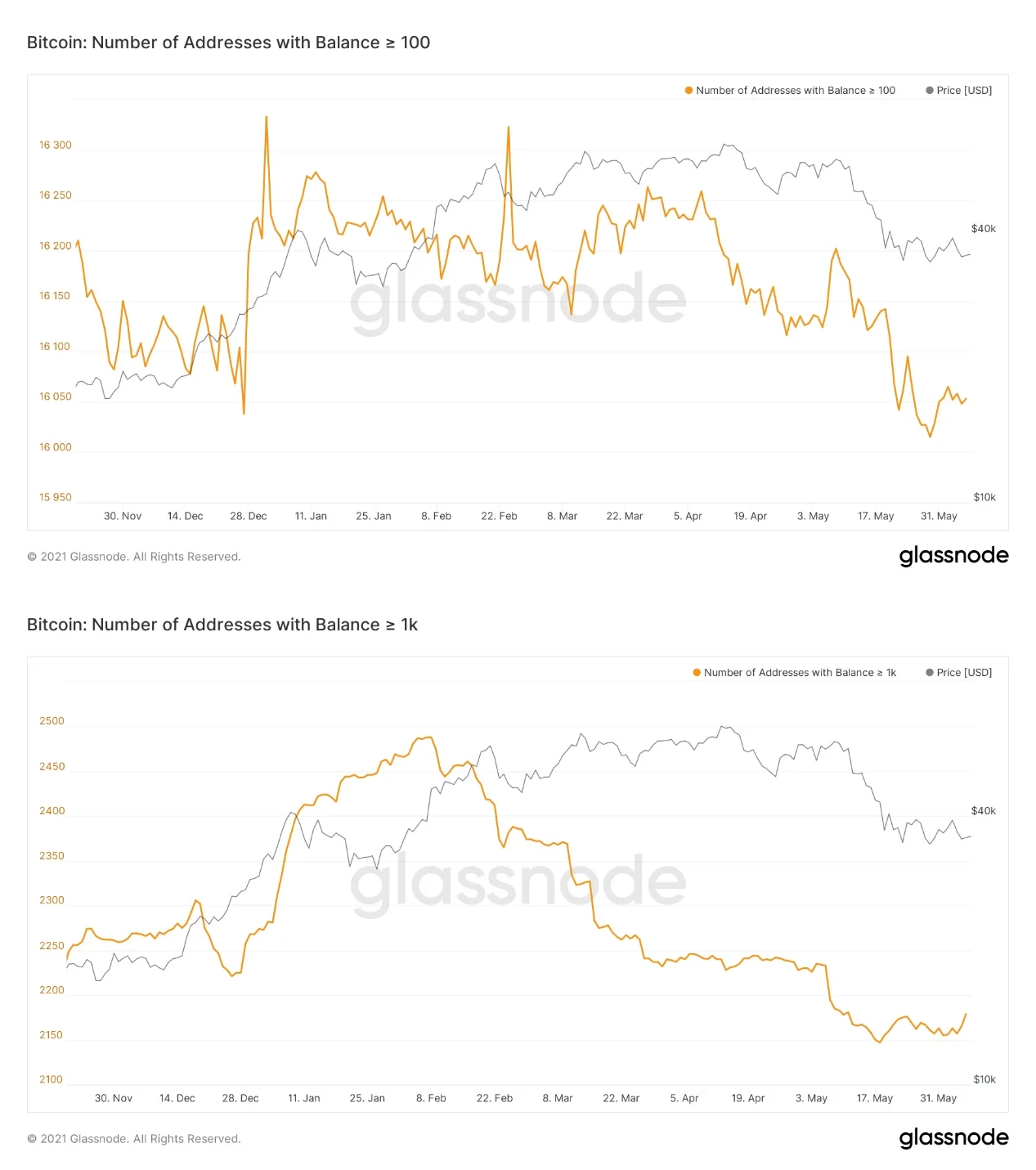
Changes in Addresses Holding >100/1000 BTC in 2021, Source Glassnode
Meanwhile, the number of addresses holding 100/1000 BTC has shown a slow upward trend after hitting a new low last week. Based on rough estimates, at least 100,000 Bitcoin have completed their transfer from retail investors to long-term investors during this period.
From the charts above, we can also interpret another piece of information: while numerous corporations and institutional investors including Tesla and Ruffer have been reducing their Bitcoin holdings, there is a mysterious force continuously buying Bitcoin in the secondary market. This also reflects that there remains significant disagreement in the current crypto market regarding future direction—those bearish on the market have chosen to take profits and exit, while those bullish continue to buy. However, one thing is certain: after 12 years of continuous development, Bitcoin has made substantial progress in terms of liquidity and risk resilience, and will play an even greater bridging role between the traditional world and the crypto world in the future.
Disclaimer
This article may contain content related to products that are not available in your region. This article is dedicated to providing general information only and is not responsible for any factual errors or omissions. This article represents only the author's personal views and does not represent the views of OKX. This article is not intended to provide any of the following advice, including but not limited to: (i) investment advice or investment recommendations; (ii) an offer or solicitation to buy, sell, or hold digital assets; or (iii) financial, accounting, legal, or tax advice. Holding digital assets (including stablecoins) involves high risk and may fluctuate significantly or even become worthless. You should carefully consider whether trading or holding digital assets is suitable for you based on your financial situation. For questions regarding your specific circumstances, please consult your legal/tax/investment professionals. The information appearing in this article (including market data and statistics, if any) is for general reference purposes only. Although we have exercised all reasonable care in preparing this data and these charts, we assume no responsibility for any factual errors or omissions expressed herein. © 2025 OKX. This article may be reproduced or distributed in its entirety, and excerpts of 100 words or less may also be used, provided such use is non-commercial. Any reproduction or distribution of the entire article must also prominently state: "Copyright © 2025 OKX, used with permission." Permitted excerpts must cite the article title and include attribution, such as "Article Title, [Author Name (if applicable)], © 2025 OKX." Some content may be generated or assisted by artificial intelligence (AI) tools. No derivative works or other uses of this article are permitted.
Show More
Recommended Reading
OKX Pay: Ushering in a New Era of Next-Generation Crypto Payments
The choice of tens of millions of users. Register with OKX to enjoy an exceptional trading experience and diverse wealth management products. A letter from OKX CEO Star: Today, we officially launch the first version of OKX Pay to over 100 million global users. As the industry's first payment application to truly achieve the integration of non-custodial and compliance, OKX Pay will be embedded within the OKX App and is currently available in select markets, with a full rollout expected within months.
March 22, 2026

A New Chapter: Building Next-Generation Financial Infrastructure Together
The partnership between OKX and Intercontinental Exchange (ICE) is a significant moment for OKX and equally profound for the evolution of the entire digital asset market. ICE builds and operates the world's most important financial infrastructure, including the New York Stock Exchange and global derivatives and clearing platforms. ICE's decision to invest in OKX and join our board reflects our shared belief that digital asset technology will play a significant role in financial markets.
March 10, 2026
To Another Year of Building
As CEO of OKX and a builder who remains true to my original aspirations, I am proud to reflect on the extraordinary growth and progress OKX has achieved this year. Despite numerous challenges, 2024 was a year of focus, innovation, and resilience. We not only expanded and optimized our products but also made important progress in launching transparent, regulation-compliant localized businesses, while further strengthening our global management team. Notably, after experiencing...
January 29, 2026

2025: Steady Progress Toward Financial Freedom
— Year-End Letter from OKX Founder and CEO Star to Global Users. "Financial freedom" is often misunderstood. It does not mean the absence of rules, but rather having the right to choose even when rules exist—and when the system is truly tested, it remains reliable and effective. This is what we have remained focused on throughout 2025. First, I would like to extend my sincere gratitude to our customers, partners, and regulators worldwide.
January 16, 2026

OKX Officially Launches in Germany and Poland
Author: Erald Ghoos, CEO of OKX Europe. Today is a significant day for OKX—and for crypto users across Europe. We have officially launched a fully compliant centralized cryptocurrency trading platform in Germany and Poland! For us, this is not just a geographic expansion, but a commitment to building the future of cryptocurrency the right way: secure, transparent, and tailored to local needs. If you are in Germany...
October 21, 2025

Partnership Upgrade! OKX Collaborates with Standard Chartered to Expand in Europe
On October 15, Erald Ghoos, CEO of OKX Europe, announced that OKX is extending its strategic partnership with Standard Chartered to the European Economic Area (EEA). Earlier this year, OKX first partnered with Standard Chartered in the UAE to launch a collateral mirroring program—a...
October 15, 2025