Grayscale Applies to Convert Bitcoin Trust to ETF — Where Will the Market Go Next?
Recently, Grayscale submitted a filing to the US SEC, revealing its intention to convert its Bitcoin Trust into an ETF (Exchange-Traded Fund), with the timing of the conversion dependent on the regulatory environment.
Since Bitcoin's rebound in early March, there hasn't been much market movement. According to OKX data, Bitcoin is currently quoted at approximately $57,000, still within the consolidation range.
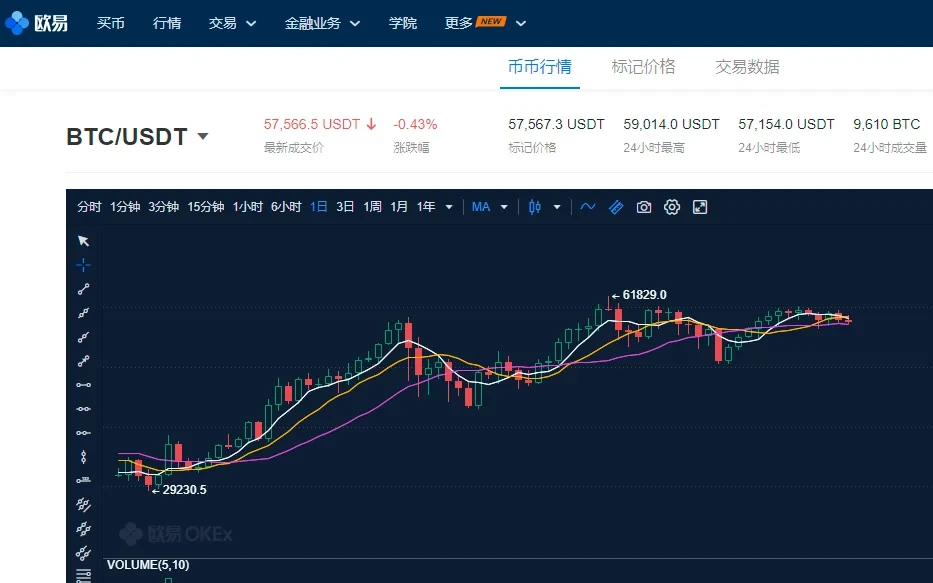
(Bitcoin price trend, Source: OKX)
While Bitcoin's price action has been uneventful, there has been undercurrents in the broader market with continuous news flow. Last week, CME announced plans to launch new Micro Bitcoin futures contracts on May 3 (with a contract size of one-tenth of a Bitcoin). This week's focus is on Grayscale's plan to convert its Bitcoin Trust into an ETF.
In fact, Grayscale first submitted a Bitcoin ETF application to the SEC in 2016, but after dialogue with the SEC in 2017, Grayscale withdrew the application, citing that the regulatory environment for digital assets had not yet developed to the point where such a product could be successfully brought to market. When we connect these two applications, we can extract a great deal of information — today, let's discuss this topic together.
Who Is Grayscale?
Grayscale was founded in 2013, and that same year launched GBTC, pioneering the model of providing digital asset exposure to investors in the form of securities, without the need to purchase, store, or custody digital assets.
With GBTC, Grayscale became the first company in the US to launch a publicly traded Bitcoin fund, and the first and only institution to convert a Bitcoin fund into an SEC reporting company. These pioneering achievements brought greater transparency, regulatory clarity, and reporting standards to the investment community.
Although Grayscale has been established for 8 years, it was not until 2020 that it became widely known to the public due to market development and regulatory reasons. Looking at Grayscale's growth trajectory, it can be roughly divided into the following three phases:
**Exploration Phase: 2013–2016.** The Bitcoin Trust was its only product. In 2014, the non-redeemable clause was established. In 2015, GBTC was listed on the OTC market, connecting the primary and secondary markets. During this period, assets under management were small, growing by only $700 million;
**Development Phase: 2017–2019.** Nine new products were added, and assets under management increased by $2.6 billion;
**Rising Phase: Post-2020.** On one hand, compliance reached a higher level — the Bitcoin Trust and Ethereum Trust became SEC reporting companies, and the lock-up period for primary market subscription shares was reduced from 12 months to 6 months. On the other hand, both fund inflows and assets under management doubled.
How Does Grayscale's Bitcoin Trust Work?
Most of us have heard that Grayscale entered the crypto space through a trust fund model, but the underlying operational rules may not be entirely clear. Before discussing Grayscale's conversion of its Bitcoin Trust to an ETF, it is necessary to first understand how Grayscale currently operates its Bitcoin Trust fund.
First, the subscription mechanism. Grayscale's Bitcoin Trust accepts subscriptions from investors in two forms: cash subscription and in-kind subscription (BTC).
In the cash subscription model, investors submit subscription funds to Grayscale, which directs an authorized broker to purchase BTC in the spot market, then deposits it with a custodian for cold storage, while simultaneously issuing Bitcoin Trust shares (GBTC) of equivalent value to the investors.
In the BTC in-kind subscription model, investors transfer BTC to Grayscale, which deposits the BTC with a partner custodian, while simultaneously issuing GBTC shares of equivalent value to the investors.
The cash subscription portion flows into the spot market at the time of subscription, while the in-kind subscription portion may bring funds back to the spot market after the 6-month lock-up period ends.
Second, the redemption mechanism. Since October 28, 2014, Grayscale's Bitcoin Trust has suspended its redemption mechanism, and currently does not allow share redemptions. In the future, the trust sponsor may decide to implement a redemption mechanism upon obtaining SEC regulatory approval, but Grayscale currently has no intention of submitting a redemption plan to the SEC.
Third, the lock-up period. In January 2020, the Bitcoin Trust officially became an SEC reporting company, and the lock-up period was reduced from 12 months to 6 months. Shares subscribed in the primary market can be freely transferred after 6 months.
Additionally, Grayscale charges an annual management fee of 2%, which is not low compared to newer competitors. In our previous article "Day 24 of GBTC Negative Premium: Has the 'Grayscale Bull' Bowed Its Head?", we provided a detailed comparison, which will not be repeated here. Interested readers may refer back to it.
According to OKlink data, Grayscale currently manages 13 single-asset trust funds and one diversified fund containing mainstream coins, with a current total value of $45.856 billion.
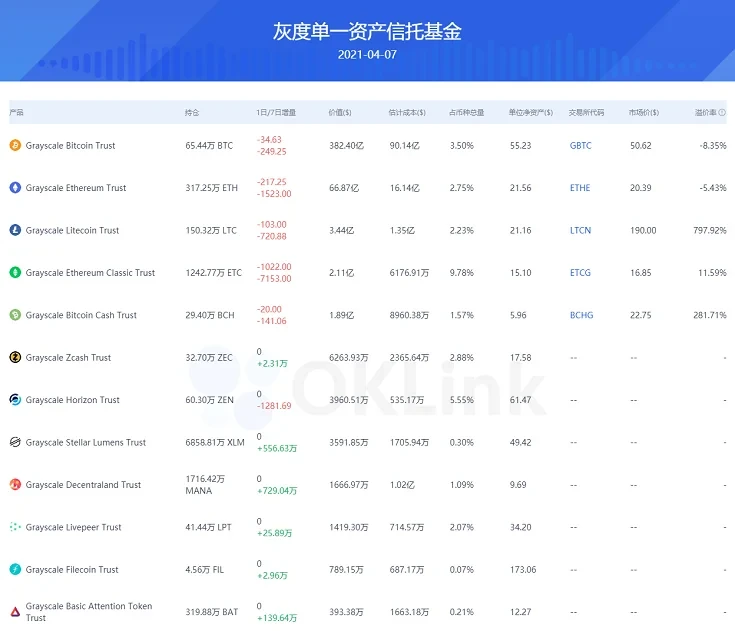
(Grayscale single-asset trust products, Source: OKlink)
Additionally, there are 20 registered but not yet officially launched trust products.
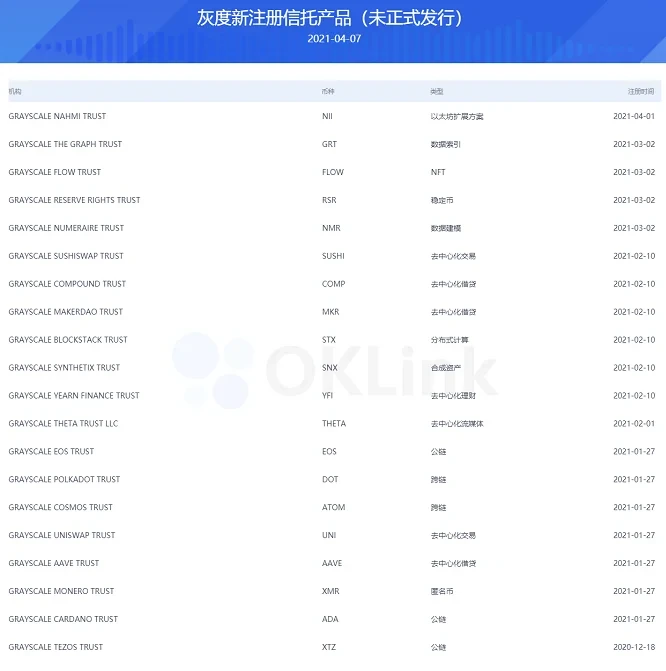
(Grayscale newly registered trust products, Source: OKlink)
Sustained Market Cap Growth and Negative Premium
Thanks to its early-mover advantage and the tailwind of the bull market, the market value of Grayscale's trusts has risen significantly in recent years. Looking at the Bitcoin Trust fund alone, its market cap has grown from $4.9 billion at the end of August 2020 to the current $38.1 billion, a gain of 677%.
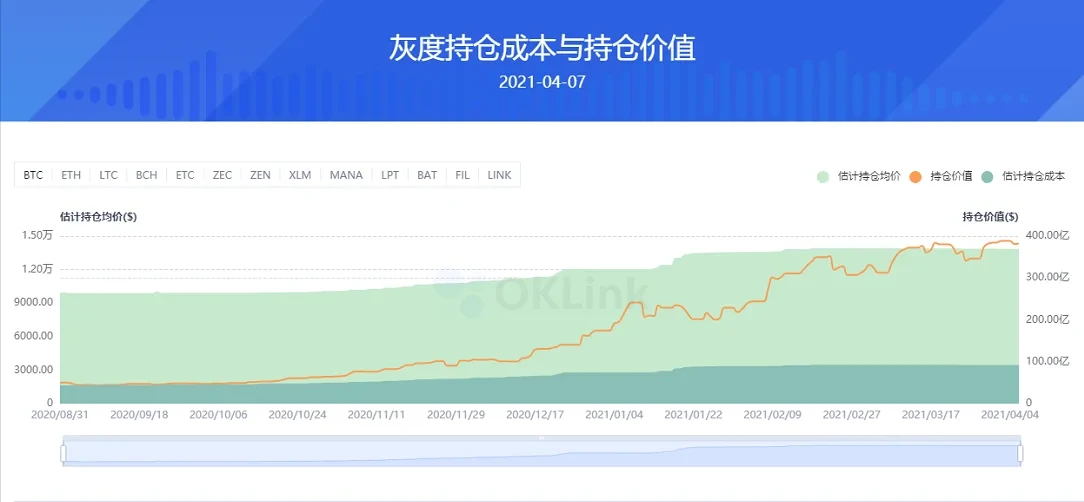
(Grayscale Bitcoin Trust holdings value, Source: OKlink)
The flip side of this massive market cap growth is that over the past month, GBTC's premium rate in the secondary market has remained consistently negative. Particularly on March 24 of this year, the premium rate once reached -14.34%. Regarding the reasons for the negative premium, the most straightforward explanation is that the supply of GBTC in the secondary market has exceeded demand. Simply put, GBTC has become less attractive. Further analyzing this, the reason is that within Grayscale's trust model, the arbitrage mechanism cannot function effectively, and the market is speculative — investment conviction does not work here, so smart capital will naturally seek better investment avenues.
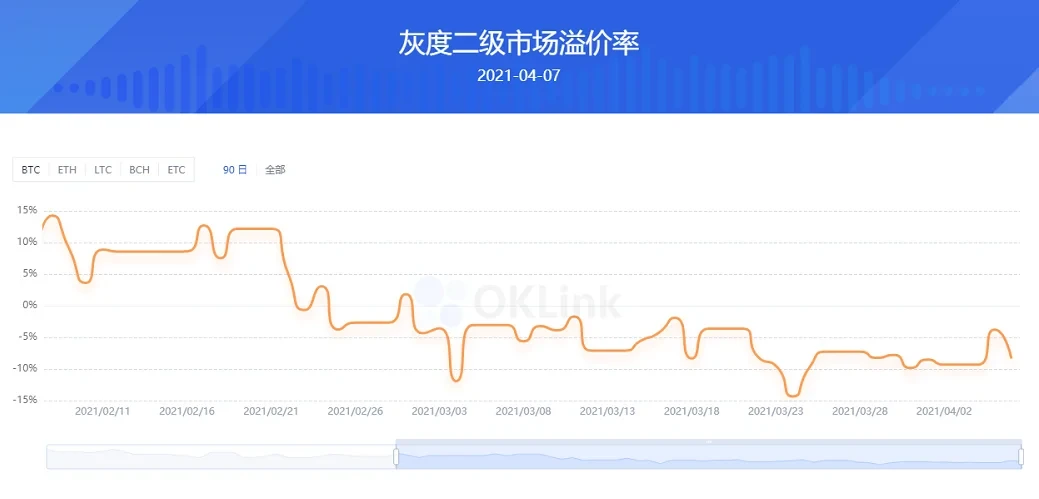
(Grayscale GBTC secondary market premium rate, Source: OKlink)
"Watch him build his towers, watch him host his guests, watch his towers crumble." Although Grayscale is currently the largest Bitcoin trust fund in the market, in the rapidly developing field of digital asset investment, being "large" is both an advantage and potentially a shackle on transformation. As the saying goes: a big fish may not necessarily eat a small fish, but a fast fish will always eat a slow fish.
Converting to ETF: Grayscale's Path to Self-Redemption
Grayscale's GBTC is a trust fund product similar to an ETF, allowing subscriptions on the primary market and trading on the secondary market simultaneously. This mechanism generates two types of prices: real-time net asset value (NAV) and real-time market price. Grayscale's GBTC allows accredited investors to subscribe for GBTC shares with cash or Bitcoin, but the shares can only be sold on the secondary market after a 6-month lock-up period.
When GBTC first started trading at a negative premium, some in the market believed the same situation would occur with ETFs — everyone was in the same boat, so there was no need to worry excessively. But in reality, Grayscale's trust and traditional ETFs are completely different.
In traditional financial market ETFs, shares subscribed on day one can typically be sold the same day or the next day. Therefore, when NAV exceeds market price, investors buy ETF shares on the secondary market and redeem them at NAV at any subsequent time, thereby capturing the arbitrage.
When market price exceeds NAV, investors first subscribe and then arbitrage on the secondary market.
However, GBTC's lock-up period is as long as six months, which means if Bitcoin plummets after purchase, investors cannot sell and can only watch their assets depreciate.
Let me provide a brief summary here, and we can see the necessity and urgency of Grayscale's transformation:
1. ETFs allow market makers to freely create and redeem shares; GBTC does not allow redemptions, and share liquidation must be conducted through secondary market trading.
2. GBTC has a 6-month lock-up period, typically resulting in high premiums. ETFs have better liquidity and typically do not exhibit premiums or discounts.
3. GBTC trading fees are high, involving broker fees, annual management fees, and additional premium costs. Bitcoin ETF fees are lower, some at 1% or even lower (0.4%).
4. GBTC has high investment barriers, starting at $50,000, and is only open to accredited investors. Bitcoin ETFs have fewer restrictions on investor qualifications and investment amounts.
At the beginning of this article, we also mentioned that Grayscale submitted its first Bitcoin ETF application in 2016, and later, after dialogue with the SEC, withdrew its application with the reasoning that "the regulatory environment for digital assets had not yet developed to the point where such a product could be successfully brought to market." Looking back now, Grayscale's resubmission of the Bitcoin ETF application also carries the implication that "the regulatory environment for digital assets has now developed to the point where Bitcoin ETF can be successfully brought to market."
Especially in February 2021, Canadian regulators approved North America's first Bitcoin ETF. This Bitcoin ETF from Purpose Investments achieved $165 million in trading volume on its first day and broke through the $1 billion asset management milestone within a month, holding 14,086.295 BTC. The warming of the external environment may prompt the US SEC to relent, which can be interpreted as one inevitable reason driving Grayscale's transformation application.
However, another point that needs to be made clear is that even if the SEC approves Grayscale's Bitcoin ETF application, Grayscale's dominance will be far less than before. Once the SEC opens this gate, it will inevitably approve a相当一批 already-submitted similar applications. At that point, the current "one dominant player" landscape will very likely evolve into a "multiple strong players" landscape. But clearly, such a landscape would be a healthier situation for institutional investors, retail investors, and the digital assets industry alike.
Disclaimer: Digital asset trading involves significant risk. This material should not be used as a basis for investment decisions, nor should it be construed as investment or trading advice. Please ensure you fully understand the risks involved and trade cautiously. OKX Academy provides information for reference only, and does not constitute any investment advice. All investment activities by users are unrelated to this site.
Disclaimer
This article may contain product content not applicable to your region. This article is committed to providing general information only and is not responsible for any factual errors or omissions. This article solely represents the author's personal opinions and does not reflect OKX's views. This article is not intended to provide any advice, including but not limited to: (i) investment advice or investment recommendations; (ii) offers or solicitations to buy, sell, or hold digital assets; or (iii) financial, accounting, legal, or tax advice. Holdings in digital assets (including stablecoins) involve high risk and may fluctuate significantly, or even become worthless. You should carefully consider whether trading or holding digital assets is appropriate for you based on your financial situation. For questions specific to your circumstances, please consult your legal/tax/investment professionals. The information in this article (including market data and statistics, if any) is provided for general reference only. Although we have taken all reasonable precautions in preparing such data and charts, we assume no responsibility for any factual errors or omissions expressed herein. © 2025 OKX. This article may be reproduced or distributed in its entirety, or excerpts of 100 words or less may be used, provided that such use is non-commercial. Any reproduction or distribution of the full article must prominently state: "This article is copyrighted © 2025 OKX, used with permission." Permitted excerpts must cite the article title and include attribution, e.g., "Article Title, [Author Name (if applicable)], © 2025 OKX". Some content may be generated or assisted by artificial intelligence (AI) tools. Derivative works or other uses of this article are not permitted.
Show More
Recommended Reading
OKX Pay: Ushering in the Next Generation of Crypto Payments
The choice of tens of millions of users. Register with OKX and enjoy an exceptional trading experience along with a diverse range of wealth management products. From a letter by OKX CEO Star: Today, we officially launch the first version of OKX Pay to over 100 million global users. As the industry's first payment application to truly achieve non-custodial and compliant integration, OKX Pay will be embedded within the OKX App and is currently available in select markets, with a full global rollout expected within months.
March 22, 2026

A New Chapter: Building the Next Generation of Financial Infrastructure Together
The partnership between OKX and the Intercontinental Exchange (ICE) marks a significant moment for OKX and is equally momentous for the evolution of the entire digital assets market. ICE builds and operates the world's most critical financial infrastructure, including the New York Stock Exchange and global derivatives and clearing platforms. This investment by ICE Select in OKX and its joining of our board reflects our shared conviction — that digital assets technology will reshape financial markets.
March 10, 2026
Celebrating Another Year of Relentless Building
As CEO of OKX and a builder who never forgets the original mission, I take great pride in looking back on the extraordinary growth and progress OKX has achieved this year. Despite challenges, 2024 was a year filled with focus, innovation, and resilience. We not only expanded and optimized our products, but also made significant progress in launching transparent and regulation-compliant localized businesses, while further strengthening our global management team. It is worth noting that after experiencing
January 29, 2026

2025: Steady Progress Toward Financial Freedom
— Year-End Letter from OKX Founder & CEO Star to Global Users "Financial freedom" is often misunderstood. It does not mean the absence of rules, but rather having the freedom to choose — even in the presence of rules — and when the system is truly put to the test, it remains reliable and effective. This is precisely what we focused on throughout 2025. First, I would like to express sincere gratitude to our global customers, partners, and regulators.
January 16, 2026

OKX Officially Launches in Germany and Poland
By Erald Ghoos, CEO of OKX Europe Today is a significant day for OKX — and for crypto users across Europe. We have officially launched a fully compliant centralized cryptocurrency exchange in Germany and Poland! For us, this is not just a geographic expansion, but a commitment to building the future of cryptocurrency the right way: secure, transparent, and tailored to local needs. If you are in Germany
October 21, 2025
Partnership Upgrade! OKX and Standard Chartered Join Forces to Expand into Europe
On October 15, Erald Ghoos, CEO of OKX Europe, stated that OKX is expanding its strategic partnership with Standard Chartered to the European Economic Area (EEA). Earlier this year, OKX first partnered with Standard Chartered in the UAE to launch a collateral mirroring program — this was a
October 15, 2025