Why the Crypto Market Anticipates a Bitcoin ETF
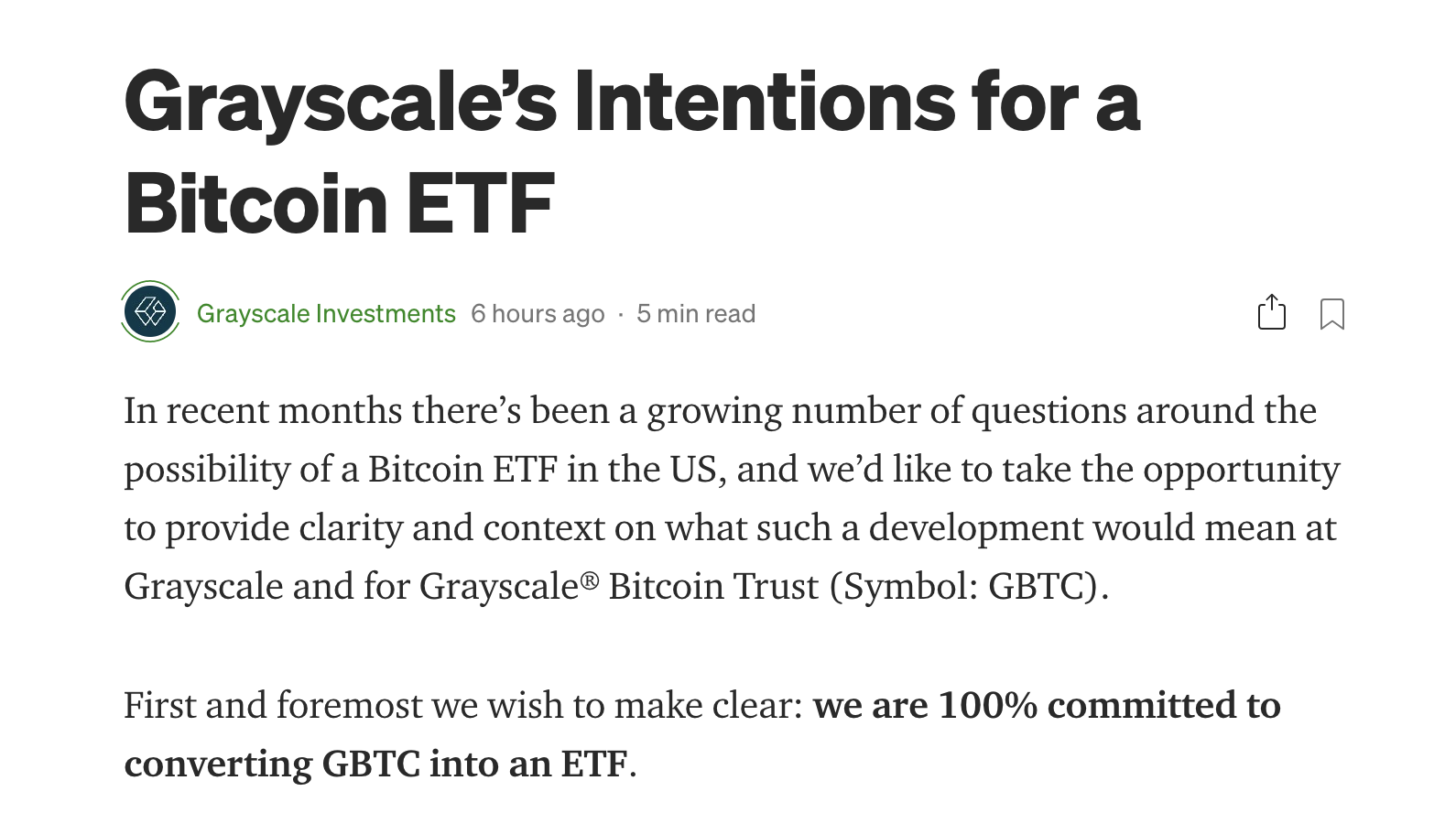
Last week, Grayscale, the world's largest digital asset management company, announced that they are committed to converting GBTC (Grayscale Bitcoin Trust) into an ETF. The news immediately reignited market attention and discussion around Bitcoin ETFs.
What is a Bitcoin ETF? Why did Grayscale apply to convert its GBTC to a Bitcoin ETF? Why has the U.S. SEC consistently refused to approve Bitcoin ETFs? What impact would a Bitcoin ETF approval have on the market? Addressing the most highly discussed questions in the current market, we will provide an in-depth yet accessible analysis in this article.
What is a Bitcoin ETF?
First, let's understand ETFs—the full name is Exchange-Traded Fund. It is an open-end fund with variable fund shares that trades on exchanges. In traditional financial markets, it is already a very mature trading product. It combines the operational characteristics of closed-end funds and open-end funds: investors can both subscribe to and redeem fund shares, while also being able to buy and sell ETF shares on the secondary market at market prices like closed-end funds. However, subscriptions and redemptions must be exchanged for fund shares with a basket of stocks or exchanged for a basket of stocks with fund shares.
Similarly, a Bitcoin ETF simply replaces the trading underlying in traditional financial market ETF products with Bitcoin. The slight difference is that traditional ETFs typically simulate a diversified investment portfolio or asset index that ordinary investors may find difficult to construct and maintain at low cost, while Bitcoin ETFs only track the price of Bitcoin as a single crypto asset.
Frequently Rejected Bitcoin ETF Applications
In fact, institutions and individual investors have been submitting Bitcoin ETF applications to the U.S. SEC for a long time. As early as 2013, the concept of Bitcoin ETFs was already proposed. In 2016, the Winklevoss brothers were the first to apply to the U.S. SEC to issue a Bitcoin ETF, followed by more than a dozen subsequent applications. The Grayscale mentioned above is not the first to submit a similar application to the SEC; also in 2016, Grayscale submitted a Bitcoin ETF application, which was later withdrawn after communication with the SEC. According to incomplete statistics, in the following years, multiple institutions including Solid X, VAN Eck, Exchange Listed Funds Trust, Proshares BTC ETF, First Trust, Direxion, and Bitwise Bitcoin ETF submitted Bitcoin ETF applications to the U.S. SEC, but none were approved.
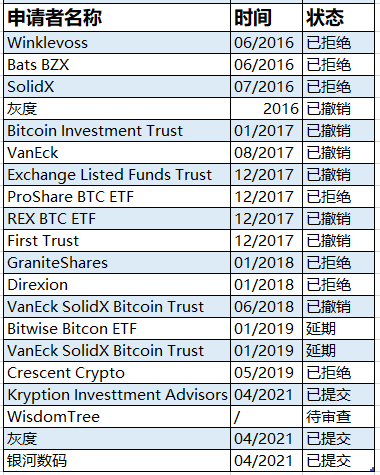
(Partial ETF application records from 2016-2021, source: diar.co, OKX diagram)
Currently in the market, there are already multiple Bitcoin trust trading products including Grayscale, providing safe and compliant investment channels to qualified investors. However, with the further development of the crypto market, trading underlyings like GBTC clearly cannot meet the practical needs of investors. This can be seen from the GBTC negative premium we have been monitoring.
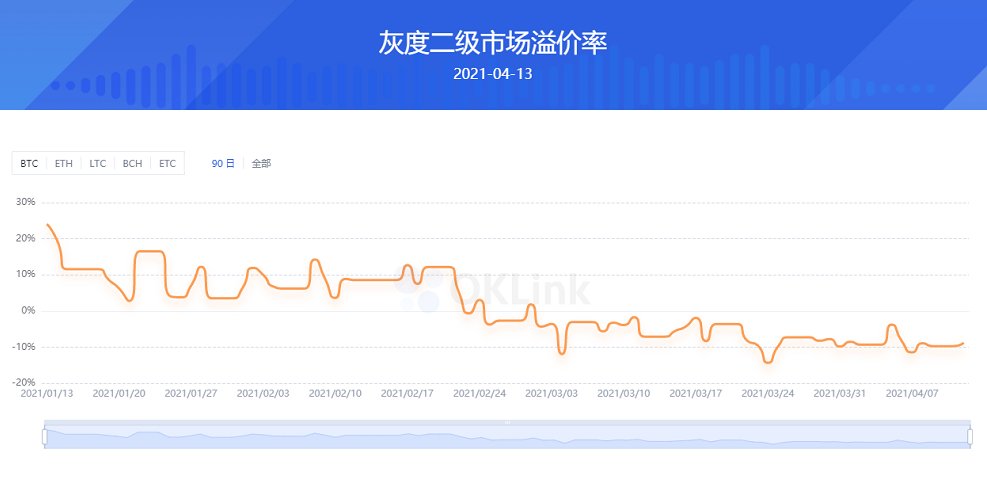
(GBTC premium rate in secondary market, source: OKlink.com)
From statistics compiled by OKlink, as of April 13, GBTC has sustained a negative premium in the secondary market for 44 consecutive days. The reasons, apart from increased competition from similar products, include the high investment threshold of "GBTCs," lock-up periods lasting several months, and insufficient liquidity—these are urgent issues to resolve. After all, in any investment market, trading convenience and fund utilization efficiency are issues that investors care greatly about. In this context, the crypto market and professional investors' demand for Bitcoin ETFs appears increasingly urgent.
Why the U.S. SEC Has Not Approved Bitcoin ETF Applications
Above we listed partial records of Bitcoin ETF applications submitted to the U.S. SEC over the past 5 years. Among the initiators were celebrities like the Winklevoss brothers and top industry players like CBOE, but none passed.
Among the rejection reasons given by the SEC that we have seen so far, concerns about potential Bitcoin price manipulation are their greatest focus and worry. Then-U.S. SEC Chairman Jay Clayton stated in June 2019, "Price manipulation is a potential issue that the SEC is concerned about."
Crescent Crypto Asset Management co-founder Christopher Matta also discussed this issue: "While rejecting other ETFs, the SEC has consistently emphasized wanting to see a large-scale regulated market, including surveillance sharing agreements to monitor manipulation activities."
At the same time, the SEC acknowledges that investors can indeed obtain an additional layer of protection by trading Bitcoin products based on exchanges.
In 2018, in the SEC's rejection letter to Granite Shares, it stated, "Compared to unregulated Bitcoin spot trading markets, trading Bitcoin ETFs on national securities trading venues may provide some additional protection for investors, but the Commission must consider this potential benefit while considering whether the proposal meets every applicable requirement of trading laws."
In short, the U.S. SEC's attitude can be summarized as: I want to protect the general public of ordinary investors, and I also want to bring Bitcoin ETF products under my regulatory scope, but you need to show me that you are worthy of being regulated.
Of course, regarding the U.S. SEC's attitude of rejecting all applicants, there are also many critical voices. Its Commissioner Hester stated bluntly in an interview: "The move to block Bitcoin ETFs harms both investors and innovators."
However, with Jay Clayton departing from the SEC last month, and market participant enthusiasm continuing to rise, people seem to have new expectations for Bitcoin ETF approval.
If a Bitcoin ETF is Approved, What Impacts Will It Bring?
While the U.S. SEC has kept a tight grip on Bitcoin ETF approvals, its neighbor Canada approved the first North American Bitcoin ETF last month. This Bitcoin ETF under Purpose Investments achieved $165 million in trading volume on its first day and broke through $1 billion in assets under management after one month, currently holding 14,086.295 BTC.
Comparing the influence of the U.S. and Canada, we can optimistically speculate that once the U.S. SEC approves a Bitcoin ETF, it will undoubtedly open a new door for the crypto world, providing more investors with more convenient channels to invest in Bitcoin. Here, it's worth reviewing the trend after the gold ETF launch as a reference to estimate Bitcoin's future direction.
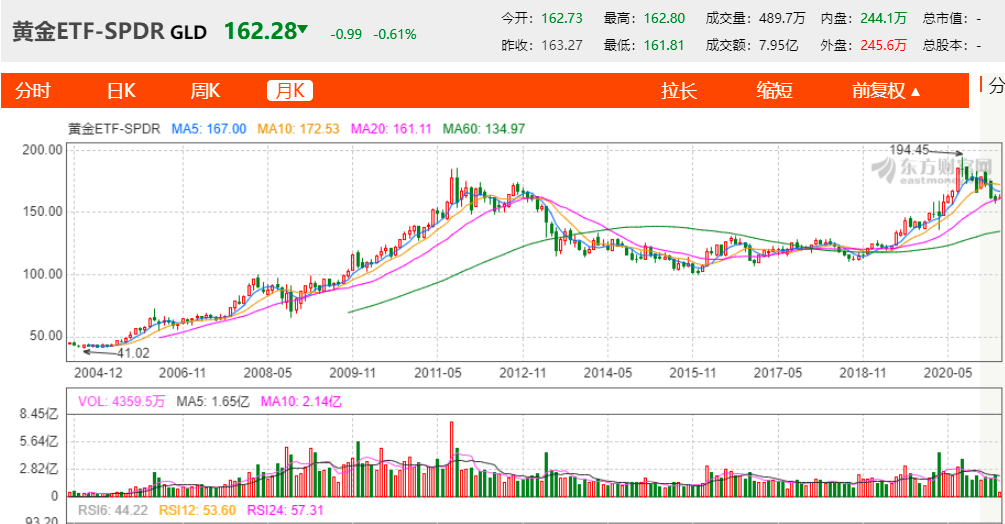
(2004-2020 SPDR Gold ETF trend, source: East Money)
SPDR Gold ETF is the world's largest gold ETF fund, managed by World Gold Trust Services and State Street Global Advisors, listed for trading on the New York Stock Exchange in November 2004. It was the first exchange-traded security in the U.S. with commodities as the primary asset. Since listing, it began a 7-year unilateral upward trend.
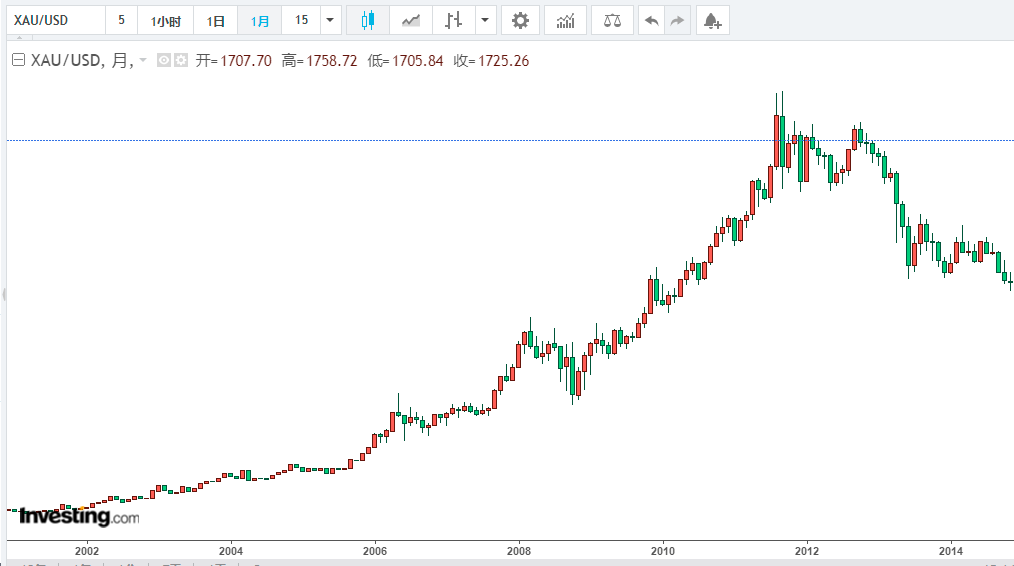
(2002-2014 Gold spot price trend, source: Investing.com)
During the same period, gold spot prices also rose from $270 to $1,900, an increase of 603%. Of course, the surge in gold prices during this period mainly benefited from the globally upward economic cycle at that time, but it remains undeniable that the launch of SPDR Gold ETF made a considerable contribution to the rise in gold prices.
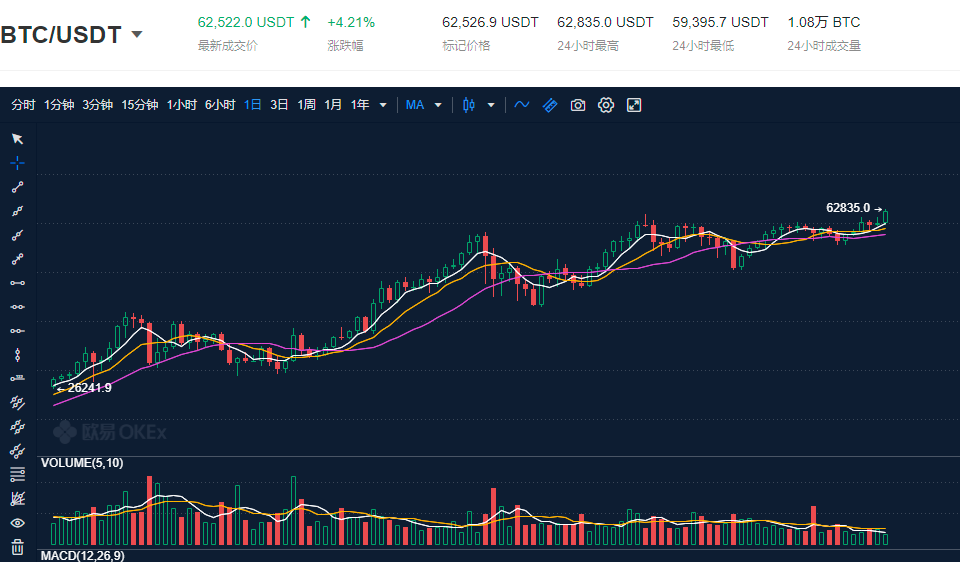
As of the time of writing, the Bitcoin quote on the OKX platform is $62,522, reaching a new all-time high. Let's take this time as a new starting point. In a few years, when we look back, we will see whether Bitcoin ETF listing in the future can lead the crypto market to demonstrate the momentum gold showed back then.
Of course, today when we discuss Bitcoin ETFs, we must not simply look at their potential impact on Bitcoin prices, but should examine this historical moment from a higher dimension.
First, if a Bitcoin ETF is approved, it will help stabilize the crypto market. According to current U.S. law, the SEC will be able to comprehensively regulate Bitcoin ETFs under the 1933 Securities Act, 1934 Securities Trading Act, and 1940 Investment Company Act:
The 1940 Act prescribes a series of investor protection measures, including restrictions on related transactions, restrictions on leverage, board independence, and segregated regulation of fund assets, making mutual funds and Bitcoin ETF products after listing in the U.S. subject to the constraints of the most strictly regulated 1940 Act.
Second, if a Bitcoin ETF is approved, it will provide protection for more traditional investors who lack understanding of crypto assets, thereby expanding the scope of the investor population. Due to Bitcoin's special nature, if improperly managed, Bitcoin is difficult to recover. Therefore, investing in Bitcoin through ETFs avoids this risk, which can attract more institutional investors to invest in Bitcoin and is also beneficial for cryptocurrency community development. Additionally, by directly converting Bitcoin into traditional assets through ETFs, institutional investors do not need to understand Bitcoin's complex concepts, allowing them to indirectly invest in Bitcoin through familiar stock trading platforms.
Finally, if a Bitcoin ETF is approved, it will greatly promote liquidity in the crypto market, further stabilizing the market. Earlier we mentioned Bitcoin ETF advantages compared to GBTC in liquidity and trading thresholds—investors can subscribe to ETF shares on the first day and choose to sell the next day. So, when the net value exceeds the market price, investors buy ETFs in the secondary market and redeem at net value price at any subsequent time, thereby arbitraging. When the market price exceeds net value, investors first subscribe, then arbitrage in the secondary market. The substantial increase in market participants will bring better liquidity experiences and greatly increase Bitcoin's market value, while rising Bitcoin market value will in turn act on market stability, forming a virtuous cycle.
Discussing this issue to this point, we actually no longer need to overly focus on when the SEC will approve Bitcoin ETF applications. More importantly, before that, we need to establish a complete infrastructure and further improve its stability to ensure more investors can smoothly enter this market.
As Bloomberg ETF expert Eric Balchunas said, SEC approval of Bitcoin ETFs is just a matter of time: "I think this is just an SEC issue. Once they change their minds, I think it will happen quickly."
Disclaimer: Digital asset trading involves significant risk. This material should not serve as the basis for investment decisions, nor should it be interpreted as advice to engage in investment trading. Please ensure you fully understand the risks involved and invest cautiously. OKX Academy only provides information for reference and does not constitute any investment advice. All user investment activities are unrelated to this site.
Disclaimer
This article may contain content related to products that are not applicable in your region. This article only aims to provide general information and is not responsible for any factual errors or omissions therein. This article only represents the author's personal views and does not represent OKX's views. This article intends to provide no advice, including but not limited to: (i) investment advice or investment recommendations; (ii) offers or solicitations to purchase, sell, or hold digital assets; or (iii) financial, accounting, legal, or tax advice. Holding digital assets (including stablecoins) involves high risk and may fluctuate significantly or even become worthless. You should carefully consider based on your financial situation whether trading or holding digital assets is suitable for you. For questions about your specific situation, please consult your legal/tax/investment professionals. Information appearing in this article (including market data and statistics, if any) is for general reference only. Although we have taken all reasonable care in preparing these data and charts, we assume no responsibility for any factual errors or omissions expressed herein. © 2025 OKX. This article can be fully reproduced or distributed, or excerpts of 100 words or less from this article can be used, provided such use is non-commercial. Any reproduction or distribution of the entire article must prominently state: "Copyright © 2025 OKX, used with permission." Permitted excerpts must cite the article name and include attribution, such as "Article Name, [Author Name (if applicable)], © 2025 OKX." Some content may be generated or assisted by artificial intelligence (AI) tools. Derivative works or other uses of this article are not permitted.
Show More
Recommended Reading
OKX Pay: Opening a New Era of Next-Generation Crypto Payments
The choice of tens of millions of users. Register with OKX to enjoy an ultimate trading experience and diverse wealth management products. A letter from OKX CEO Star: Today, we officially launch the first version of OKX Pay to over 100 million global users. As the industry's first payment application to truly integrate non-custodial and compliant features, OKX Pay will be embedded in the OKX App and is currently open to select markets, expected to fully open within a few
March 22, 2026

New Chapter: Building Next-Generation Financial Infrastructure Together
OKX's partnership with Intercontinental Exchange (ICE) is an important moment for OKX and equally significant for the evolution of the entire digital asset market. ICE establishes and operates the world's most important financial infrastructure, including the New York Stock Exchange and global derivatives and clearing platforms. This ICE selection to invest in OKX and join our board of directors reflects our shared belief—digital asset technology will play a role in financial markets
March 10, 2026

Tribute to Another Year of Moving Forward
As OKX's CEO, and as a builder who remains true to original aspirations, I proudly review the extraordinary growth and progress OKX achieved this year. Despite numerous challenges, 2024 was still a year filled with focus, innovation, and resilience. We not only expanded and optimized products but also made important progress in launching transparent and regulatory-compliant localized operations, while further strengthening the global management team. Worth mentioning is that after experiencing
January 29, 2026

2025: Steady Progress Toward Financial Freedom Together
— OKX Founder and CEO Star's Year-End Letter to Global Users "Financial freedom" is often misunderstood. It doesn't mean no rules, but rather having the right to choose while rules exist—and when the system truly faces tests, it remains reliable and effective. This is exactly the direction we consistently focused on in 2025. First, I want to express sincere gratitude to global clients, partners, and regulatory agencies
January 16, 2026

OKX Has Officially Launched in Germany and Poland
Author: Erald Ghoos, OKX Europe CEO Today is significant for OKX—and for crypto users across Europe as well. We have officially launched a fully compliant centralized cryptocurrency trading platform in Germany and Poland! For us, this is not just a geographic expansion, but a commitment to building the cryptocurrency future in the right way: safe, transparent, and meeting local needs. If you are in Germany
October 21, 2025

Partnership Upgrade! OKX Joins Hands with Standard Chartered to Expand European Markets
On October 15, OKX Europe CEO Erald Ghoos stated that OKX is extending its strategic partnership with Standard Chartered to the European Economic Area (EEA). Earlier this year, OKX first partnered with Standard Chartered in the UAE to launch a collateral mirroring program—this is a
October 15, 2025