Total crypto asset market cap shrinks by nearly half - has the market bubble been cleared?
July is already halfway through, and summer momentum is strong in the Northern Hemisphere. In contrast, the crypto assets market forms a sharp contrast with the hot summer. Since Bitcoin prices hit a new high on April 14, the entire crypto market has experienced two significant declines on April 18 and May 19, as well as a three-month downtrend of "one step forward, two steps back," which has severely impacted investor sentiment. Over three months, Bitcoin prices fell from a high of $64,846.9 to below $29,000 at their lowest, currently maintaining around $32,000, a decline of over 50%.
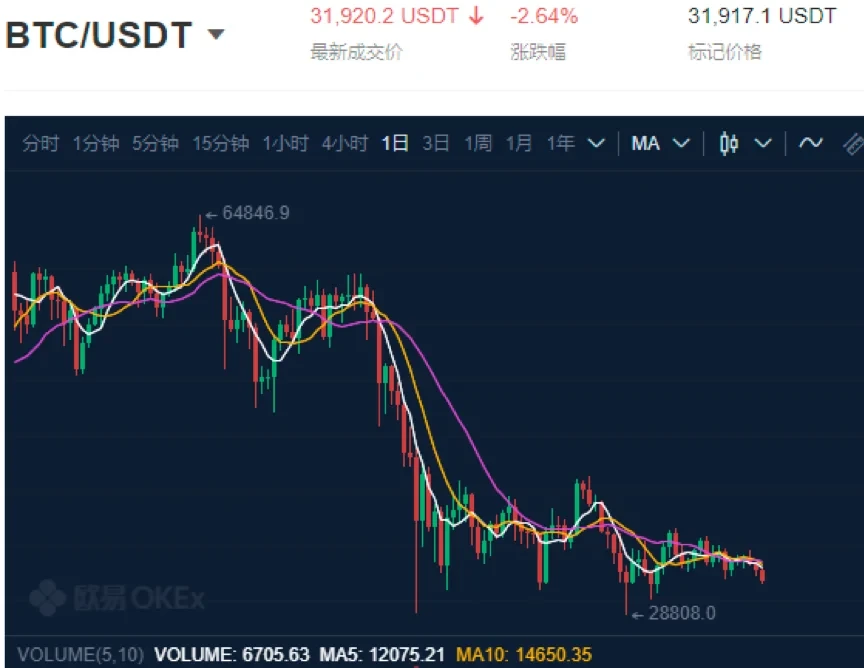
Recent Bitcoin price trend, source OKXOKX
Meanwhile, the total market cap of the crypto market has also shrunk from $2.56 trillion to the current $1.37 trillion, a decline of nearly 50%.
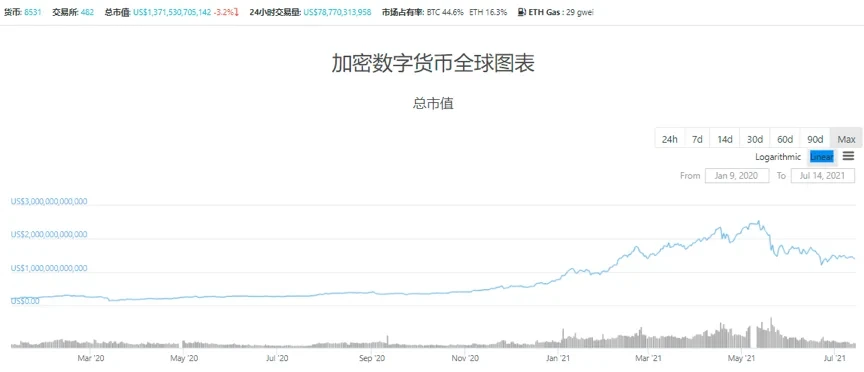
Change in total crypto asset market cap, source coingecko
In this "endlessly declining" market, discussions about "how big is the crypto asset market bubble?" and "will Bitcoin prices fall further" are naturally topics of great interest to those following this industry.
In the following content, we will discuss the emergence and subsequent evolution of the "crypto market bubble" that everyone is concerned about, as well as the impact of the "bubble."
What is the "Crypto Market Bubble"
In fact, the concept of "bubble" is a very vivid expression in modern economic society. If we explore further, its economic principles can be traced back to the most basic "commodity prices fluctuate around value." We know that the price of any commodity is based on its value, but in an open market, most of the time, commodity prices often cannot be equated with their value, but rather fluctuate cyclically around their value. When a commodity's price is higher than its fair market value, we can say a "bubble" has appeared, and the greater the price exceeds the value, the larger the "bubble."
The crypto market bubble we refer to here also follows this economic principle. Since Bitcoin holds an absolutely dominant position in the crypto market, we generally use the Bitcoin Bubble Index (BBI) as an indicator to measure the overall bubble level of the crypto market.
This index is compiled by Chai Next based on Metcalfe's Law and related theories, estimating the reasonable value of public chains through the number of active addresses to determine the current market bubble level, providing market participants with a new perspective on understanding market operating patterns. The bubble index trend range is 0-100, with 0 representing completely undervalued, 100 representing completely bubbly, and 50 representing reasonable valuation. It's worth mentioning that Metcalfe's Law was proposed in the 1980s by Robert Metcalfe, the inventor of ethernet (a computer local area network technology, not Ethereum — author's note). This theory states that the sum of connections between any two nodes in a communication network is the triangular number n(n − 1)/2, thus proportional to the square of the number of nodes. In the 40 years since, this theory has been confirmed by relevant cases and quickly became one of the bases for internet company valuation. As Bitcoin gradually developed and grew, applying Metcalfe's Law to Bitcoin valuation also gradually became market consensus.
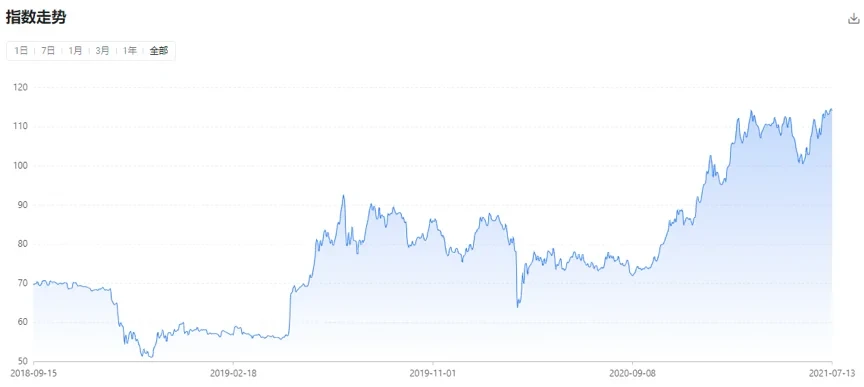
Bitcoin bubble index trend over the past three years, data source Chai Next, screenshot from qkl123
After introducing Metcalfe's Law and the principle behind the Bitcoin bubble index, let's return to today's topic. According to this index, today's Bitcoin bubble index is 113.88, far exceeding the upper limit of 100, meaning that if we follow the rules mentioned above, current Bitcoin prices are still in a completely bubbly state. Looking at a longer timeframe, over the past three years, the Bitcoin bubble index's low point appeared in late December 2018, when the lowest point was 51.19, then hovered between 51-93 for more than 2 years, until breaking through 100 on January 6, 2021, then rising steadily, currently still maintaining high levels.
How Does the "Crypto Market Bubble" Grow?
If we look at the Bitcoin bubble index trend chart above in stages, while also referencing Bitcoin's price changes in the secondary market, we can intuitively discover some interesting patterns, making it relatively easy to answer the question in the subheading: the growth and contraction of the "crypto market bubble" is closely related to the inflow and outflow of funds in this market. Specifically:
First stage: From Q3 2018 to Q1 2019, these 6 months were the period when market funds accelerated outflow and the market gradually bottomed out after the 2017 bull market peak. Off-market incremental funds stopped, and on-market存量 funds flowed out almost completely. Bitcoin prices fluctuated between $3,100 and $5,000, and the total crypto market cap fell to a minimum of $102.7 billion. Correspondingly, the Bitcoin bubble index was also in the low range of 50-70.
Second stage: From Q2 2019 to Q2 2020, as platforms like OKXOKX launched new coin trading models like Jumpstart, attracting a new round of funds to enter, while on-market funds also became active. Bitcoin prices rose from $5,000 to around $14,000 at one point, and the total crypto market cap once again broke through $300 billion from $102.7 billion. During this period, except for the extreme market conditions in March 2020 when global financial market liquidity dried up causing a massive short-term fund exodus, the Bitcoin bubble index basically stabilized between 70-93.
Third stage, from Q3 2020 to present, can be described as having perfect timing, location, and human harmony. On-market, stimulated by many hot topics like the Bitcoin halving effect and "DeFi Summer," off-market, authoritative compliance channels represented by Grayscale and MicroStrategy opened a crazy "buy buy buy" mode. The enthusiasm of various investors in the market was quickly ignited, and the speed of incremental funds entering was unprecedented. Bitcoin prices rose rapidly from around $10,000 to $65,000, and the total crypto market cap also rose all the way, reaching a historical high of $2.56 trillion. Unsurprisingly, the Bitcoin bubble index also rose rapidly from 72 to around 120, with the "bubble" growing at a visible speed.
In short, crypto asset bubbles are the fruit, fund flows are the cause, and the Bitcoin bubble index is a reference tool for us to intuitively observe this process. Next, let's go a step further and look at what factors have promoted the massive inflow of off-market funds into the crypto market since Q3 2020, especially after entering 2021, thereby blowing up the "bubble."
First and foremost is the impact of massive "money printing" by the world's major economies, represented by the United States. According to media reports, on the evening of January 14 local time, US President-elect Biden announced through a television speech a $1.9 trillion stimulus plan before officially taking office; at the end of March, Biden again proposed a large-scale spending proposal, announcing a $2.25 trillion infrastructure and employment support package, plus subsequent bills including expanding Medicare and child tax credits, the total money printing scale of all bills exceeds $4 trillion. Through the following change in US money supply M2, we can more intuitively see the scale and intensity of the Federal Reserve's "money printing" over the past year.
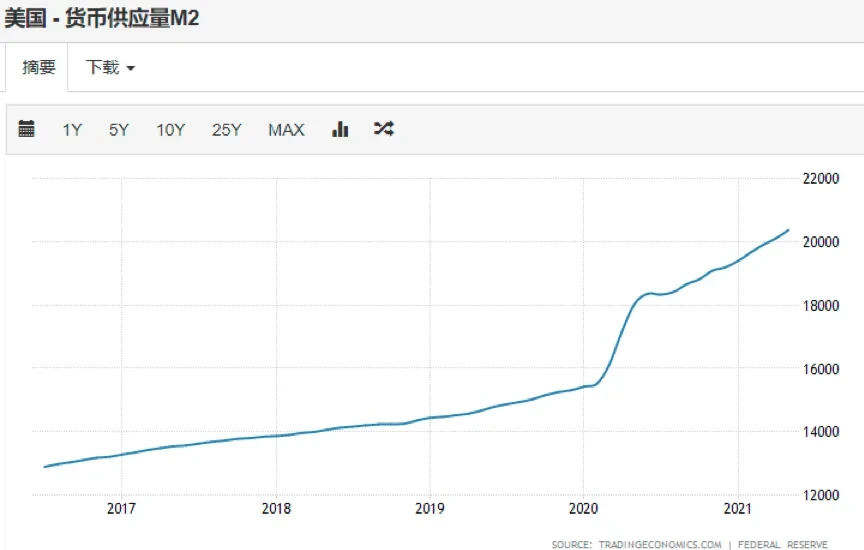
US money supply M2 change over the past four years (unit: billion USD), source tradingeconomics
Besides the United States, the EU's money supply has also grown significantly over the past year. According to Sina Finance news, on the evening of December 10, 2020 Hong Kong time, the European Central Bank announced interest rate decisions and the latest monetary policy. The European Central Bank maintained the three key interest rate levels unchanged, while adding another 500 billion euros to the 1.35 trillion euro emergency anti-epidemic bond purchase program, and extending it by at least 9 months to the end of March 2022. This means that before March 2022, 1.85 trillion euros in funds will flow into the market.
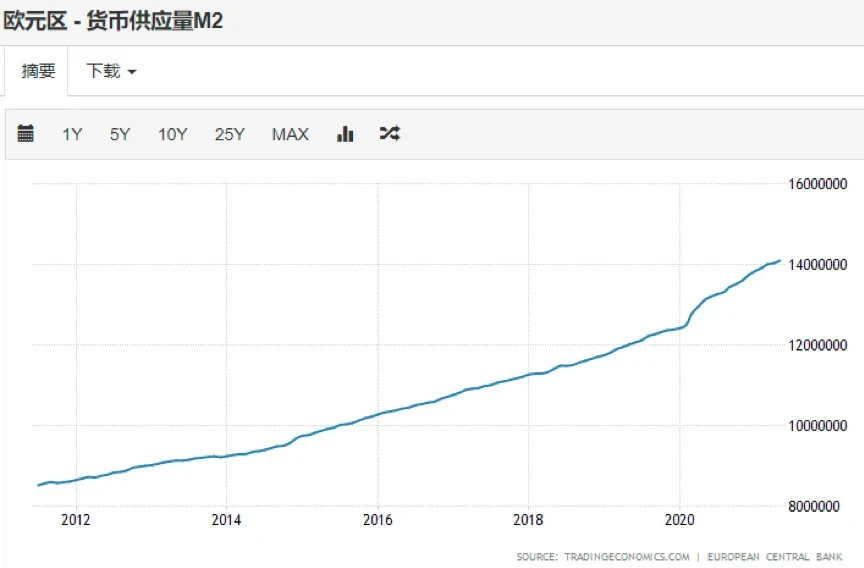
EU money supply M2 change over the past decade (unit: million euros), source tradingeconomics
Against this backdrop, after 2020, major global financial markets were stimulated by positive news and纷纷 showed a strong upward trend. As an emerging and dynamic investment market, the crypto market naturally can also get a significant share of this pie.
Secondly, looking from within the crypto market, unprecedented new situations have also emerged, the most representative of which is the rise of DeFi. With its open, free, and transparent operating mechanism, DeFi has opened a new door for investors to protect privacy and safely obtain stable returns to the greatest extent. This can be called a rare social financial practice in human history, naturally attracting and retaining a large amount of funds to participate. It can be said that the continuously improving infrastructure of the crypto market is a prerequisite for attracting funds to enter, and the massive inflow of off-market funds will undoubtedly further promote the evolution of crypto market infrastructure to a higher level.
The "Crypto Market Bubble" Is Not a Monster
In the minds of many investors, there are certain misconceptions about bubbles. When seeing a bubble appear in a market, they often avoid it like the plague, but this is actually unnecessary. History as a mirror, at the end of the 20th century and beginning of the 21st century when the internet emerged, there was also a "dot-com bubble" that affected financial markets in multiple countries across Europe, America, and Asia.
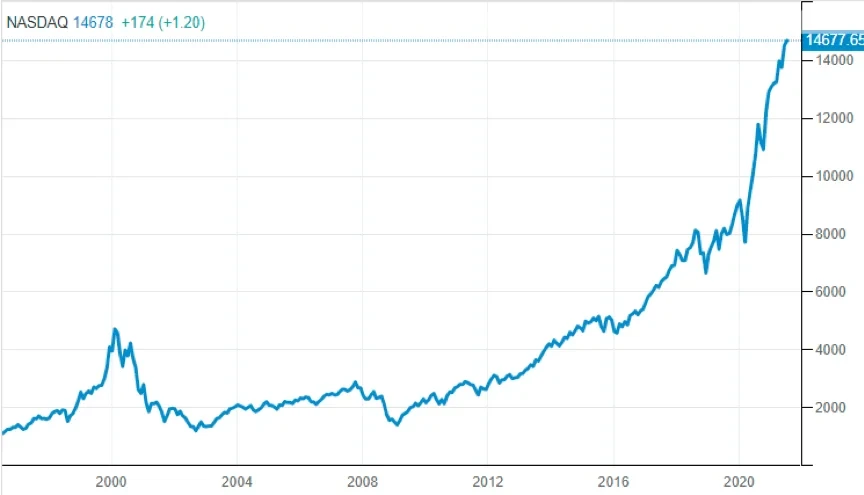
Nasdaq Composite Index trend over the past 25 years, source tradingeconomics
Looking at the Nasdaq Composite Index, which is dominated by tech stocks, from 1995 to 2000, the index experienced rapid growth, reaching a high of 5,132.52 points on March 10, 2000, more than double that of 1999. But soon, the "dot-com bubble" was burst, and the Nasdaq Composite Index fell all the way below 2,000 points over the following three years, with the market returning to calm. After experiencing 5 years of repair and exploration, in 2008, the internet finally welcomed a new explosion period, with the Nasdaq Composite Index rising from 2,200 points to 14,600 points. So during the quiet period from 2003 to 2008, what happened to the internet? From the perspective of latecomers, we know that during these 5 years, internet infrastructure made significant progress, whether from hardware configuration, such as bandwidth upgrades, device iteration and price reduction, or from software richness, etc., all created unprecedented conditions for more people to access and use the internet, and laid a solid foundation for the internet to move from the PC era to mobile internet.
Therefore, objectively speaking, the birth and development of an epoch-making new industry are often accompanied by bubbles, because behind funds is human nature driven by interests, making it difficult to be absolutely rational. When facing new things with huge potential, manic emotions will inevitably appear, and in this process, accompanied by massive fund inflows, it will also bring top-notch talent and technology from various fields to the emerging industry. Only under the joint promotion of funds, talent, and technology can emerging industries have the opportunity to achieve breakthrough progress in a short time, and have sufficient power to open up the situation when facing various obstacles. From the development history of the internet, we can find that the development of new things is never smooth sailing, and there will inevitably be various setbacks and difficulties. The alternating favorable and adverse circumstances in this process will be expressed through the size of the "bubble" we mentioned, but as long as practice can prove that this path is correct, then the discussion about bubbles seems not so important. The internet 20 years ago was like this, and the crypto market 20 years later is also like this.
Disclaimer
This article may contain product-related content not applicable to your region. This article is intended to provide general information only and is not responsible for any factual errors or omissions herein. This article represents only the author's personal views and does not represent the views of OKX. This article is not intended to provide any advice, including but not limited to: (i) investment advice or investment recommendations; (ii) offers or solicitations to buy, sell, or hold digital assets; or (iii) financial, accounting, legal, or tax advice. Holding digital assets (including stablecoins) involves high risk, may fluctuate significantly, and even become worthless. You should carefully consider whether trading or holding digital assets is suitable for you based on your financial situation. For questions about your specific situation, please consult your legal/tax/investment professional. The information appearing in this article (including market data and statistical information, if any) is for general reference only. Although we have taken all reasonable precautions in preparing these data and charts, we assume no responsibility for any factual errors or omissions expressed herein. © 2025 OKX. This article may be reproduced or distributed in full, or excerpts of 100 words or less from this article may be used, provided that such use is non-commercial. Any reproduction or distribution of the entire article must also prominently state: "Copyright © 2025 OKX, used with permission." Permitted excerpts must cite the article title and include the source, for example "Article Title, [Author Name (if applicable)], © 2025 OKX". Some content may be generated or assisted by artificial intelligence (AI) tools. Derivative works or other uses of this article are not permitted.
Show More
Recommended Reading
OKX Pay: Opening a New Era of Next-Generation Crypto Payments
The choice of tens of millions of users, register OKX, enjoy ultimate trading experience and diverse wealth management products. A letter from OKX CEO Star: Today, we officially launch the first version of OKX Pay to over 100 million global users. As the industry's first payment application to truly achieve non-custodial and compliant integration, OKX Pay will be embedded in the OKX App, currently available to some markets, expected to fully launch within months
March 22, 2026

New Chapter: Building Next-Generation Financial Infrastructure Together
OKX's partnership with Intercontinental Exchange (ICE) is an important moment for OKX and equally significant for the evolution of the entire digital assets market. ICE establishes and operates the world's most important financial infrastructure, including the New York Stock Exchange and global derivatives and clearing platforms. ICE's strategic investment in OKX and joining our board reflects both parties' shared belief — digital assets technology will transform financial markets
March 10, 2026

Tribute to Another Year of Forging Ahead
As CEO of OKX, and as a builder who never forgets the original intention, I am proud to look back on OKX's extraordinary growth and progress this year. Despite many challenges, 2024 was a year filled with focus, innovation, and resilience. We not only expanded and optimized our products, but also made important progress in launching transparent and regulatory-compliant localized businesses, while further strengthening our global management team. Notably, after experiencing
January 29, 2026

2025: Steady Progress Toward Financial Freedom Together
— Annual letter from OKX Founder and CEO Star to global users "Financial freedom" is often misunderstood. It doesn't mean no rules, but rather having the right to choose while rules exist — and when the system is truly tested, it remains reliable and effective. This is exactly what we focused on throughout 2025. First, I want to extend sincere gratitude to our global clients, partners, and regulatory authorities
January 16, 2026

OKX Officially Launches in Germany and Poland
Author: Erald Ghoos, CEO of OKX Europe Today is significant for OKX — and for crypto users across Europe. We have officially launched a fully compliant centralized cryptocurrency trading platform in Germany and Poland! For us, this is not just a geographic expansion, but a commitment to building the cryptocurrency future the right way: secure, transparent, and meeting local needs. If you're in Germany
October 21, 2025

Partnership Upgrade! OKX Partners with Standard Chartered Bank to Expand European Market
On October 15, Erald Ghoos, CEO of OKX Europe, stated that OKX is expanding its strategic partnership with Standard Chartered Bank to the European Economic Area (EEA). Earlier this year, OKX first partnered with Standard Chartered Bank in the UAE to launch the collateral mirroring program — a
October 15, 2025