Caught in the Russia-Ukraine Conflict: The Role and Impact of crypto assets
As of March 3, 2022, the war between Russia and Ukraine has entered its eighth day. Compared to the clarity of the war itself, numerous factors have joined both before and after the outbreak of this conflict, playing different roles and serving different functions, and these people and events have attracted even more attention than the war itself.
crypto assets have also been inevitably drawn into the Russia-Ukraine conflict, with both Russia and Ukraine, Western countries, and the crypto market itself forming a triangular game. This game is not only a tangible financial battle, but also an intangible battle of ideologies. This game and debate may bring something different to the future world financial and economic systems. For the crypto market itself, this may be a turning point or even a starting point, like newborn mammals beginning to embark on their own evolutionary path and completely changing the face of the entire biosphere.
As the world becomes increasingly flat and more of a "global village," the entire world has become animals on a "spider web," with rain and dust, just as the materialist development view states: the entire world is an organically interconnected whole. A butterfly flaps its wings, a hurricane rises, and then in turn affects the butterfly itself.
"The World's First Crypto War," What Role Will crypto assets Play?
Before the outbreak of the Russia-Ukraine war, crypto assets had already become tools in the confrontation between Russia and Ukraine. For example, Ukraine announced the legalization of crypto assets, while Russia restricted crypto assets to prevent capital outflow, among other measures. After the war officially began, crypto assets became deeply involved, whether as an emerging crowdfunding tool for war, a means of sanctions and anti-sanctions, or as a safe haven option. crypto assets and participants in the crypto market have all been actively or passively drawn into this war. The Washington Post even described the Russia-Ukraine war as "the world's first crypto war."
On the third day of the Russia-Ukraine war, February 26, the Ukrainian government announced through its official Twitter that it would accept donations in crypto assets including BTC, ETH, USDT, and others. To date, it has raised over $35 million in crypto assets.
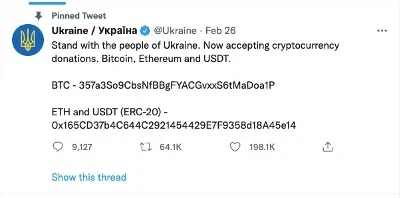
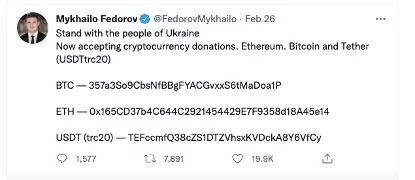
Twitter screenshots of Ukraine accepting crypto asset donations
In addition, many crypto market projects and practitioners have also begun to provide support to Ukraine. For example, Ethereum founder Vitalik Buterin called on social media to support local Ukrainians through Ukraine DAO, and Tron founder Justin Sun announced a $200,000 donation to Ukraine.
It can be said that crypto assets, due to their inherently global nature, have in fact become a powerful emerging crowdfunding tool for war. This attribute of crypto assets will be gradually deeply explored in this war. If there are future conflicts, crypto assets will only become more deeply involved.
As for whether this "crowdfunding tool" becomes an "executioner" that kills people or a sword that upholds justice, that depends on how people use it. "Guns don't kill people, the people who pull the trigger do."
Another role played by crypto assets is being used by various parties as a means of sanctions and anti-sanctions. For example, U.S. sanctions against Russia have spread to the crypto field: the U.S. Department of the Treasury issued new regulations on March 1, prohibiting Americans from providing any support to Russian oligarchs and entities, including using crypto assets for Trading. At the same time, it prohibits Russian citizens and entities from using crypto assets Trading platforms to conduct any Trading behavior. This move can strike Russia's already crippled real economy and relatively fragile financial system, thereby achieving sanction objectives.
Ukraine has taken a more aggressive approach, with its government sending letters to some Trading platforms, asking them to stop serving Russian users on the grounds of "concerns that crypto assets could be used to evade sanctions." Meanwhile, European Central Bank President Lagarde called on legislators to approve a crypto technology regulatory framework, noting that this would prevent Russia from circumventing economic sanctions.
So can Russia use crypto assets to escape sanctions? Realistically speaking, it's quite difficult. Although Bitcoin and other crypto assets can indeed help funds bypass the banking system and transfer more easily globally, large-scale use of crypto assets for cross-border fund transfers is currently not realistic. Moreover, every Trading record is stored on the blockchain, readable by anyone, and cannot be tampered with, making it easier to track and thereby take corresponding measures to identify Trading from "sanctioned entities."
Of course, the road has not been completely blocked. Russia still has opportunities to use various crypto assets-related tools to evade sanctions, but the key is finding methods to conduct Trading without using the U.S. dollar. Additionally, the transparency of crypto assets is built on the blockchain. Russia can develop new tools to help hide Trading records, thereby evading sanctions to a certain extent.
Being used as a safe haven option is the third role crypto assets play in this war, but this option is more for citizens of both Russia and Ukraine. Because the current size of the crypto market is relatively small, insufficient to serve as a large-scale Trading medium between official organizations or governments, but it is quite reliable as a safe haven option for some people.
In fact, according to data from crypto data company Kaiko, since the outbreak of the Russia-Ukraine war, Bitcoin Trading volume using rubles has soared to its highest level since last May, while Trading volume using Ukraine's hryvnia has climbed to its highest level since last October. According to a report by the Russian government, there are over 12 million crypto assets wallets opened by Russian citizens, involving total funds of approximately 2 trillion rubles.
On the same day the U.S. Department of the Treasury issued new sanctions, Bitcoin prices briefly rallied, soaring from around $41,800 to near $44,000, a 24-hour gain of over 14%. This may be the result of Russian citizens buying heavily in the short term under the guidance of safe haven sentiment.
The Russia-Ukraine war is the largest European military conflict since World War II, and crypto assets represented by Bitcoin have also been swept up in it. Both sides have discovered the advantages of borderless, permissionless crypto assets. Just as the Internet has developed to become an important part of warfare, the war between Russia and Ukraine may be "the world's first crypto assets war," but it will definitely not be the last.
The Battle of Crypto Market Ideologies, What is "Crypto Spirit"?
As the entire crypto industry has been drawn into the Russia-Ukraine conflict, both industry participants and crypto assets themselves have actively or passively revealed their positions. Between regulation and being regulated, sanctions and anti-sanctions, support and opposition, the ideological battle of the crypto market has also been brought to the table. It can be said that under the Russia-Ukraine conflict, the decisions of crypto projects and whether crypto assets can truly be decentralized in the future—these debates may have very important impacts on the future development of the crypto industry, or even on the basic appearance and direction of the industry.
Realistically speaking, the current crypto industry overall leans toward pro-Western ideology, so the entire crypto industry has almost overwhelmingly supported Ukraine. Many crypto projects and individuals have stated their positions and donated crypto assets to Ukraine, just as Ethereum founder Vitalik said: Ethereum is neutral, but he is not.
After the United States issued policies requiring some crypto companies to comply with their demands to ban Trading by Russian addresses, most companies chose to comply: if sanctions expand to the scope of individual citizens, they will comply with the sanctions.
This move has sparked huge controversy in the crypto community: if crypto companies are forced to take "political" sides and freeze user accounts, then does crypto Trading still have so-called privacy? What is the meaning of crypto assets' "decentralization"?
On the other hand, Ukraine and other countries have also called on crypto companies to take sides, urging them to freeze Russian user accounts to prevent Russia from using crypto assets to evade sanctions. Ukraine-based NFT gaming Trading platform D Market also announced it would freeze accounts of Russian and Belarusian users, meaning these account owners cannot withdraw their assets. After this decision was announced, D Market was plunged into controversy, with many even calling it "theft," accusing it of violating the spirit of decentralization and harming innocent users.
Of course, there are also quite a few crypto companies that have stated they will not sanction ordinary users. However, as the Russia-Ukraine conflict continues and the crypto industry becomes more deeply involved, the pressure from all sides will become greater. At that point, crypto companies that claim to advocate "decentralization" will truly face a test of values. It can be said that when the crypto industry wants to enjoy the protection brought by regulation, it must also face such controversies.
Currently, many users in the crypto community believe that the purpose of the crypto economy is decentralization and openness, not privilege and autocracy. Even in the current special circumstances, crypto entities should follow this principle as much as possible. "All crypto companies have a responsibility to defend people's economic freedom, not become weapons to oppress innocent people."
Just as the Cypherpunk group, where Bitcoin originated, believed: it is better to allow criminals and terrorists to develop and use strong encryption systems, despite certain risks, but this is necessary to defend individual privacy.
However, as more and more people and stakeholders join the crypto industry, the industry's original philosophy will become increasingly diluted. We want more people to join the crypto world, but when more and more people join, it becomes more difficult to ensure that the original philosophy is recognized and executed. This is an unsolvable paradox.
Under the Butterfly Effect, Where Will the Crypto Market Go in the Future?
crypto assets being drawn into the Russia-Ukraine conflict—what impact will this have on the crypto market itself? We can explore this from two aspects: short-term prices and long-term development.
From the perspective of short-term market conditions, after the full outbreak of the Russia-Ukraine conflict, prices of crypto assets represented by Bitcoin, like the general environment, were overall bearish and experienced a crash. However, subsequently due to safe haven sentiment, sanctions and anti-sanctions, and other factors, there was a rapid rebound, and Bitcoin even broke through $45,000 at its peak.
According to Glassnode data, the number of non-zero Bitcoin addresses has surpassed 40 million in 2022, hitting a historic high. From this data, it seems Bitcoin has once again demonstrated its effectiveness as "digital gold," just like during the previous Turkish unrest and Cyprus crisis, rising against the trend.
However, rigidly applying empiricism will undoubtedly be harmful. As everyone knows, the main reason for this round of Bitcoin and crypto market trends is the massive money printing by central banks led by the Federal Reserve due to the pandemic impact. Currently, the Federal Reserve is about to raise interest rates and tighten liquidity. The impact of this general environment on crypto market rises and falls will be more important than the black swan event of the Russia-Ukraine war, unless the Russia-Ukraine war expands comprehensively and spirals out of control.
For a detailed understanding of the impact of Federal Reserve rate hikes, you can view OKX Academy's article: "Federal Reserve Rate Hikes (Part 1): Will Rate Hikes End the Bull Market?".
From the perspective of U.S. stocks, historical data shows that since the outbreak of geopolitical conflicts, U.S. stocks generally decline in the short term, with an impact period of 10-30 days, after which they quickly recover. The current Russia-Ukraine conflict has lasted 8 days. Based on past patterns, in the next three weeks, the conflict may still have a certain impact on U.S. stocks. Given the current depth of U.S. stock influence on the crypto market, specific market trends also need to be monitored in the next three weeks, and proper risk control should be maintained.
From a long-term development perspective, the Russia-Ukraine war may to some extent rewrite or accelerate the historical process of the crypto industry.
Through the Russia-Ukraine war, crypto assets can be said to have truly reached the center of the world financial stage and begun to truly have a broad impact on the financial world. Under this influence, both Russia and Ukraine, as well as Western countries and others, are engaging in various games around crypto assets.
Both Russia and Ukraine—one avoiding sanctions, the other collecting donations—while Western countries are studying how to prevent crypto assets from becoming tools for Russia to evade sanctions. All these actions are watched by the world. Next, this will prompt more countries and more institutions to reflect, imitate, or even innovate. The benefits brought by crypto assets are obvious. If the size is large enough, can another system be built outside the traditional financial system, or at least serve as a very important supplement.
This Russia-Ukraine war has brought crypto assets represented by Bitcoin their "perfect narrative": traditional financial value transfer facilities paralyzed, assets frozen by centralized institutions, capital controls... This exactly aligns with the original narrative of Bitcoin or blockchain—a permissionless, decentralized value transfer network.
Especially in war environments, when sovereign nations themselves face threats and fiat currencies relying on sovereign credit cannot escape unscathed, supra-sovereign hard currency is a lifesaver. Previously, there seemed to be only gold; now there is another option. The Russia-Ukraine war has brought crypto assets completely into the mainstream. In the future, more people and funds will pour in, which will undoubtedly greatly accelerate the overall development of the crypto industry.
Finally, realistically speaking, the role and effect played by crypto assets in this Russia-Ukraine conflict are still supporting and secondary. Traditional financial markets still occupy a dominant position. However, like newborn mammals, in the process of tenaciously fighting against the descendants of dinosaurs, they gradually rose to become the rulers of the entire earth's biosphere, and then a bipedal species emerged from the primate group, completely changing the face of the entire biosphere.
Disclaimer
This article may contain product-related content not applicable to your region. This article is intended to provide general information only and does not accept responsibility for any factual errors or omissions therein. This article represents only the author's personal views and does not represent the views of OKX. This article is not intended to provide any advice, including but not limited to: (i) investment advice or investment recommendations; (ii) offers or solicitations to buy, sell, or hold digital assets; or (iii) financial, accounting, legal, or tax advice. Holding digital assets (including stablecoins) involves high risk, may fluctuate significantly, and may even become worthless. You should carefully consider whether Trading or holding digital assets is suitable for you based on your financial situation. For questions about your specific situation, please consult your legal/tax/investment professional. The information appearing in this article (including market data and statistics, if any) is for general reference only. Although we have taken all reasonable precautions in preparing these data and charts, we accept no responsibility for any factual errors or omissions expressed herein. © 2025 OKX. This article may be reproduced or distributed in its entirety, or excerpts of 100 words or less from this article may be used, provided such use is non-commercial. Any reproduction or distribution of the entire article must prominently state: "Copyright © 2025 OKX. Used with permission." Permitted excerpts must cite the article name and include attribution, for example "Article Name, [Author Name (if applicable)], © 2025 OKX". Some content may be generated or assisted by artificial intelligence (AI) tools. Derivative works or other uses of this article are not permitted.
Show More
Recommended Reading
OKX Pay: Opening a New Era of Next-Generation Crypto Payment
The choice of tens of millions of users. Register with OKX to enjoy ultimate Trading experience and diverse wealth management products. A letter from OKX CEO Star: Today, we are officially launching the first version of OKX Pay to our over 100 million global users. As the industry's first Payment application that truly achieves non-custodial and compliant integration, OKX Pay will be embedded within the OKX App, currently available to select markets, and expected to fully
March 22, 2026

New Chapter: Building Next-Generation Financial Infrastructure Together
The partnership between OKX and Intercontinental Exchange (ICE) is an important moment for OKX and equally significant for the evolution of the entire digital assets market. ICE establishes and operates the world's most important financial infrastructure, including the New York Stock Exchange as well as global derivatives and clearing platforms. This investment by ICE in OKX and joining our board reflects both parties' shared belief—digital assets technology will play a crucial role in financial markets
March 10, 2026
Tribute to Another Year of Forging Ahead
As OKX's CEO, and also a builder who remains true to our original mission, I am proud to look back on OKX's extraordinary growth and progress this year. Despite numerous challenges, 2024 has been a year of focus, innovation, and resilience. We have not only expanded and optimized our products, but also made significant progress in launching transparent and compliant localized businesses, while further strengthening our global management team. Notably, after experiencing
January 29, 2026

2025: Steady Progress Toward Financial Freedom Together
— Annual letter from OKX Founder and CEO Star to global users "Financial freedom" is often misunderstood. It doesn't mean absence of rules, but rather having the right to choose within the framework of rules—and when the system is truly tested, it remains reliable and effective. This is exactly the direction we have consistently focused on throughout 2025. First, I would like to extend my sincere gratitude to our global clients, partners, and regulatory
January 16, 2026

OKX Has Officially Launched in Germany and Poland
Author: Erald Ghoos, CEO of OKX Europe Today is significant for OKX—and for crypto users across Europe as well. We have officially launched fully compliant centralized cryptocurrency Trading platforms in Germany and Poland! For us, this is not just a geographic expansion, but a commitment to building the cryptocurrency future the right way: secure, transparent, and meeting local needs. If you are in Germany
October 21, 2025

Partnership Expanded! OKX Partners with Standard Chartered to Expand European Market
On October 15, OKX Europe CEO Erald Ghoos stated that OKX is expanding its strategic partnership with Standard Chartered to the European Economic Area (EEA). Earlier this year, OKX first partnered with Standard Chartered in the UAE to launch the collateral mirroring program—a
October 15, 2025