Where Are We in the Bull Market? What Should You Do?
With Bitcoin breaking through $60,000 again this Friday, "the bull market continues" has become the consensus among most people. However, due to market volatility and external factors, many investors now share the same doubt: Where are we in the bull market? What should you do to capture and retain returns?
If we count last year's "May 12 Bitcoin halving" as the start of this halving cycle, it has now been one year and five months. We know that the larger Bitcoin's market cap grows, the lower its volatility becomes, the slower its upward trajectory, and the longer the bull market lasts. Therefore, when using historical comparisons to determine where we are in this bull market, we need to consider the overall picture first, then use technical analysis theories to pinpoint the current position. Once you have your own conclusion, you can formulate your investment strategy accordingly.
The Three Stages of a Bull Market: Where Are We Now?
A bull market can be roughly divided into three stages by progress: early, mid, and late. Based on their main characteristics, they are also called: the incubation and preparation phase, the full-scale eruption phase, and the speculative frenzy phase. There are transitional periods of varying length between each stage, characterized by oscillating range-bound movement that gradually wears down investor patience.
So, where are we in the bull market now? First, the conclusion: we are at the end of the consolidation phase between the second and third stages, on the eve of the third stage beginning.
Looking back at this halving cycle's progression: starting from Bitcoin's "May 12 halving," until Bitcoin broke above $20,000, this entire period was the first stage of the bull market—the incubation and preparation phase. Prior to this, the market had experienced the despair-inducing "March 12" crash, yet the bull market emerged from that despair. After Bitcoin broke above $10,000 in early May, bulls and bears fought back and forth in consolidation until mid-September when it finally held above $10,000 and never dropped below again. The bull market then showed itself amid skepticism, until early December when it broke through the all-time high and held above $20,000—the incubation phase was complete, and the second stage began. This stage gathers funds and investors already in the market while drawing in some perceptive participants from outside. During this period, not everyone believed in the bull market; each slight pullback would trigger questions like "Is the bull market still alive?"
With Bitcoin breaking through and holding above $20,000 in December last year, the bull market gradually entered the second stage—the full-scale eruption phase. Not only did Bitcoin surge dramatically, doubling in a month, but the entire crypto market exploded under Bitcoin's leadership: ETH followed with a doubling in January, then DeFi sector leaders and traditional mainstream digital assets rallied in succession, lifting their respective sectors as a whole. Other popular narratives such as storage, NFT, Layer2, and meme coins represented by DOGE also rotated and erupted in turn. Eventually, nearly all digital assets were lifted. This stage saw an increasing number of new investors entering due to the explosive gains, and the crypto market continued to soar as new investors kept flowing in. Everything looked beautiful until the "May 19" massive crash came, directly ending this phase.
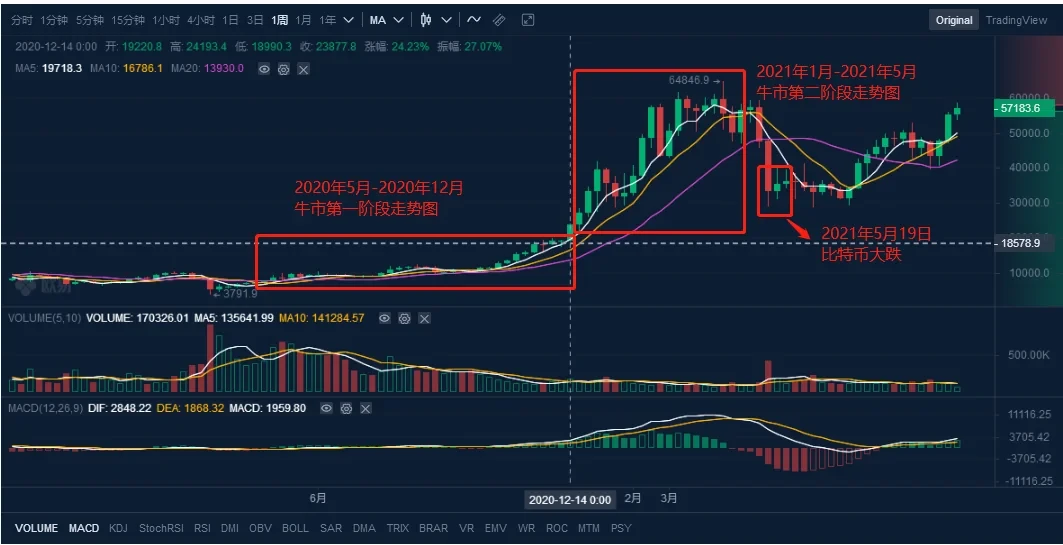
Bitcoin Price Chart for This Cycle (Source: OKX Platform)
After the "May 19" crash, the market entered a long consolidation transition period, wearing out many people's patience, to the point where some believed the bull market had ended and exited. By October, as Bitcoin continuously approached its all-time high, the voice of "the bull is still alive" grew louder. However, the随之而来的问题是: 牛市现在处在What阶段?
Readers who have made it this far likely already agree with the conclusion given at the beginning: that the bull market is at the end of the consolidation between the second and third stages, on the eve of the third stage beginning. However, drawing a conclusion from simply reviewing this cycle's events alone may lack sufficient evidence. So let's also examine this from historical precedent and technical analysis theories.
Looking at Bitcoin's previous two halving cycles, the final stage of each bull market featured an accelerated rally, forming a "sharp peak" on the chart (as shown in the two charts below). This aligns with the characteristics of the third bull market stage—the speculative frenzy phase—and also fits the internal logic of how bull markets end: the market accelerates upward, new funds fail to sustain it, collapses after exhausting all energy, and the bull market ends.
However, this halving cycle has not yet exhibited an accelerated "sharp peak" formation—in other words, the third stage has not begun, and the bull market has not fully developed. The "May 19" crash was more of a major correction following the inability to sustain the full-scale eruption, combined with external factors.
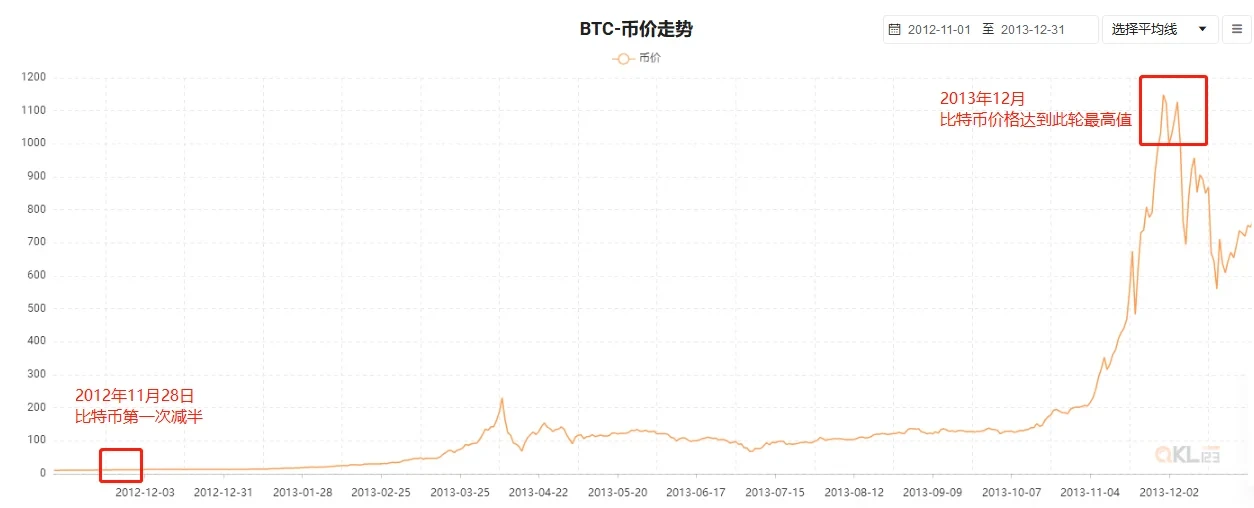
Bitcoin First Halving Cycle Price Chart (Source: qkl123)
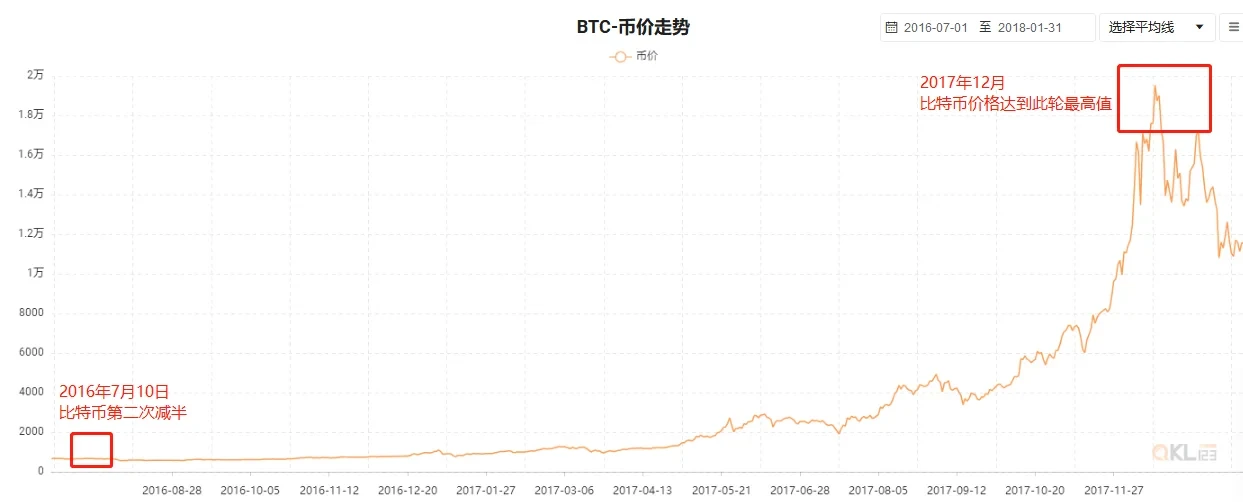
Bitcoin Second Halving Cycle Price Chart (Source: qkl123)
From technical analysis theories such as Elliott Wave Theory, analyzing on the weekly chart: from the "May 12 halving" to mid-August 2020 when Bitcoin reached $12,000—this was Wave 1. From late October 2020 when it broke the previous high, through April 2021 when it reached its all-time high above $64,000—this was Wave 3, the primary impulse wave. We are currently in Wave 4, the corrective wave. Due to external factors, the correction has lasted longer. Given the completeness of the wave pattern, there should be another Wave 5, the primary impulse wave, ahead. Of course, practitioners of Elliott Wave Theory often disagree on their wave counts—Person A might see it as Wave 1, while Person B sees it as Wave 2. This is merely one individual's perspective.
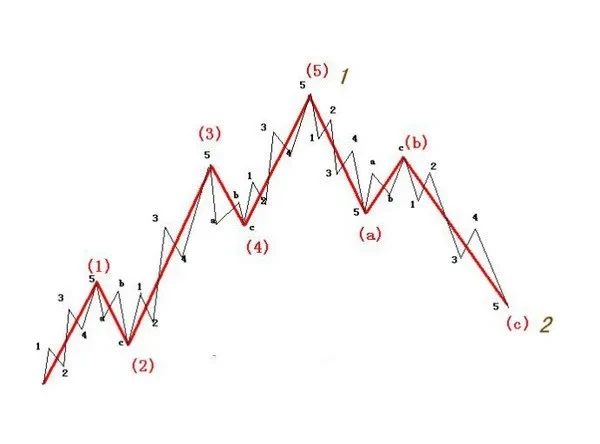
Simplified Elliott Wave Theory Diagram
Based on the above analysis, we can see that the bull market has reached the late stage. Looking at the trajectory and duration of each phase of Bitcoin bull markets, the further along the bull market progresses, the greater the gains, but the relatively shorter the duration. From the bull market timeline, the current bull market may have less than six months remaining. However, in the final ~30% of this period, the returns available could exceed 60% of the entire bull market's gains. Referencing Bitcoin's previous two halving cycle bull markets: "All gains that appeared substantial in the early stages become a flat line compared to the late-stage parabolic surge."
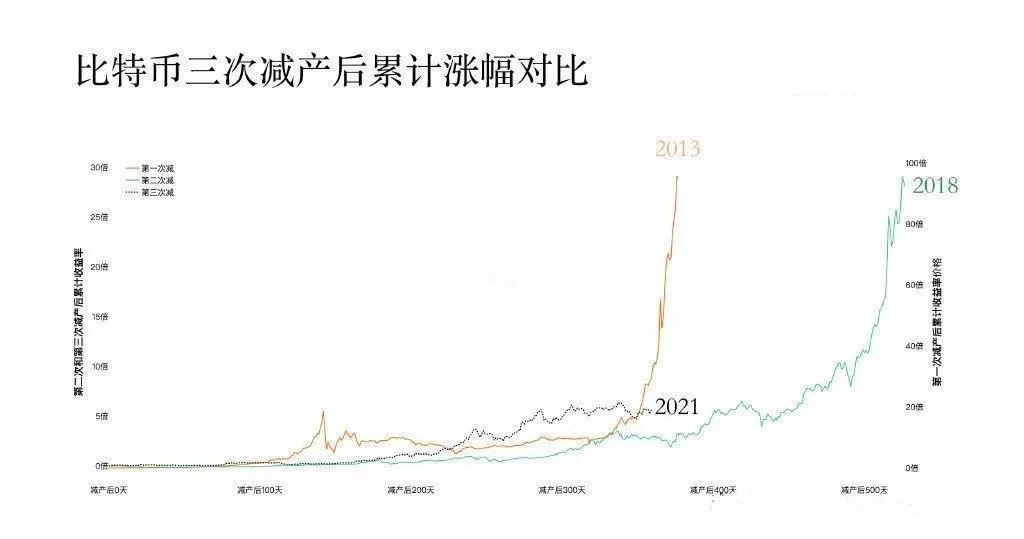
Bitcoin Three Halving Cycle Cumulative Gains Comparison (Source: Weibo @Beatle News)
However, the same theory, after being studied by different people, may lead to completely different conclusions due to their individual cognition, experience, and even expectations. The key is to have your own judgment—even if that judgment is wrong. As long as your judgment is evidence-based, you can refine and optimize it based on how events unfold.
The Bull Market Has Reached Mid-to-Late Stage: What Should You Do Next?
From the above, we can conclude that the bull market is in its mid-to-late stage. So at this stage, what should you do to seize the opportunities that may arrive at any time?
The most important thing is to establish an investment strategy that suits you, and continuously optimize it through practice. An investment strategy encompasses many aspects and is a comprehensive "project": including asset selection, fund allocation, trading method selection (spot, futures, wealth management, etc.), and common trading strategy selection (DCA, grid trading, trend trading, etc.). Due to space limitations, here we will focus primarily on asset allocation.
The crypto market, compared to traditional investment markets, is still quite "young." Many mature strategies from traditional investment markets can be applied to the crypto market. Here are two applicable strategies:
The 80 Rule: A guideline for estimating risk tolerance in investments. Under this rule, the proportion of risky investments depends on age. The crypto market is still in an early stage of development, with high volatility and correspondingly greater risk, so reasonable capital allocation is essential.
- Formula: Crypto market total investment ratio = (80 - your age) × 100%
- For example, if you are 30 years old, the total funds you invest in the crypto market can account for 50% of your total assets. At 40 years old it is 40%, at 50 years old it is 30%, and so on. This is because as people age, their risk tolerance decreases, and the proportion allocated to risky investments should gradually decline.
The 4321 Rule: This law was derived by investors from long-term investment and wealth management experience, guiding people on fund allocation during investing. Applied specifically to the crypto market, it works as follows:
- 40% of funds for stable investments, such as accumulating Bitcoin, participating in term or flexible wealth management products to earn returns.
- 30% of funds for insured investments, selecting leading blockchain projects across various sector narratives.
- 20% of funds for speculative investments, choosing smaller-cap digital assets to take on some risk for potentially higher returns.
- 10% of funds for high-risk investments, such as futures, crypto margin trading, and other financial derivatives.
Faced with a wide variety of blockchain projects with varying risk levels, only through proper allocation and disciplined investing can you achieve the optimal balance between returns and risk.
After introducing some specific methodologies, let us explore some philosophical theories. Whether assessing which stage the overall market is in or formulating a specific investment strategy, decisions should be logical—not made arbitrarily. Otherwise, you will regret it later and continue falling into the same traps.
For example, applying the principle of "dialectical development" to Bitcoin's current halving cycle: The essence of development is the emergence of new things and the demise of old things, corresponding to the turbulence and the glimmer of hope within it at the start of each halving cycle. The path of development is a unity of progressiveness and曲折性, corresponding to the pullbacks caused by internal and external factors each time. The state of development is a unity of quantitative and qualitative change, corresponding to Bitcoin's repeated testing and consolidation as it breaks through major resistance levels. The cause of development is the combined effect of internal and external factors, corresponding to the major selloffs caused by external factors such as "March 12" and "May 19," and the subsequent recovery of lost ground.
Making logical judgments about things is far more reliable than decisions based purely on intuition, and it better enables you to see beyond the surface to the essence, make correct decisions, and persist until the end.
Finally, this article is for reference only and does not constitute investment advice. The market carries risks, and trading requires caution.
Disclaimer
This article may contain product-related content not applicable to your region. This article is intended to provide general information only and makes no responsibility for any factual errors or omissions. This article represents the author's personal views only and does not represent OKX's views. This article is not intended to provide any advice, including but not limited to: (i) investment advice or investment recommendations; (ii) offers or solicitations to buy, sell, or hold digital assets; or (iii) financial, accounting, legal, or tax advice. Holdings in digital assets (including stablecoins) involve a high degree of risk and may fluctuate significantly, or even become worthless. You should carefully consider whether trading or holding digital assets is appropriate for you based on your financial situation. For questions about your specific circumstances, please consult your legal/tax/investment professional. The information contained in this article (including market data and statistics, where applicable) is provided for general reference purposes only. Although all reasonable precautions have been taken in preparing such data and charts, we accept no responsibility for any factual errors or omissions expressed herein. © 2025 OKX. This article may be reproduced or distributed in its entirety, or excerpts of 100 words or less may be used, provided that such use is non-commercial. Any reproduction or distribution of the full article must prominently state: "This article is copyrighted © 2025 OKX, used under permission." Permitted excerpts must cite the article title and include the source, for example, "Article Title, [Author Name (if applicable)], © 2025 OKX." Some content may have been generated or assisted by artificial intelligence (AI) tools. Derivative works and other uses of this article are not permitted.
Show More
Recommended Reading
OKX Pay: Ushering in the Next Generation of Crypto Payments
The choice of tens of millions of users. Register on OKX and enjoy an exceptional trading experience and diverse wealth management products. A letter from OKX CEO Star: Today, we officially launch the first version of OKX Pay to over 100 million global users. As the industry's first payment application that truly integrates non-custodial and compliant solutions, OKX Pay will be embedded within the OKX App and is currently available in select markets, with full
2026年3月22日

A New Chapter: Building the Next Generation of Financial Infrastructure Together
The partnership between OKX and the Intercontinental Exchange (ICE) represents a significant milestone for OKX, and is equally meaningful for the evolution of the entire digital assets market. ICE builds and operates the world's most critical financial infrastructure, including the New York Stock Exchange and global derivatives and clearing platforms. ICE's strategic investment in OKX and joining our board reflects our shared belief that digital assets technology will transform financial mar
2026年3月10日
Reflecting on Another Year of Building
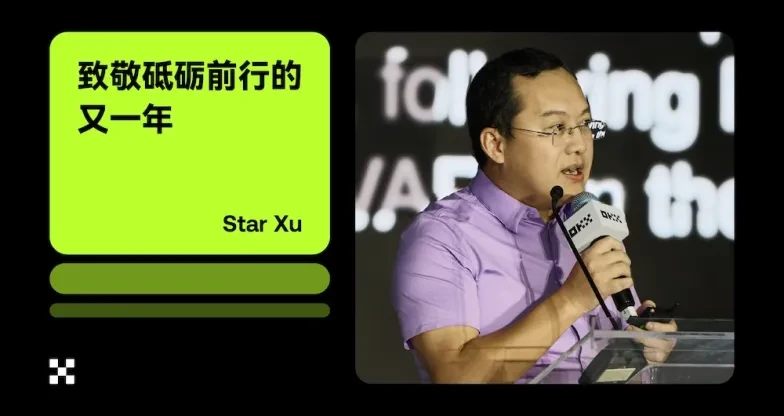
As OKX's CEO and a builder who stays true to the mission, I take great pride in looking back on the remarkable growth and progress OKX has achieved this year. Despite challenges, 2024 was a year defined by focus, innovation, and resilience. We not only expanded and improved our products, but also made significant strides in launching transparent and regulation-compliant localized businesses, while further strengthening our global management team. It is worth noting that after
2026年1月29日

2025: Steady Progress Toward Financial Freedom
— An End-of-Year Letter to Global Users from OKX Founder and CEO Star "Financial freedom" is often misunderstood. It does not mean an absence of rules, but rather having the freedom to choose—even when rules exist—and that the system remains reliable and effective when truly put to the test. This has been our unwavering focus throughout 2025. First, I would like to express my heartfelt gratitude to our global customers, partners, and regulators.
2026年1月16日

OKX Officially Launches in Germany and Poland
By Erald Ghoos, CEO of OKX Europe Today is a momentous day for OKX—and for crypto users across Europe. We have officially launched our fully compliant centralized cryptocurrency exchange in Germany and Poland! For us, this is more than a geographic expansion; it is a commitment to building the future of cryptocurrency the right way: secure, transparent, and tailored to local needs. If you are in Germany
2025年10月21日

Partnership Upgrade! OKX and Standard Chartered Expand Into Europe
On October 15, Erald Ghoos, CEO of OKX Europe, stated that OKX is expanding its strategic partnership with Standard Chartered to the European Economic Area (EEA). Earlier this year, OKX first teamed up with Standard Chartered in the UAE, launching a collateral mirroring program—a
2025年10月15日