OKX Research: Russia Caught in Sanctions, Crypto Faces a Dilemma
OKX Research
Since Russia's military operation in Ukraine, multiple countries and regions led by the United States have gradually become involved in the conflict, announcing increasingly severe sanctions against Russia in the financial and trade sectors:
Several Russian banks have been excluded from SWIFT, PayPal has blocked major Russian banks and certain users, Mastercard and Visa have announced the suspension of operations in Russia, while companies like Audi and BMW have相继宣布停止为俄罗斯供货, or suspending local production. Assets of some Russian billionaires abroad have been directly frozen or seized. According to Italy's Ministry of Economy and Finance, it has seized Russian billionaire assets worth 140 million euros within the country.
Before a breakthrough in Russia-Ukraine negotiations or a final resolution to the situation, there is potential for further escalation in the scope and intensity of sanctions. In this context, discussions about "Russia using crypto assets to break through sanctions" have intensified.
1. Bitcoin Trades at a Premium Against Ruble — Is Capital Flowing to crypto assets?
On February 26, US and European leaders issued a joint statement,决定于近期内将部分俄罗斯银行移出SWIFT (金融报文传输系统). This measure is also called the "financial nuclear weapon" against Russia.
Founded in 1979, SWIFT is the world's leading provider of secure financial messaging services. Although it is itself neutral, it must comply with EU regulations. As early as 2012, SWIFT was prohibited from serving sanctioned Iran.
During the four years Iran was excluded from SWIFT, its economy and fiat currency exchange rate were significantly impacted: Iran's crude oil exports decreased by 17.2% that year and 42.2% the following year. As a resource-based country, the blockage of energy exports such as oil led to a substantial economic decline (after sanctions were lifted, crude oil exports increased by nearly 80% and GDP rebounded 13.4%). On the other hand, Iran's fiat currency exchange rate against the US dollar declined significantly, and inflation surged. This shows that the "financial nuclear weapon" nickname is not unfounded.
Although Russia has been implementing various defensive measures since 2014, including increasing gold reserves, reducing dollar settlement ratios, and developing domestic financial information transfer systems, exclusion from SWIFT would still severely impact Russia's energy exports, fiat currency exchange rates, inflation levels, and financial market stability. Russia's former Finance Minister stated in 2014: One year after being removed from the SWIFT system, Russia's domestic economy could contract by 5%.
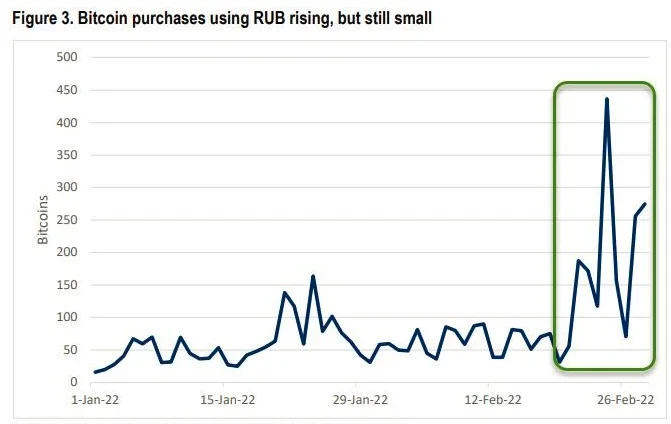
Facing a multi-pronged sanctions "siege," Russia's Select becomes critical. The market has gradually seen views emerge that "Russia will Select crypto assets to evade sanctions." Bitcoin trading at a $18,000 premium on Russian P2P exchanges, and Bitcoin's strong surge of over 14% on February 28, all seem to serve as strong evidence for this view. However, according to Chainalysis data, the trading volume of crypto assets denominated in rubles has not shown significant growth, and Citigroup's report indicates that Russia's recent daily average Bitcoin trading volume is approximately 210 coins, accounting for about 1.75% of Bitcoin's global spot trading volume. Furthermore, on-chain data does not show signs of Russian capital pouring into crypto assets.
2. crypto assets Currently Cannot Be Russia's Solution
It is undeniable that crypto assets are gradually gaining increasing mainstream recognition, achieving significant progress in underlying infrastructure, upper-layer applications, market capitalization, and other aspects. But so far, crypto assets cannot become Russia's way out of the sanctions dilemma. The main reasons are as follows:
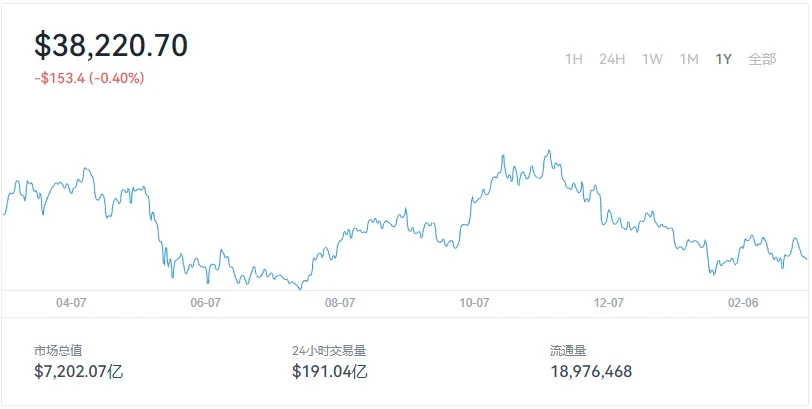
First, driven by numerous positive developments last year, the total market capitalization of crypto assets once approached the $3 trillion (2.97 trillion) mark. However, as the market has gradually weakened, Bitcoin's current market capitalization has shrunk to approximately $740 billion.
In stark contrast is Russia's rank among the top 15 economies globally: Russia's 2021 GDP totaled 130 trillion rubles, equivalent to $1.77 trillion, with crude oil exports at $110.119 billion. Obviously, the scale of Bitcoin and crypto assets currently cannot accommodate Russia's financial needs for trading, settlement, and capital outflows.
During the 2014 Crimea crisis, Russia's net capital outflow was $151 billion, and this net capital outflow will likely increase further this time. But the crypto market clearly cannot currently absorb large capital flowing out of Russia.
Globally, crypto assets account for approximately 3% of total global assets, and in the博弈 among various economic entities, they still cannot become the main player.
Second, the difficulty for various crypto assets to bypass territorial regulations and come to Russia's aid is continuously increasing. Because crypto assets have gradually broken out of their niche and entered mainstream attention, government departments and financial institutions' understanding of crypto assets continues to deepen, and various methods for tracking crypto assets on-chain have become more professional and sophisticated.
With regulations continuously improving and mainstream platforms' KYC systems becoming increasingly mature, the larger the amount of crypto assets traded, the harder it becomes to evade scrutiny and tracking by sanctioning authorities. Chainalysis staff have also stated: The United States and other sanctioning governments around the world can use on-chain analysis tools to prepare for Russia's use of crypto assets to evade sanctions. The transparency of blockchain combined with on-chain data analysis tools can ensure that sanctions remain a reliable deterrent.
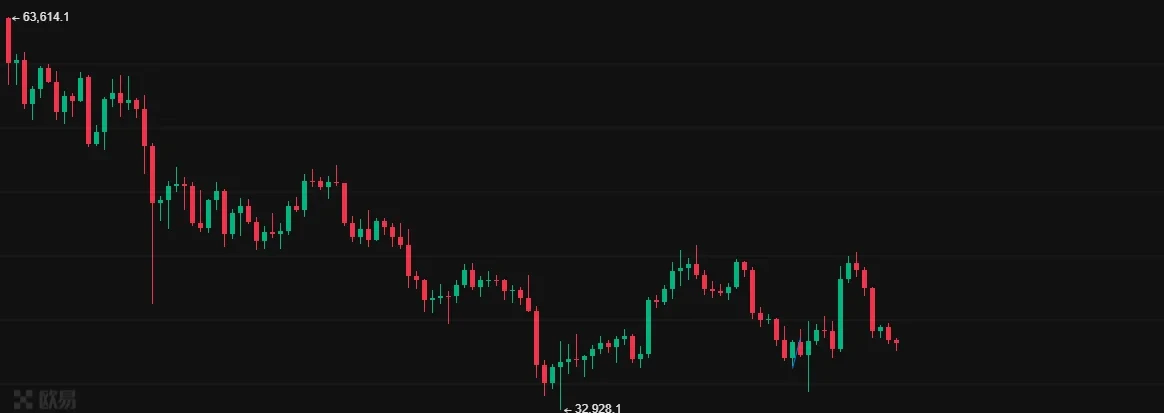
At the same time, although Bitcoin bears the title of "digital gold," its current nature is still a risk asset. After mainstream capital entered at scale in 2021, the correlation between crypto assets and US stocks is increasing, and the influence of international situations and monetary policy is also gradually growing. From Bitcoin and gold taking diametrically opposite paths amid the deterioration of the Russia-Ukraine situation, it can be seen: In the eyes of mainstream assets, Bitcoin serves more as a financial product for diversifying investment portfolios, rather than acting as a safe haven Select.
3. Russia Caught in a Dilemma, crypto assets Also Face a Select
Although there is no data proving that Russia would use crypto assets as a solution to break through the situation, financial authorities in various countries have nonetheless made statements on this matter:
The European Central Bank President stated that regulators must prevent Russia from using crypto assets to evade sanctions;
US Treasury Secretary Yellen warned that crypto assets need to pay attention to channels for evading sanctions;
Japan's Financial Services Agency (FSA) also stated it is blocking blacklisted Russian entities from using crypto assets to evade sanctions.
At present, although crypto assets have decentralized attributes and hold a neutral position, crypto assets trading platforms and various service providers are subject to the regulations of economic entities and have obligations to cooperate with financial authorities' reviews and implement sanctions.
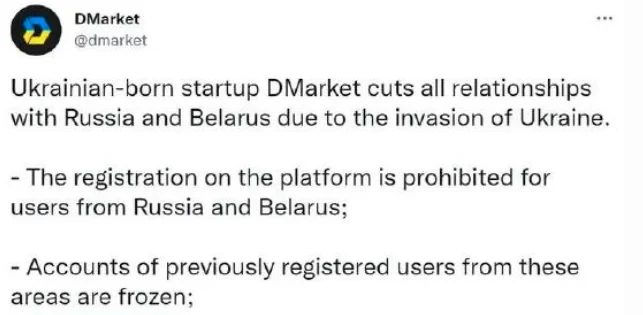
For example: USDC issuer Circle announced it would temporarily suspend all fiat payments for Russian accounts; hardware wallet Trezor stated it had immediately stopped shipping to Russia after sanctions were implemented; Coinbase also stated it would block registered IP addresses or access or use of related services from sanctioned regions; and NFT trading platform D Market even directly announced it would freeze NFT assets from users in Russia and Belarus; although exchanges like Kraken rejected the Ukrainian Deputy Prime Minister's request to block Russian crypto assets accounts, they still stated that "if ordered by the US State Department" such a scenario would not be covered by their commitment.
Currently, Russia finds itself in a sanctions dilemma, and the crypto industry also faces a difficult Select:
On one hand, crypto-native companies cannot stand by and ignore financial authorities' scrutiny and the need to cooperate with sanctions. Once actions like the D Market platform freezing user assets occur on a large scale, it will inevitably create a huge shock to claims of "decentralization" and "crypto assets' superiority over traditional assets in terms of ownership"; On the other hand, some investors, affected by the market's downward trend, desperately hope that Russian capital will flow into crypto assets to boost the market.
It should be noted that once Russian capital shows a tendency to evade sanctions through crypto assets, the honeymoon period between Bitcoin and mainstream institutions and financial regulators will also come to an end, and the situation will become increasingly complex. However, as natural gas and crude oil prices continue to rise, the United States and Europe, already experiencing soaring inflation rates, are also under immense pressure. Stubbornly insisting on implementing sanctions will only result in mutual damage. Therefore, the possibility of a breakthrough in Russia-Ukraine negotiations and subsequent easing of tensions cannot be ruled out.
At present, whether in terms of market capitalization as a percentage of total global assets or the number of holders as a percentage of the global population, crypto assets indeed cannot become a critical factor in high-stakes博弈. However, the outstanding characteristics of crypto assets determine that they are still full of imagination for the future. Blockchain technology and encrypted digital applications still have overall expectations higher than other emerging technologies.
Disclaimer
This article may contain product content that does not apply to your region. This article is only致力于提供一般性信息,不对其中的任何事实错误或遗漏负责任. This article represents only the author's personal views and does not represent OKX's views. This article is not intended to provide any recommendations, including but not limited to: (i) investment advice or investment recommendations; (ii) offers or solicitations to purchase, sell, or hold digital assets; or (iii) financial, accounting, legal, or tax advice. Holding digital assets (including stablecoins) involves high risk and may fluctuate significantly or even become worthless. You should carefully consider whether trading or holding digital assets is appropriate for you based on your financial situation. For questions about your specific circumstances, please consult your legal/tax/investment professional. The information in this article (including market data and statistics, if any) is provided for general reference purposes only. Although we have taken all reasonable precautions in preparing such data and charts, we assume no responsibility for any factual errors or omissions expressed herein. © 2025 OKX. This article may be reproduced or distributed in its entirety, or excerpted in portions of 100 words or less, provided that such use is non-commercial. Any reproduction or distribution of the full article must prominently state: "This article is copyrighted © 2025 OKX, used with permission." Permitted excerpts must cite the article name and include attribution, for example "Article Name, [Author Name (if applicable)], © 2025 OKX." Some content may be generated or辅助生成 by artificial intelligence (AI) tools. Derivative works and other uses of this article are not permitted.
Show More
Recommended Reading
OKX Pay: Opening a New Era of Next-Gen Crypto Payments
The Select of tens of millions of users, Register with OKX and enjoy an exceptional trading experience and diverse wealth management products. A letter from OKX CEO Star: Today, we officially launched the first version of OKX Pay for over 100 million global users. As the industry's first payment application to truly achieve non-custodial and compliant integration, OKX Pay will be embedded within the OKX App, currently available in select markets, with full rollout expected within months.
March 22, 2026

A New Chapter: Building the Next Generation of Financial Infrastructure Together
OKX's partnership with the Intercontinental Exchange (ICE) represents a significant milestone for OKX and holds equally profound meaning for the evolution of the entire digital assets market. ICE establishes and operates the world's most critical financial infrastructure, including the New York Stock Exchange and global derivatives and clearing platforms. This Select by ICE to invest in OKX and join our board of directors reflects our shared conviction that digital assets technology will transform financial markets.
March 10, 2026
Paying Tribute to Another Year of Resilience and Progress
As CEO of OKX and a builder who stays true to the original mission, I take great pride in reflecting on the extraordinary growth and progress OKX has achieved this year. Despite formidable challenges, 2024 was a year marked by focus, innovation, and resilience. We not only expanded and optimized our products but also made significant strides in launching transparent and regulation-compliant localized businesses, while further strengthening our global management team. It is worth noting that after experiencing...
January 29, 2026

2025: Steady Progress Toward Financial Freedom
— Year-End Letter to Global Users from Star, Founder and CEO of OKX "Financial freedom" is often misunderstood. It does not mean the absence of rules, but rather having the right to make choices within a framework of rules—and having that system remain reliable and effective when truly put to the test. This is precisely what we focused on throughout 2025. First, I would like to extend my sincere gratitude to global customers, partners, and regulators...
January 16, 2026

OKX Officially Launches in Germany and Poland
By Erald Ghoos, CEO of OKX Europe Today is significant for OKX—and for crypto users across Europe. We have officially launched a fully compliant centralized cryptocurrency trading platform in Germany and Poland! For us, this is not just a geographic expansion, but a commitment to building the future of cryptocurrency the right method: secure, transparent, and meeting local needs. If you are in Germany...
October 21, 2025

Partnership Upgrade! OKX Partners with Standard Chartered to Expand into Europe
On October 15, OKX Europe CEO Erald Ghoos stated that OKX is expanding its strategic partnership with Standard Chartered into the European Economic Area (EEA). Earlier this year, OKX first partnered with Standard Chartered in the UAE, launching a collateral mirroring program—a...
October 15, 2025