Behind Market "Surges and Crashes": Understanding the Cyclical Events That Impact Price Movements
Next Thursday, November 4th at 2:00 AM Beijing Time, the Federal Reserve's FOMC meeting will convene and announce the latest interest rate decision. Although there are still three days until this time, the market has already reacted: the crypto market continues to decline, with trading volumes also continuing to shrink. Current market expectations are: the Fed will begin tapering its current $120 billion monthly bond purchase program after next week's meeting. As a result, market funds, particularly short-term funds, have started to choose to wait and see, preventing "black swans" from appearing, and waiting for "the other shoe to drop" before making their choices.
The crypto market is inherently a global market. As the entire market develops and grows, its relationship with the traditional world becomes increasingly close, and consequently, the impact it receives becomes increasingly significant.
As next Thursday's Fed meeting—the seventh of 2021—approaches, market wait-and-see sentiment is growing, and there are even instances of profit-taking. This inevitably recalls the impact of the last Fed meeting (September 22) on the market: the market fell for three consecutive days before the meeting, with Bitcoin dropping from a high of $48,822 to a low of $39,566, a decline of 18.9%; ETH dropped from a high of $3,677 to a low of $2,646, a decline of 28%; other digital assets all experienced declines of over 30%, with some small-market-cap digital assets even being directly cut in half. Ultimately, the meeting confirmed "maintaining the benchmark rate at 0-0.25% unchanged," and Bitcoin and most other digital assets bottomed out and stabilized on September 22.
Looking at a longer timeframe, you'll find that every Fed action has a greater or lesser, good or bad impact on the market, because the Fed controls the US dollar, the "source of living water" for all investment markets. Besides the Fed's interest rate policy, there are many other factors affecting market rises and falls. Some affect the foundation of the bull market, while others only affect short-term fluctuations. Although these impacts vary in magnitude, for individual investors they can be "catastrophic."
Events That Affect Bull Market Fundamentals
We know that the foundation of a bull market is the continuous inflow of new funds, so events that can affect bull market fundamentals are basically matters of macroeconomic development and macroeconomic policy.
Among these, Fed meetings receive the most attention. Fed meetings typically last one to two days, are held 8 times a year, and are spaced approximately 6 weeks apart. Their main task is to determine US monetary policy, achieving a balance between economic growth and price stability through monetary policy regulation.
Due to the US dollar's status as a "world currency," the results of Fed meetings profoundly affect all investment markets worldwide, and the crypto market is no exception. Every time the Fed raises the benchmark rate (i.e., rate hikes), the market responds with declines, sometimes even directly ending the entire bull market. For example, in December 2017, Bitcoin's second halving cycle reached a historic high of nearly $20,000, but with the Fed's rate hikes, Bitcoin's price directly collapsed. Subsequently, every slight rebound would be wiped out due to rate hikes. As shown below:
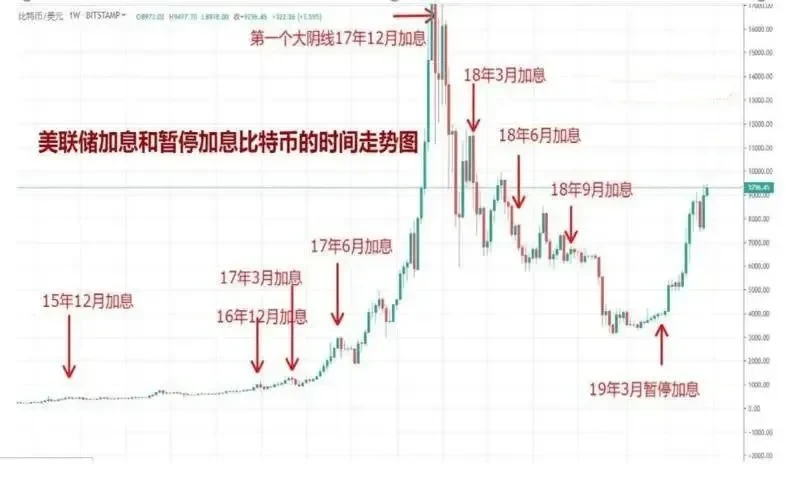
Bitcoin's first two halving cycles and Fed rate hikes correlation chart (Source: Bitfan)
Why do Fed rate hikes fundamentally affect the entire bull market process? Behind this phenomenon lies actually the most important logic of modern economic operation: the state regulates the credit scale and economic temperature of the entire society through the banking system. Simply put, the state first issues currency through the central bank, then through the entire commercial banking system for deposit absorption, lending, and credit creation.
To use an analogy, the modern economy is a complex water conservancy project. The central bank is the upstream reservoir, the issued fiat currency is the water in the reservoir, and various investment markets are fields of different sizes. Fields need water for irrigation to make crops grow strong, but if there's too much or too little water, it will cause floods or droughts. At this time, sluice gates are needed to control the water volume and flow rate.
The two most important gates through which the state regulates the economy through the banking system are reserve requirements and the benchmark interest rate. Fed meetings mainly discuss the issue of the benchmark interest rate. If the Fed raises the benchmark interest rate, it's equivalent to turning down the faucet, which will reduce the flow of funds in the market, thereby making the bull market become water without a source, a tree without roots—the entire foundation of the bull market disappears, which would be a devastating blow.
Returning to this Fed meeting, the background of this meeting is that the Fed's continued monetary easing has significantly increased inflation levels, creating expectations of rate hikes due to excessive inflation. However, the US has also characterized recent high inflation levels as "transitional"—for example, US Treasury Secretary Yellen stated as early as August this year that inflation is expected to slow by the end of this year. However, last Sunday, Yalen changed her stance, saying high inflation is expected to continue through the first half of next year.
This round of the crypto market's bull market largely benefits from the Fed's massive monetary easing caused by the COVID-19 pandemic. It can be said that this is an artificial bull market created by funds. If rate hikes occur once, a bull market correction or even a burst is very possible. Therefore, you must pay attention to Fed meetings' adjustments to monetary policy.
In addition to Fed meetings, Bank of England (British pound) and European Central Bank (Euro) meetings also need attention, as both also hold 8 meetings per year.
There are many other events affecting bull market fundamentals, including the US non-farm index, CPI index, etc. Both will have important impacts on Fed monetary policy and Treasury fiscal policy. For details, you can join OKX official communities to learn more.
Events That Affect Short-Term Price Movements
The crypto market is a relatively young market, and many events can have significant impacts on it. The impacts of these events may be short, but the shocks are often large. Due to space limitations, here we mainly discuss two events: CME BTC futures gaps and the rises and falls of traditional investment markets represented by the US stock market.
Investors who frequently do contract trading are certainly no strangers to CME BTC futures gaps. Due to their "nine out of ten gaps get filled" performance, many investors habitually check whether CME BTC futures have appeared gaps every Monday. If there's a gap up opening, Bitcoin may experience a decline to fill the gap next; if there's a gap down opening, Bitcoin may experience a rise to fill the gap next.
Gaps can generally be divided into four categories: common gaps, breakaway gaps, exhaustion gaps, and continuation gaps. Among them, breakaway gaps have a relatively lower probability of being filled, while common gaps and exhaustion gaps have a higher probability of being filled, and continuation gaps usually don't get filled.
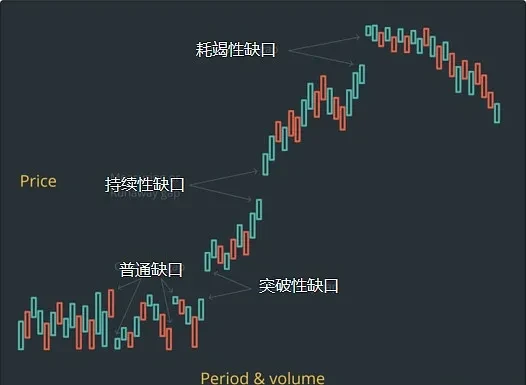
CME BTC futures gap types (Source: Tuoluocaijing)
Why do CME BTC futures gaps get filled? Currently, there's no unified explanation—is it that people are accustomed to gaps being filled, or do they think they should be filled? Someone said: There were originally no CME gaps, but as more people mentioned them and more people believed in them, they became real gaps. But regardless, CME BTC futures gap fills can serve as a reference to assist in judging future market conditions.
Since last year's Bitcoin "3.12" crash, the impact of traditional investment markets represented by the US stock market on the crypto market has been increasingly recognized and acknowledged by people. Every rise and fall in US stocks can cause rises and falls in the crypto market. A small decline in US stocks may lead to a large decline in the crypto market. Some even call the crypto market a pet of the US stock market. So what's the reason behind this?
One reason is that traditional investment markets like US stocks have more institutions and professional investors who are stronger and more accurate in collecting and judging market information. Relative to the crypto market, they can be said to be "the first to know when the spring river water warms." Therefore, the rises and falls of US stocks, especially surges and crashes, many times truly reflect market temperature and sentiment. This temperature and sentiment are also transmitted to the crypto market without delay.
There's also a view in the market that now, with many institutions entering the market, they've brought huge amounts of "old money" to the crypto market. The positive aspect is that it makes the crypto market more prosperous, but on the other hand, because "old money" has aversion and inertia toward market risks, every time global negative factors appear, "old money" will prioritize withdrawing from the more volatile crypto market, and may even transfer this "withdrawn capital" to the stock market, causing the crypto market to fall more severely and deeply. For example, last year's three US stock circuit breakers and the crypto market's "3.12" crash.
Conclusion
Every "surge and crash" in the crypto market has a reason behind it. These reasons often manifest as certain events. The impacts of these events may be long-term or short-term, but for crypto market investors, they are all factors that need real-time attention.
Disclaimer
This article may contain product-related content that is not applicable to your region. This article is intended to provide general information only and assumes no responsibility for any factual errors or omissions contained herein. This article represents only the author's personal views and does not represent the views of OKX. This article is not intended to provide any advice, including but not limited to: (i) investment advice or investment recommendations; (ii) offers or solicitations to buy, sell, or hold digital assets; or (iii) financial, accounting, legal, or tax advice. Holding digital assets (including stablecoins) involves high risk, may fluctuate significantly, and may even become worthless. You should carefully consider whether trading or holding digital assets is suitable for you based on your financial situation. For questions about your specific situation, please consult your legal/tax/investment professional. The information appearing in this article (including market data and statistics, if any) is for general reference only. Although we have taken all reasonable precautions in preparing these data and charts, we assume no responsibility for any factual errors or omissions expressed herein. © 2025 OKX. This article may be reproduced or distributed in full, or excerpts of 100 words or less from this article may be used, provided such use is non-commercial. Any reproduction or distribution of the entire article must also prominently state: "This article copyright © 2025 OKX, used with permission." Permitted excerpts must cite the article name and include attribution, for example "Article Name, [Author Name (if applicable)], © 2025 OKX". Some content may be generated or assisted by artificial intelligence (AI) tools. Derivative works or other uses of this article are not permitted.
Show More
Recommended Reading
OKX Pay: Opening a New Era of Next-Generation Crypto Payments
The choice of tens of millions of users. Register with OKX to enjoy the ultimate trading experience and diverse wealth management products. A letter from OKX CEO Star: Today, we are officially launching the first version of OKX Pay to our over 100 million global users. As the industry's first payment application to truly achieve non-custodial and compliant integration, OKX Pay will be embedded in the OKX App, currently open to select markets, and expected to fully launch within months
March 22, 2026

New Chapter: Building Next-Generation Financial Infrastructure Together
The partnership between OKX and Intercontinental Exchange (ICE) is an important moment for OKX and equally significant for the evolution of the entire digital asset market. ICE establishes and operates the world's most important financial infrastructure, including the New York Stock Exchange and global derivatives and clearing platforms. This ICE investment in OKX and joining our board reflects both parties' shared belief—digital asset technology will be in financial markets
March 10, 2026
Tribute to Another Year of Forging Ahead
As OKX's CEO and also a builder who never forgets the original intention, I'm proud to look back on the remarkable growth and progress OKX has achieved this year. Despite many challenges, 2024 was still a year filled with focus, innovation, and resilience. We not only expanded and optimized our products, but also made important progress in launching transparent and compliant localized businesses, while further strengthening our global management team. Notably, after experiencing
January 29, 2026

2025: Steady Progress Toward Financial Freedom Together
—— Year-end letter from OKX Founder and CEO Star to Global Users "Financial freedom" is often misunderstood. It doesn't mean no rules, but rather having the right to choose even when rules exist—and when the system is truly tested, it remains reliable and effective. This is exactly the direction we've remained focused on throughout 2025. First, I want to extend sincere gratitude to our global clients, partners, and regulatory authorities
January 16, 2026

OKX Officially Launches in Germany and Poland
Author: Erald Ghoos, CEO of OKX Europe Today is significant for OKX—and also for crypto users across Europe. We have officially launched a fully compliant centralized cryptocurrency trading platform in Germany and Poland! For us, this is not just a geographic expansion, but a commitment to building the cryptocurrency future the right way: secure, transparent, and meeting local needs. If you're in Germany
October 21, 2025

Partnership Upgrade! OKX Partners with Standard Chartered Bank to Expand European Market
On October 15, OKX Europe CEO Erald Ghoos stated that OKX is expanding its strategic partnership with Standard Chartered Bank to the European Economic Area (EEA). Earlier this year, OKX first partnered with Standard Chartered Bank in the UAE to launch the collateral mirroring program—this is a
October 15, 2025