What Has Bitcoin Done to the World Over the Past Decade?
Just yesterday (April 14), Coinbase, a well-known cryptocurrency trading platform, successfully went public.
Coinbase's listing provides more investors and the general public with a window to understand Bitcoin and enter a new world. Of course, this is only the beginning.
At this important moment destined to be recorded in the history of the cryptocurrency industry, let's review history and examine what changes Bitcoin has brought to the world since its inception, and where it's headed in the future.
In October 2008, Satoshi Nakamoto published the Bitcoin white paper. Three months later, on a small server in Helsinki, Satoshi mined the first block on the Bitcoin chain, along with the first 50 Bitcoin.
At that time, a global economic crisis was spreading, and Bitcoin was born in "chaotic times." In fact, in Bitcoin's first block, Satoshi also left this thought-provoking message:
"The Times 03/Jan/2009 Chancellor on brink of second bailout for banks"
This sentence not only provides evidence for Bitcoin's birth time, but from it we can also catch a hint of mockery and contempt for the old financial world.
Therefore, Bitcoin, born under this background, naturally carries genes of change and rebellion. And Bitcoin carrying these genes will inevitably face countermeasures from the traditional world. Until today, voices questioning Bitcoin continue to emerge one after another, but some changes are quietly happening.
Shift in Regulatory Attitudes of Major Countries
In the early four or five years, due to Bitcoin's minimal influence, aside from the European Central Bank's 2012 "Virtual Currency Systems" report that categorized Bitcoin as "Type 3 virtual currency," other major countries in the world basically adopted a laissez-faire attitude toward its development.
Until 2013, Bitcoin welcomed its first bull market in history, with its price breaking through the $1,000 mark for the first time, making people begin to face this new thing squarely. In the United States, according to policy guidelines formulated by the U.S. Department of the Treasury in March 2013, two guiding principles for virtual currency regulation were established: first, to promote innovation; second, to ensure transparency. At the federal government level, the U.S. Commodity Futures Trading Commission, the Securities and Exchange Commission, the Internal Revenue Service, the Consumer Financial Protection Bureau, and others are also studying how to respond to the challenges posed by virtual currency.
In China, on December 5, 2013, the People's Bank of China, the China Banking Regulatory Commission, the Ministry of Industry and Information Technology, the China Securities Regulatory Commission, and the China Insurance Regulatory Commission jointly issued the "Notice on Preventing Bitcoin Risks," defining Bitcoin as a virtual commodity, clarifying that Bitcoin does not have the same legal status as currency and cannot and should not be used as currency in market circulation.
The following table shows the regulation and attitudes of major countries toward Bitcoin as of November 2015. Based on legality as the standard, they are briefly divided into three categories: legal, neutral, prohibited or restricted. We can first browse through the information in the table, and the following text will continue to track attitude shifts in some countries using this standard.
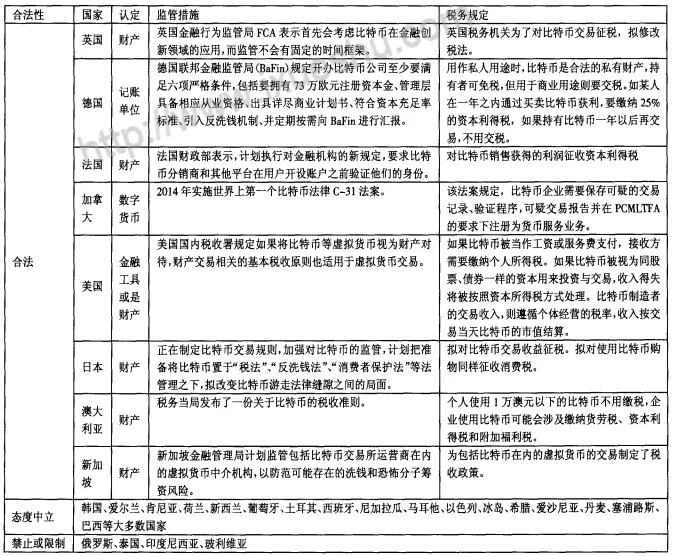
(Regulation and attitudes of major countries toward Bitcoin in 2015, Source: "Cooperative Economy and Science & Technology," Authors: Zhu Sijia, Cui Jianhua)
After Bitcoin's price broke through $1,000 in 2013, it soon entered a bear market cycle. However, exploration of Bitcoin regulatory legislation quietly accelerated during the bear market. After entering 2015, more and more traditional financial institutions and government departments in Europe and America began to deeply explore and experiment with Bitcoin's application value, sending positive signals for the development of the cryptocurrency industry.
In 2015, with the preliminary completion of Bitcoin regulatory legislation processes represented by New York State in the United States, related legislation in California also gradually emerged. The California legislature developed the state's money transmission law to explicitly regulate virtual currency business. The bill stipulates that cryptocurrency companies must have a license from the Department of Business Oversight (DBO) or have obtained tax-exempt permission from the agency to operate. Since then, California and New York have become the two poles of Bitcoin financial regulatory policy in the United States.
In Europe, regulatory policies in many countries are also changing. By 2017, many countries including Spain, Finland, Belgium, and Poland had announced allowing Bitcoin to exist or classifying it as a financial instrument, taxing or exempting from value-added tax according to law. And most of these countries had a neutral attitude two years earlier.
In Asia, following Japan, South Korea also announced in January 2018 that it would tax cryptocurrency trading platforms according to existing tax policies, with a rate of 22% corporate income tax and 2.2% local income tax. In March 2021, South Korea further began implementing a "real-name system for cryptocurrency trading," strengthening regulation of the cryptocurrency industry and promoting its orderly development.
The Thai Cabinet also passed two major royal decree drafts in March 2018. The bill aims to regulate cryptocurrency trading and tax capital gains of cryptocurrency investors.
Multinational Corporations Are Also Taking Action
Along with the improvement of regulatory policies in major countries, international corporate giants quickly followed suit.
For example, recent news: Musk announced on his social media account that Tesla would accept Bitcoin payments, which not only sparked heated discussion in the cryptocurrency community but even drove a short-term rise in Bitcoin's price.
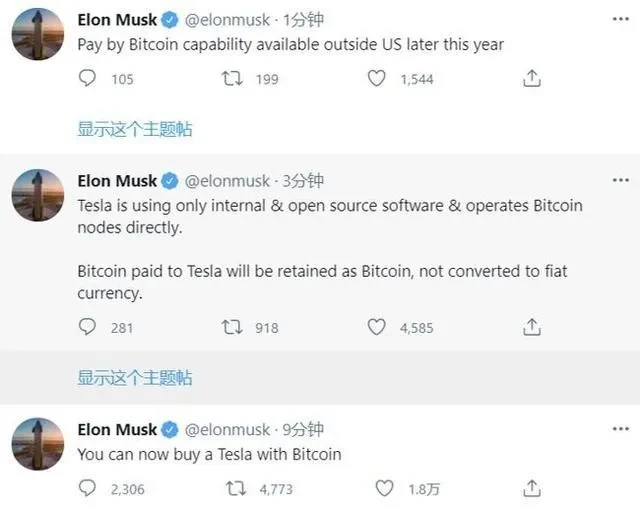
Pushing time forward, as early as 2014, companies like Dell and Microsoft had already announced support for Bitcoin payments. In the following years, gaming platform Steam, online travel giant Expedia, one of America's largest jewelry retailers Marks Jewelers, Domino's Pizza, Starbucks, NBA's Sacramento Kings and Dallas Mavericks, and others successively announced acceptance of Bitcoin payments. As Bitcoin's price continued to rise and its influence grew, the industries involved in companies supporting Bitcoin payments became increasingly diverse. According to incomplete statistics, hundreds of companies currently support Bitcoin payments.
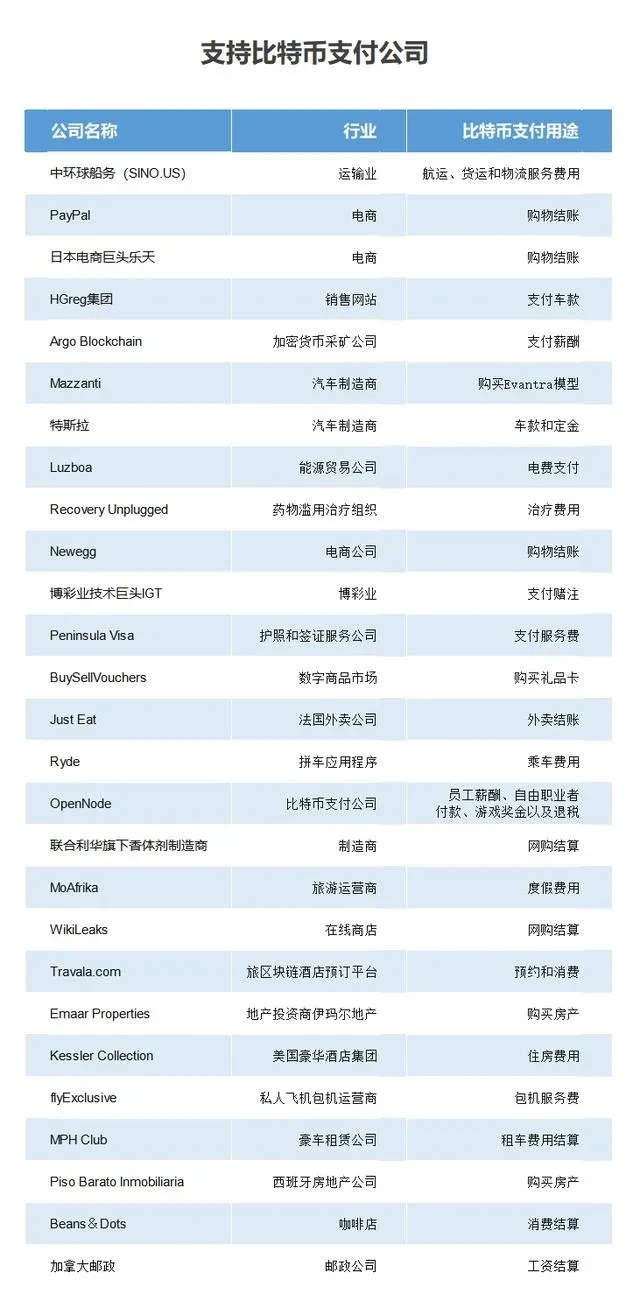
(Some companies supporting Bitcoin payments, OKX chart)
Notably, payment leaders such as PayPal and Mastercard also announced support for Bitcoin payments, and VISA announced the use of cryptocurrency USDC as a payment settlement method. The advancement of payment giants into the cryptocurrency field obviously carries much greater significance and impact. These giants, on one hand, have billions of individual users, and on the other hand, connect thousands of large and small merchants, undoubtedly providing excellent channels for cryptocurrency to further reach broader user groups. And such changes, even if only advanced 10 years ago, discussing using an asset without national credit backing as payment or value exchange would have required great imagination. But today, all this has quietly become something that is happening.
So, what exactly has happened over these ten years? What made Bitcoin go from a very niche topic in the tech geek community to today's disruptor and innovator in the world?
The most obvious is the change in Bitcoin's price. If calculated from May 2010 when 10,000 Bitcoin purchased $25 worth of pizza, to today when Bitcoin's price broke through $64,000, Bitcoin's price has soared 25.6 million times. Although Bitcoin's price has fallen back today, according to OKX market data, Bitcoin still maintains a high level of $62,000. Calculated at real-time prices, Bitcoin's total market value reaches $1.17 trillion.
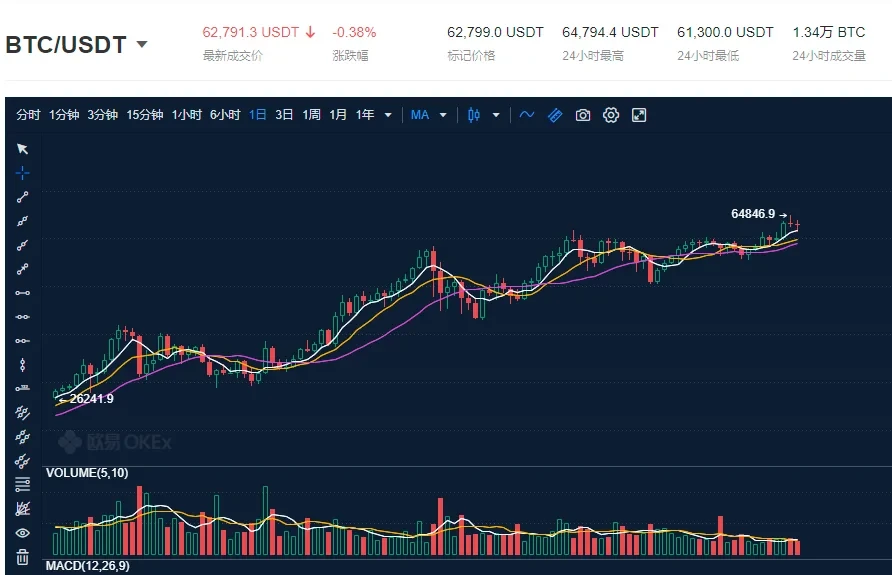
For comparison, the current total U.S. stock market value is $41.84 trillion (February 2021 data, Source: Sina Finance), and the total gold market value is between $10-11 trillion (February 2021 data, Source: Sina Finance). That is, Bitcoin's market value has reached 3% of the U.S. stock market value and 10% of the gold market value. At the same time, looking at a longer time frame, the United States took 100 years to reach today's scale, gold took 50 years, while Bitcoin took only 10 short years.
Behind these number changes is the selection and flow of funds, but even more so is the transformation of a new era replacing the old era. At every juncture driving era progress, nothing happens overnight, nor is it smooth sailing. Setbacks are inevitable during the process, but what can be certain is that once the general trend of the new era begins, it will be unstoppable.
Disclaimer
This article may contain content about products not available in your region. This article is intended to provide general information only and is not responsible for any factual errors or omissions contained herein. This article represents only the author's personal views and does not represent OKX's views. This article is not intended to provide any advice, including but not limited to: (i) investment advice or investment recommendations; (ii) offers or solicitations to buy, sell or hold digital assets; or (iii) financial, accounting, legal or tax advice. Holding digital assets (including stablecoins) involves high risk, may fluctuate significantly, and may even become worthless. You should carefully consider whether trading or holding digital assets is suitable for you based on your financial situation. For questions about your specific situation, please consult your legal/tax/investment professional. The information appearing in this article (including market data and statistics, if any) is for general reference only. Although we have taken all reasonable precautions in preparing these data and charts, we assume no responsibility for any factual errors or omissions expressed herein. © 2025 OKX. This article may be reproduced or distributed in full, or excerpts of 100 words or less from this article may be used, provided such use is non-commercial. Any reproduction or distribution of the entire article must also prominently state: "This article is copyrighted © 2025 OKX, used with permission." Permitted excerpts must cite the article name and include attribution, for example "Article Name, [Author Name (if applicable)], © 2025 OKX". Some content may be generated or assisted by artificial intelligence (AI) tools. Derivative works or other uses of this article are not permitted.
Show More
Recommended Reading
OKX Pay: Opening a New Era of Next-Generation Cryptocurrency Payments
The choice of tens of millions of users. Register with OKX to enjoy the ultimate trading experience and diverse wealth management products. A letter from OKX CEO Star: Today, we officially launch the first version of OKX Pay to over 100 million global users. As the industry's first payment application to truly achieve non-custodial and compliant integration, OKX Pay will be embedded in the OKX App, currently open to some markets, and expected to fully launch within months
March 22, 2026

New Chapter: Building Next-Generation Financial Infrastructure Together
The partnership between OKX and Intercontinental Exchange (ICE) is an important moment for OKX and equally significant for the evolution of the entire digital assets market. ICE establishes and operates the world's most important financial infrastructure, including the New York Stock Exchange and global derivatives and clearing platforms. ICE's strategic investment in OKX and joining our board reflects both parties' shared belief—digital assets technology will play a crucial role in financial markets
March 10, 2026

Tribute to Another Year of Forging Ahead
As OKX's CEO and also a builder who never forgets the original intention, I proudly review the remarkable growth and progress OKX has achieved this year. Despite numerous challenges, 2024 was a year filled with focus, innovation, and resilience. We not only expanded and optimized our products but also made important progress in launching transparent and regulatory-compliant localized businesses, while further strengthening our global management team. Notably, after experiencing
January 29, 2026

2025: Steady Progress Toward Financial Freedom Together
—— Annual letter from OKX Founder and CEO Star to global users. "Financial freedom" is often misunderstood. It doesn't mean no rules, but rather having the right to choose when rules exist—and when the system is truly tested, it remains reliable and effective. This is exactly the direction we have consistently focused on in 2025. First, I want to extend sincere gratitude to our global clients, partners, and regulatory authorities
January 16, 2026

OKX Officially Launches in Germany and Poland
Author: Erald Ghoos, CEO of OKX Europe. Today is significant for OKX—and for cryptocurrency users across Europe. We have officially launched our fully compliant centralized cryptocurrency trading platform in Germany and Poland! For us, this is not just a geographic expansion, but a commitment to building the cryptocurrency future the right way: secure, transparent, and meeting local needs. If you are in Germany
October 21, 2025

Partnership Upgrade! OKX Partners with Standard Chartered to Expand European Market
On October 15, OKX Europe CEO Erald Ghoos stated that OKX is expanding its strategic partnership with Standard Chartered to the European Economic Area (EEA). Earlier this year, OKX first partnered with Standard Chartered in the UAE to launch the collateral mirroring program—this is a
October 15, 2025