Why Do Bull Markets Often See Crashes? How to Anticipate Them?
Throughout every major bull market, sharp selloffs frequently follow significant rallies. While prices typically recover to new highs afterward, sudden market crashes can still cause substantial pain—sometimes resulting in the frustrating scenario where the price hasn't moved, yet your holdings have vanished. So, why do bull markets tend to experience dramatic crashes, and how can you anticipate them to prepare in advance? This article provides an in-depth analysis of these two questions, along with 10 common market data indicators to help you better predict market selloffs.
This bull market is shaped by a convergence of factors: Bitcoin halving, the economic cycle, global central bank stimulus triggered by the pandemic, and institutions entering at scale—making it more sustained and intense than the previous two halving cycles. There's no guarantee we won't encounter more heart-stopping rapid drops in the periods ahead.
Most market participants have heard the saying: bull markets bring crashes, bear markets bring rallies. In the context of crypto, "crashes" are virtually inseparable from bull market conditions.
Though four days have passed, many investors likely still feel the sting from Tuesday night's selloff: according to OKX data, Bitcoin plummeted from a high of $50,790 to a low of $42,619 within a single hour—an $8,000 drop, representing a 16% decline. Measured from the cycle peak of $52,920, the drawdown exceeded $10,000, or 24%.
Leading Bitcoin lower, the broader market was decimated: ETH, the second-largest cryptocurrency, fell from $4,029 at its peak to a low of $2,991—a 25.7% loss. Most mainstream coins and altcoins saw losses exceeding 30%, with many cut in half. It felt like一夜之间everything had been reset to square one.
In fact, when viewed in historical context, this drop wasn't particularly extreme for this bull market cycle. According to TradingView data, over the 8 months following Bitcoin's break above $20,000, there were 3 instances of single-day declines exceeding 20%, 11 instances exceeding 15%, including the historic May 19 crash.
Looking further back across each halving cycle:
On November 28, 2012, Bitcoin's first halving occurred. The price surged from an $11 bottom to a cycle high above $1,169—a gain of 10,500%—over the course of one year. During that cycle, there were 14 instances of single-day declines exceeding 20%, 25 instances exceeding 15%, with the largest single-day drop reaching 65%.
On July 10, 2016, Bitcoin's second halving took place. The price climbed from a $650 bottom to a cycle high of $19,800—a 2,950% gain—over roughly 18 months. During that cycle, there were 8 instances of single-day declines exceeding 20%, 17 instances exceeding 15%, with a maximum single-day drop of 31%.
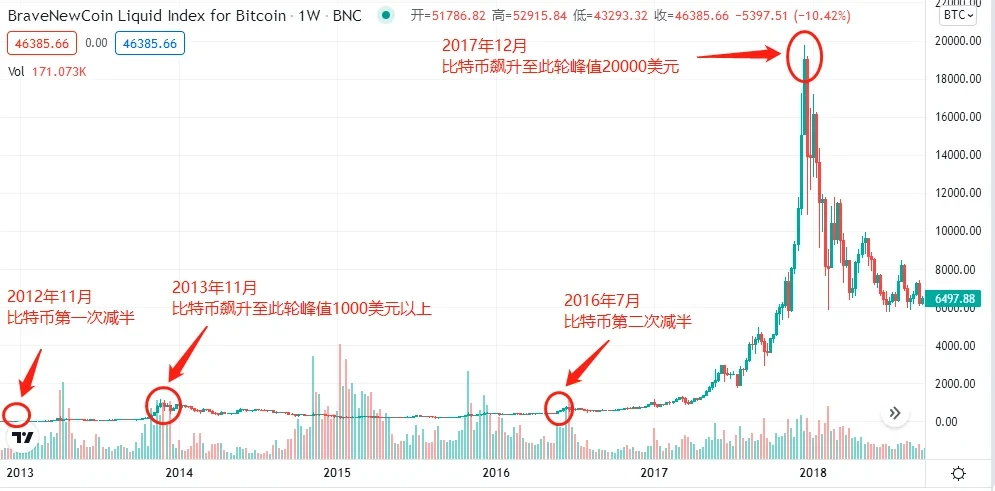
Bitcoin First and Second Halving Cycles (Source: TradingView)
Comparing data across Bitcoin's three halving cycles reveals a clear pattern: bull market duration has progressively lengthened, while the frequency and magnitude of crashes have gradually diminished.
This also suggests the crypto market is maturing, though it remains in a very early stage—because only in a market's infancy do extreme volatility and the opportunities it creates exist. A mature market loses its capacity for large fluctuations, which also means losing opportunity and vitality.
Generally speaking, the more mature a market becomes, the higher the proportion of institutional and professional investors, and the more retail participants get squeezed out. Bitcoin is trending in this direction: massive institutional and professional capital is pouring in, and each significant dip causes retail panic selling, handing a portion of their holdings to institutional and professional investors. Market power gradually shifts toward them, while retail investors' capital share in the global market steadily declines.
There's a saying in trading: opportunities are forged through crashes. If you have a sound understanding of the overall market trajectory—recognizing that we're in a bull cycle—then every dip can be viewed as an opportunity to accumulate at lower prices. So, how do you seize these opportunities? The key is understanding the underlying reasons and logic behind crashes, knowing both the what and the why, so you can truly align knowledge with action and convert your insights into profits.
Why do bull markets frequently see crashes? There are multiple answers, but the most fundamental one is: new capital flowing into the market cannot keep pace with the rate of price appreciation. At that point, bullish momentum becomes unsustainable, while profit-taking pressure mounts and sentiment gradually shifts. The market direction reverses, triggering a panic-driven exodus—and the crash unfolds.
Essentially, all investment markets—including traditional mainstream markets like real estate, stocks, and gold—share the same fundamental logic for bull market rallies: continuous influx of new capital. Other external factors merely accelerate or decelerate this process: positive catalysts speed up the bull market's progression but shorten its duration; negative catalysts slow it down but extend how long it lasts (the reasoning behind this is worth exploring—it has practical applications).
Another notable cause is the impact of derivatives such as futures, lending, and other financial instruments on spot prices. Particularly in this Bitcoin halving cycle, most major exchanges have launched derivatives and other financial services, with open interest in futures reaching successive all-time highs.
Every rally attracts large numbers of traders adding leverage to chase further gains. Eventually, deleveraging becomes necessary for the market to move forward cleanly. When leveraged long positions get liquidated, selling pressure drives prices down, triggering another wave of liquidations, more selling, and further declines... This is what the market displays: consecutive selloffs, cascading liquidations, more liquidations, more selling. Like interlocking rings of dominoes stacked in layers, each connected to the next, mutually reinforcing and因果循环. That long lower wick appearing on candlesticks during major drops is largely the handiwork of deleveraging.
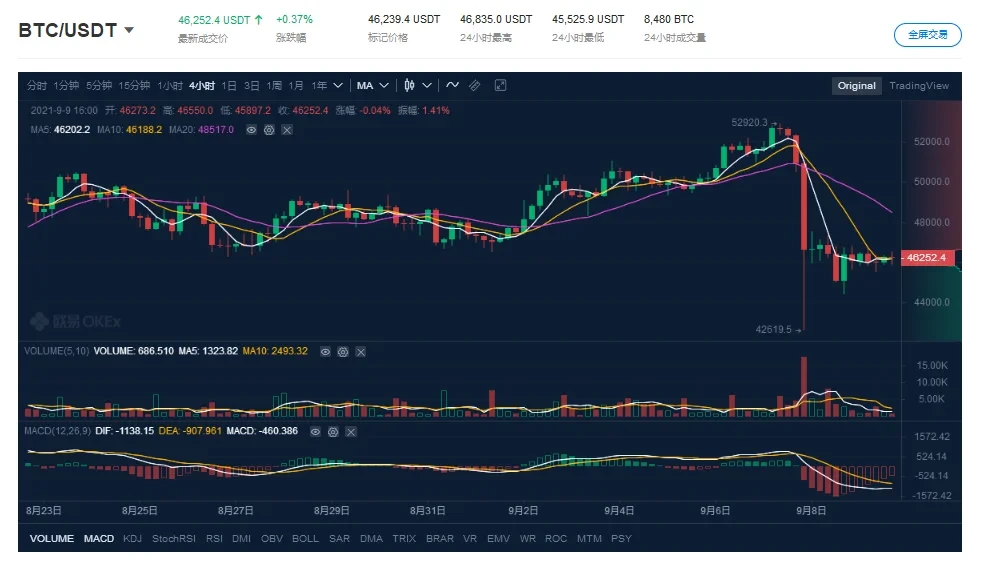
Bitcoin September 7 Crash Candlestick Chart (Source: OKX)
Now that we understand why bull markets tend to crash, how can we anticipate crashes and prepare in advance?
First, you need a thorough understanding of the fundamental logic behind each leg of a bull market's ascent: every upward move is driven by new participants and fresh capital entering the market. When there are no more "new entrants," and existing participants have no additional funds—most are already "fully invested"—this may signal a阶段性顶部, and a crash could be imminent.
Building on this logic, you can reasonably reference various data indicators to sharpen your判断, such as:
1. Bitcoin 60-Day Cumulative Gain: exceeds 80%—indicating extreme bubble risk; the higher the number, the greater the risk.
2. AHR999x Top-Grabbing Indicator: drops below 0.45—signaling a bull market top or阶段性顶部.
3. MVRV Ratio: the higher the value, the more the price is significantly overvalued and the greater the risk; above 3.5 indicates excessive bubble conditions.
4. Fear & Greed Index: the higher the reading, especially approaching 100, the more greedy the market. The longer greed persists, the greater the crash risk.
5. Bitcoin-Related Data:
- Bitcoin Market Dominance and Turnover Rate: lower dominance signals proximity to a bull market top; typically reaching 30%-40% indicates high risk. Higher turnover rates, especially sharp increases following major rallies, signal greater crash risk.
- Supply Held Over 1 Year: below 45% is a high-risk zone.
- Bitcoin Active and New Addresses: significant increases or decreases in either metric, combined with Bitcoin at relatively high prices, may signal downside risk.
6. Fund Inflow/Outflow: large-scale fund outflows or a high volume of sell orders signal crash risk.
7. Bitcoin Rainbow Chart: entering the orange/red top zone indicates extreme bubble risk.
8. Puell Multiple: examines market cycles from a mining revenue perspective. Values between 4 and 10.5 indicate relatively greedy market sentiment and potentially the late-stage of a bull run.
9. Pi Cycle Top Indicator: signals a cycle top when the 111 DMA crosses above the 350 DMA multiplied by 2.
10. RHODL Ratio: when the indicator enters the red band, it means the market is approaching the top of its cycle.
There are, of course, many other market data indicators you can reference, such as Google Trends, the S2F Model, and the NUPL indicator. These 10 are simply common examples. Ultimately, all of these data indicators require human application—they're not infallible. You can select a few to study deeply, understand their underlying logic, and use them to better anticipate market crashes.
Closing Thoughts
Investing is the变现 of your认知. If your understanding falls short, any wealth accumulated through luck will eventually be lost through mismanagement.
In a bull market, only two things truly matter: buying the dip and timing the top. For many, locking in gains at the top is more important than catching the bottom—so mastering the skill of anticipating crashes to successfully exit positions is essential.
Disclaimer
This article may contain product information not applicable to your region. This article is intended to provide general information only and makes no representation as to any factual errors or omissions. The views expressed herein are those of the author and do not reflect the opinions of OKX. This article is not intended to provide, and should not be relied upon as, any (i) investment advice or investment recommendations; (ii) an offer or solicitation of an offer to buy, sell or hold digital assets; or (iii) financial, accounting, legal or tax advice. Holdings in digital assets (including stablecoins) involve a high degree of risk and may fluctuate considerably, potentially becoming worthless. You should carefully consider whether trading or holding digital assets is appropriate for you given your financial situation. For questions regarding your specific circumstances, please consult your legal/tax/investment professional. Any information (including market data and statistical information, if applicable) appearing in this article is for general reference purposes only. While all reasonable precautions have been taken in preparing these data and charts, we assume no responsibility for any factual errors or omissions expressed herein. © 2025 OKX. This article may be reproduced or distributed in its entirety, or excerpts of 100 words or fewer may be used, provided that such use is non-commercial. Any reproduction or distribution of the full article must also include prominent attribution: "This article is © 2025 OKX, used with permission." Permitted excerpts must cite the article title and include the source, for example, "Article Title, [Author Name (if applicable)], © 2025 OKX." Some content may have been generated or assisted by artificial intelligence (AI) tools. Derivative works and other uses of this article are not permitted.
Show More
Recommended Reading

OKX Pay: Ushering in the Next Generation of Cryptocurrency Payments
The choice of tens of millions of users. Register with OKX and enjoy an exceptional trading experience alongside a full suite of wealth management products. A letter from OKX CEO Star: Today, we officially launch the first version of OKX Pay to our global user base of over 100 million. As the industry's first truly non-custodial and compliant payments application, OKX Pay will be embedded within the OKX App, currently available in select markets with a full rollout expected
March 22, 2026

A New Chapter: Building the Next Generation of Financial Infrastructure Together
The partnership between OKX and the Intercontinental Exchange (ICE) marks a significant milestone for OKX—and holds equally profound meaning for the evolution of the entire digital assets market. ICE builds and operates the world's most critical financial infrastructure, including the New York Stock Exchange and global derivatives and clearing platforms. ICE's decision to strategically invest in OKX and join our Board of Directors reflects our shared conviction—that digital assets technology will transform financial市
March 10, 2026

Reflecting on Another Year of Building
As OKX's CEO and a builder who has never forgotten his original mission, I take great pride in looking back on the extraordinary growth and progress OKX has achieved this year. Despite significant challenges, 2024 was a year defined by focus, innovation, and resilience. Not only did we expand and refine our product offerings, but we also made major strides in launching transparent, regulation-ready localized businesses, while continuing to strengthen our global management team. Notably, after navigating through a
January 29, 2026

2025: Steady Progress Toward Financial Freedom
— An End-of-Year Letter to Global Users from Star, Founder & CEO of OKX "Financial freedom" is often misunderstood. It doesn't mean the absence of rules, but rather having the freedom to choose—even in the presence of rules—and having a system you can trust to hold firm when it is truly tested. This is precisely what we remained focused on throughout 2025. First, I want to express my sincere grat
January 16, 2026

OKX Officially Launches in Germany and Poland
By Erald Ghoos, CEO of OKX Europe. Today marks a momentous day for OKX—and for crypto users across Europe. We have officially launched our fully compliant centralized cryptocurrency exchange platform in Germany and Poland! For us, this is more than a geographic expansion—it represents a commitment to building the future of cryptocurrency the right way: secure, transparent, and tailored to local needs. If you're in Germany
October 21, 2025

Partnership Upgrade! OKX and Standard Chartered Expand Across Europe
On October 15, Erald Ghoos, CEO of OKX Europe, announced that OKX is expanding its strategic partnership with Standard Chartered to the European Economic Area (EEA). Earlier this year, OKX and Standard Chartered first joined forces in the UAE, launching a collateral mirroring initiative—a
October 15, 2025