Stablecoin Market Cap Continues to Grow, Why Bitcoin Isn't Rising?
The cryptocurrency market over the past month can be described as "endlessly declining." Since Bitcoin broke below the $40,000 mark on May 19th, it has attempted multiple upward rallies, all ending in failure, currently oscillating weakly below $33,000. Meanwhile, ETH, which led the strong rally two months ago, also shows clear weakness. According to OKX market data, it fell from $4,371 to $1,941 within 40 days, a decline of 63.6%. Looking at the overall cryptocurrency market cap changes, it has also shrunk from $2.6 trillion in April to $1.36 trillion today.
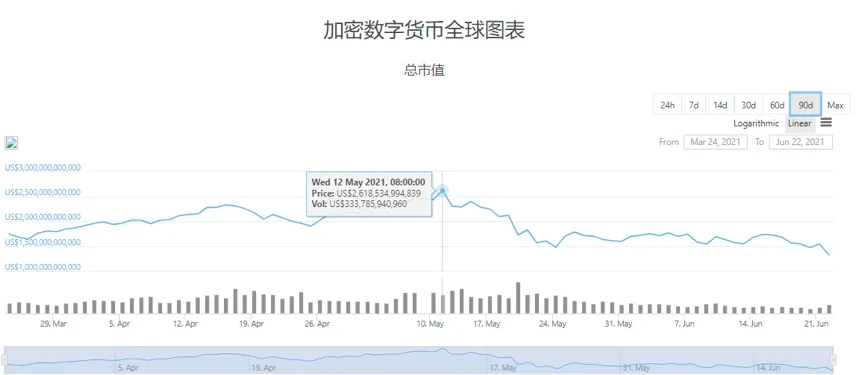
Total cryptocurrency market cap changes over the past 90 days, source: coingecko
However, amidst this bleakness, the stablecoin market seems unaffected by the overall decline. According to coingecko statistics, the current total market cap of stablecoins has surpassed $110 billion, reaching $110.33 billion, at historically high levels.
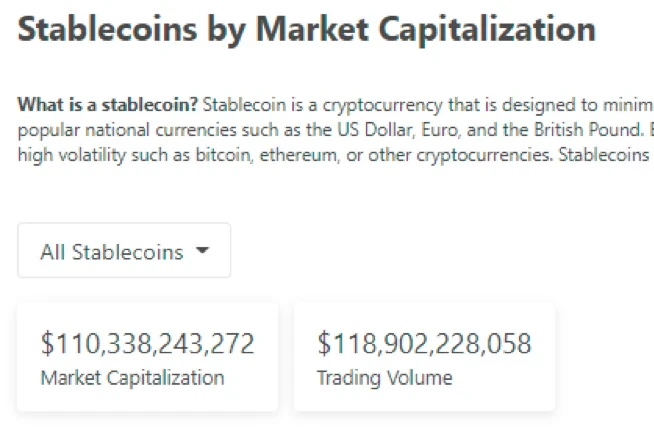
Current total stablecoin market cap, source: coingecko
Among them, USDT continues to firmly hold the top spot in the stablecoin market with a market cap of $62.68 billion. Although its market share is constantly being eroded by newcomers, it still maintains an absolute advantage with a 56.8% share. Therefore, the following content of this article will continue to focus on USDT to examine the development trajectory of the stablecoin market over the past year.
One Year, 600+ Issuances, Market Cap Achieves 10X Growth
From June 2020 to June 2021, over the past year, the total stablecoin market cap grew from $10.99 billion to today's $110.3 billion, exactly completing a 10-fold journey. Throughout this year, stablecoins not only provided solid backing during the magnificent cryptocurrency bull market but also served as essential liquidity tools for the booming DeFi sector. Moreover, during this process, in addition to traditional fiat-collateralized stablecoins, we also witnessed the rise of crypto asset-collateralized stablecoins and algorithmic stablecoins. From a data perspective, over this year, USDT's market cap grew from $9.6 billion to $62.6 billion, with corresponding market share declining from 87.5% to 56.8%; USDC's market cap grew from $950 million to $25 billion, with market share rising from 8.48% to 23.55%; while DAI's market cap also grew from $130 million a year ago to $4.86 billion, with market share rising from 1.18% to 4.64%.
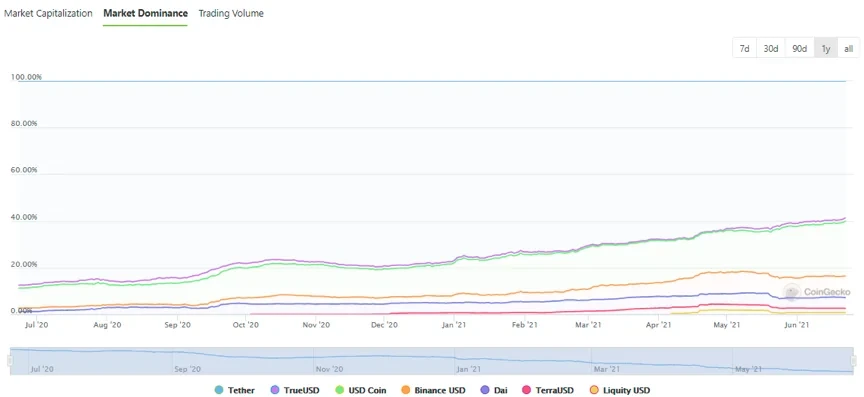
Market share changes of selected mainstream stablecoins over the past year, source: coingecko
USDT Printing Slows, On-chain Trading Decelerates
As a bellwether for the stablecoin market, historically every large-scale USDT issuance has drawn close market attention, and its on-chain trading activity is seen as an important indicator for measuring market sentiment. From the above data, we find that although USDT circulation increased by $53 billion over the past year, if we shorten the timeline to the past six months, there are new discoveries.
First is the change in issuance frequency. According to tokenview statistics, since January 2021, USDT has been issued 73 times in total, details as follows:
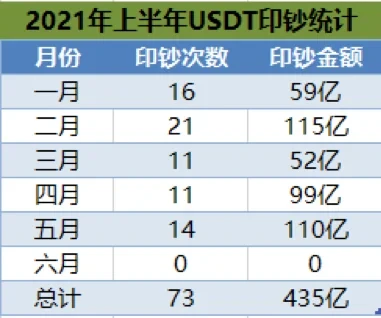
USDT issuance statistics in the first half of 2021, data source: tokenview, chart by OKX
From the above statistics, it's not difficult to find that January and February totaled 37 issuances, accounting for 50% of the first half; issuance amount reached $17.4 billion, accounting for 40% of the total first-half issuance amount. Subsequently, an overall downward trend appeared, and by June 22nd, issuance count was 0.
Second is the decline in daily trading transaction counts and trading amounts. According to tokenview statistics, on June 21st, USDT (including ERC20, Omni, and TRC20) network-wide trading transactions were 772,000, while on the 22nd as of writing, trading transactions were only 222,000, merely 13.3% of March's high point of 1.66 million, and compared to the 450,000 transactions at the beginning of the year, only 50% of that level.
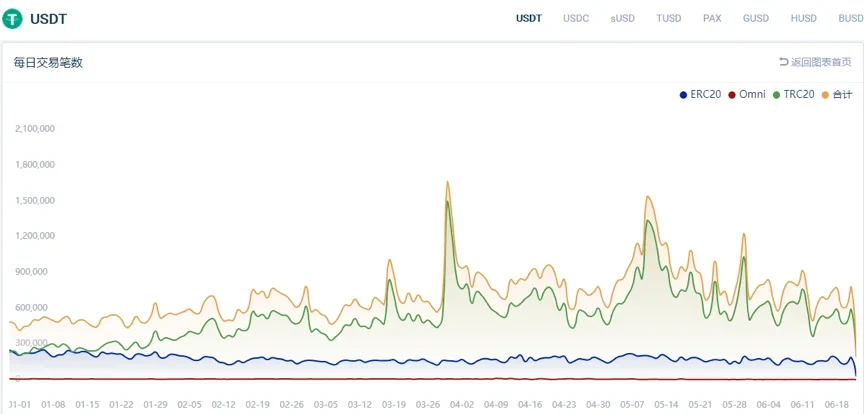
USDT daily trading transaction count changes over the past six months, source: tokenview
In terms of trading amount, a similar trend exists. Since reaching a trading peak in May, it rapidly declined, with recent 24-hour trading amount only $3.57 billion USDT, less than 10% of the May peak, and also far below the $9.62 billion trading volume at the beginning of the year.
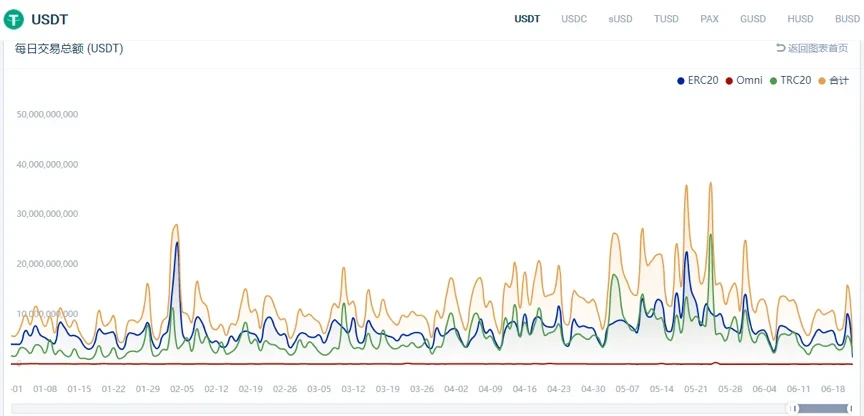
USDT daily trading amount changes over the past six months, source: tokenview
Stablecoin Market Cap Continues to Grow, Why Bitcoin Isn't Rising?
For a long time previously, every stablecoin issuance represented by USDT was interpreted by the market as a signal of incoming new funds, and Bitcoin prices would typically see varying degrees of upward movement in a relatively short period afterward. However, with the news that the total stablecoin market cap surpassed $110 billion, so far, Bitcoin and other mainstream crypto asset prices haven't shown any signs of increase. So has this indicator failed? Of course not.
In fact, there's a major misconception here, or rather treating experience as having rigorous logical causality. What many investors have long believed—that stablecoin issuance necessarily leads to price increases for Bitcoin and other crypto assets—is more of a summary at the experiential level, and the validity of this experience also requires certain prerequisites. First, in the cryptocurrency market before June 2020, although there were institutional investors positioning themselves, the overall capital volume didn't hold an advantage. Taking Grayscale, which we're most familiar with, as an example, in early June 2020, its BTC holdings were only 360,000, while by the end of January 2021, it rapidly increased to 650,000, meaning Grayscale increased its holdings by 80% of its position over the past five years in just half a year. This phenomenon aligns perfectly with the market view that "this bull market is driven by institutional investors." Based on this, we can say that after mid-2020, during the acceleration phase of this bull market, more institutional investors entered the market with capital through compliant channels, driving Bitcoin's price increase, and these investors clearly have minimal demand for USDT and other stablecoins.
Secondly, another obvious change is that DeFi has risen at an unimaginable speed, with new decentralized investment methods like liquidity mining attracting large amounts of capital. We know that participating in DeFi protocol liquidity mining not only requires crypto assets like ETH but also large amounts of stablecoins to complete trading. Thus, DeFi has also become an important destination for stablecoins, a new situation unprecedented in the cryptocurrency market.
Therefore, after significant changes in both internal and external cryptocurrency market environments, investors also need to adapt accordingly, with updated understanding of the impact of stablecoin issuance, as well as the facts of reduced USDT printing frequency, declining trading transaction counts, and decreasing trading amounts mentioned above.
It should be noted that while cryptocurrency market volatility was significant in the first half of this year, stablecoin flows between secondary markets and DeFi protocols were also quietly changing.
According to glassnode statistics, in the first half of 2021, the stablecoin share held by crypto asset exchanges and the share locked in DeFi smart contracts showed opposite trends. Specifically:
In crypto asset exchanges, the stablecoin share held has fallen from a high of 14.55% in February to 2.45% on June 22nd. In specific quantities, it decreased from $4.13 billion to $1.52 billion.
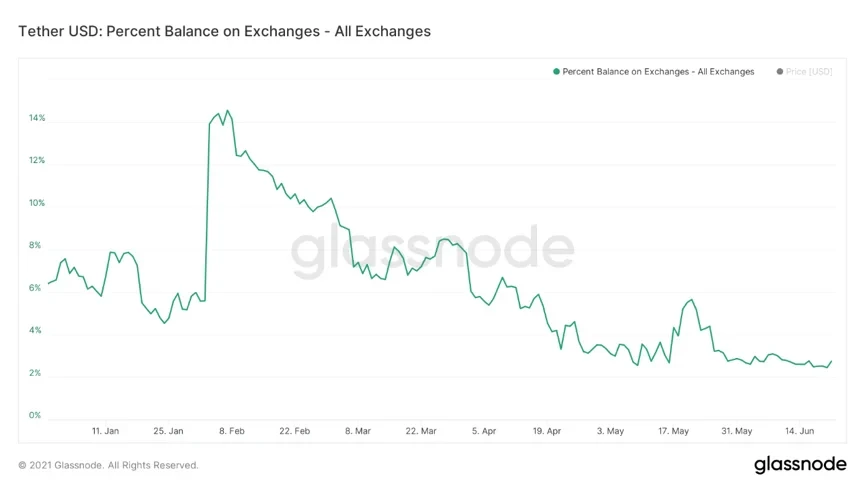
Exchange-held stablecoin share changes over the past six months, source: glassnode
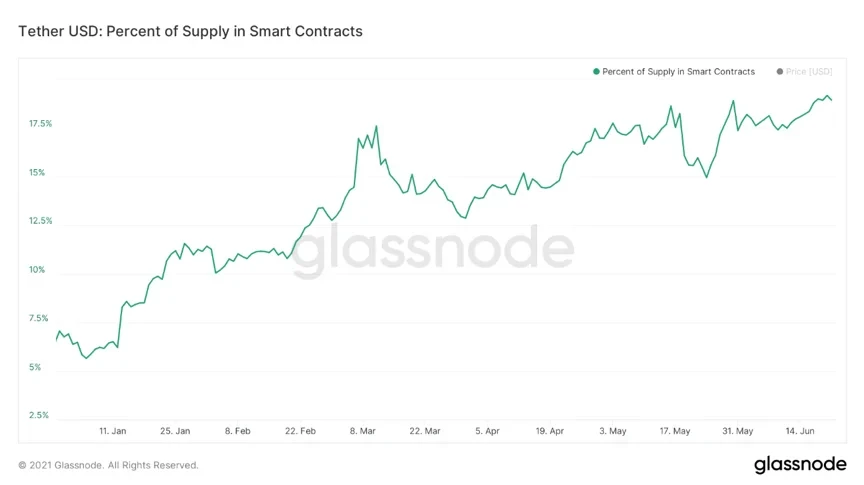
Stablecoin share locked in DeFi smart contracts over the past six months, source: glassnode
Meanwhile, in DeFi smart contracts, the locked stablecoin share rose from 5.65% to 18.94%. By comparison, the change is quite significant.
Finally, let's also pay attention to algorithmic stablecoins. Although currently among the three major categories of stablecoins, algorithmic stablecoins don't hold advantages in price stability, market cap, or application scope, as the most thoroughly decentralized stablecoins, they are undoubtedly the ideal partners for DeFi's future development. For example, Fei, a new-generation algorithmic stablecoin that recently garnered significant market attention, has returned above water value after early turbulence, currently ranking tenth in the stablecoin market with a $400 million market cap.
In the long term, the stablecoin market structure has already undergone tremendous changes quietly. With continuous DeFi innovation and development, I believe there's still considerable room for expansion in stablecoin application scenarios. Future stablecoins will exist not merely as bridges connecting on-exchange and off-exchange trading and as safe-haven assets within exchanges, which requires us to view this important infrastructure in the cryptocurrency market with a developmental rather than static perspective.
Disclaimer
This article may contain content about products not available in your region. This article is intended to provide general information only and does not accept responsibility for any factual errors or omissions contained herein. This article represents the author's personal views only and does not represent OKX's views. This article is not intended to provide any advice, including but not limited to: (i) investment advice or investment recommendations; (ii) offers or solicitations to buy, sell, or hold digital assets; or (iii) financial, accounting, legal, or tax advice. Holding digital assets (including stablecoins) involves high risk, may fluctuate significantly, and may even become worthless. You should carefully consider whether trading or holding digital assets is suitable for you based on your financial situation. For questions about your specific situation, please consult your legal/tax/investment professional. Information appearing in this article (including market data and statistics, if any) is for general reference only. While we have taken all reasonable care in preparing these data and charts, we accept no responsibility for any factual errors or omissions expressed herein. © 2025 OKX. This article may be reproduced or distributed in full, or excerpts of 100 words or less from this article may be used, provided such use is non-commercial. Any reproduction or distribution of the entire article must also prominently state: "Copyright © 2025 OKX. Used with permission." Permitted excerpts must cite the article name and include attribution, for example "Article Name, [Author Name (if applicable)], © 2025 OKX". Some content may be generated or assisted by artificial intelligence (AI) tools. Derivative works or other uses of this article are not permitted.
Show More
Recommended Reading
OKX Pay: Opening a New Era of Next-Generation Crypto Payments
The choice of tens of millions of users. Register with OKX to enjoy ultimate trading experience and diverse wealth management products. A letter from OKX CEO Star: Today, we are officially launching the first version of OKX Pay to our hundreds of millions of global users. As the industry's first payment application to truly achieve non-custodial and compliant integration, OKX Pay will be embedded in the OKX App, currently available to select markets, expected to fully
March 22, 2026

New Chapter: Building Next-Generation Financial Infrastructure Together
OKX's partnership with Intercontinental Exchange (ICE) marks an important moment for OKX and holds equally profound significance for the evolution of the entire digital assets market. ICE establishes and operates the world's most important financial infrastructure, including the New York Stock Exchange and global derivatives and clearing platforms. ICE's strategic investment in OKX and joining our board reflects both parties' shared belief—digital assets technology will transform financial markets
March 10, 2026
Tribute to Another Year of Forging Ahead
As OKX's CEO, and also a builder who remains true to our original mission, I proudly look back on OKX's extraordinary growth and progress this year. Despite numerous challenges, 2024 was a year of focus, innovation, and resilience. We not only expanded and optimized our products but also made significant progress in launching transparent and compliant localized operations, while further strengthening our global management team. Notably, after experiencing
January 29, 2026

2025: Steady Progress Toward Financial Freedom Together
— Annual letter from OKX Founder and CEO Star to global users "Financial freedom" is often misunderstood. It doesn't mean absence of rules, but rather having the right to choose while rules exist—and when the system is truly tested, it remains reliable and effective. This is exactly the direction we've remained focused on throughout 2025. First, I want to extend sincere gratitude to our global clients, partners, and regulatory authorities
January 16, 2026

OKX Officially Launches in Germany and Poland
Author: Erald Ghoos, CEO of OKX Europe Today is significant for OKX—and for cryptocurrency users across Europe. We have officially launched our fully compliant centralized cryptocurrency trading platform in Germany and Poland! For us, this is not just a geographic expansion, but a commitment to building the cryptocurrency future the right way: secure, transparent, and meeting local needs. If you're in Germany
October 21, 2025

Partnership Upgrade! OKX Partners with Standard Chartered to Expand European Market
On October 15th, Erald Ghoos, CEO of OKX Europe, stated that OKX is expanding its strategic partnership with Standard Chartered to the European Economic Area (EEA). Earlier this year, OKX first partnered with Standard Chartered in the UAE to launch the collateral mirroring program—a
October 15, 2025