Stablecoin Market Cap Growth Slows – Can the Bull Market Continue?
Since Bitcoin price found support at the $30,000 mark again in late July, it rose all the way to around $48,000 over the following month, a gain of up to 60%. According to OKX market data, Bitcoin price has pulled back in the past two days and is currently trading around $46,200.
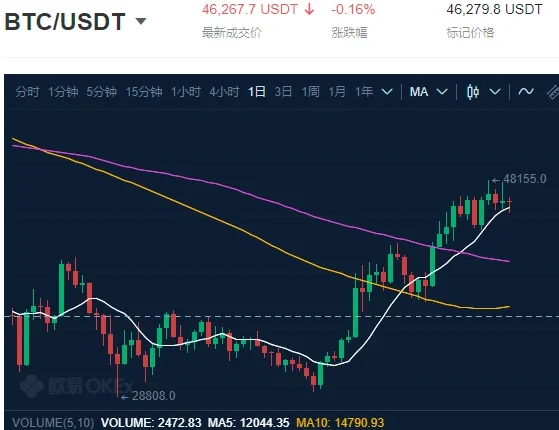
Recent Bitcoin price trend, source: OKX
However, at the same time, we surprisingly discovered that as Bitcoin price stabilized and recovered, the overall crypto market also presented a thriving picture in the short term. For example, looking at total market capitalization data, it returned above $2 trillion for the first time in three months, a gain of over 55% compared to the cyclical low of $1.29 trillion on July 20, and only 23% away from the previous high of $2.6 trillion. So when the market reaches this point, it inevitably raises the question again: Is the crypto bull market back?
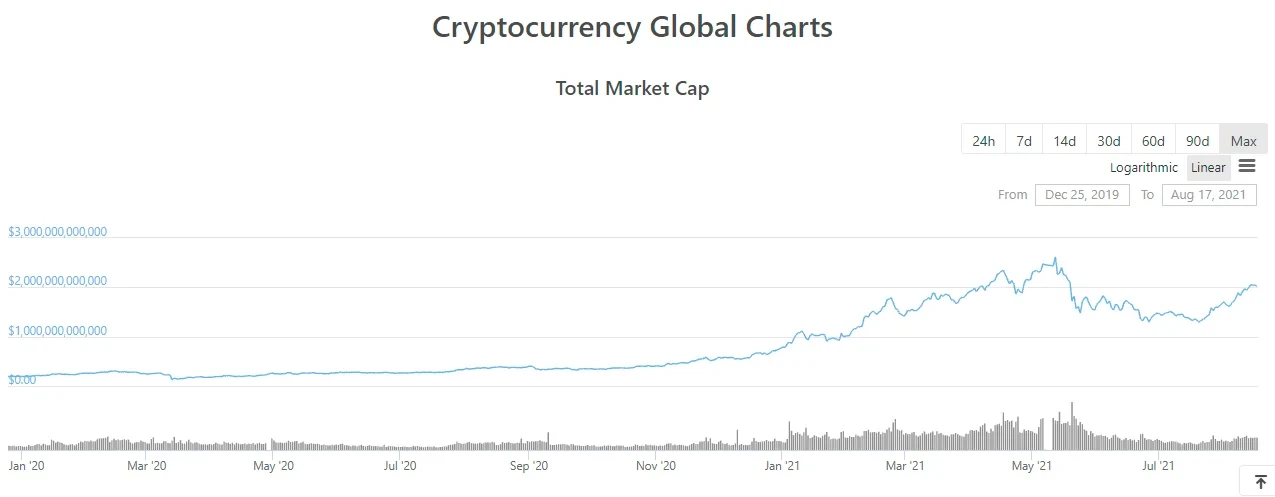
Crypto market total cap trend since 2020, source: coingecko
Last week when Bitcoin price stood above the 120-day line, we discussed from dimensions including Bitcoin balance changes in CEX addresses and inflow/outflow situations, as well as changes in the number of addresses holding different amounts. Today, let's take a different approach by examining stablecoin issuance over recent months and corresponding market cap changes to revisit this question.
First, let's understand the stablecoin market overview. According to coingecko statistics, there are currently 59 stablecoins in the market, nearly half of which aim to peg to the US dollar, with USDT and USDC firmly in the top two spots. The current total market capitalization of stablecoins is $118.511 billion, accounting for 5.93% of total crypto market cap.
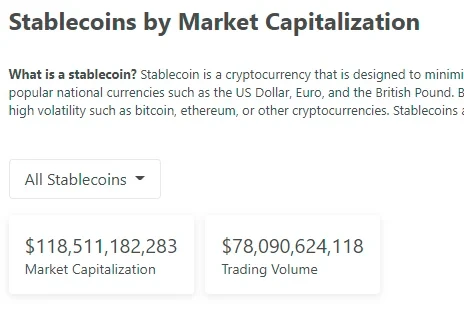
Stablecoin market total cap data, source: coingecko
Regarding stablecoin classification, we have introduced it multiple times in previous articles. From the perspective of whether there are collateral assets and the type of collateral assets, they can be divided into fiat-collateralized stablecoins, crypto asset-collateralized stablecoins, and algorithmic stablecoins; from the degree of decentralization perspective, they can be divided into centralized stablecoins, semi-centralized stablecoins, and decentralized stablecoins, etc., which we won't elaborate on here. At the same time, due to different economic models and application scenarios between algorithmic stablecoins and collateralized stablecoins, when discussing the impact of stablecoins on overall crypto market trends, we will focus on collateralized stablecoins, mainly emphasizing issuance, market cap changes, trading volume of mainstream stablecoins, and finally briefly compare key stablecoin indicators from 2020 to May 2021 during extreme market conditions.
Currently among collateralized stablecoins, major fiat-collateralized stablecoins include USDT, USDC, PAX, TUSD, etc., while well-known crypto asset-collateralized stablecoins include Dai.
According to Tether official website information, current total USDT market cap is $64.06 billion (including authorized but unissued portions), with actual circulating market cap of $63.898 billion; at the same time, we can see that Tether has issued EURT, a euro-pegged stablecoin, currently with circulating market cap of approximately 44.9988 million euros (approximately $52.6486 million), which we might as well include here.
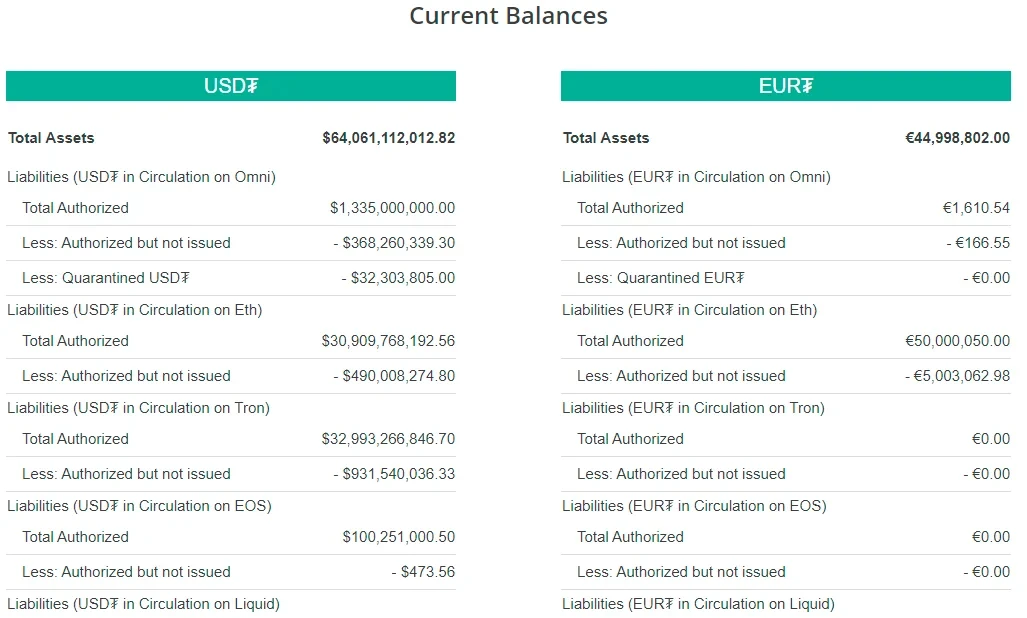
USDT and EURT issuance and market cap data (partial), source: Tether official website
In addition, looking at the time distribution of USDT issuances, after experiencing the issuance frenzy of the first half of 2021, it went through a prolonged lull from June to August, with zero USDT issuance for two months during June and July, until completing the first issuance of Q3 on August 9, totaling 1 billion USDT, then completing the second issuance on August 15.
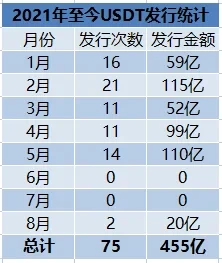
2021 USDT issuance statistics, data source: tokenview, chart: OKX
From the above statistics, it's not hard to see that since entering 2021, USDT market cap increase reached $45.5 billion, accounting for 71.2% of current circulating total market cap; of this $45.5 billion increase, issuance in the first 6 months was $43.5 billion, accounting for over 95.6%.
Next, let's look at USDC. According to coingecko statistics, USDC currently has total circulating market cap of $27.4 billion, firmly holding the second spot in stablecoin market by market cap. Looking at each issuance, unlike USDT's characteristics of low frequency and large single amounts, USDC issuance shows high frequency and small amounts. From the comparison below, we can also see that during June-August when USDT issuance stagnated, USDC instead experienced a small issuance peak.
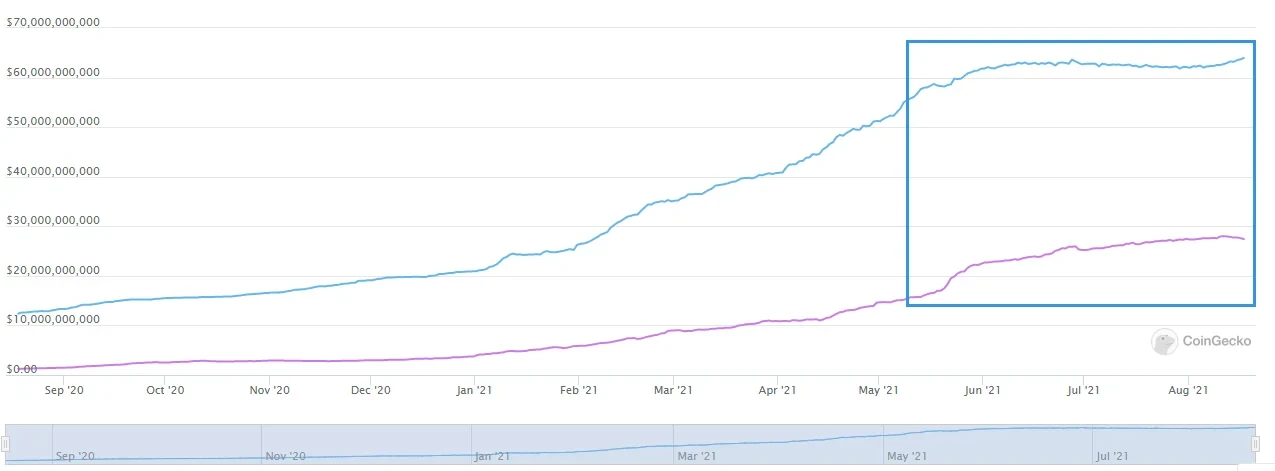
Comparison of USDC (bottom) and USDT (top) market cap changes, source: coingecko
Among fiat-collateralized stablecoins, besides the two giants above, others such as TUSD, PAX, GUSD, although relatively small in total market cap, still show good upward momentum. From coingecko statistics, we can see that current TUSD circulating market cap is $1.297 billion, a gain of 329.47% compared to the yearly low ($302 million on January 11, 2021). However, looking at the past three months, TUSD's total market cap experienced significant shrinkage, dropping from a high of $1.68 billion to as low as $1.234 billion.
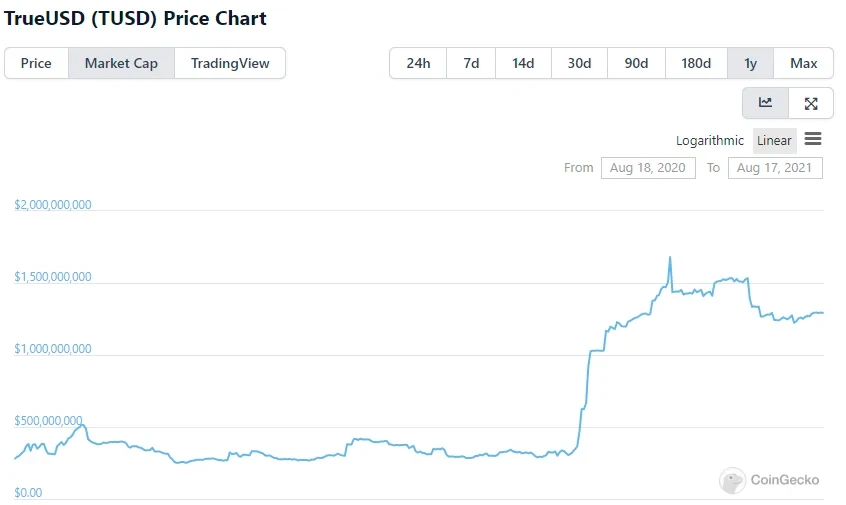
TUSD market cap changes over the past year, source: coingecko
Now let's look at PAX and GUSD. PAX current total circulating market cap is $942 million, GUSD circulating total market cap is $293 million. Similar to TUSD's market cap trend during the same period, PAX and GUSD also experienced a process of first rising then falling, and neither has returned to previous peak market cap levels.
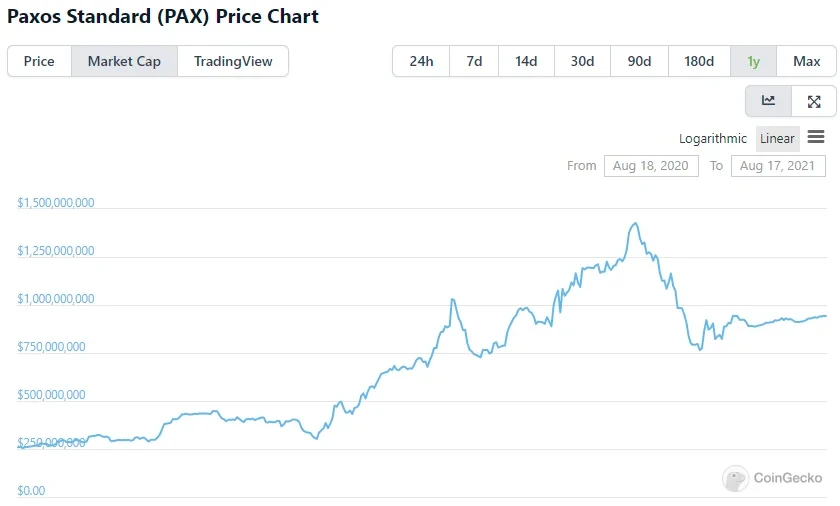
PAX market cap changes over the past year, source: coingecko
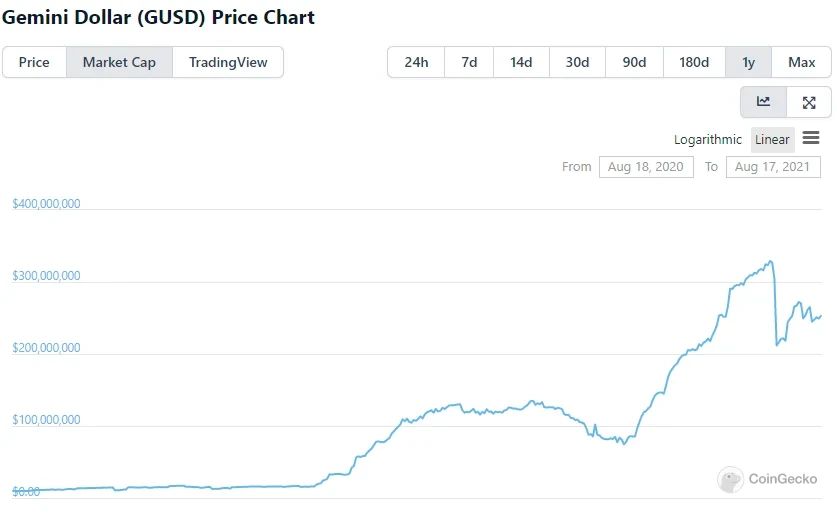
GUSD market cap changes over the past year, source: coingecko
Finally, let's look at Dai, the representative of crypto asset-collateralized stablecoins. According to coingecko data, Dai's current total circulating market cap is $5.706 billion, a gain of over 388.94% compared to the beginning of the year's $1.167 billion. Specifically looking at the past three months, it also shows a relatively obvious upward trend, with circulating market cap expanding from $4.051 billion in May to $5.706 billion, growth approaching 41%.
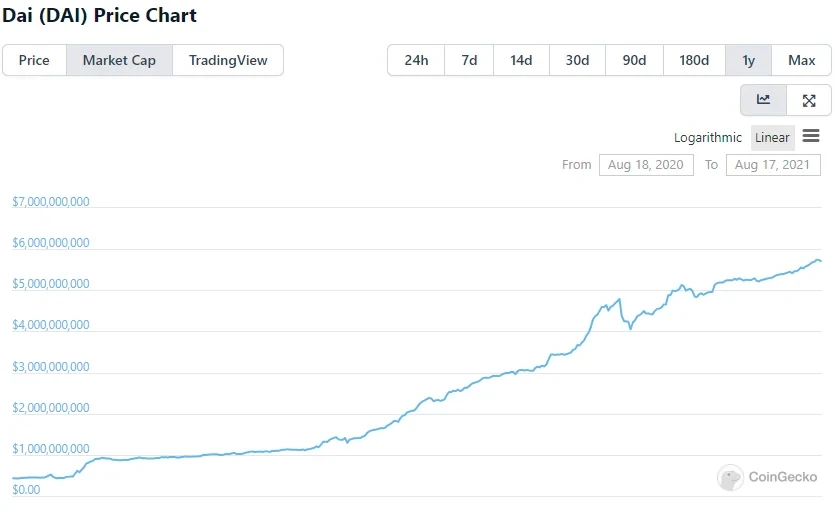
Dai market cap changes over the past year, source: coingecko
To briefly summarize, looking at the performance of the selected collateralized stablecoins over recent months, their total market cap has reached $93.883 billion. Besides Dai and USDC showing significant increases in market cap over recent months, the rest are basically in a stagnant or declining state. From the trading volume dimension, data for all the above stablecoins show significant declines. Taking USDT trading volume statistics from coingecko as an example, trading volume on the 17th of this month was only $69.259 billion, not only far below the yearly peak of $295.373 billion, but even returning to late 2020 levels.
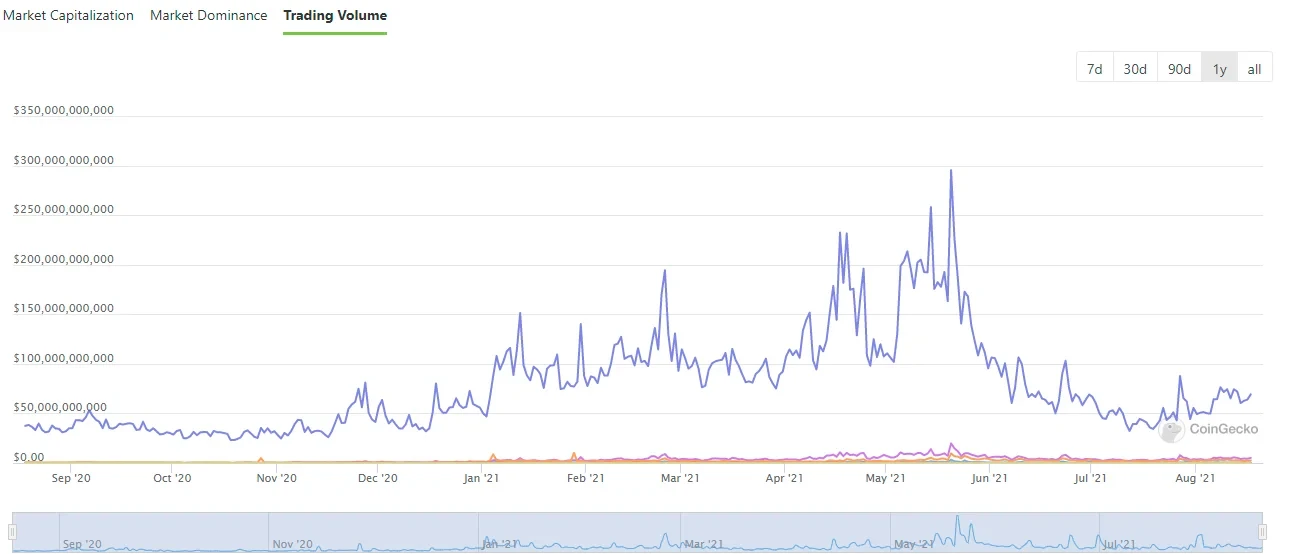
Mainstream stablecoin trading volume trends over the past year, source: coingecko
Next, let's review changes in stablecoin market circulating market cap from early 2020 before the May 19 extreme market event in 2021. In fact, from the description above, we've already been able to detect some clues. Let's use data to verify this further.
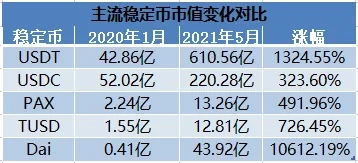
Comparison of mainstream stablecoin market cap changes between January 2020 and May 2021, data source: coingecko, chart: OKX
From the comparison chart above, we can intuitively see that during the 2020-2021 bull market, stablecoins represented by USDT all experienced large-scale issuance or accelerated issuance periods. Among them, USDT's market cap increased more than 13-fold, Dai's market cap increased the most, exceeding 106-fold, and USDC, which had the least issuance during this period, still achieved a 3.23-fold increase. As stablecoins serve as an important bridge connecting the traditional financial world and the crypto world, there's no doubt that the large-scale expansion of stablecoin market cap described above played an undeniable role in driving Bitcoin and even the entire crypto market upward. Looking at stablecoin issuance speed and market cap growth magnitude over the past three months, it's clearly incomparable to the prosperity from January 2020 to May 2021.
So can we say that without stablecoin boost, this bull market can be declared completely over? Obviously, this conclusion is very rigorous. On one hand, with institutional investors entering the market in large numbers since 2020, especially with the launch of many compliant channels such as Grayscale Trust, North American Bitcoin ETFs, and Ethereum ETFs, providing investors with more convenient and safe methods to invest in crypto assets. From this perspective, stablecoin application space has been greatly compressed. In other words, as the compliance process of crypto asset investment continues to advance, for investors wanting to invest in Bitcoin, Ethereum and other crypto assets, stablecoins are no longer a necessary option, and may even form a trade-off competitive relationship. Therefore, when we saw above that TUSD, PAX and GUSD circulating market caps decreased rather than increased over the past three months, we shouldn't be surprised.
On the other hand, with the rapid development of DeFi, the relatively safe and stable returns method of liquidity mining has attracted more and more stablecoins to flow into various DeFi protocols. According to glassnode statistics, stablecoins currently locked in smart contracts account for 19.74% of total stablecoin circulation.
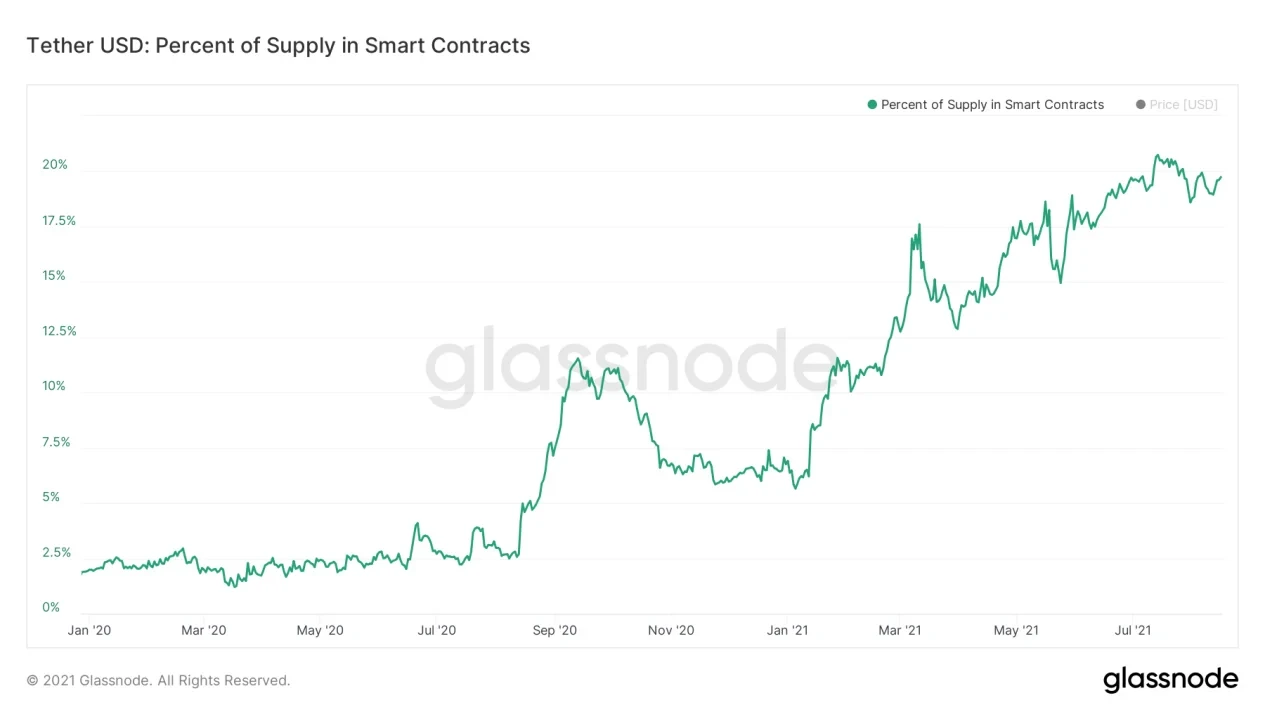
Ratio of stablecoins locked in smart contracts to total stablecoin circulation, source: glassnode
In early 2020, this ratio was only 1.9%. Thus, we can see that besides being used by investors to directly invest in crypto assets, a large portion of issued stablecoins are locked in DeFi smart contracts. Therefore, from the current crypto market situation, we can no longer simply apply the old experience of stablecoin issuance - inflow to CEX - driving market up. Similarly, the recent fact of slowing stablecoin issuance growth also cannot support the conclusion that the crypto market cannot continue to rise going forward, because the major premise of the market has quietly changed, and our way of looking at the market naturally needs to change accordingly.
Disclaimer
This article may contain content related to products that are not available in your region. This article is intended to provide general information only and does not take responsibility for any factual errors or omissions therein. This article represents only the author's personal views and does not represent OKX's views. This article is not intended to provide any of the following advice, including but not limited to: (i) investment advice or investment recommendations; (ii) offers or solicitations to buy, sell or hold digital assets; or (iii) financial, accounting, legal or tax advice. Holding digital assets (including stablecoins) involves high risk, may fluctuate significantly, and may even become worthless. You should carefully consider whether trading or holding digital assets is suitable for you based on your financial situation. For questions about your specific situation, please consult your legal/tax/investment professional. Information appearing in this article (including market data and statistics, if any) is for general reference only. Although we have taken all reasonable precautions in preparing these data and charts, we assume no responsibility for any factual errors or omissions expressed herein. © 2025 OKX. This article may be copied or distributed in full, or excerpts of 100 words or less from this article may be used, provided such use is non-commercial. Any copying or distribution of the entire article must also prominently state: "Copyright © 2025 OKX. Used with permission." Permitted excerpts must cite the article name and include attribution, for example "Article Name, [Author Name (if applicable)], © 2025 OKX". Some content may be generated or assisted by artificial intelligence (AI) tools. Derivative works or other uses of this article are not permitted.
Show More
Recommended Reading
OKX Pay: Opening a New Era of Next-Generation Crypto Payments
The choice of tens of millions of users. Register OKX to enjoy ultimate trading experience and diverse wealth management products. A letter from OKX CEO Star: Today, we officially launch the first version of OKX Pay to over 100 million global users. As the industry's first payment application to truly achieve non-custodial and compliant integration, OKX Pay will be embedded in the OKX App, currently open to select markets, expected to fully launch within months
March 22, 2026

New Chapter: Building Next-Generation Financial Infrastructure Together
OKX's partnership with Intercontinental Exchange (ICE) is an important moment for OKX and equally significant for the evolution of the entire digital asset market. ICE establishes and operates the world's most important financial infrastructure, including the New York Stock Exchange and global derivatives and clearing platforms. ICE's strategic investment in OKX and joining our board reflects both parties' shared belief—digital asset technology will transform financial markets
March 10, 2026

Tribute to Another Year of Forging Ahead
As OKX's CEO, and also a builder who stays true to our original mission, I'm proud to look back on OKX's remarkable growth and progress this year. Despite many challenges, 2024 was a year of focus, innovation and resilience. We not only expanded and optimized our products, but also made important progress in launching transparent and compliant localized operations, while further strengthening our global management team. Notably, after experiencing
January 29, 2026

2025: Steady Progress Toward Financial Freedom Together
— Year-end letter from OKX Founder and CEO Star to global users "Financial freedom" is often misunderstood. It doesn't mean no rules, but rather having the right to choose even when rules exist—and when the system is truly tested, it remains reliable and effective. This is exactly what we focused on throughout 2025. First, I want to extend sincere gratitude to our global clients, partners and regulatory authorities
January 16, 2026

OKX Officially Launches in Germany and Poland
Author: Erald Ghoos, CEO of OKX Europe Today is a significant day for OKX—and for crypto users across Europe. We have officially launched our fully compliant centralized cryptocurrency trading platform in Germany and Poland! For us, this is not just geographic expansion, but a commitment to building the cryptocurrency future the right way: secure, transparent, and meeting local needs. If you're in Germany
October 21, 2025

Partnership Expanded! OKX Partners with Standard Chartered to Expand European Market
On October 15, OKX Europe CEO Erald Ghoos stated that OKX is expanding its strategic partnership with Standard Chartered to the European Economic Area (EEA). Earlier this year, OKX first partnered with Standard Chartered in the UAE to launch the collateral mirroring program—a
October 15, 2025