In this bull market known as the "institutional bull," have professional investors made money?
To begin with, let's pose a question: In the 2020-2021 crypto market bull run, do you think the professional investors who rushed in have made money?
After a full decade of vigorous development, the total market capitalization of the crypto market has successfully joined the trillion-dollar club, reaching as high as $2.47 trillion this May. Even after more than two months of continuous declines, the current market capitalization remains at $1.3 trillion, comparable to the stock market scale of countries like South Korea, Switzerland, Australia, and Canada.
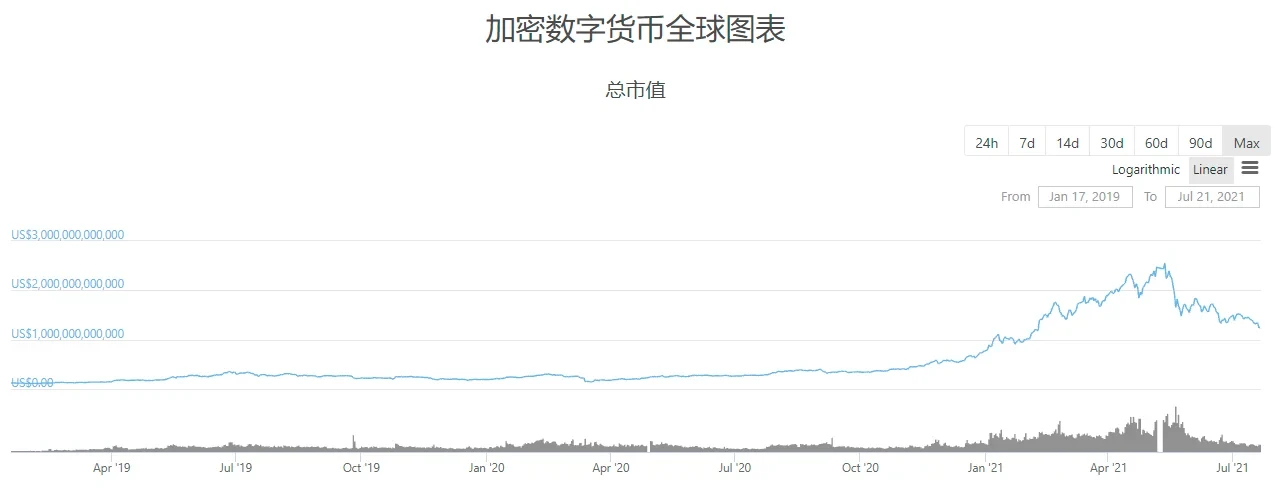
Changes in total crypto market capitalization since January 2019, source: coingecko
Accompanying the expansion of crypto market capitalization is the diversification of trading participants and increasing professionalization of market trading. Specifically, in the previous two bull markets, retail investors were more active in the market. However, since the 2017 bull market, unsurprisingly, more and more professional investors have begun to get involved, especially in the past year or so, with professional investors showing an accelerating trend of entering the market. At the same time, they have also brought rich and diverse investment methods from traditional financial markets to the crypto market. For example, the trust model represented by Grayscale, and the Purpose Bitcoin ETF launched by Purpose Investments, among others.
Overall, participants in the current crypto market can be roughly divided into four categories: retail investors, crypto hedge funds (such as Brevan Howard Capital), crypto venture capital (such as Digital Currency Group), and institutional investors (such as MicroStrategy, Tesla, etc.). The latter three categories are generally referred to as professional investors in the market. Since these types of investors mostly have strong asset strength and have natural advantages in accessing market information compared to ordinary retail investors, it's easy to assume that professional investors in the crypto market are sure to make money without losing. So in this article, relying on public market data, we will focus on analyzing representative institutions among the above three types of professional investors to see how everyone's returns are performing as this round of market action reaches this point.
First, let's look at the overall situation. According to statistics from OK Link, a well-known blockchain information service website, there are currently 42 companies that directly hold Bitcoin positions (not including companies that hold Bitcoin through trust institutions such as Grayscale), holding 545,700 Bitcoin, with a current total value of $17.672 billion, accounting for 2.95% of Bitcoin's total market capitalization.
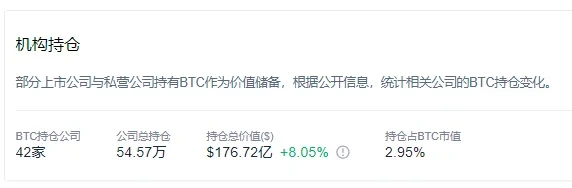
Institutional Bitcoin holdings data, source: OKLink On-Chain Master
The Enigmatic Tesla
Although Tesla is neither the earliest entrant nor the largest-scale investor among known professional investors, due to Musk's powerful influence in the crypto market over the past year, we'll look at it first.
On July 21, according to an estimate by Fortune magazine, as Bitcoin prices fell below $30,000 the previous day, Tesla's nearly $1.5 billion in paper gains from investing in Bitcoin had completely retraced and even turned into a loss. If Bitcoin falls to $25,000, Tesla will suffer a $300 million loss; if it falls to $20,000, the loss will rise to $500 million, equivalent to almost all of Tesla's pre-tax profit for the first quarter.
Clearly, the estimate made by Fortune magazine above has a premise: that Tesla did not sell again after selling 10% of its holdings in the first quarter to "verify Bitcoin's liquidity." Although Musk stated through his social account multiple times in the second quarter that neither he personally nor Tesla had sold Bitcoin, before seeing Tesla's second-quarter financial report, we still need to put a question mark on Musk's statement. After all, in the face of vital interests, no "promise" can be easily trusted, especially when this "promise" comes from Musk.
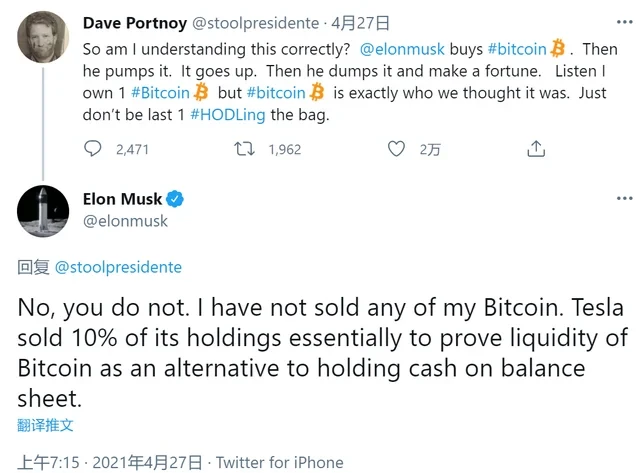
Musk's reply regarding "testing Bitcoin liquidity and not selling Bitcoin again," source: social media screenshot
Next, let's briefly review Tesla's record of trading Bitcoin this year.
On the evening of February 8 Beijing time, in a file Tesla submitted to the U.S. Securities and Exchange Commission (SEC), the company stated that it had purchased $1.5 billion worth of Bitcoin. Tesla stated in the file that the purchase of Bitcoin was to "gain more flexibility to further diversify and maximize our returns on cash." At the same time, the file also showed that Tesla sold some Bitcoin in the first quarter, generating $272 million in cash and profiting $101 million. Meanwhile, the net value of crypto assets on Tesla's balance sheet at the end of the first quarter was $1.331 billion. So what is Tesla's cost?
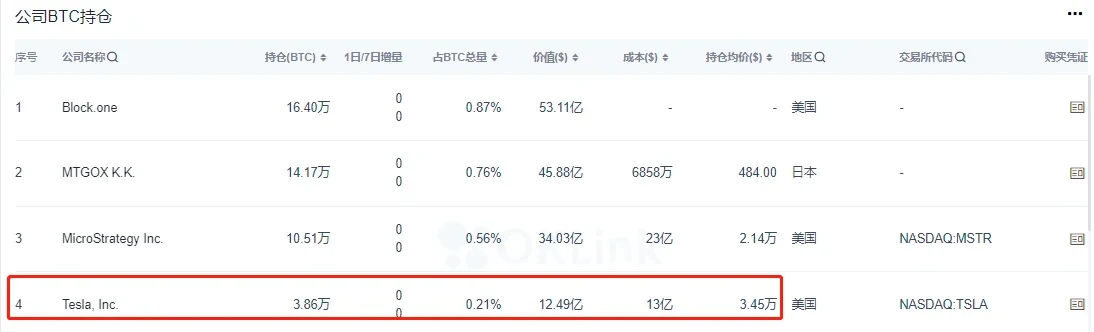
Tesla Bitcoin holdings information, source: OKLink On-Chain Master
We might refer to the information provided by OKLink On-Chain Master. According to OKLink On-Chain Master statistics, Tesla currently holds 38,600 Bitcoin with a cost of $1.3 billion, and an average holding price of $34,500. According to OKX market data, as of 15:00 Hong Kong time on July 22, Bitcoin was quoted at $32,000, having already fallen below Tesla's cost price, a loss of $2,500 per Bitcoin. Based on holdings of 38,600 Bitcoin, the total loss is $96.5 million. However, it should be pointed out that in the second quarter, there were only 3 days when Bitcoin's daily high was below $34,500, meaning that on any of the other 88 days, Tesla had the opportunity to sell and clear its position at a profit. Even if the average selling price was $50,000, these 38,600 Bitcoin could have brought Tesla returns as high as $598.3 million.
Of course, this is just our speculation. The final result will have to wait until Tesla's second-quarter financial report is released before we can see the answer.
The "Buy, Buy, Buy" MicroStrategy
From the Tesla Bitcoin holdings information table above, we can see that above Tesla, there is another major Bitcoin holder—MicroStrategy, whose Bitcoin holdings are close to 3 times that of Tesla, reaching 105,100. In last month's article "MicroStrategy Wants to Issue Debt to Add to Bitcoin Position—Will Anyone Still Buy After $285 Million Impairment?," we once provided detailed statistics of MicroStrategy's Bitcoin purchases. Let's review them again here to get an intuitive understanding of its holding scale and holding cost.
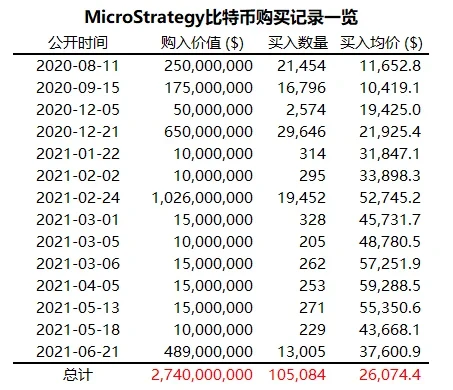
Overview of MicroStrategy Bitcoin purchase records, graphic: OKX
Since August 2020, MicroStrategy has conducted 14 Bitcoin purchases, buying a cumulative 105,084 Bitcoin at a cost of $2.74 billion, with an average price of approximately $26,000 per Bitcoin. Moreover, from the detailed records in the above chart, we can also see that after MicroStrategy established a base position of 70,470 Bitcoin between August and December 2020, there were multiple records of "buying more as prices rose" during subsequent upward movements. In 2021, MicroStrategy's largest addition occurred on February 24, purchasing a total of 19,452 Bitcoin at an average price of $52,700; while the purchase with the highest average price occurred on April 5, buying 253 Bitcoin at an average price of $59,200. It's worth mentioning that unlike Tesla using its own funds to buy Bitcoin, only $551 million of MicroStrategy's Bitcoin position comes from its own funds, with the rest basically raised through financing means such as issuing Senior Unsecured Convertible Notes and Senior Secured Notes. Except for one $1.05 billion senior unsecured convertible note with zero interest, the other funds raised require interest payments of 0.75% or 6.125%, meaning MicroStrategy also has approximately $30 million in additional costs that need to be calculated into the total cost of its Bitcoin holdings. Calculated based on current Bitcoin prices, MicroStrategy's Bitcoin holdings are worth approximately $3.403 billion, with a paper gain of $94 million. However, due to the lag nature of the above public data, like Tesla, the final profit or loss situation will need to wait for its second-quarter financial report to be released before it can be revealed. According to official news, MicroStrategy will release its second-quarter financial report on July 29, at which point we'll take a look.
"Old Friend" Grayscale
Grayscale Trust is an "old friend" we often mention. Due to Grayscale's first-mover advantage, in the early stage of this bull market, Grayscale stole the spotlight and bought as many as 650,000 Bitcoin in the low price range.
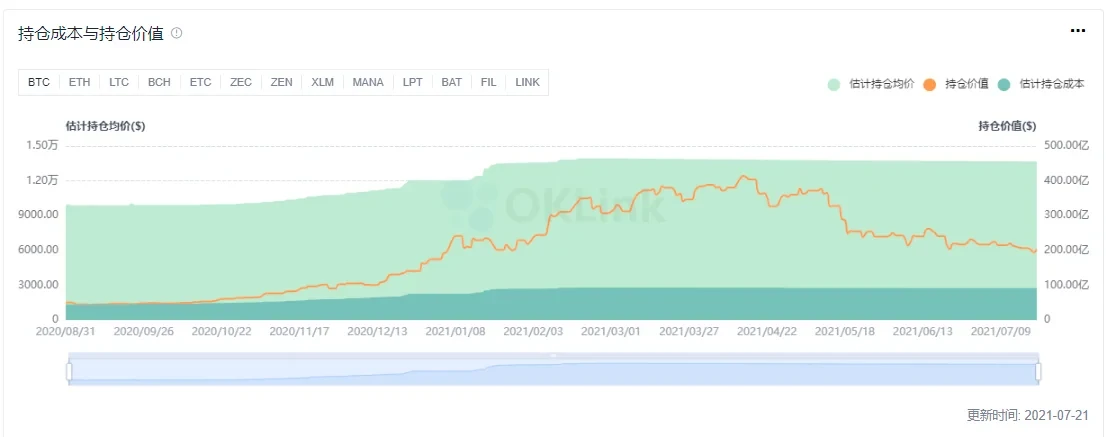
Grayscale Bitcoin holding cost and holding value, source: OKLink On-Chain Master
Also according to statistical data from OKLink On-Chain Master, the Bitcoin currently held by Grayscale is worth $20.293 billion, with an average holding price of only $13,700, far below that of Tesla and MicroStrategy.
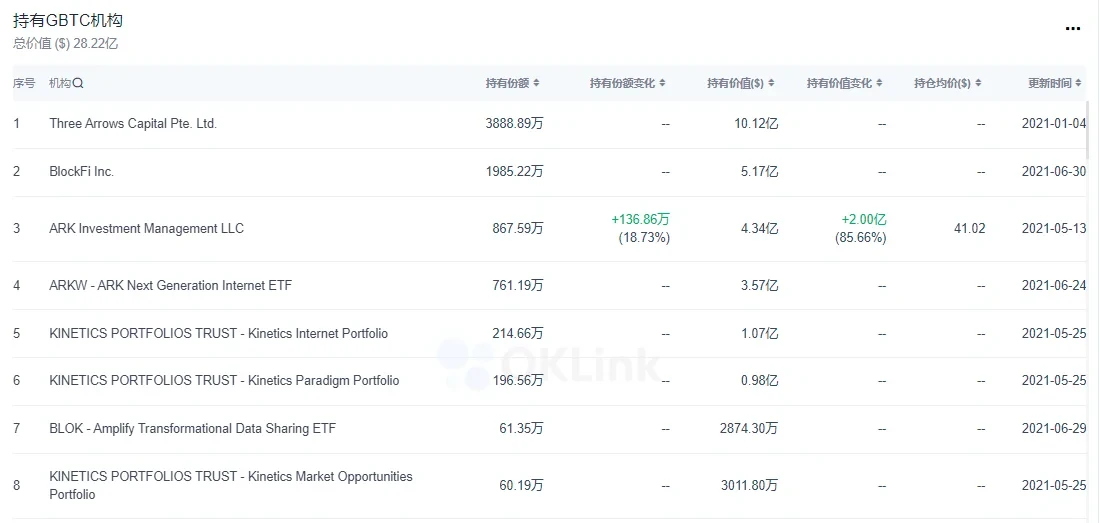
List of some institutions holding GBTC, source: OKLink On-Chain Master
According to statistics, 96 institutions currently hold Bitcoin through Grayscale Trust, among which Three Arrows Capital Pte. Ltd, Block Fi Inc, ARK Investment Management LLC, ARKW – ARK Next Generation Internet ETF, and KINETICS PORTFOLIOS TRUST – Kinetics Internet Portfolio all have holding values exceeding $100 million, ranking in the top five. Calculated based on current Bitcoin prices,
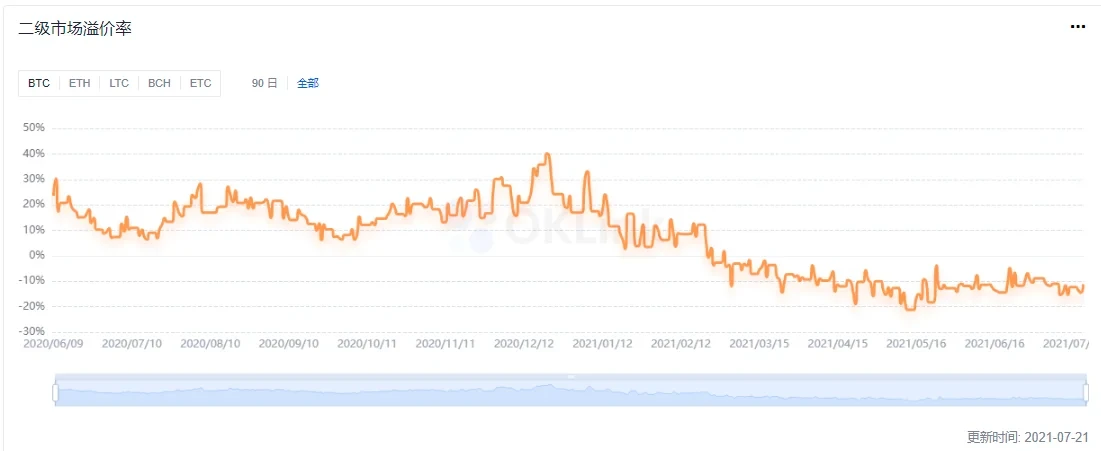
GBTC secondary market premium rate changes, source: OKLink On-Chain Master
Currently, institutions holding Bitcoin through Grayscale are basically in a profitable state. However, it's also worth noting that since March, due to poor market conditions and limited GBTC liquidity, GBTC's premium rate has remained negative for a long time, currently at -11.19%, meaning that compared to secondary market prices, institutions holding GBTC also need to bear some significant profit-shrinkage losses.
Disclaimer
This article may contain product-related content not applicable to your region. This article is intended only to provide general information and does not take responsibility for any factual errors or omissions contained herein. This article represents only the author's personal views and does not represent the views of OKX. This article is not intended to provide any of the following recommendations, including but not limited to: (i) investment advice or investment recommendations; (ii) offers or solicitations to buy, sell, or hold digital assets; or (iii) financial, accounting, legal, or tax advice. Holding digital assets (including stablecoins) involves high risk, may fluctuate significantly, and may even become worthless. You should carefully consider whether trading or holding digital assets is suitable for you based on your financial situation. For questions about your specific situation, please consult your legal/tax/investment professional. The information appearing in this article (including market data and statistical information, if any) is for general reference only. While we have taken all reasonable precautions in preparing these data and charts, we accept no responsibility for any factual errors or omissions expressed herein. © 2025 OKX. This article may be reproduced or distributed in full, or excerpts of 100 words or less from this article may be used, provided that such use is non-commercial. Any reproduction or distribution of the entire article must also prominently state: "Copyright © 2025 OKX. Used with permission." Permitted excerpts must cite the article name and include attribution, for example "Article Name, [Author Name (if applicable)], © 2025 OKX". Some content may be generated or assisted by artificial intelligence (AI) tools. Derivative works or other uses of this article are not permitted.
Show More
Recommended Reading
OKX Pay: Opening a New Era of Next-Generation Crypto Payments
Join tens of millions of users—register with OKX to enjoy the ultimate trading experience and diverse wealth management products. A letter from OKX CEO Star: Today, we are officially launching the first version of OKX Pay to over 100 million global users. As the industry's first payment app to truly achieve non-custodial and compliant integration, OKX Pay will be embedded within the OKX App, currently available in select markets, expected to fully launch within months
March 22, 2026

New Chapter: Building Next-Generation Financial Infrastructure Together
OKX's partnership with Intercontinental Exchange (ICE) is an important moment for OKX and equally significant for the evolution of the entire digital assets market. ICE establishes and operates the world's most important financial infrastructure, including the New York Stock Exchange as well as global derivatives and clearing platforms. This strategic investment by ICE in OKX and joining our board reflects both parties' shared belief—digital assets technology will transform financial markets
March 10, 2026

Tribute to Another Year of Forging Ahead
As CEO of OKX and a builder who remains true to our original mission, I'm proud to look back on OKX's extraordinary growth and progress this year. Despite numerous challenges, 2024 was a year filled with focus, innovation, and resilience. We not only expanded and optimized our products, but also made significant progress in launching transparent and compliant localized businesses, while further strengthening our global management team. Notably, after experiencing
January 29, 2026

2025: Steady Progress Toward Financial Freedom Together
— A year-end letter from OKX Founder and CEO Star to global users "Financial freedom" is often misunderstood. It doesn't mean no rules, but rather having the right to choose within the framework of rules—and when the system is truly tested, it remains reliable and effective. This is exactly what we've focused on throughout 2025. First, I want to extend my sincere gratitude to our global clients, partners, and regulatory authorities
January 16, 2026

OKX Officially Launches in Germany and Poland
Author: Erald Ghoos, CEO of OKX Europe Today is significant for OKX—and for crypto users across Europe. We have officially launched our fully compliant centralized cryptocurrency trading platform in Germany and Poland! For us, this is not just a geographic expansion, but a commitment to building the cryptocurrency future the right way: secure, transparent, and meeting local needs. If you're in Germany
October 21, 2025

Partnership Upgraded! OKX Partners with Standard Chartered to Expand European Market
On October 15, OKX Europe CEO Erald Ghoos stated that OKX is expanding its strategic partnership with Standard Chartered to the European Economic Area (EEA). Earlier this year, OKX first partnered with Standard Chartered in the UAE to launch the collateral mirroring program—a
October 15, 2025