Layer 2 Scaling Showdown: Who Can Solve Ethereum's Urgent Crisis?
ARB+1. 71%
Ethereum has been criticized for high transaction fees and network congestion for a while now. The only way to solve this problem is scaling. Blockchain scaling solutions can be roughly divided into two categories: Layer 1 scaling and Layer 2 scaling. Layer 1 scaling refers to "upgrading" the underlying blockchain itself, commonly including block expansion, Segregated Witness, and sharding technology. Layer 2 refers to building peripheral or second-layer Trading networks outside the main chain, with the goal of moving most Layer 1 transactions to the second layer to reduce pressure on the mainnet. Based on different technical solutions, the main approaches include ZK Rollup, Optimistic Rollup, Plasma, sidechains, and state channels.
The highly anticipated Ethereum 2.0 is a Layer 1 scaling solution, improving on-chain scalability by modifying consensus and adopting sharding technology. However, at this stage, the full rollout of Ethereum 2.0 will take at least several years—a distant solution that doesn't address immediate needs. Therefore, Layer 2 scaling is viewed as the "lifeline" for solving Ethereum's short-to-medium-term scalability challenges, with Rollup standing out as the "optimal solution."
Layer 2 Current State: Rollup Dominates
The earliest Layer 2 project on Ethereum should be the Raiden Network, whose technical framework is similar to Bitcoin's Lightning Network, representing an implementation of state channel technology on Ethereum. Its core concept is to move transactions off-chain and settle them on-chain. However, state channels require all nodes to be online, and the counterparties must be clearly identified asset owners. So while proposed earliest, it has remained lukewarm throughout its development.
Sidechains were once considered the best Layer 2 solution. The core idea of sidechains is to build a completely independent blockchain with its own validators and operators, capable of transferring assets to and from the main chain, and selectively sending block header snapshots to the main chain to prevent forks. However, this raises another concern: we need to trust the sidechain's validators, and if a sidechain acts maliciously, asset security cannot be guaranteed.
Loom Network was among the earliest projects to propose sidechains. Loom sidechains use a DPoS consensus mechanism, suitable for high-frequency applications like gaming dApps, then settle back on Ethereum Layer 1, combining high performance with security.
But what we actually witnessed was the gradual decline of Loom. "Several prominent public chains, such as Solana and NEAR, can attract Ethereum assets through EVM compatibility plus bridges, then settle back on Ethereum—this is exactly what sidechains do, and these public chains have stronger development capabilities than most sidechains. Therefore, the Layer 2 sidechain concept can basically be replaced by the Layer 1 sidechains of these prominent public chains." Huabian Blockchain explained in a recent article about Layer 2.
Additionally, Plasma, proposed to solve sidechain issues, required users to store their own data records and go online every two weeks, resulting in poor user experience. Combined with its inability to support DeFi products, it was gradually abandoned.
Therefore, Rollup—which inherits and improves upon the concepts of sidechains and Plasma—has become the era's top choice for Layer 2 scaling solutions. On March 10th, Vitalik Buterin excitedly stated on the Tim Ferriss podcast that Ethereum 2.0 developers are focused on merging with Ethereum. He believes Rollup can meet medium-term demand before sharding development is complete, emphasizing that it can increase Ethereum's transaction throughput by 100x.
Rollup bundles large amounts of various transaction data into a single transaction published on-chain. Different solutions emerged to ensure data consistency and fund security during the process. Currently, ZK Rollup and Optimistic Rollup are hailed as the two giants of Rollup. ZK Rollup mainly introduces zero-knowledge proofs to prove data authenticity to the main chain, belonging to validity proofs. Optimistic Rollup abandons the zero-knowledge proof mechanism and instead adopts Plasma's punishment mechanism, belonging to fraud proofs.
The biggest advantage of ZK Rollup is speed and security. When Layer 1 interacts with Layer 2, due to the zero-knowledge proof mechanism, Layer 1 can easily trust data from ZK Rollup, enabling rapid transfers. However, its disadvantage is difficulty supporting general-purpose smart contracts. ZK Rollup developers need to independently develop smart contract modules, facing significant difficulty and workload. But with the advancement of ZK Rollup technology, its long-term potential is stronger.
Optimistic Rollup draws from Plasma and tends to assume nodes won't misbehave, resulting in higher trust costs. It takes at least a week to return from Layer 2 to Layer 1. However, due to its consideration for compatibility, it allows fully general-purpose smart contracts to run on Layer 2, making Optimistic Rollup lower in barriers and easier for developers to get started, making it more suitable for solving Ethereum's immediate needs.
Rollup Projects Worth Watching
Currently, four teams are drawing significant attention across the two Rollup research directions: Matter Labs (ZK Sync), StarkWare (StarkNet), Optimism, and Offchain Labs.
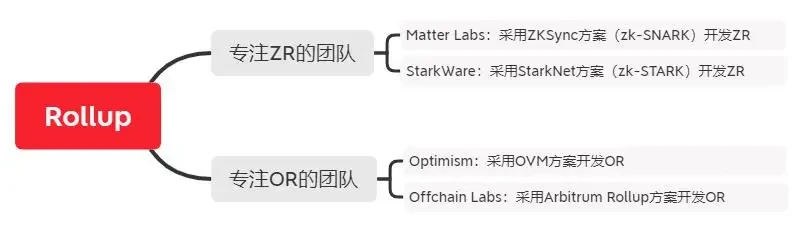
Matter Labs announced the completion of its Series A funding on March 1st, with Union Square Ventures (USV) leading the round. Current investors Placeholder, 1kx, and Dragonfly continued to participate in this round. Additionally, the project disclosed a number of heavyweight ecosystem partners, including Aave, Balancer, and 1inch, among others. Sources close to the matter revealed that ZK Sync's valuation in this round reached $120 million.
Whether from the perspective of the solution, the team, or post-implementation impact, ZK Sync is an object we need to monitor long-term. However, currently ZK Sync's functionality is relatively limited, with supported operations roughly being deposits, transfers, and withdrawals. When I donated to Gitcoin before, I used ZK Sync alongside it. Compared to Ethereum mainnet fees that often run $20-$30 or more, ZK Sync was indeed significantly cheaper.
Optimism announced it would open its public mainnet in March, allowing arbitrary contract deployment. This means popular DeFi projects on Ethereum can achieve seamless Layer 2 migration more quickly. As a partner of Optimism, Synthetix announced its mainnet deployment transition plan to Optimistic migration on January 14th.
According to StarkWare's StarkNet roadmap published on January 26th this year, StarkWare's Layer 2 scaling is divided into four phases. Phase 0's infrastructure setup is complete. Phases 1 through 3 correspond to single-operator single-application Rollup, single-operator multi-application Rollup, and decentralized-operator multi-application Rollup, respectively. By the end of 2021, StarkWare expects to achieve Phase 2 and begin Phase 3.

On March 4th, Arbitrum announced its upcoming mainnet launch. Influenced by this news, its Arbiswap testnet—Uniswap V2 running on Arbitrum Rollup—attracted large numbers of users participating in faucet testing, with many believing they might receive an airdrop by passing the test. Chainlink oracle has also launched on the Arbitrum Rollup testnet.
Currently, Optimism and Arbitrum, the fastest to launch, may quickly establish a Layer 2 ecosystem. However, many question whether Layer 2 will fragment the Ethereum ecosystem, as island issues are inevitable. With Ethereum unable to transition quickly to Ethereum 2.0, Layer 2 has become Ethereum's "lifeline." If successful, Ethereum will continue to thrive and maintain its dominance. If it fails, the blockchain world will face a multi-chain mixed battleground. Either way, we should all watch Layer 2 in 2021.
Disclaimer: digital assets trading involves significant risk. This material should not be used as a basis for investment decisions, nor should it be interpreted as advice on investment trading. Please ensure you fully understand the risks involved and invest cautiously. The OKX OKX Academy only provides information for reference and does not constitute any investment advice. All investment activities by users are unrelated to this site.
Disclaimer
This article may contain product-related content not applicable to your region. This article is committed to providing general information only and does not accept responsibility for any factual errors or omissions. This article represents the author's personal views only and does not represent OKX's views. This article is not intended to provide any advice, including but not limited to: (i) investment advice or investment recommendations; (ii) offers or solicitations to purchase, sell, or hold digital assets; or (iii) financial, accounting, legal, or tax advice. Holdings in digital assets (including stablecoins) involve high risk and may fluctuate significantly, or even become worthless. You should carefully consider whether trading or holding digital assets is suitable for you based on your financial situation. For questions about your specific circumstances, please consult your legal/tax/investment professionals. The information in this article (including market data and statistics, if any) is provided for general reference purposes only. While all reasonable precautions have been taken in preparing such data and charts, we accept no responsibility for any factual errors or omissions expressed herein. © 2025 OKX. This article may be reproduced or distributed in its entirety, or excerpts of 100 words or less may be used, provided that such use is non-commercial in nature. Any reproduction or distribution of the full article must prominently state: "This article is copyrighted © 2025 OKX, used with permission." Permitted excerpts must cite the article title and include attribution, e.g., "Article Title, [Author Name (if applicable)], © 2025 OKX." Some content may have been generated or assisted by artificial intelligence (AI) tools. Derivative works and other uses of this article are not permitted.
Show More
Recommended Reading
OKX Pay: Ushering in the Next Generation of Crypto Payment
The choice of tens of millions of users. Register on OKX to enjoy an exceptional trading experience and diverse wealth management products. A letter from OKX CEO Star: Today, we officially launch the first version of OKX Pay to our hundreds of millions of global users. As the industry's first payment application to truly achieve the fusion of non-custodial and compliant solutions, OKX Pay will be embedded within the OKX App, currently available in select markets and expected to fully launch within months.
2026年3月22日

A New Chapter: Building the Next Generation of Financial Infrastructure Together
The partnership between OKX and the Intercontinental Exchange (ICE) marks a significant milestone for OKX and holds equally profound meaning for the evolution of the entire digital assets market. ICE establishes and operates the world's most critical financial infrastructure, including the New York Stock Exchange and global derivatives and clearing platforms. This instance of ICE selecting to invest in OKX and join our Board of Directors reflects our shared conviction that digital assets technology will reshape financial markets.
2026年3月10日
Celebrating Another Year of Relentless Building
As OKX's CEO and a builder who stays true to the original mission, I take great pride in looking back on the extraordinary growth and progress OKX has achieved this year. Despite numerous challenges, 2024 was a year filled with focus, innovation, and resilience. We not only expanded and optimized our products, but also made significant strides in launching transparent and regulation-compliant localized businesses, while further strengthening our global management team. It is worth noting that after going through...
2026年1月29日

2025: Steady Progress Toward Financial Freedom
— A Year-End Letter to Global Users from OKX Founder and CEO Star. "Financial freedom" is often misunderstood. It doesn't mean the absence of rules, but rather having the right to choose—even when rules exist. And when the system is truly put to the test, it remains reliable and effective. This has been our unwavering focus throughout 2025. First and foremost, I want to extend my heartfelt gratitude to our global customers, partners, and regulators...
2026年1月16日
OKX Officially Launches in Germany and Poland
By Erald Ghoos, CEO of OKX Europe. Today is significant for OKX—and for crypto users across Europe. We have officially launched a fully compliant centralized cryptocurrency exchange in Germany and Poland! For us, this is more than a geographic expansion; it is a commitment to building the future of cryptocurrency the right way: secure, transparent, and tailored to local needs. If you are in Germany...
2025年10月21日
Level Up! OKX and Standard Chartered Join Forces to Expand into Europe
On October 15th, Erald Ghoos, CEO of OKX Europe, stated that OKX is expanding its strategic partnership with Standard Chartered to the European Economic Area (EEA). Earlier this year, OKX first partnered with Standard Chartered in the UAE, launching a collateral mirroring program—a...
2025年10月15日