If Bitcoin Technology Stalls, Ethereum May Dominate the Crypto Market
Recently, a leaked Goldman Sachs document has caught the market's attention. The Wall Street giant, in a report titled "Global Macro Research," gave Ethereum high praise, suggesting that based on factors such as real-world use cases, user base, and speed of technological iteration, Ethereum is poised to overtake Bitcoin's dominant position in the crypto market.
Just four days ago, Ethereum co-founder Vitalik Buterin also stated in an interview that if Bitcoin's technology remains unchanged, it will face a significant risk of being淘汰 (phased out). He also predicted that Ethereum's market cap could surpass Bitcoin's market cap.
According to CoinMarketCap data, Bitcoin's market cap stands at $717.283 billion, while Ethereum's market cap is $301.339 billion. Based on Ethereum's current circulating supply, ETH would need to rise to at least $6,183 to overtake Bitcoin.
Looking back at mid-to-late May, when Ethereum decoupled from Bitcoin and ETH/BTC continued to climb, the Ethereum community was buzzing with calls for "1 ETH = 0.1 BTC" and "Ethereum price to reach $10,000." However, after the 5·19 crash, and the terrifying moment when Justin Sun's 600,000 Ethereum risked liquidation that could have sent the price to $1,000, the market is still digesting this panic.
Worth mentioning is that Bitcoin's market share is recovering, having risen from 39.66% on May 19 to 44.43% on May 25, a gain of 4.77 percentage points in just seven days. Between May 20 and May 24, Bitcoin saw a net inflow of $1.204 billion. In contrast, Ethereum has shown net outflows over the past five days, with outflows totaling $2.667 billion. ETH/BTC has also dropped from 0.08239 to 0.06779. Multiple data points suggest that since the May 19 crash, Bitcoin appears to be reclaiming its former dominance, while Ethereum, after leading the rally for a period, may need considerable time to recover.
Calls Arise Again: Ethereum Will Surpass Bitcoin
Whenever Ethereum outperforms, the narrative of Ethereum overtaking Bitcoin's market cap resurfaces. In this cycle, as Ethereum has made rapid progress in real-world applications, user base, and technological capabilities, the calls for Ethereum to replace Bitcoin as the dominant force in the crypto market have been particularly loud.
First, JPMorgan stated in a research report in late April that Bitcoin functions more like a crypto commodity, competing with gold as a store of value, while Ethereum serves as the backbone of the crypto-native economy and is more commonly viewed as a medium of exchange. Theoretically, Ethereum has greater potential value and should ultimately 胜 (outperform) Bitcoin from a long-term perspective. Then, Arthur Hayes wrote an article stating that Ethereum's price could reach $10,000 and its market cap might surpass Bitcoin's. One of Hayes's arguments was that technology is more valuable than currency—for example, the US dollar M0 is $5.8 trillion, while the total market cap of FANG (Facebook, Apple, Amazon, Netflix, and Google) is $6.36 trillion, because the dollar is merely pure currency running on the US financial system network and is not more valuable than companies providing real goods and services denominated in dollars.
Subsequently, Vitalik Buterin told CNN in an interview that if Bitcoin's technology remains unchanged, it faces a significant risk of being淘汰 (phased out). He also predicted that Ethereum's market cap could surpass Bitcoin's.
As is well known, Bitcoin protocol upgrades are divided into six stages: proposing new ideas, submitting a BIP draft, detailed discussions on the proposal, entering formal development, voting for activation and launch, and finally third-party application integration support. This process is very lengthy—for instance, Bitcoin's Taproot upgrade was first proposed over three years ago but is still停留在 (at) the miner signaling stage. Fortunately, it has already secured support from 96.88% of mining pool hashrate, and the upgrade may be activated in November. However, even upon activation, Taproot still faces a gradual third-party adoption process, which can be seen from SegWit's implementation—activated in August 2017, SegWit's network-wide adoption rate still hovers between 50% and 60%. The main reason for this is concerns that new protocols may introduce unnecessary risks.
In contrast, Ethereum's protocol upgrades are noticeably faster than Bitcoin's. The difficulty bomb potentially activating in December shows that Ethereum is rushing to transition to PoS. Additionally, the July EIP-1559 will help Ethereum further capture value from its ecosystem and boost its price. More recently, Goldman Sachs has also joined the chorus, stating that as Ethereum becomes increasingly widespread in DeFi and NFT applications, along with its first-mover advantage in technology, it may replace Bitcoin as the dominant crypto asset in the future.
In the short term, Ethereum is still in a recovery phase following the price crash, specifically manifested as following Bitcoin without establishing its own independent trend. First, ETH/BTC dropped from 0.08239 on May 15 to 0.06779. Second, CoinMarketCap data shows that on May 17, Bitcoin's market share was 39.97% and Ethereum's was 19.03%. One week later, on May 24, Bitcoin's market share rose to 46.55% while Ethereum fell to 17.55%. This indicates that after the 5·19 crash, many altcoins suffered severe pullbacks and Bitcoin is reclaiming its lost territory. Third, QKL123 data shows that over the past five days, Bitcoin funds have shown a net inflow trend, reaching $1.204 billion, while Ethereum saw a net outflow of $2.667 billion over the past five days. Finally, yesterday OKX published "Within Two Weeks, Total Value Locked Dropped by Nearly 40%—What Happened to DeFi on Ethereum?", which mentioned that the total value locked in DeFi on Ethereum dropped by nearly 40%. Currently, Ethereum's on-chain ecosystem is also in a recovery phase.
Worth noting is that the Consensus conference officially began on May 24 (US local time), lasting three days. Since 2015, the Consensus conference has successfully held six editions. Except for 2018, when Bitcoin's price trend was downward during and after the Consensus conference, Bitcoin has been in an upward trend during the conference in all other years. Hence, there is a saying in the industry called "Consensus conference effect." Perhaps influenced by this factor, combined with the current rebound following the cryptocurrency's oversold conditions from the previous days, Ethereum has risen 34% in the past two days. As of press time, it was trading at $2,581.47, down 40.95% from its all-time high of $4,371.96.
A Small Goal: 1 ETH = 0.1 BTC
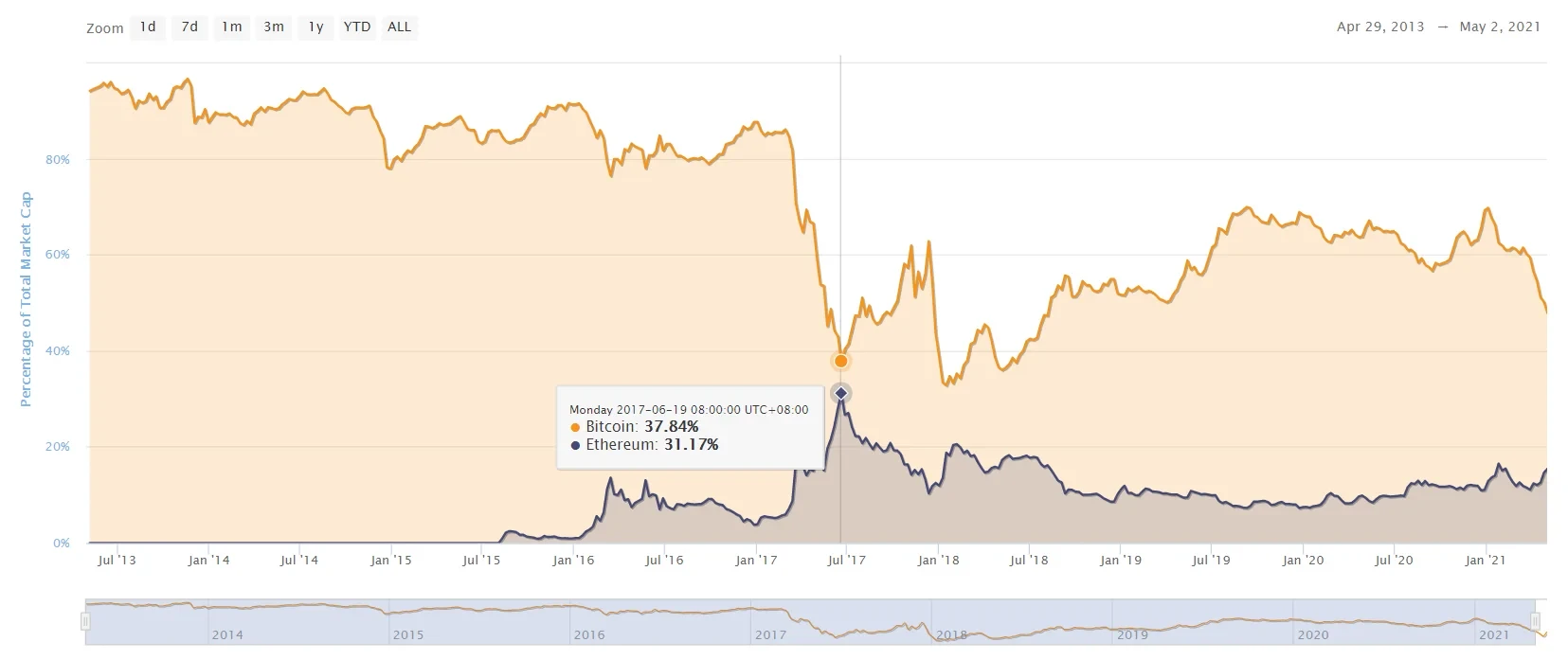
Looking back at history, the closest Ethereum came to Bitcoin's market cap was on June 19, 2017. At that time, Bitcoin's market share was 37.84%, while Ethereum reached 31.17%. Bitcoin's price was $2,599.89 and Ethereum's was $354.90, with ETH/BTC at 0.136506. Data shows that since ETH/BTC fell below 0.1 on February 12, 2018, 1 ETH = 0.1 BTC has become Ethereum's goal.
Goldman Sachs stated that Ethereum has enormous potential. Ethereum supports smart contracts and provides developers with methods for creating new applications. Currently, most DeFi is built on the Ethereum network, and the rising NFT trend is also constructed on Ethereum. Although Ethereum faces criticisms such as network congestion and high gas fees, this is both a reflection of Ethereum's thriving on-chain ecosystem and the driving force pushing Ethereum to accelerate its development.
The imminent introduction of the EIP-1559 protocol will significantly change how Ethereum's transaction fees are calculated, creating a structural decrease in Ethereum's supply. In the current Ethereum system, miners receive block rewards and all transaction fees. After implementing EIP-1559, the structure becomes "base fee + tip." Miners will only receive block rewards and tips, while the base fee will be entirely burned. This means that if block rewards fall below the burned base fee, it could cause Ethereum to become deflationary, driving Ethereum's price higher.
Second, Layer 2 (layer-2 scaling solutions), which address Ethereum's pressing issues, has entered a period of rapid development. Sidechain projects such as Polygon and Celer have all made good progress recently. Various projects using Rollup solutions—which Vitalik has praised and are considered top-tier among Layer 2 solutions—are either launching on mainnet by the end of May or listing in July. This will help Ethereum capture more value from its on-chain ecosystem.
Influenced by Musk's recent "Bitcoin is not environmentally friendly" comments, the industry has recently been focused on finding "green cryptocurrencies." Although Ethereum currently uses the PoW consensus mechanism, developers are working hard toward the goal of transitioning Ethereum to PoS by year-end. The advantage of PoS is that it greatly improves the energy efficiency of the Ethereum network and ends the current energy race among miners.
In its research report, Goldman Sachs put forth a viewpoint: Bitcoin's scarcity is insufficient to support its store-of-value function, and Ethereum will take its place. Goldman Sachs's reasoning is that the success of a store of value depends on demand, not scarcity. Currently, the primary stores of value in the market all have stable supply—for example, gold's supply increases at a rate of 2% per year, yet it remains the recognized store of value. Rare elements like osmium, however, are not stores of value, because fixed and limited supply incentivizes hoarding, forcing new buyers to bid higher than existing buyers, thereby driving up price volatility and creating financial bubbles.
Although Ethereum's total supply is not capped, the amount of Ethereum generated per unit of time is a fixed value. If the Ethereum economy is expanding but the issuance rate remains unchanged, then Ethereum is essentially a deflationary economic model. Therefore, compared with maintaining value through limited supply, what is more important is reducing the sharp and unpredictable growth of new supply. Ethereum clearly fits this model.
Although Ethereum's future is highly anticipated, it still faces three uncontrollable factors. First, it is widely acknowledged that this bull market is driven by institutions. Currently, publicly traded companies still prefer holding Bitcoin. Among listed companies, only Meitu appears to use Ethereum as a monetary store of value. For institutions to accept and invest in Ethereum requires a process, and the sustained buying momentum for Ethereum among institutions seems slightly lacking. Second, the major ecosystem currently on Ethereum is concentrated in DeFi. While DeFi is an innovation in the crypto market, it is also the freest and most Wild West segment on the blockchain. As it grows larger, it will inevitably attract attention from governments around the world.届时 (At that time), regulations on DeFi will also affect Ethereum's development. Finally, the Ethereum 2.0 upgrade may face delays due to technical difficulty, which will also constrain Ethereum's development. Therefore, for Ethereum, perhaps at this stage it should first achieve the small goal of 1 ETH = 0.1 BTC before discussing the possibility of overtaking Bitcoin's market cap.
Disclaimer
This article may contain product-related content that does not apply to your region. This article is only致力于 (committed to) providing general information and is not responsible for any factual errors or omissions. This article represents only the author's personal views and does not constitute the views of OKX. This article is not intended to provide any advice, including but not limited to: (i) investment advice or investment recommendations; (ii) offers or solicitations to buy, sell, or hold digital assets; or (iii) financial, accounting, legal, or tax advice. Holding digital assets (including stablecoins) involves high risk and prices may fluctuate significantly or even become worthless. You should carefully consider whether trading or holding digital assets is suitable for you based on your financial situation. For questions about your specific circumstances, please consult your legal/tax/investment professional. The information in this article (including market data and statistics, if applicable) is provided for general reference only. While we have taken all reasonable precautions in preparing this data and these charts, we assume no responsibility for any factual errors or omissions expressed herein. © 2025 OKX. This article may be reproduced or distributed in its entirety, or brief excerpts of 100 words or less may be used, provided that such use is non-commercial. Any reproduction or distribution of the full article must prominently state: "This article is copyright © 2025 OKX, used with permission." Permitted excerpts must cite the article name and include attribution, for example, "Article Name, [Author Name (if applicable)], © 2025 OKX." Some content may have been generated or assisted by artificial intelligence (AI) tools. Derivative works and other uses of this article are not permitted.
Show More
Recommended Reading
OKX Pay: Ushering in a New Era of Next-Gen Crypto Payment
The preferred choice of tens of millions of users. Register with OKX and enjoy an exceptional trading experience and diverse wealth management products. A letter from OKX CEO Star: Today, we officially launched the first version of OKX Pay for over 100 million global users. As the industry's first truly integrated non-custodial and compliant payment application, OKX Pay will be embedded within the OKX App and is currently available in select markets, with full rollout expected within
March 22, 2026

A New Chapter: Building the Next Generation of Financial Infrastructure Together
The partnership between OKX and Intercontinental Exchange (ICE) represents a significant moment for OKX and is equally meaningful for the evolution of the entire digital assets market. ICE builds and operates the world's most critical financial infrastructure, including the New York Stock Exchange and global derivatives and clearing platforms. This investment from ICE in OKX and its joining our board reflects our shared belief that digital assets technology will transform financial markets.
March 10, 2026
To Another Year of Building
As CEO of OKX and a builder who stays true to the original mission, I take great pride in reflecting on the extraordinary growth and progress OKX has achieved this year. Despite the challenges, 2024 was a year marked by focus, innovation, and resilience. We not only expanded and optimized our products, but also made significant strides in launching transparent and regulation-compliant localized businesses, while further strengthening our global management team. Notably, after going through
January 29, 2026

2025: A Steady Progression Toward Financial Freedom
— A Year-End Letter to Global Users from Star, Founder and CEO of OKX. "Financial freedom" is often misunderstood. It does not mean an absence of rules, but rather having the freedom to choose even in the presence of rules—and, when the system is truly tested, it remains reliable and effective. This is precisely what we focused on throughout 2025. First, I would like to express sincere gratitude to our global customers, partners, and regulators.
January 16, 2026

OKX Officially Launches in Germany and Poland
By Erald Ghoos, CEO of OKX Europe. Today is a significant day for OKX—and for crypto users across Europe. We have officially launched our fully compliant centralized cryptocurrency trading platform in Germany and Poland! For us, this is not just a geographic expansion, but a commitment to building the future of cryptocurrency the right way: secure, transparent, and tailored to local needs. If you are in Germany
October 21, 2025

Partnership Upgrade! OKX Joins Forces with Standard Chartered to Expand into Europe
On October 15, Erald Ghoos, CEO of OKX Europe, stated that OKX is expanding its strategic partnership with Standard Chartered to the European Economic Area (EEA). Earlier this year, OKX first partnered with Standard Chartered in the UAE to launch the collateral mirroring program—this
October 15, 2025