The Risks and Opportunities of Algorithmic Stablecoins
In the crypto assets space, stablecoins are a unique presence. Serving as a bridge between the traditional financial world and the crypto assets world, their creation stems from pressures from the traditional world and practical demands from the crypto world. However, after years of development, the use cases for stablecoins have expanded significantly. Particularly since 2020, with the explosive rise of DeFi (decentralized finance), the crypto world has placed higher demands on both the imagination and the supply of stablecoins.
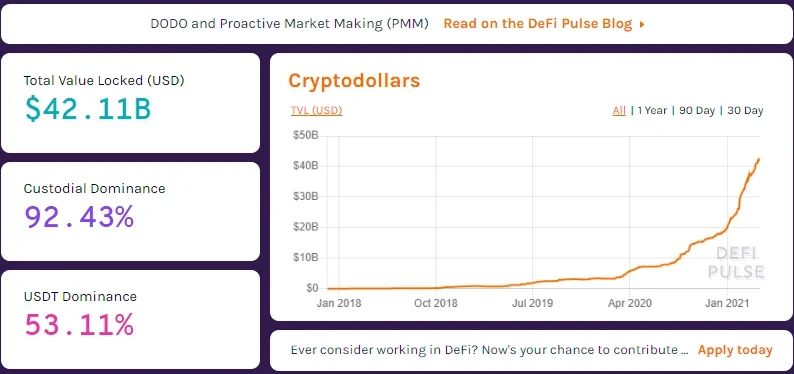
(Stablecoin assets locked on the Ethereum chain, source: DEFI PULSE)
As of April 1, the value of stablecoin assets locked on the Ethereum chain alone has exceeded $42.1 billion.
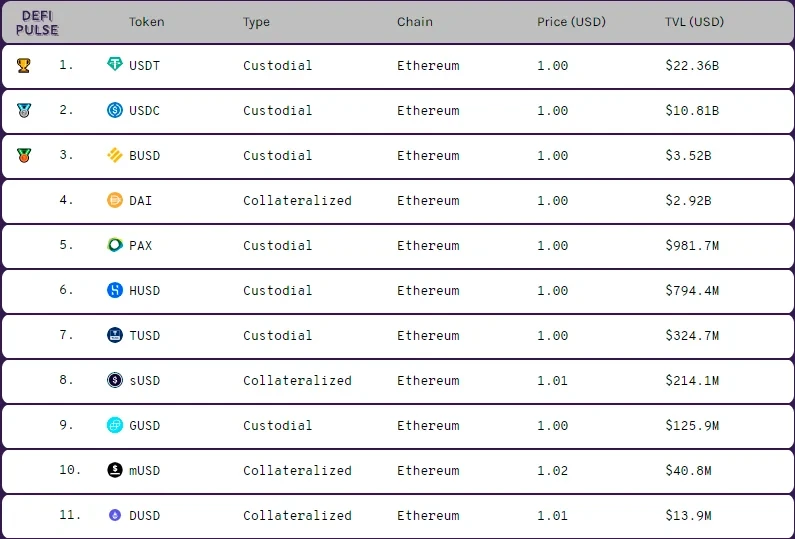
Among them, USDT's locked value reached $22.36 billion, accounting for 53.11% of the total. The second to fifth positions are held by USDC, BUSD, DAI, and PAX respectively.
According to the commonly accepted industry classification, stablecoins can currently be divided into three types: fiat-backed, crypto assets-backed, and algorithmic stablecoins. We are more familiar with the typical representatives of the first two categories—USDT and DAI—so we won't elaborate on them here. Today, we'll focus on algorithmic stablecoins.
As the name suggests, algorithmic stablecoins are a type of currency that adjusts the total market supply based on algorithms. When the stablecoin price is above the pegged price, the market supply is increased; when the stablecoin price is below the pegged price, the supply is reduced, or arbitrage opportunities are provided to balance the stablecoin price. This model does not peg to real-world fiat currency and requires no collateral for the stablecoin. It relies entirely on market will and algorithms for regulation, which the market also refers to as elastic currency.
In fact, algorithmic stablecoins are not a new topic. Academic research on algorithmic stablecoins can be traced back to at least 2014. That year, Professor Ferdinando Ametrano of Politecnico di Milano published a paper titled "Hayek Money: The Cryptocurrency Price Stability Solution." In the same year, cryptocurrency economist Robert Sams also published a paper on the topic of "Cryptocurrency Stabilization: Seigniorage Shares." It is worth noting that the former served as the project lead for Bitcoin developer conferences, while the latter had 11 years of hedge fund work experience. In the years following, discussions about algorithmic stablecoins remained largely within academic circles until the emergence of Ampleforth in 2019, which put the aforementioned academic theories into practice. In June 2020, its token AMPL entered the industry's视野 through DeFi, and by July 2020, AMPL's market capitalization soared to $1 billion. Subsequently, a host of algorithmic stablecoins led by AMPL, including ESD, Base, Mith, and Frax, emerged like bamboo shoots after a spring rain, attracting market attention.
In this article, we will focus on a macro-level analysis of the design mechanisms of algorithmic stablecoins, with the aim of establishing a framework for understanding algorithmic stablecoins together.
Currently, the mechanism designs of algorithmic stablecoins can be divided into passive and active types. The principle defining whether a mechanism is active or passive here primarily considers the degree of token holder participation during the process of the algorithmic stablecoin's target price fluctuating around the benchmark price.
Passive Mechanism
The passive adjustment mechanism, also known as rebase, continuously adjusts the token supply through system issuance and destruction to regulate the token price to the target level. The simplest logic is that of AMPL, which maintains the target price within 5% above or below the benchmark price by increasing or decreasing the number of tokens held by users. If the token price exceeds the target price, it indicates that current demand exceeds supply, and tokens need to be issued to balance supply and demand to achieve price stability. When the token price is below the target price, the system destroys tokens to balance supply and demand. The process of issuance or destruction is the rebase.
This special mechanism means that users are not purchasing a fixed amount of AMPL tokens but rather a share of AMPL's market capitalization. After the rebase, the proportion of the holder's total network holdings remains the same as before the rebase. Rebase is not dilution because all account balances are adjusted proportionally. Whether the adjustment is positive or negative, there are no related airdrops or trading changes in wallet balances; it is simply the AMPL smart contract function at work.
Therefore, regardless of how the total supply is adjusted, the proportion of tokens held by token holders relative to the total token supply will remain unchanged. The price regression after rebase adjusts the token supply is achieved through market behavior, so this does not mean that price regression will necessarily be achieved after quantity adjustment. Due to the currently small size of algorithmic stablecoins, when speculative behavior is active in the market, it often causes price deviations. In addition to AMPL, another relatively well-known algorithmic stablecoin, YAM, also adopts the rebase mechanism. We will discuss the shortcomings of the rebase mechanism later. Next, let's understand another commonly used mechanism in the algorithmic stablecoin field—the active mechanism that requires user participation.
Active Mechanism
As mentioned above, unlike the rebase method, the active mechanism primarily introduces more user behavior by issuing multiple tokens to incentivize users to participate in token destruction and issuance. However, although the mechanism settings differ, all roads lead to Rome. The underlying logic of the active mechanism is similarly to achieve supply-demand balance by controlling token supply, stabilizing the token price near the benchmark price.
Under the active mechanism, changes in stablecoin supply only affect holders of other issued tokens, no longer impacting all holders. Therefore, for users who do not participate in supply adjustment, their total asset value is only affected by unit price. The advantage of the active adjustment mechanism lies in making it easy for users to understand in terms of usage, while reducing the impact of quantity fluctuations in wallets on practical applications.
Currently, a typical representative of the active mechanism in the market is Basis. Before introducing Basis, let's first understand Basis's innovation. In this project, in addition to the algorithmic stablecoin BAC (Basis Cash), two tokens representing equity and bond concepts were introduced: BAS (Basis Share, equity-like) and BAB (Basis Bond, bond-like). In the following introduction, we will mention the roles of BAS and BAB in the process of balancing BAC price.
Simply put, when the BAC price is below the target price, users can destroy BAC to exchange for BAB. The price of BAB is the square of BAC (i.e., BAB price = BAC price^2). Therefore, the lower BAC is below $1, the lower the BAB price. When users purchase BAB, they are destroying BAC to reduce supply. If the BAC price exceeds $1, the system issues additional BAC, and users can exchange their low-cost BAB for BAC on a 1:1 basis. When issuing new tokens, the system prioritizes repaying previously issued debt. BAB purchasers are essentially conducting an arbitrage. If, after repaying all debts, the BAC price has not returned to normal levels, the system continues to issue additional tokens to be distributed to staked BAS holders until the supply-demand relationship balances and BAC returns to the target price.
Although the active adjustment mechanism stimulates user participation in the destruction and issuance process by introducing economic rewards, it should still be noted that, like the passive mechanism, the active mechanism also faces the problem of how to achieve long-term price stability for algorithmic stablecoins. Simply put, due to the economic model constraints between the stablecoin BAC, equity BAS, and bond BAB, when the BAC price is above the target price, users naturally want to hold equity token BAS to receive BAC dividends. Besides purchasing directly, another way to obtain BAS is by participating in BAC liquidity mining, which drives demand for BAC and further pushes up its price. When the BAC price is below the target price, arbitrageurs purchasing BAB to destroy BAC is a crucial step in returning its price to normal levels. Arbitrageurs can only profit if BAC rises above the target price, which requires arbitrageurs to have sufficient confidence in the stablecoin price increase. Without it, the lack of sufficient supply reduction may keep the stablecoin below the target price for an extended period, or even lead directly to project failure. Although BAB plays the role of a bond in the active adjustment mechanism, debt repayment depends on the BAC price. BAB can only be exchanged for BAC when the BAC price is above the benchmark price. Therefore, the destruction mechanism only takes effect when there is confidence in BAC.
Thus, we can see that the advantage of the active adjustment mechanism lies in using a multi-token model to issue bonds BAB when the token price is undervalued to destroy BAC and restore it to normal levels, and to repay debts and distribute to equity holders with the issued BAC when the token price is overvalued. This distribution method is easier to understand and mobilizes user enthusiasm, making supply adjustment more elastic and aligned with market principles.
However, just as the rebase mechanism struggles to maintain stablecoin price stability, the active mechanism cannot keep stablecoins stable either. For example, the price of BAC has recently remained below its target price.
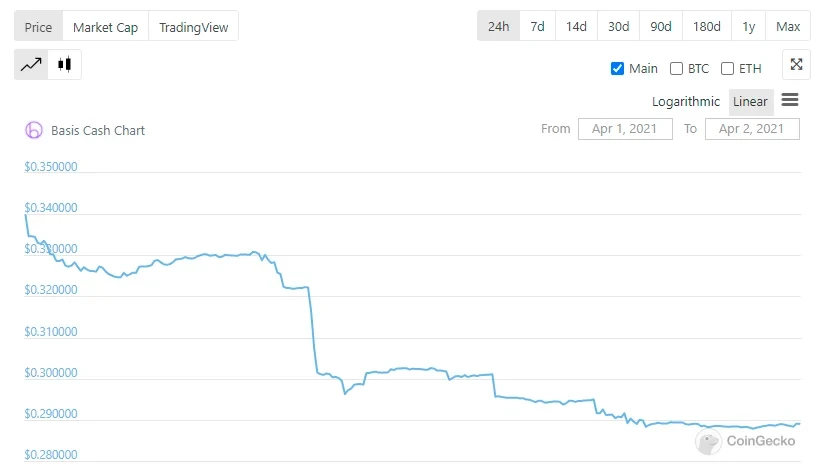
Furthermore, another star algorithmic stablecoin project—Terra—has also shown significant price volatility since its launch. Terra is a blockchain protocol supporting stable programmable payments and open financial infrastructure, backed by a basket of fiat-pegged stablecoins algorithmically maintained by its native token Luna. The Terra blockchain adopts a dual-token model: the Luna token (for staking and stabilizing algorithmic tokens) and the Terra stablecoin family pegged to fiat currencies including the US dollar and Korean won. To summarize simply: users can mint Terra by burning Luna, or send Terra to the system and receive equivalent value in Luna.
Luna is currently listed on the OKX trading platform. The current price of Luna is reported at 18.9 USDT, representing an increase of over 300% from its previous low.

The "Opportunity" of Algorithmic Stablecoins
Like Bitcoin, algorithmic stablecoins are an unprecedented social experiment in the history of human monetary reform. Among the three types of stablecoins currently circulating in the market, algorithmic stablecoins are the design closest to the original intent of blockchain. Particularly in DeFi, the trust issues of fiat-backed stablecoins have always been a difficult problem to solve, while over-collateralized stablecoins suffer from low capital utilization efficiency and liquidation risks. Thus, algorithmic stablecoins have emerged as a new solution. Secondly, algorithmic stablecoins achieve price stability by adjusting supply, and the processes of total supply issuance and destruction present various arbitrage opportunities. Finally, stablecoins are bound to be an important component of DeFi. If algorithmic stablecoins can achieve price stability, they will change the current stablecoin landscape. The emergence of successful pegging mechanisms will also allow algorithmic coins to extend beyond the application of stablecoins. Therefore, some users have even proposed that "DeFi without algorithmic stablecoins is not true DeFi."
The "Risk" of Algorithmic Stablecoins
This point has been mentioned more than once in the discussion above. The biggest problem currently facing algorithmic stablecoins is that they are not "stable" enough. This "instability" limits the further expansion of algorithmic stablecoins' market share. A classic joke goes: "I paid attention to algorithmic stablecoins because of the stablecoin concept, but I participated in them because they are unstable."
Therefore, overall, algorithmic stablecoins currently face a very contradictory problem—on one hand, they want to completely offset price control by centralized institutions through algorithms; on the other hand, they lack sufficient market recognition to maintain their own price stability. They cold-start by offering arbitrage opportunities to ensure their price can achieve 1:1 equivalence with the pegged currency, but the overall development logic somewhat resembles Bitcoin's early development path, slowly growing amid market skepticism and speculation, accumulating market consensus to reach Bitcoin's status as digital gold. However, a new contradiction arises—Bitcoin's ability to develop slowly and steadily stems from its high volatility bringing long-term investment returns and wealth-creation myths. Stablecoins don't have this, and once they do, it contradicts the original intention of algorithmic stablecoins.
Therefore, while calling algorithmic stablecoins "an unprecedented social experiment in the history of human monetary reform" may seem somewhat premature, it is not an exaggeration. Algorithmic stablecoins currently appear to be a distant experiment without clear use cases. But they may also represent this industry's best attempt at creating a trustless stable cryptocurrency. Let us embrace such attempts.
Disclaimer: Digital assets trading involves significant risks. This material should not be used as a basis for investment decisions, nor should it be interpreted as advice to engage in investment trading. Please ensure you fully understand the risks involved and invest cautiously. The OKX tutorial team only provides information for reference and does not constitute any investment advice. All investment actions by users are unrelated to this site.
Disclaimer
This article may contain content related to products not available in your region. This article is dedicated to providing general information only and is not responsible for any factual errors or omissions. This article represents the author's personal views and does not reflect the views of OKX. This article is not intended to provide any of the following advice, including but not limited to: (i) investment advice or investment recommendations; (ii) offers or solicitations to buy, sell, or hold digital assets; or (iii) financial, accounting, legal, or tax advice. Holding digital assets (including stablecoins) involves high risks, may fluctuate significantly, or even become worthless. You should carefully consider whether trading or holding digital assets is suitable for you based on your financial situation. For questions regarding your specific circumstances, please consult your legal/tax/investment professionals. The information appearing in this article (including market data and statistics, if any) is for general reference only. Although we have exercised all reasonable care in preparing this data and these charts, we assume no responsibility for any factual errors or omissions expressed herein. © 2025 OKX. This article may be copied or distributed in its entirety, or excerpts of 100 words or less may be used, provided such use is non-commercial. Any copying or distribution of the entire article must also prominently state: "This article is copyrighted © 2025 OKX, used with permission." Permitted excerpts must cite the article title and include attribution, such as "Article Title, [Author Name (if applicable)], © 2025 OKX." Some content may be generated or assisted by artificial intelligence (AI) tools. Derivative works or other uses of this article are not permitted.
Show More
Recommended Reading
OKX Pay: Ushering in a New Era of Next-Generation Crypto Payments
The choice of tens of millions of users. Register with OKX to enjoy an exceptional trading experience and diverse wealth management products. A letter from OKX CEO Star: Today, we officially launch the first version of OKX Pay to over 100 million global users. As the industry's first payment application to truly achieve the integration of non-custodial and compliance, OKX Pay will be embedded within the OKX App. It is currently open to select markets and is expected to be fully rolled out within months.
March 22, 2026

A New Chapter: Building the Next Generation of Financial Infrastructure Together
The partnership between OKX and Intercontinental Exchange (ICE) is an important moment for OKX and equally significant for the evolution of the entire digital assets market. ICE builds and operates the world's most important financial infrastructure, including the New York Stock Exchange and global derivatives and clearing platforms. ICE's decision to invest in OKX and join our board reflects a shared belief—that digital assets technology will play a transformative role in financial markets.
March 10, 2026
To Another Year of Building
As CEO of OKX and a builder who never forgets his original intention, I am proud to look back on the extraordinary growth and progress OKX has achieved this year. Despite numerous challenges, 2024 was a year of focus, innovation, and resilience. We not only expanded and optimized our products but also made important progress in launching transparent and regulatory-compliant localized businesses, while further strengthening our global management team. Notably, after experiencing...
January 29, 2026

2025: Steady Progress Toward Financial Freedom
— Year-End Letter from OKX Founder and CEO Star to Global Users. "Financial freedom" is often misunderstood. It does not mean the absence of rules, but rather having the right to choose even when rules exist—and when the system is truly tested, it remains reliable and effective. This is what we have focused on throughout 2025. First, I would like to extend my sincere gratitude to customers, partners, and regulators worldwide.
January 16, 2026

OKX Officially Launches in Germany and Poland
By: Erald Ghoos, CEO of OKX Europe. Today is a significant day for OKX—and for crypto users across Europe. We have officially launched a fully compliant centralized cryptocurrency trading platform in Germany and Poland! For us, this is not just a geographic expansion, but a commitment to building the future of cryptocurrency the right way: secure, transparent, and meeting local needs. If you are in Germany...
October 21, 2025

Partnership Upgrade! OKX Collaborates with Standard Chartered to Expand in Europe
On October 15, Erald Ghoos, CEO of OKX Europe, announced that OKX is extending its strategic partnership with Standard Chartered to the European Economic Area (EEA). Earlier this year, OKX first partnered with Standard Chartered in the UAE to launch a collateral mirroring program—this is...
October 15, 2025