Exploring the Financial Value and Cultural Value of Ethereum Under Its "Deflationary Model"
Since its launch in 2015, Ethereum has continued to gain attention and has firmly established itself as the second-largest cryptocurrency, with a market cap of $556.5 billion, surpassing Alibaba/Visa/JP Morgan, making it the 15th largest entity in the world by assets.
Protected by the world's most powerful computing network after Bitcoin, users have immense confidence in the security of the Ethereum ecosystem. Following the formal implementation of the EIP-1559 protocol, ETH has lower inflation than Bitcoin. With the support of the DeFi ecosystem, Ethereum possesses greater financial attributes than Bitcoin. Backed by protocols such as ERC-721, Ethereum has captured unprecedented cultural value. In other words, Ethereum today combines high security, low inflation, strong financial value, and cultural value all in one.
1**, Ethereum's Financial Value**
Ethereum's high gas fees have been lucrative for miners but have left many network users deeply dissatisfied. However, with the London upgrade introducing the burn mechanism to Ethereum in early August, while it did not reduce network gas fees, its fee burn mechanism has already ushered Ethereum into a "deflationary" era ahead of schedule.
The Ethereum network has become one where the more it is used, the more deflationary it becomes, and the more deflationary it is, the more valuable it becomes. This stands in stark contrast to the Bitcoin network, where miners' transaction fee revenue has been steadily increasing. Currently, the Bitcoin network has an annual inflation rate of 1.7% and will remain in an inflationary state until 2140.
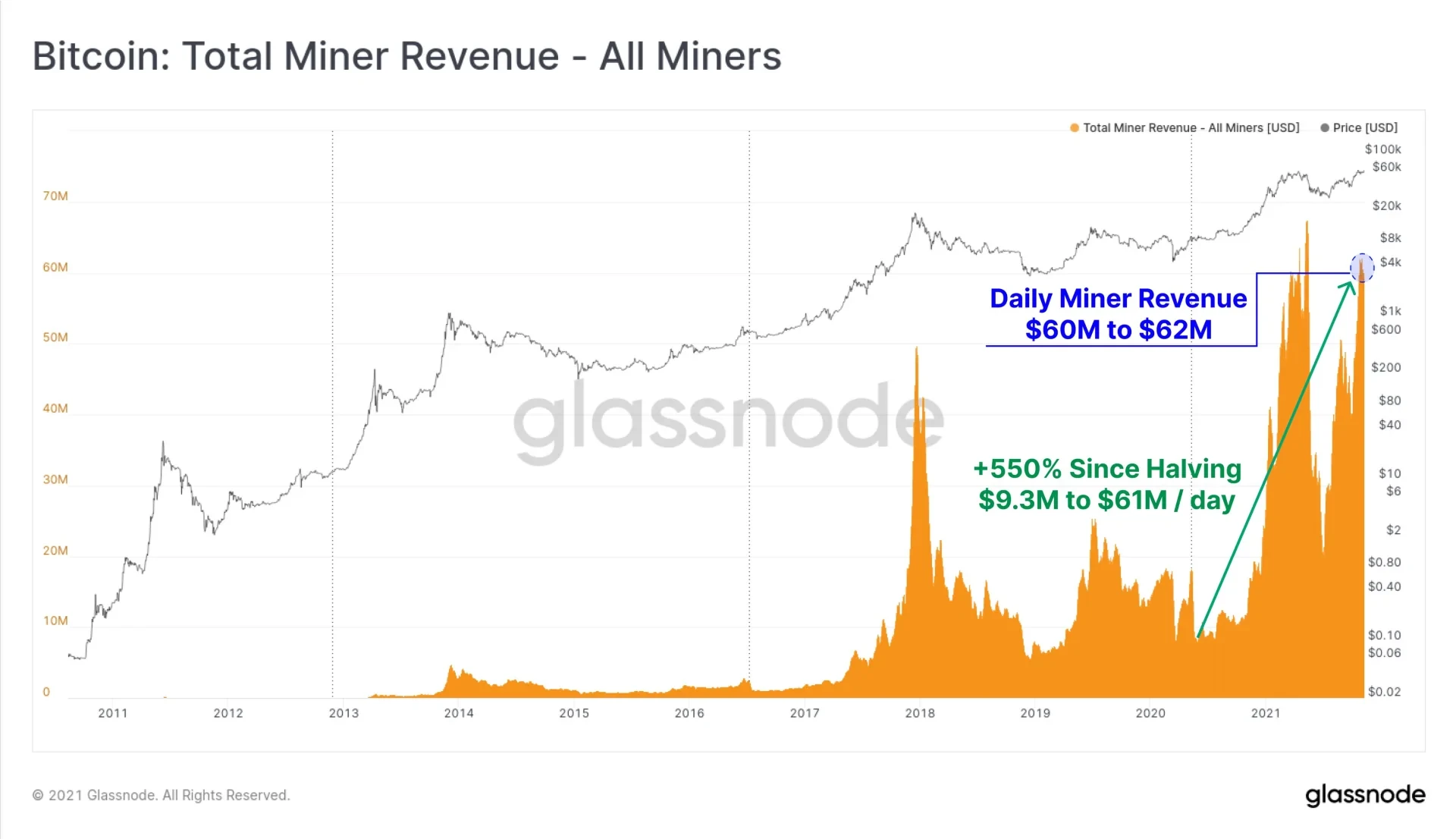
Bitcoin network miner returns, data source: glassnode
In contrast, according to data from the Ultrasound Money burn tracker, since the London upgrade, Ethereum has burned 797,900 ETH, at a burn rate of 5.97 ETH/minute, with an average burn of 1.3122 ETH per block. Approximately 15,000 ETH (worth $65 million at current prices) are burned every day.
Additionally, according to estimates, as long as Ethereum's average gas fee stays above 150 Gwei, the network can be maintained in a deflationary state. Since mid-September, Ethereum gas fees have remained above 150 Gwei for half the time. During the last week of October, Ethereum gas fees exceeded 150 Gwei for seven consecutive days, placing the entire network in a deflationary state. Taking into account the rate at which new ETH is being created, Watchthe Burn reports that as of early November, the weekly net issuance was -8,034 ETH (approximately $34 million).
This current situation overturns the previous notion that "for Ethereum to enter a deflationary state, it would have to wait until after the merger between ETH 1.0 and ETH 2.0" — that is, the merger of the current Ethereum chain with the Beacon Chain, which is currently expected to take place in the first half of 2022. Therefore, it appears that Ethereum's deflation has arrived at least six months ahead of schedule.
Although high gas fees have led to traders bearing excessive transaction costs — for example, the average cost of transferring an ERC-20 token is currently $46. If traders engage in more complex operations, such as providing liquidity to DeFi protocols or swapping tokens on Uniswap, current costs could be as high as $140 — the rapid development of L2 solutions is expected to reduce transaction fees without disrupting the Ethereum ecosystem.
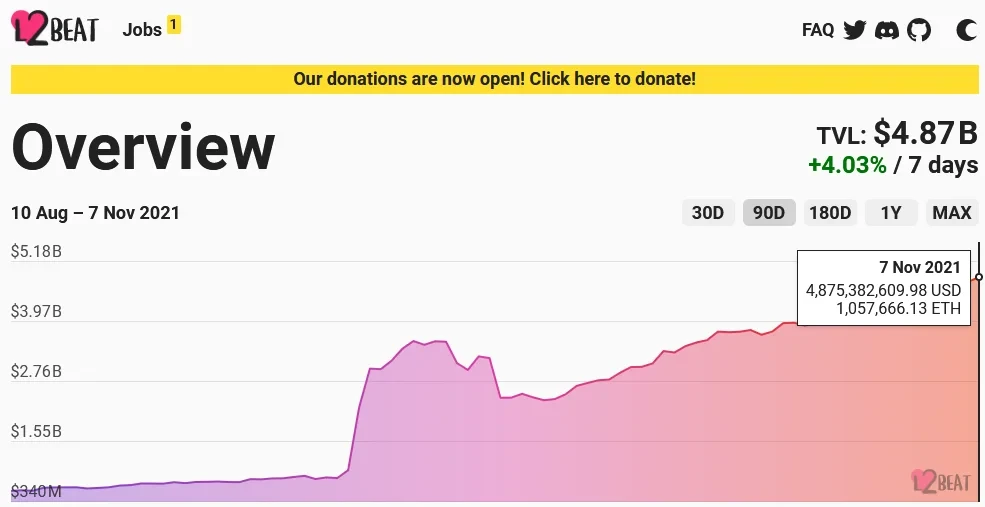
L2 network staking, data source: L2BEAT
According to L2BEAT data, as of early November, the total value of assets locked across networks such as Arbitrum and Optimism reached a record $4.87 billion, representing a nearly 600% increase over the past three months.
Of course, deflation is only one aspect of Ethereum's financial value. The prosperous development of DeFi is the true backbone of Ethereum's financial value. This is because Ethereum exists both as an interest-bearing asset and because the decentralized finance network empowers the Ethereum network.
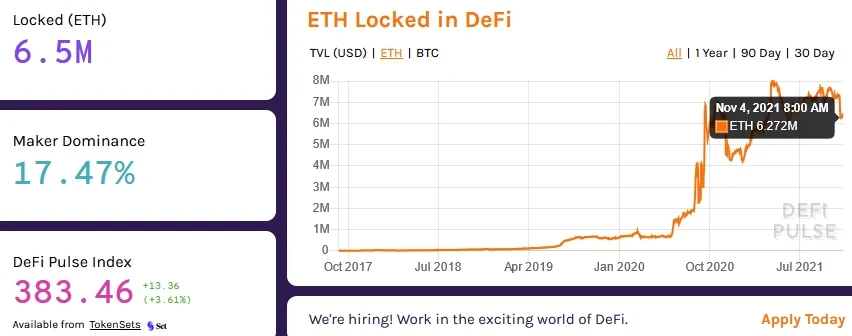
According to the latest data from DeFiPulse, more than 6.27 million ETH is currently staked as a crypto asset in DeFi, accounting for over 6% of ETH's circulating supply. Nearly 3,000 lending, DEX, payment, and derivatives projects are operating on the Ethereum network. Together, they form the foundation of Ethereum's DeFi empire. Among them, Uniswap, focused on spot trading; dYdX, focused on derivatives trading; MakerDAO, focused on stablecoin issuance; Synthetix, focused on asset synthesis; and Curve, focused on lending, each hold the top position in their respective DeFi sub-sectors.
In terms of network activity, according to bitinfocharts data, from early 2020 to the present, despite Ethereum network fees increasing over 100-fold in fiat terms during this period, the number of active network users has also risen from 200,000 at that time to 1 million currently. During the same period, the number of active addresses on the Bitcoin network only doubled.
Daily active addresses, as an important indicator of network growth, can be used to measure the total value of a network. Metcalfe's Law, applied when valuing Facebook (now Meta), states that the value of a network is proportional to the square of its number of users. If we apply Metcalfe's Law to measure the value of Ethereum and Bitcoin networks, the former's growth rate is more than six times greater than the latter's over the same period.
Finally, assuming that in 2022 the Ethereum protocol successfully upgrades to 2.0, with the support of the Layer 2 ecosystem, Ethereum network activity is expected to increase by an order of magnitude, and network value will rise exponentially.
Overall, the deflation of the Ethereum network, DeFi growth, and rising network activity are all key supporting factors for the value of the Ethereum network. The explosion of NFTs in 2021 serves as an important pillar of Ethereum's "cultural value."
2**, Ethereum's Cultural Value**
Since early 2021, NFTs have emerged as a remarkable phenomenon in the crypto world, demonstrating that the crypto world is not limited to finance but can also carry "cultural value."
You may think that culture is esoteric, but in reality, culture is a specific identity and value consensus formed by a group of people based on their habits and customs. For example, if you believe that an investor who collects CryptoPunks is wealthy, or feel that owning an Art Blocks piece of your own is cool, or believe that holding an Axie Infinity creature has appreciation potential — rather than thinking NFTs are nothing more than a Ponzi scheme like MMM — then you have a value consensus for NFT-based cultural products. As long as you identify with it, you may be willing to spend real money on these artworks.
Currently, the total market cap of NFTs in the Ethereum ecosystem is close to $6 billion, and the total trading volume of the top ten projects exceeds $7.8 billion. The related NFT sub-sectors include: 1) Crypto art; 2) PFP NFTs; 3) Generative Art; 4) Crypto gaming (GameFi); 5) Community NFTs (represented by LOOT), among others.
On the NFT development timeline, crypto art was the first to gain popularity. In March 2021, during Christie's single-lot online-only auction, the digital artwork "Everydays: The First 5000 Days" by American artist Mike Winkelman, known by the pseudonym "Beeple," was sold for $69,346,250 (approximately RMB 451 million). This sale price ranked as the third-highest for a living artist's artwork and broke records for digital art auction prices and the highest price for an online-only lot. This event became a landmark moment in NFT history.
Following that, PFP NFTs entered the mainstream. The 10,000-pixel avatar collection CryptoPunks, launched by Larva Labs in June 2017, suddenly went viral in the crypto community in July 2021, sparking a months-long crypto avatar frenzy. The design style of CryptoPunks is cyberpunk-inspired and, to some extent, represents the rebellious spirit of the crypto world's revolution. Investors who hold CryptoPunks are seen as pioneers of crypto art and identifiers with punk culture.
Afterward, the NFT market saw the emergence of generative crypto art represented by Art Blocks. Generative crypto art refers to the process where artists write programs, add randomness to their works by triggering changes through seeds, and then the artwork is automatically generated by computer algorithms. In other words, generative art is a process in which the human mind and computer algorithms jointly produce randomized artworks.
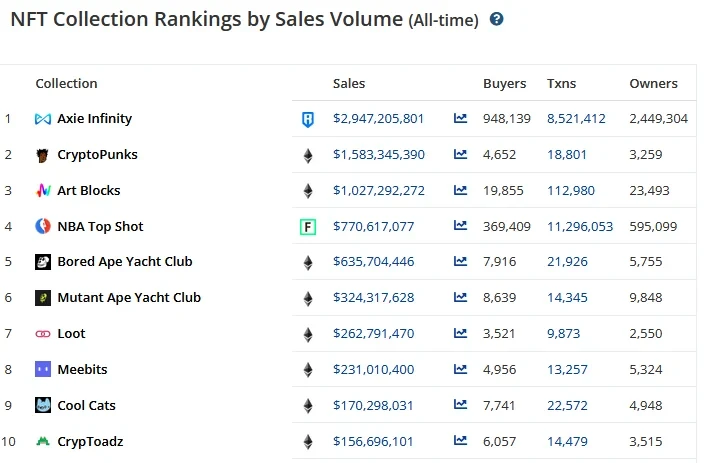
Top 10 NFT projects by trading volume, data source: cryptoslam.io
According to the latest data from cryptoslam.io, Art Blocks is the largest generative art trading platform, with historical trading volume exceeding $1 billion, ranking third after Axie Infinity and CryptoPunks. This is enough to demonstrate the popularity of generative art within the NFT space.
While crypto PFPs, crypto art, and generative art were developing rapidly, crypto gaming (GameFi) was also gaining momentum. The most representative of these is Axie Infinity, whose creation provided a practical and viable solution for the "Play to Earn" sector. Although Axie Infinity runs on the low-cost customized Layer 2 network Ronin, its settlement layer remains Ethereum, making Axie Infinity a project fully belonging to the Ethereum ecosystem. As of now, Axie Infinity has dominated the NFT market with total trading volume approaching $3 billion, demonstrating the immense potential of the Play to Earn sector.
Finally, since the NFT boom, large institutions and publicly listed companies have also actively joined the NFT space, contributing to the cultural value of the Ethereum ecosystem. This includes Visa purchasing a CryptoPunk, Louis Vuitton launching the NFT treasure-hunt game Louis the Game, and Twitter enabling individual users to set NFT profile pictures, among others.
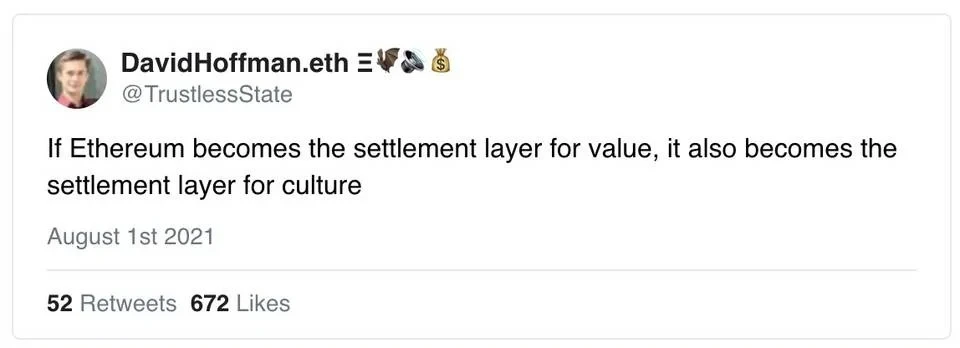
Previously, Bankless co-founder David Hoffman proposed that if Ethereum can become a value settlement layer, it can also become a cultural settlement layer. Truly a combination of both literary and martial excellence. Looking at it now, Ethereum is moving in this direction.
Disclaimer
This article may contain product-related content that is not applicable in your region. This article is only dedicated to providing general information and does not accept responsibility for any factual errors or omissions. This article represents the author's personal views only and does not represent OKX's views. This article is not intended to provide any advice, including but not limited to: (i) investment advice or investment recommendations; (ii) offers or solicitations to buy, sell, or hold digital assets; or (iii) financial, accounting, legal, or tax advice. Holdings in digital assets (including stablecoins) involve high risk and may fluctuate significantly, or even become worthless. You should carefully consider whether trading or holding digital assets is suitable for you based on your financial situation. For questions about your specific circumstances, please consult your legal/tax/investment professional. The information contained in this article (including market data and statistics, where applicable) is for general reference purposes only. While we have taken all reasonable precautions in preparing such data and charts, we accept no liability for any factual errors or omissions expressed herein. © 2025 OKX. This article may be reproduced or distributed in its entirety, or excerpts of 100 words or less may be used, provided that such use is non-commercial in nature. Any reproduction or distribution of the full article must prominently state: "This article is copyrighted © 2025 OKX, used with permission." Permitted excerpts must cite the article title and include attribution, for example "Article title, [author name (if applicable)], © 2025 OKX." Some content may have been generated or assisted by artificial intelligence (AI) tools. Derivative works or other uses of this article are not permitted.
Show More
Recommended Reading
OKX Pay: Ushering in a New Era of Next-Generation Crypto Payments
The choice of tens of millions of users, register with OKX and enjoy an exceptional trading experience and diverse wealth management products. A letter from OKX CEO Star: Today, we officially launch the first version of OKX Pay to over 100 million global users. As the industry's first truly non-custodial and compliant payment application, OKX Pay will be embedded within the OKX App and is currently available in select markets, with full rollout expected within
March 22, 2026

A New Chapter: Building the Next Generation of Financial Infrastructure Together
The collaboration between OKX and Intercontinental Exchange (ICE) represents a significant milestone for OKX and holds profound meaning for the evolution of the entire digital assets market. ICE builds and operates the world's most critical financial infrastructure, including the New York Stock Exchange and global derivatives and clearing platforms. This ICE Select investment in OKX and joining our board of directors reflects our shared belief that digital assets technology will
March 10, 2026
Tribute to Another Year of Resilience and Progress
As OKX's CEO and a builder who stays true to the original mission, I take great pride in looking back on the extraordinary growth and progress OKX has achieved this year. Despite significant challenges, 2024 was a year defined by focus, innovation, and resilience. We not only expanded and optimized our products but also made important strides in launching transparent and regulation-compliant localized businesses, while also strengthening our global management team. It is worth noting that after going through
January 29, 2026

2025: Steady Progress Toward Financial Freedom
— Year-End Letter to Global Users from Star, OKX Founder and CEO "Financial freedom" is often misunderstood. It doesn't mean the absence of rules, but rather the right to have choices even when rules exist — and that the system remains reliable and effective when truly put to the test. This is precisely what we have remained focused on throughout 2025. First and foremost, I would like to express my sincere gratitude to our global customers, partners, and regulators.
January 16, 2026
OKX Officially Launches in Germany and Poland
By Erald Ghoos, CEO of OKX Europe — Today is a significant day for OKX — and for crypto users across Europe. We have officially launched a fully compliant centralized cryptocurrency trading platform in Germany and Poland! For us, this is not just a geographic expansion, but a commitment to building the future of cryptocurrency the right way: secure, transparent, and tailored to local needs. If you are in Germany
October 21, 2025
Partnership Upgrade! OKX and Standard Chartered Join Forces to Expand into Europe
On October 15th, Erald Ghoos, CEO of OKX Europe, stated that OKX is expanding its strategic partnership with Standard Chartered into the European Economic Area (EEA). Earlier this year, OKX first teamed up with Standard Chartered in the UAE to launch the collateral mirroring program — a
October 15, 2025