Through the "Walmart Supports Litecoin Payment Hoax", Exploring Multinational Corporations Involved in Blockchain Business
On the evening of September 13th (Hong Kong time), news that "Walmart announced support for online payments using Litecoin" spread through overseas media and was quickly re-tweeted by the Litecoin Foundation's official Twitter account. With the boost from Bloomberg, Reuters, CNBC, and other authoritative overseas media outlets, as well as numerous first-tier domestic industry media, it quickly ignited market investor sentiment. According to OKX platform data, that evening, between 21:15 and 21:30, Litecoin prices experienced a short-term violent surge, with the maximum gain reaching 33.65%.
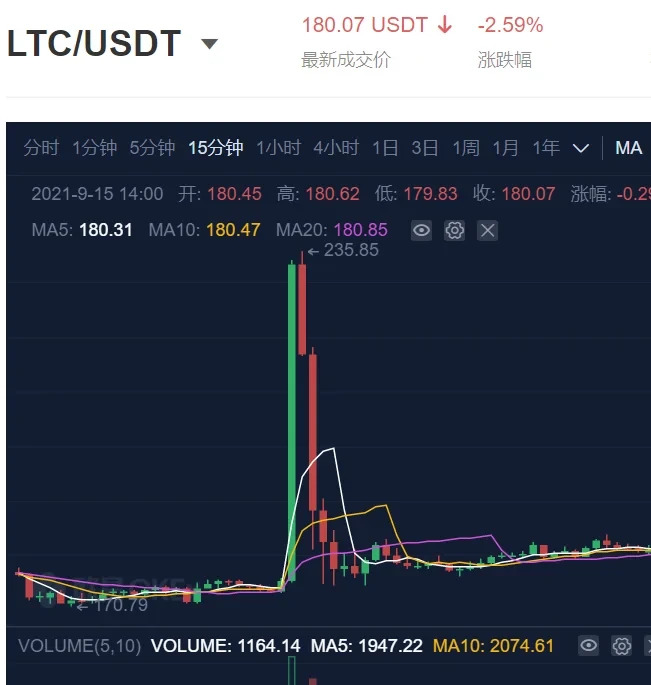
Litecoin price movement on the evening of September 13, source: OKX
However, Litecoin's official Twitter account quickly deleted the retweeted post about the Walmart partnership, and Walmart publicly clarified that this was fake news. Affected by this news, Litecoin prices dropped accordingly, returning to their pre-rally levels by 22:30. This more-than-one-hour hoax came to an end. However, the impact of this hoax cannot be overlooked. On one hand, the short-term significant volatility brought to the crypto market — Litecoin's strong rally successfully drove mainstream crypto assets like Bitcoin and Ethereum to rise in tandem. But after the news was debunked, the related crypto assets simultaneously reversed downward. During this period, judging by the temporarily increased trading volume in LTC/USDT spot trading and LTCUSD perpetual swap trading on the OKX platform, many investors chased the rally in both the spot and futures markets during the first half hour. Third-party data website bybt's statistics on forced liquidations in the crypto asset futures market on that day also serve as supporting evidence: data shows that on September 13th, the value of short positions forcibly liquidated in the futures market was $169 million, while long positions forcibly liquidated exceeded $500 million, approximately three times the value of short liquidations. On the other hand, the negative impact of frequent false news in the crypto market on establishing a sound market order and protecting investor confidence cannot be underestimated. For example, when news broke on July 26 this year that "Amazon planned to accept Bitcoin payments before the end of 2021," Amazon officially debunked it the next day. This mix-up also caused significant Bitcoin price fluctuations. In fact, the time interval between these two news events was less than two months.
Given the characteristics of the crypto market's current stage of development, similar news events will most likely continue to occur for some time to come, and to a large extent, they are unpredictable and unavoidable. So, for the majority of ordinary investors in this market, is there any way to minimize the impact of such false news on their investment decisions? Perhaps there is. For example, consciously learning more comprehensive industry information in daily life, so that one has more accurate judgment when encountering difficult-to-verify news next time. Taking the Walmart incident as an example, many people may only know Walmart as a global leading retail giant, but are unaware that it had actually already entered the blockchain business. Next, let's expand on this topic and sort out which well-known multinational corporations have deployed blockchain or announced acceptance of crypto asset payments, and on this basis, briefly discuss useful logic for identifying false information.
According to Patsnap's global patent database, as of August 2021, more than 69,000 blockchain-related patent applications have been filed globally, of which 14,000 are valid patents. From the perspective of applicants' regions, the top three are China, the United States, and South Korea. Since blockchain business is a technology-driven industry at its current stage of development, the dimension of patent application volume can more directly reflect the depth of a particular entity's deployment in the blockchain industry.
Switching to the perspective of enterprise-subject blockchain patent applications, according to the "2020 Global Blockchain Patent Rankings TOP100" list published by 01CAI Finance, among all countries with blockchain patents globally, Chinese companies rank first in the world in both scale and patent application volume. As of 2020, 3,218 Chinese companies had cumulatively filed 20,434 blockchain patents, accounting for 54.3% and 53.7% of the global totals respectively. Next, the United States has 2,048 companies participating in blockchain patent applications, with a cumulative patent count of 10,921, accounting for 34.6% and 28.7% of the global totals respectively.
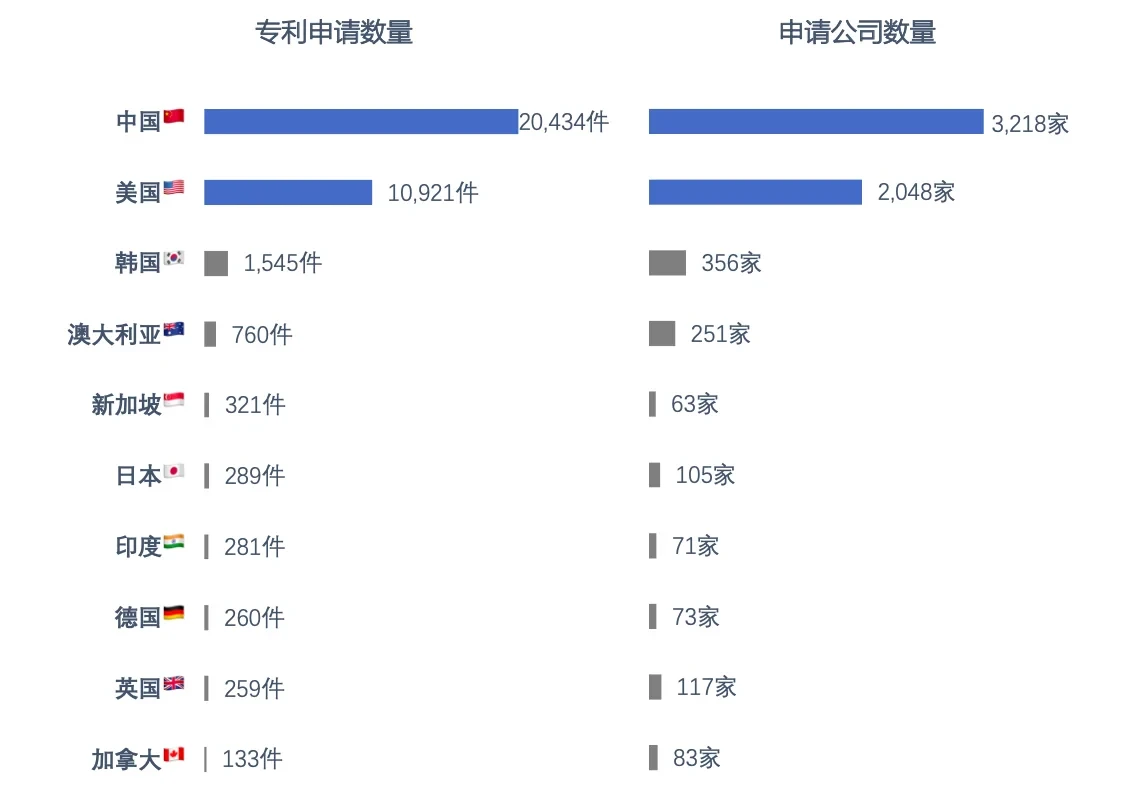
Global major countries' blockchain patent application company numbers and patent application volumes (as of 2020), data source/chart: 01CAI Think Tank
Specifically, in the 2020 Global Blockchain Patent Rankings TOP100, 52 Chinese companies were listed, with Alibaba, Tencent, and Ping An Group ranking in the top three, followed by US and UK companies such as IBM, nChain, MasterCard, and Walmart.
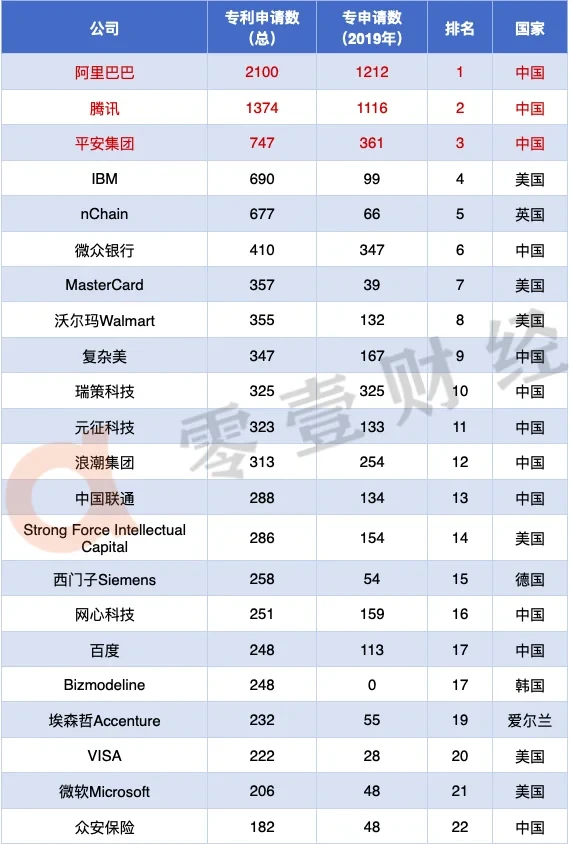
2020 Global Blockchain Patent Rankings TOP100 (partial), source/chart: 01CAI Think Tank
For the top three companies, we are more or less familiar with their blockchain-related businesses, so we will skip them for now.
Next is IBM. When it comes to IBM, one must mention the Hyperledger project. As early as December 2015, under the leadership of the Linux Foundation, IBM and 29 other members co-founded the Hyperledger open-source project, dedicated to applying blockchain solutions to various industries. Within the Hyperledger consortium, IBM led the incubation of the Fabric sub-project, which first met the needs of smart contract execution for various commercial application scenarios. By February 2016, IBM launched its blockchain platform service BaaS, laying a solid foundation for IBM's continuous involvement in diverse fields and the efficient development of corresponding technical tools. In 2018, IBM continued to launch IBM Blockchain World Wire, a global payment system based on blockchain and the Stellar protocol, enabling financial institutions to clear and settle cross-border payments within seconds, and further developed a corresponding blockchain payment system. By the end of 2019, the cross-border payment network World Wire had integrated six international banks, and its Lumens was accelerating its development as a bridge currency between various countries' legal tender, entering broader cross-border trading markets.
As for one of the protagonists of this article — Walmart. Walmart also entered the blockchain space very early, beginning trials of distributed ledger technology to improve its supply chain in 2016. In 2018, it began announcing that some of its food suppliers use the IBM Food Trust blockchain application system, achieving a breakthrough among the many declining retail enterprises. Worth mentioning is that in the field of food safety, Walmart also co-founded the Safe Food Blockchain Traceability Consortium with IBM, Tsinghua University's E-Commerce Trading Technology Laboratory, and other units in 2017, aimed at further strengthening food tracking, traceability, and safety cooperation through blockchain technology, as well as improving the transparency and safety of China's food supply chain.
As for Microsoft, an IT leader that has established unified standards for the global software model, it also launched a project called "Azure BaaS" in November 2015, introducing blockchain technology to Azure and providing BaaS services for customers using Azure cloud services.
Google's layout in the blockchain industry is equally profound. In 2016, Google, together with Amazon AWS, provided cloud services supporting blockchain technology applications for customer groups primarily consisting of financial institutions. In the following three years, cloud services became an important entry point for Google's blockchain布局. Later, Google collaborated with several leading companies in the blockchain field such as Chainlink to introduce blockchain technology into Google Cloud, exploring how users can better use distributed ledger technology and enabling smart contracts to securely access off-chain data sources, traditional bank payments, and website APIs.
Finally, let's discuss what business considerations lie behind traditional enterprises announcing acceptance of crypto asset payments. According to incomplete statistics, tens of thousands of large and medium-sized enterprises worldwide have currently announced acceptance of mainstream crypto assets such as Bitcoin and Ethereum as optional payment methods for consumers. From the perspective of these enterprises, are they really doing so because they are optimistic about the development prospects of crypto assets? Perhaps not. Because for any enterprise, profitability comes first. When they announce acceptance of crypto assets as payment methods, what they see is the increasingly large user base in the growing crypto market. To better retain these consumers, adding this new payment method is undoubtedly wise. But from another angle, if consumers were allowed to directly pay with Bitcoin and other crypto assets, it would essentially transfer the potential price volatility risk of these crypto assets onto the enterprise, which is clearly not the optimal option. What is the better solution? That is to complete trading through intermediary institutions like Visa, Mastercard, and PayPal that can quickly process crypto asset and legal tender trading exchanges. Going back to the "Walmart announces support for online Litecoin payments" mentioned at the beginning, if we consider it according to this logic, it largely does not align with Walmart's need to maximize interests.
Disclaimer
This article may contain product-related content that does not apply to your region. This article is only intended to provide general information and does not responsible for any factual errors or omissions. This article represents only the author's personal opinions and does not represent OKX's views. This article is not intended to provide any advice, including but not limited to: (i) investment advice or investment recommendations; (ii) offers or solicitations to buy, sell, or hold digital assets; or (iii) financial, accounting, legal, or tax advice. Holding digital assets (including stablecoins) involves high risk, may fluctuate significantly, or even become worthless. You should carefully consider whether trading or holding digital assets is suitable for you based on your financial situation. For questions regarding your specific circumstances, please consult your legal/tax/investment professional. The information in this article (including market data and statistics, if any) is provided for general reference purposes only. Although we have taken all reasonable precautions in preparing such data and charts, we assume no liability for any factual errors or omissions expressed herein. © 2025 OKX. This article may be reproduced or distributed in its entirety or with excerpts of 100 words or fewer, provided that such use is non-commercial. Any reproduction or distribution of the full article must prominently state: "This article is copyrighted © 2025 OKX, used with permission." Permitted excerpts must cite the article title and include attribution, for example, "Article title, [author name (if applicable)], © 2025 OKX". Some content may have been generated or assisted by artificial intelligence (AI) tools. Derivative works and other uses of this article are not permitted.
Show More
Recommended Reading
OKX Pay: Ushering in the Next Generation of Crypto Payment Era
The choice of tens of millions of users. Register with OKX and enjoy an exceptional trading experience and diverse wealth management products. A letter from OKX CEO Star: Today, we officially launch the first version of OKX Pay to over 100 million global users. As the industry's first payment application to truly achieve the fusion of non-custodial and compliant solutions, OKX Pay will be embedded within the OKX App, currently available in select markets, with full rollout expected in the coming months.
March 22, 2026

A New Chapter: Building the Next Generation of Financial Infrastructure Together
The partnership between OKX and the Intercontinental Exchange (ICE) represents a significant milestone for OKX, and is equally meaningful for the evolution of the entire digital assets market. ICE builds and operates the world's most important financial infrastructure, including the New York Stock Exchange and global derivatives and clearing platforms. This investment by ICE in OKX and its joining of our board reflects our shared belief — that digital assets technology will transform financial markets.
March 10, 2026
Paying Tribute to Another Year of Perseverance
As CEO of OKX and a builder who stays true to the original mission, I take great pride in reflecting on the extraordinary growth and progress OKX has achieved this year. Despite significant challenges, 2024 was nonetheless a year of focus, innovation, and resilience. We not only expanded and optimized our products, but also made important progress in launching transparent and regulation-compliant localized businesses, while further strengthening our global management team. It is worth noting that after going through
January 29, 2026

2025: Steady Progress Toward Financial Freedom
— A Year-End Letter to Global Users from Star, Founder and CEO of OKX. "Financial freedom" is often misunderstood. It does not mean living without rules; rather, it means having the freedom to choose — even with rules in place — and when the system is truly put to the test, it remains reliable and effective. This is what we have remained focused on throughout 2025. First, I would like to extend my sincere gratitude to our global customers, partners, and regulators.
January 16, 2026

OKX Officially Launches in Germany and Poland
By Erald Ghoos, CEO of OKX Europe. Today is a significant day for OKX — and for crypto users across Europe. We have officially launched our fully compliant centralized cryptocurrency trading platform in Germany and Poland! For us, this is more than just a geographic expansion — it is a commitment to building the future of cryptocurrency the right way: secure, transparent, and tailored to local needs. If you are in Germany
October 21, 2025
Partnership Upgrade! OKX Joins Forces with Standard Chartered to Expand into European Markets
On October 15th, Erald Ghoos, CEO of OKX Europe, stated that OKX is expanding its strategic partnership with Standard Chartered to the European Economic Area (EEA). Earlier this year, OKX first partnered with Standard Chartered in the UAE to launch the collateral mirroring program — a
October 15, 2025