Grid Trading: Built for Range-Bound Markets
Grid Trading is a trading strategy "built for range-bound markets." While it has been widely used in traditional investment markets, it remains relatively niche in the crypto space, and has sparked two polarized schools of thought due to its distinct advantages and drawbacks.
Proponents argue it is particularly well-suited for retail investors — once the strategy is set, buy and sell orders are clear-cut, profits and losses are predictable, and neither technical analysis nor news tracking is required. In this view, it is a stable and reliable trading approach.
Critics, on the other hand, point to its high trading frequency (which demands significant effort), low capital efficiency, and vulnerability to trending markets — warning that being locked into a position for extended periods during a sustained move can be extremely painful for average investors.
So how does grid trading actually work? Is it suitable for retail investors, how should you use it, and how do you mitigate its inherent weaknesses?
Simply put, grid trading is an automated strategy that buys low and sells high within a predefined price range. The strategy calculates buy and sell prices for each small grid, places orders automatically, and repeatedly buys dips and sells rallies as the market fluctuates to capture returns from volatility. As a form of quantitative trading, grid trading has been applied in traditional financial markets for years and is a proven, effective strategy. But does it work in crypto?
We know that over 80% of the time, crypto markets are range-bound. The vast majority of investors lack technical analysis skills, rarely study the fundamentals behind blockchain projects, and tend to trade on emotion — chasing gains and panic-selling — which more often than not results in losses.
In such choppy conditions, grid trading demonstrates its strengths. Simply set the price range's upper and lower bounds, determine the number of grids, and the strategy is ready to run. Regardless of where the market goes afterward, the strategy executes faithfully: automatically buying dips and selling rallies within the trading range as digital asset prices fluctuate.
Building a Grid Trading Strategy
So how do you set up a solid grid Trading strategy? Here are the key steps:
First, select a good trading asset. This is the foundation of a successful grid trading strategy. What makes a good trading asset in the crypto market? Key criteria include: proven by long market exposure, sufficient trading depth, high market recognition, and preferably mainstream digital assets like BTC or ETH. The grid trading strategy does not chase sustained price rallies — it capitalizes on continuous volatility. As long as the asset keeps oscillating within a range without trending sharply in one direction, returns can be quite attractive.
Second, determine grid spacing and density. This has two dimensions: setting the upper and lower price bounds, and deciding the number of grids. The upper and lower bounds can be based on recent highs and lows over a chosen period. For example, if you select BTC as your trading asset and want to start grid trading now, you could use $20,000 (the start of the current major cycle) as the lower bound and $64,000 (the cycle high) as the upper bound. If your strategy has a longer time horizon, you could even use May 12 of last year — around $8,200 — as the halving date starting point.
Once the upper and lower bounds are set, divide the range into equal intervals. Grid spacing can reference the asset's average daily volatility — ideally no greater than the average daily range, with 5% being a common choice. This also determines the grid count, typically around 20 grids. Once the spacing is confirmed, you can calculate the price level for each grid, and strictly execute buys and sells at those predetermined levels regardless of market fluctuations.
Third, find a suitable entry price. This can be informed by technical indicators, such as: BTC's daily MA60, Bitcoin's 60-day cumulative return, the ahr999 coin-hoarding index, and so on. If you are not familiar with these indicators, simply start a few grids below the current price — say 3 to 5 grids down. Of course, every situation is different. For example, if the current market is oscillating after a major crash, you could enter at the current price, with the initial position accounting for roughly one-tenth of your total capital.
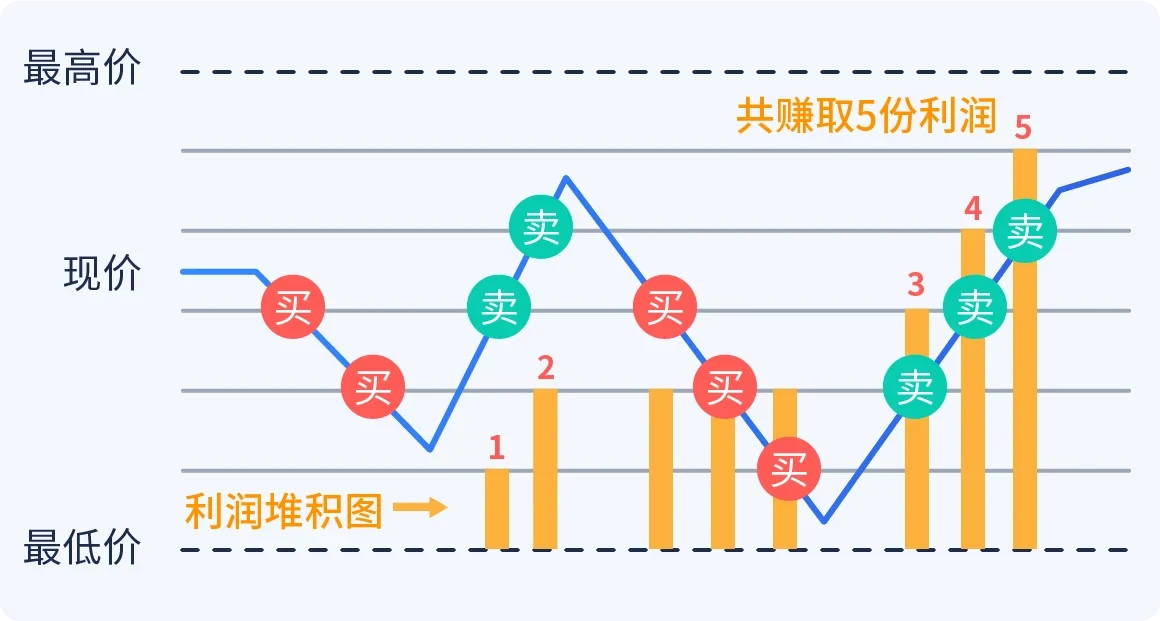
Grid Trading Returns Chart Example (Source: YunFinance)
Fourth, understand the difference between arithmetic grids and geometric grids, and the scenarios each is suited for. The key distinction lies in the price difference between individual grids: arithmetic grids use a fixed absolute price interval between grids, making them better suited for relatively narrow range-bound trading; geometric grids use a fixed percentage change between grids, making them better suited for rangebound rallies or wider ranging markets.
Optimizing a Grid Trading Strategy
No trading strategy is perfect, and grid trading is no exception. Its main drawbacks include: vulnerability to trending markets (which can break the grid), low capital efficiency, and high trading frequency requiring significant time and effort. Here is how to address these:
Trending markets primarily manifest as: losses when the price breaks below the lower bound, and missing out on gains when the price breaks above the upper bound. For losses below the lower bound, the best approach is position management and discipline — avoid making impulsive decisions due to emotional stress. Additionally, you can use spare cash to dollar-cost average (DCA) and sell in batches when the price recovers, then resume the grid strategy. For gains above the upper bound, consider reserving a portion of lower-priced holdings as a base position and combining it with the grid strategy. Adjust the base position size based on market conditions: the higher the price, the smaller the base position; the lower the price, the larger the base position. Finally, in extreme market conditions or severe deterioration of the broader environment, implement staged stop-losses.
For the "low capital efficiency" drawback, there is no fully effective solution currently available. You could try buying large positions when the market experiences significant dips, but this actually goes against the grid trading principle of "gradual buying and risk diversification" — the price may continue to fall, leaving you without funds. So, if you want grid trading's stable returns, you must accept some of its drawbacks.
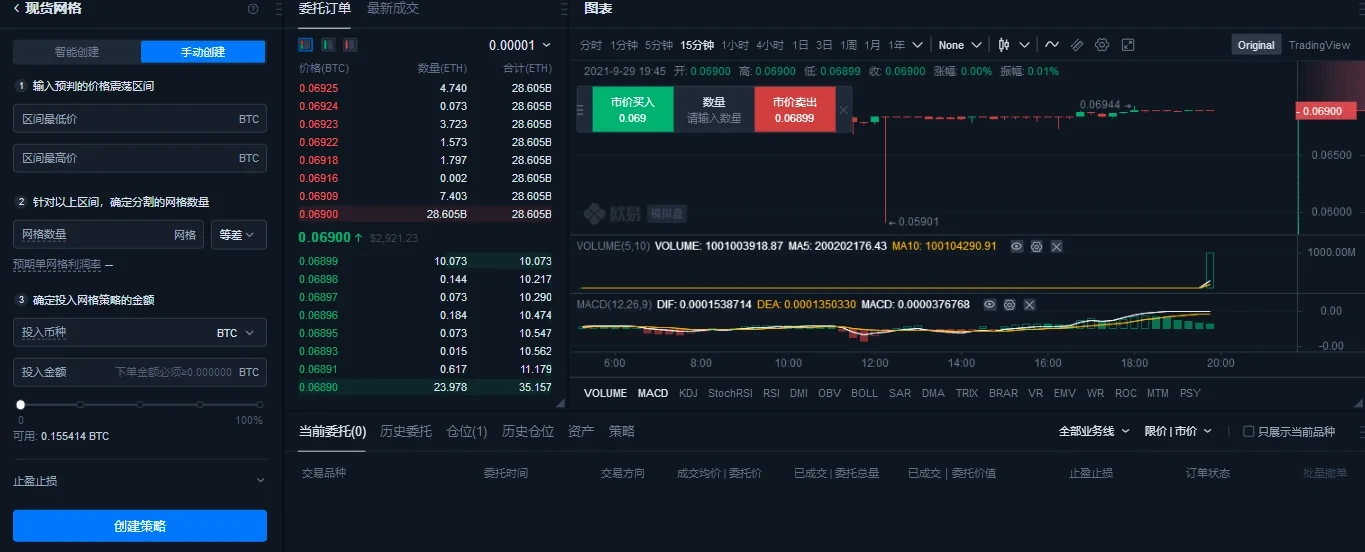
For the "high trading frequency requiring significant time and effort" drawback, the key is to select the right trading platform. The OKX platform, for instance, supports smart grid trading strategy creation — once configured, the system trades automatically, saving you time and effort.
OKX currently offers grid simulated trading, supporting both "Smart Create" and "Manual Create" grid trading modes. Users can visit the OKX website, click Assets Management in the top right corner — Start Simulated Trading, and select grid trading to try it out. Simulated grid trading on OKX will be launching soon — please refer to official announcements for the specific date.
Of course, all optimization methods are built on one fundamental前提: selecting the right trading asset. If that foundation is flawed, every strategy and optimization plan is a castle in the air — the harder you work, the bigger the mess. So it bears repeating: be cautious when selecting trading assets, diversify across two or more assets, and never put all your eggs in one basket.
Grid trading is inherently a risk-diversifying, stable-return trading strategy that requires a long-term perspective and considerable patience. But it is also a strategy validated by the market and by time — because it is specifically designed for rangebound markets, and whether in a bull market, bear market, or across any digital asset or the broader market, 80% of the time is spent oscillating within ranges.
Beyond grid trading, there are many other trading strategies available in the market. No strategy is inherently good or bad, and none can guarantee 100% profitability. What matters most is finding the one that suits you.
Disclaimer
This article may contain product-related content not applicable to your region. This article is intended to provide general information only and makes no representation as to the accuracy or completeness of any information provided. The views expressed in this article are solely those of the author and do not represent the views of OKX. This article is not intended to provide, and should not be construed as, any recommendation or suggestion to (i) invest or make investment decisions, (ii) make an offer or solicitation to buy, sell, or hold digital assets, or (iii) financial, accounting, legal, or tax advice. Holdings in digital assets (including stablecoins) involve a high degree of risk and can fluctuate dramatically and may even become worthless. You should carefully consider whether trading or holding digital assets is appropriate for you in light of your financial situation. Please consult your legal/tax/investment professional regarding questions about your specific circumstances. Any information contained herein (including market data and statistics, if applicable) is provided for general reference purposes only. While all reasonable precautions have been taken in preparing this data and these charts, we assume no responsibility for any factual errors or omissions herein expressed. © 2025 OKX. This article may be reproduced or distributed in its entirety, or in excerpts of 100 words or fewer, provided such use is for non-commercial purposes. Any reproduction or distribution of the full article must also include prominent attribution: "This article is copyrighted © 2025 OKX, used under permission." Authorized excerpts must cite the article name and include the source, e.g., "Article title, [author name if applicable], © 2025 OKX." Some content may have been generated or assisted by artificial intelligence (AI) tools. Derivative works and other uses of this article are not permitted.
Show More
Recommended Reading
OKX Pay: Ushering in a New Era of Crypto Payments
Trusted by tens of millions of users. Register with OKX to enjoy an exceptional trading experience and a wide range of wealth management products. A letter from OKX CEO Star: Today, we are officially launching the first version of OKX Pay to over 100 million global users. As the industry's first payment application to truly integrate non-custodial functionality with regulatory compliance, OKX Pay will be embedded directly within the OKX App, currently available in select markets with global rollout expected within months.
March 22, 2026

A New Chapter: Building the Next Generation of Financial Infrastructure
The partnership between OKX and the Intercontinental Exchange (ICE) marks a significant milestone for OKX and holds profound meaning for the evolution of the entire digital assets market. ICE builds and operates the world's most critical financial infrastructure, including the New York Stock Exchange and global derivatives and clearing platforms. ICE's decision to invest in OKX and join our board reflects our shared conviction — that digital assets technology will transform financial markets.
March 10, 2026
To Another Year of Building
As OKX's CEO and a builder who has never forgotten the original mission, I take great pride in reflecting on the remarkable growth and progress OKX has achieved this year. Despite the challenges, 2024 was a year defined by focus, innovation, and resilience. We not only expanded and refined our products, but also made significant strides in launching transparent, regulation-compliant localized businesses, while further strengthening our global management team. It is worth noting that after experiencing
January 29, 2026

2025: A Steady Progression Toward Financial Freedom
— An End-of-Year Letter to Global Users from Star, Founder and CEO of OKX "Financial freedom" is often misunderstood. It does not mean the absence of rules, but rather the freedom to choose — even within a system of rules — and to know that when the system is truly tested, it remains reliable and effective. This has been our unwavering focus throughout 2025. First, I would like to extend my sincere gratitude to our global customers, partners, and regulators for
January 16, 2026

OKX Officially Launches in Germany and Poland
By Erald Ghoos, CEO of OKX Europe. Today is a momentous day for OKX — and for crypto users across Europe. We have officially launched our fully compliant centralized cryptocurrency exchange in Germany and Poland! For us, this is more than a geographic expansion — it is a commitment to building the future of cryptocurrency the right way: secure, transparent, and tailored to local needs. If you are in Germany
October 21, 2025
Partnership Upgrade! OKX and Standard Chartered Expand into Europe
On October 15, Erald Ghoos, CEO of OKX Europe, stated that OKX is expanding its strategic partnership with Standard Chartered into the European Economic Area (EEA). Earlier this year, OKX first teamed up with Standard Chartered in the UAE to launch the collateral mirroring program — a
October 15, 2025