Stablecoin Market Cap Hits Record High as Corporations and Institutions Begin to "Test the Waters"
In the evolution of digital assets, stablecoins serve as one of the most important assets and as a gateway for funds entering the crypto market, playing a profound role and influence in the cryptocurrency space. As stablecoin market capitalization continues to expand, it has increasingly attracted widespread attention from investment markets as well as global financial and regulatory institutions. The Federal Reserve is no exception—Powell recently expressed at a meeting that "private stablecoins can coexist with a digital dollar."
USDC, USDT, and other stablecoins have repeatedly hit new issuance highs, driving market capitalization to climb steadily. USDT and USDC's combined market cap represents approximately 8% of Bitcoin and Ethereum's total market capitalization. Meanwhile, competition among stablecoins continues to intensify quietly—USDC recently surpassed USDT to become the largest stablecoin by circulation on Ethereum. In the realm of application innovation, numerous tech giants and banking institutions are researching and testing stablecoins, while some countries are deeply studying and advancing reforms in the stablecoin space. On the other hand, stablecoins remain a key focus for international regulators, with many major regulatory bodies recently attempting to promote and accelerate stablecoin regulation. What is the current state of stablecoins? What is the relationship between their continuous issuance growth and crypto market fluctuations? And what will regulation and innovation bring?
Stablecoin Market Reaches New Highs
Despite the recent downturn in the crypto assets market, stablecoin market capitalization has continued to grow rapidly, primarily driven by surging supply from the two major stablecoins. According to Glassnode data, as of January 19, USDT's circulating supply was 78.314 billion tokens, while USDC's circulating supply reached 45.84 billion tokens. USDC's market cap has now exceeded half of USDT's, with both of the largest dollar-backed stablecoins in the market reaching new circulation highs, pushing the total stablecoin market capitalization to a fresh all-time high.
The Block mentioned in its "2022 Digital Assets Outlook" report that dollar-backed stablecoins experienced explosive growth of 388% in 2021. According to CoinGecko data, on January 20, the total stablecoin market capitalization reached $173.3 billion, expanding approximately 6 times from $29 billion at the beginning of 2021. The largest contributors were the dollar-backed stablecoins USDT and USDC—the former issued by Tether in 2014, and the latter issued by Coinbase and Circle. Both have been leaders in the stablecoin market and remain in constant competition.
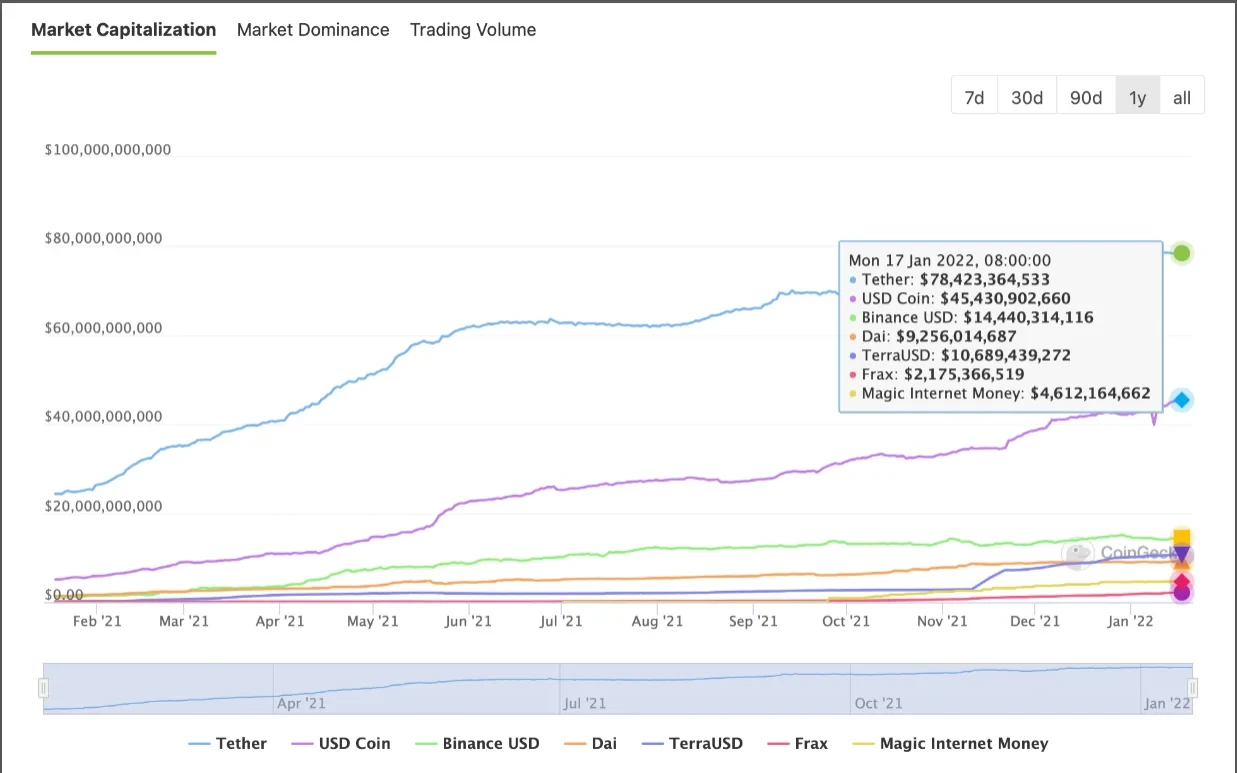
Stablecoin Market Cap Trend Data Source: CoinGecko
Following multiple large-scale issuances of USDC from last year to this year, USDC surpassed USDT for the first time on January 14 to become the stablecoin with the largest circulation on Ethereum. According to OKLink on-chain data, the total stablecoin liquidity on Ethereum is $108.6 billion, with ERC-20 USDC circulation at $39.829 billion and ERC-20 USDT circulation at $39.828 billion. Although the margin is slim, it demonstrates the fierce competition between the two major stablecoins jointly driving market growth.
Another indicator showing record-breaking performance is stablecoin usage. According to a report from the U.S. President's Working Group, stablecoin utilization increased by 500% between October 2020 and October 2021, with no signs of this adoption rate slowing down. This is supported by data: in 2021 alone, adjusted annual trading volume for stablecoins exceeded $5 trillion, representing year-over-year growth of over 370% compared to 2020.
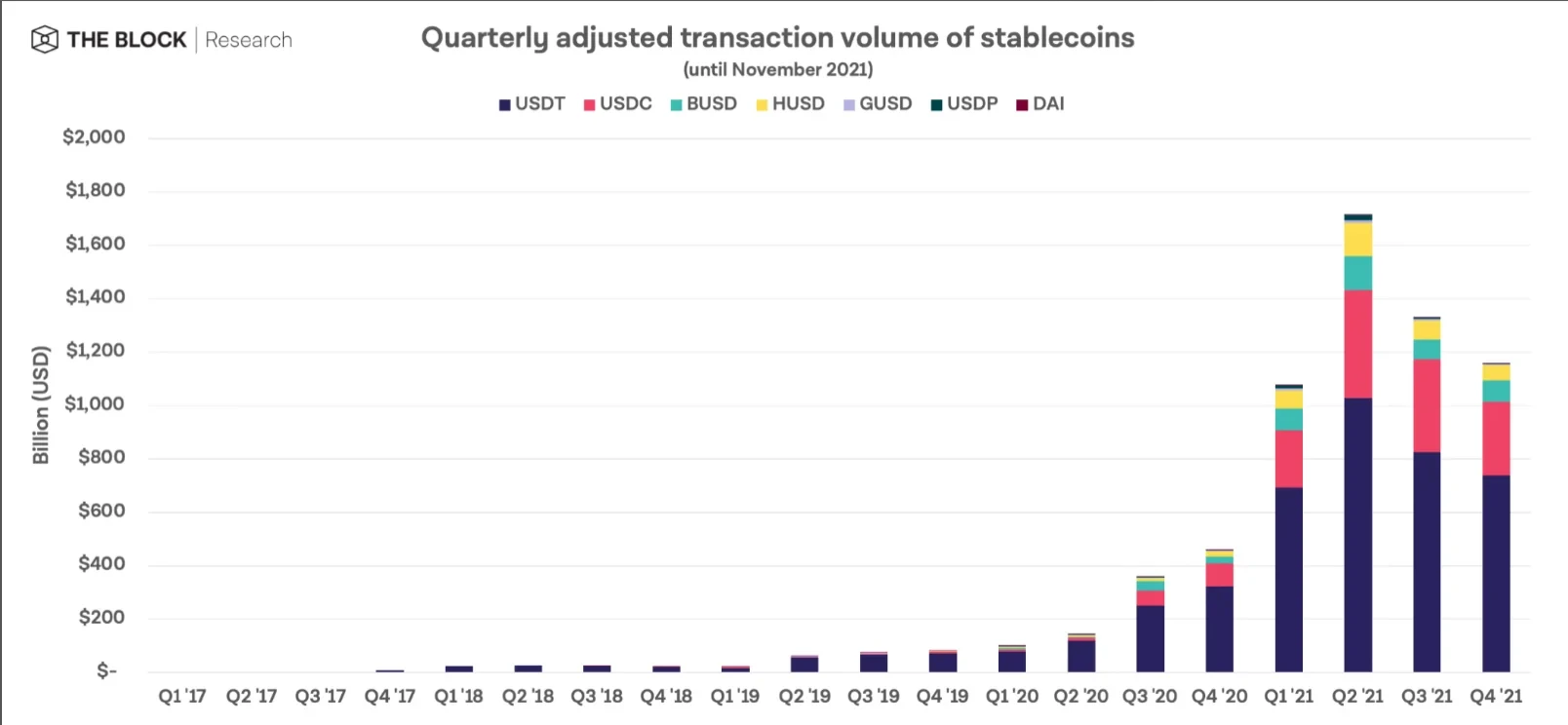
Quarterly Adjusted Stablecoin Trading Volume Source: Coin Metrics
So what is the intrinsic relationship between stablecoin growth and crypto market prices? Historically, significant price volatility in the crypto assets market often triggers stablecoin issuance. This is also reflected in on-chain data—when prices fluctuate, stablecoin on-chain activity (minting or burning) becomes more active.
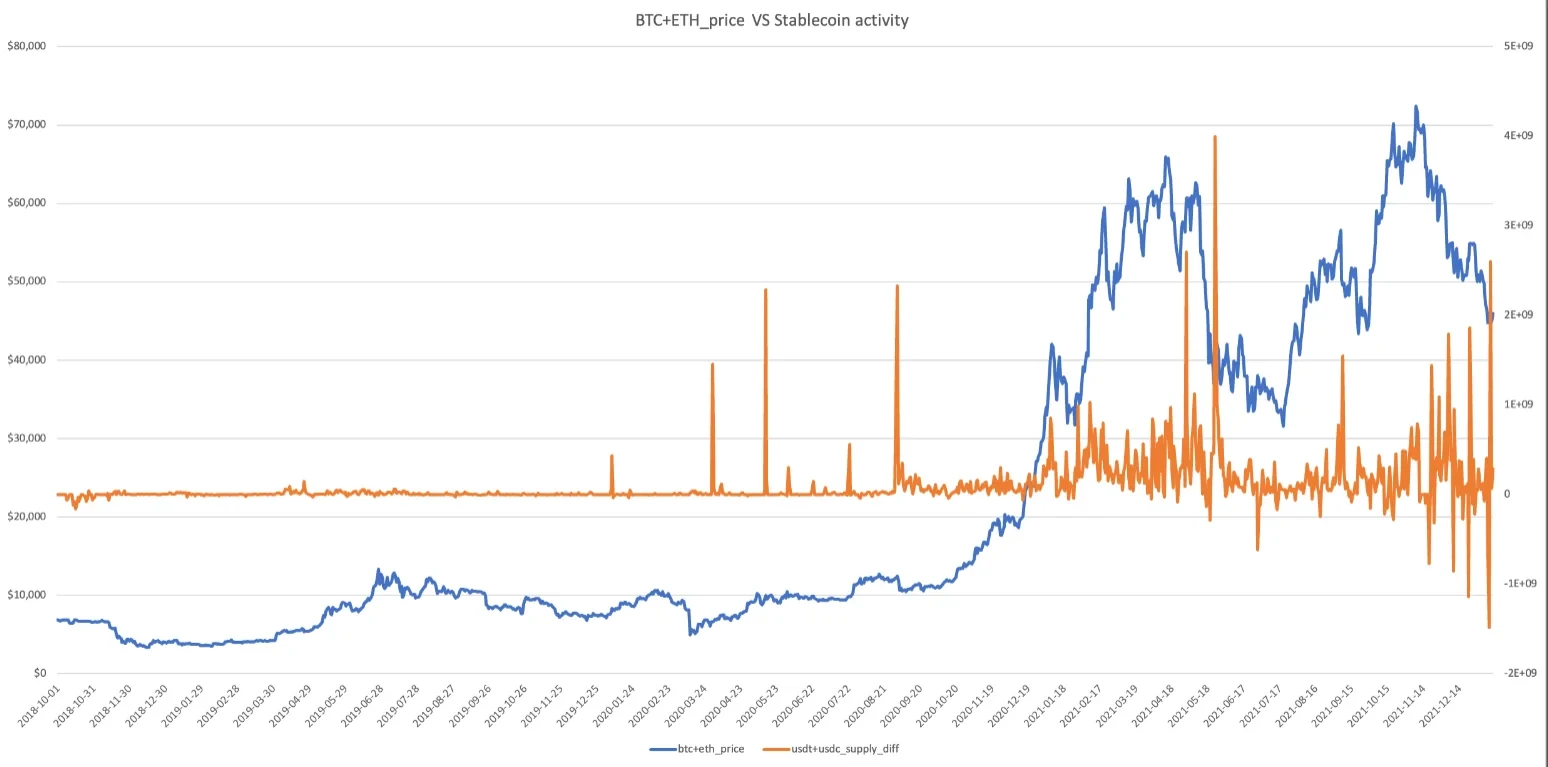
Stablecoin Activity & BTC+ETH Prices Data Source: OKLink
According to OKLink's latest analysis, although crypto market prices have generally risen following stablecoin (USDT and USDC) issuance, there is no direct causal relationship between crypto asset price increases and dollar-backed stablecoin issuance. Instead, market volatility creates demand for stablecoins, driving up USDT prices and creating pressure for stablecoin issuance.
Corporations and Institutions Begin Testing the Waters
Amid this rapid growth trend, stablecoins have become one of the few digital assets recognized by institutions. Due to their unique nature, stablecoins have also become a hot area for global financial innovation. In recent years, an increasing number of tech giants, financial banks, and other institutions have begun testing stablecoin projects. The most typical and representative example is Facebook's Diem (formerly Libra) project—although it ultimately failed, it provided profound insights and a demonstration effect for stablecoin innovation.
Currently, the pace of innovation attempts by globally renowned companies and banking institutions in the stablecoin space continues to accelerate. In less than one month into 2022, PayPal, Bank of America, and others have announced plans to develop digital stablecoins.
On January 7, Bloomberg reported that U.S. payment giant PayPal confirmed it is developing its own crypto stablecoin to further expand into the cryptocurrency space. This news originated from a developer who discovered hidden evidence in PayPal's application code, with code and images revealing a new dollar-backed stablecoin called "PayPal Coin." PayPal executives subsequently confirmed the authenticity of this news. PayPal is currently one of the giants with the most cryptocurrency business in the payment sector, with over 400 million users worldwide, and has gradually launched cryptocurrency-related features in the UK, US, and other regions. In addition to Facebook and PayPal, another mobile payment giant, Visa, already allowed dollar-backed stablecoins (USDC) to be used for trading settlement on its network last year.
In recent years, we have seen increasing acceptance of crypto assets by financial companies and institutions, with efforts to adapt to the changing environment. Beyond large corporations, banks and financial institutions are also actively attempting to issue stablecoins. On January 12, an announcement revealed that several U.S. banks will collaborate to launch the stablecoin USDF and establish the USDF Consortium™, backed by the Federal Deposit Insurance Corporation (FDIC), one of the industry's major regulatory bodies. Founding consortium members include New York Community Bank, First Bank, and Sterling National Bank.
According to reports, the USDF stablecoin will be minted by these U.S. banks themselves and will operate on the Provenance blockchain. This stablecoin supports 1:1 cash redemption from any member bank of the group. The consortium states that USDF's goal is to "address consumer protection and regulatory issues with non-bank issued stablecoins." Unlike private stablecoin projects such as USDT and USDC, USDF operates exclusively within the Provenance system.
Regarding the stablecoin market, Morgan Stanley's Chief Cryptocurrency Strategist, Sheena Shah, noted in a report that banks will likely attempt to capitalize on market demand for stablecoin deposits amid exponential market growth. Because stablecoins are blockchain-based, they improve efficiency while providing access to crypto deposit yields and DeFi. "Crypto asset lenders offer over 5% interest on some of these tokens, but this in turn will prompt responses from regulators and governments."
Regulators Turn Their Sights on Stablecoins
As the stablecoin market grows and innovation in the space continues, regulatory authorities in the U.S., Japan, and other countries have turned their attention to stablecoins.
On November 1, 2021, in the "Report on Stablecoins" jointly issued by the President's Working Group (PWG), the Federal Deposit Insurance Corporation (FDIC), and the Office of the Comptroller of the Currency (OCC), concerns were raised about potential "stablecoin runs" and "payment system risks." The U.S. President's team recommended that Congress pass legislation limiting stablecoin issuance to "insured depository institutions (IDIs)" and bringing them under regulatory oversight like banks. Subsequently, the Federal Reserve, OCC, and FDIC stated in a joint declaration that they plan to clarify rules and regulations for banks engaging in certain cryptocurrency-related activities in 2022. In December, the U.S. Senate held a hearing on risks posed by stablecoins, where various issues were raised, such as "Will U.S. regulators regulate stablecoins in 2022? If so, what impact will this regulation have on non-bank stablecoin issuers and the entire crypto industry?"
Following the U.S., Japan's financial regulators are planning to limit the types of entities that can issue stablecoins in the country. Sources revealed that the agency plans to propose legislation in 2022. Additionally, wallet providers engaged in "stablecoin" trading may also be subject to regulation. These platforms will be required to comply with certain security protocols—including verifying user identities and reporting any suspicious network activity. Earlier reports indicated that a consortium of approximately 70 Japanese companies plans to begin testing in the coming months and launch a yen-based cryptocurrency (possibly called DCJPY) in fiscal year 2022.
From the statements of regulators in the U.S. and Japan, the common point is the desire to limit stablecoin issuers to gain greater jurisdiction and make way for official or regulated stablecoins. Of course, beyond the U.S. and Japan, the Hong Kong Monetary Authority also released a discussion paper on crypto assets and stablecoins on January 12 this year. The paper elaborates on the HKMA's conceptual framework for regulating crypto assets, particularly stablecoins used for payment purposes, and states that a crypto asset regulatory framework will be established by July this year.
Therefore, it can be foreseen that policy pressure on the stablecoin market in 2022 may primarily come from U.S. and other countries' regulation of dollar-backed stablecoins such as USDT and USDC. After all, USDT plus USDC's market cap represents approximately 8% of Bitcoin and Ethereum's total market capitalization—this is already a substantial scale and serves as the main channel for entering or exiting the crypto market. Regulatory issues should increasingly attract attention from relevant institutions. Salman Banaei, Head of Policy Research at Chainalysis, believes that U.S. regulators may implement stablecoin regulations in 2023, with three key factors driving the U.S. to strengthen stablecoin oversight: 1) reserve backing issues; 2) stablecoins facilitating certain speculative behaviors; and 3) stablecoins potentially becoming legitimate competitors to standard payment networks.
On the other hand, it cannot be denied that as an innovative asset, stablecoins have been validated and recognized for their financial applications.
Former U.S. SEC Chairman Jay Clayton stated that tokenized securities, stablecoins, and other new digital assets can become part of global financial infrastructure, changing the status quo—such as improving efficiency and the opportunities that efficiency gains bring for accessing more markets and creating new ones. Additionally, Federal Reserve Chairman Powell recently stated at a hearing that private stablecoins can coexist with a digital dollar. Therefore, the survival and development of stablecoins in the future remains "a long journey ahead," worthy of our continued attention and exploration.
Disclaimer
This article may contain content related to products not available in your region. This article is dedicated to providing general information only and assumes no responsibility for any factual errors or omissions. This article represents the author's personal views and does not reflect OKX's opinions. This article is not intended to provide any advice, including but not limited to: (i) investment advice or investment recommendations; (ii) offers or solicitations to buy, sell, or hold digital assets; or (iii) financial, accounting, legal, or tax advice. Holding digital assets (including stablecoins) involves high risk, may fluctuate significantly, and could become worthless. You should carefully consider whether trading or holding digital assets is suitable for you based on your financial situation. For questions regarding your specific circumstances, please consult your legal/tax/investment professionals. Information appearing in this article (including market data and statistics, if any) is for general reference only. Although we have exercised all reasonable care in preparing this data and charts, we assume no responsibility for any factual errors or omissions expressed herein. © 2025 OKX. This article may be reproduced or distributed in its entirety, or excerpts of 100 words or less may be used, provided such use is non-commercial. Any reproduction or distribution of the entire article must also prominently state: "Copyright © 2025 OKX, used with permission." Permitted excerpts must cite the article title and include attribution, such as "Article Title, [Author Name (if applicable)], © 2025 OKX." Some content may be generated or assisted by artificial intelligence (AI) tools. Derivative works or other uses of this article are not permitted.
Show More
Recommended Reading
OKX Pay: Ushering in a New Era of Next-Generation Crypto Payments
The choice of tens of millions of users—register with OKX to enjoy an exceptional trading experience and diverse wealth management products. A letter from OKX CEO Star: Today, we officially launch the first version of OKX Pay to over 100 million global users. As the industry's first payment application to truly achieve the integration of non-custodial and compliance, OKX Pay will be embedded within the OKX App, currently available in select markets with a full rollout expected within months.
March 22, 2026

New Chapter: Building Next-Generation Financial Infrastructure Together
The partnership between OKX and Intercontinental Exchange (ICE) is a significant moment for OKX and equally meaningful for the evolution of the entire digital assets market. ICE builds and operates the world's most important financial infrastructure, including the New York Stock Exchange and global derivatives and clearing platforms. ICE's decision to invest in OKX and join our board reflects our shared belief that digital assets technology will play a significant role in financial markets.
March 10, 2026

To Another Year of Building
As CEO of OKX and a builder who never forgets his original aspirations, I am proud to reflect on the extraordinary growth and progress OKX has achieved this year. Despite numerous challenges, 2024 was a year of focus, innovation, and resilience. We not only expanded and optimized our products but also made significant progress in launching transparent, regulatory-compliant localized operations while further strengthening our global management team. Notably, after experiencing...
January 29, 2026

2025: Steady Progress Toward Financial Freedom
— Year-End Letter from OKX Founder and CEO Star to Global Users "Financial freedom" is often misunderstood. It does not mean the absence of rules, but rather having the right to choose within the framework of rules—and when the system is truly tested, it remains reliable and effective. This is what we have focused on throughout 2025. First, I would like to extend my sincere gratitude to customers, partners, and regulators worldwide.
January 16, 2026

OKX Officially Launches in Germany and Poland
Author: Erald Ghoos, CEO of OKX Europe Today is a significant day for OKX—and for crypto users across Europe. We have officially launched a fully compliant centralized cryptocurrency trading platform in Germany and Poland! For us, this is not just a geographic expansion, but a commitment to building the future of cryptocurrency the right way: secure, transparent, and meeting local needs. If you are in Germany...
October 21, 2025

Partnership Upgrade! OKX Collaborates with Standard Chartered to Expand into European Markets
On October 15, Erald Ghoos, CEO of OKX Europe, announced that OKX is extending its strategic partnership with Standard Chartered to the European Economic Area (EEA). Earlier this year, OKX first partnered with Standard Chartered in the UAE to launch a collateral mirroring program—this is...
October 15, 2025