Ethereum's Path to Efficiency and Speed: A Challenging Journey with a Bright Future
Recently, Ethereum co-founder Vitalik published a diagram explaining the "Polynomial Commitments" method on Twitter.
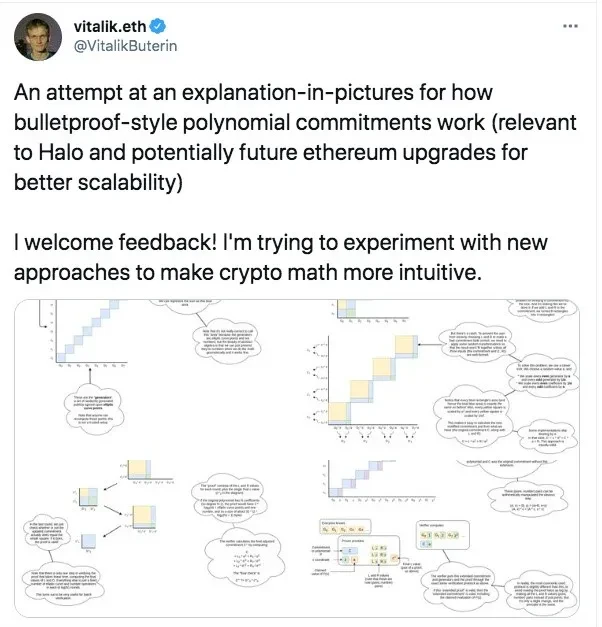
(Image source: Vitalik's Twitter)
It is reported that Ethereum co-founder Vitalik's proposed Polynomial Commitments scheme aims to solve Ethereum's state explosion problem, with the goal of drastically reducing witness data for stateless Ethereum clients, approaching near zero.
So what exactly is the Polynomial Commitments scheme about?
Wall Street analyst Jacob offered this interpretation: "The problem Vitalik is addressing (i.e., the Polynomial Commitments scheme) involves adding powers of complex numbers to general elliptic curve codes to achieve greater confidentiality and larger scale, among other benefits. It's a great idea — following this approach, many new codes can be developed. For instance, one can select two encoding systems X and Y to form a Cartesian product (x, y) and a relationship P between x and y to create a new encoding system."
Explaining it from a mathematical perspective can be somewhat abstract, so let's look directly at the advantages of the Polynomial Commitments scheme: Most notably, data availability checks become easier and free from fraud, since we can simply make random requests openly. Non-interactive custody proofs may also become easier, thereby improving Ethereum's operational efficiency.
Throughout, the Ethereum development team has never stopped its efforts to improve Ethereum's efficiency. Vitalik began researching the switch to a PoS network back in 2015 and officially proposed the 2.0 plan at the 2018 Devcon 4 conference. Of course, completing the Ethereum 2.0 plan is by no means an overnight feat — according to the currently published roadmap, eWASM deployment is scheduled for 2022 at the earliest, and only when this new chain goes live will the complete version of Ethereum 2.0 be officially released.
Prior to that, the development team proposed Layer 2 — a comprehensive solution to enhance the performance of the Ethereum network (Layer 1). Under the Layer 2 framework, several specific solutions currently exist, including: Rollups, State Channels, Sidechains, Plasma, Validium, Hybrid Solutions, and more.
Here, let's briefly break down Rollups, which has been widely discussed recently. In essence, it打包s the large amount of trading data originally distributed across blocks into a single bundled trade and publishes it on-chain. To ensure the validity of each trade within, Rollups employs different mechanisms to maintain security consistent with Layer 1. From an operational perspective, the relationship between Rollups and Ethereum is quite similar to that between Bitcoin and the Lightning Network. Eric Wall, Chief Investment Officer of crypto hedge fund Arcane Assets, stated, "Rollups can enable Ethereum to achieve a transaction processing speed of 2,000–3,000 transactions per second."
As is well known, the current ETH main chain based on PoW consensus has a transaction processing speed of only 15–20 transactions per second, and network congestion and high fees caused by insufficient processing efficiency have long been a point of criticism. Especially after the rapid rise of DeFi, peak fees一度高达数百美元, not only preventing many large-scale applications from being implemented on the Ethereum network but also keeping many smaller-fund investors out of DeFi.
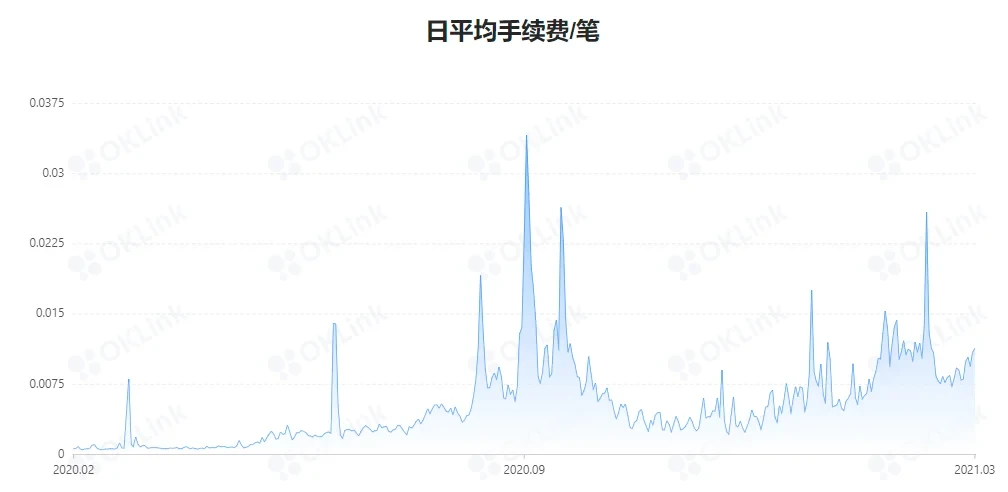
(Ethereum network daily average fees over the past year, data source: OKLink)
From the monitoring data on OKLink, we can see intuitively that between July and October 2020, as DeFi erupted, Ethereum on-chain trading fees also rose significantly. During this period, DeFi users often joked that "the money earned from mining wasn't enough to cover the fees."
Therefore, the EIP-1559 proposal that Vitalik put forward in 2019 has once again attracted heated discussion in the community. The proposal suggests reducing transaction fee volatility by burning the fees paid in ETH rather than distributing them to miners. Clearly, this proposal would hurt miners' interests, and pool operators have already voiced opposition: "This is like not tipping the waiter, and then当面烧掉小费来嘲笑他们."
Ethereum community KOL A-Jian also raised doubts: He believes that adding "fee burning" would effectivelyamount to imposing a相当高的所得税on Ethereum miners凭空, while due to the unpredictability of demand, EIP-1559 is very likely unable to make transaction fees more predictable or lower Gas prices, so it cannot create a better user experience. Despite the obstacles, the EIP-1559 proposal has been officially included in Ethereum's next major hard fork upgrade — the "London Hard Fork." Regardless of how miners view this proposal, some analysts believe this upgrade could push Ethereum's price higher and make it cheaper to use. In fact, after EIP-1559 was widely discussed, ETH's price did rise significantly. According to OKX market data, from March 7, 2021, ETH's price rose more than 30% over the following week, once approaching the $2,000 mark.
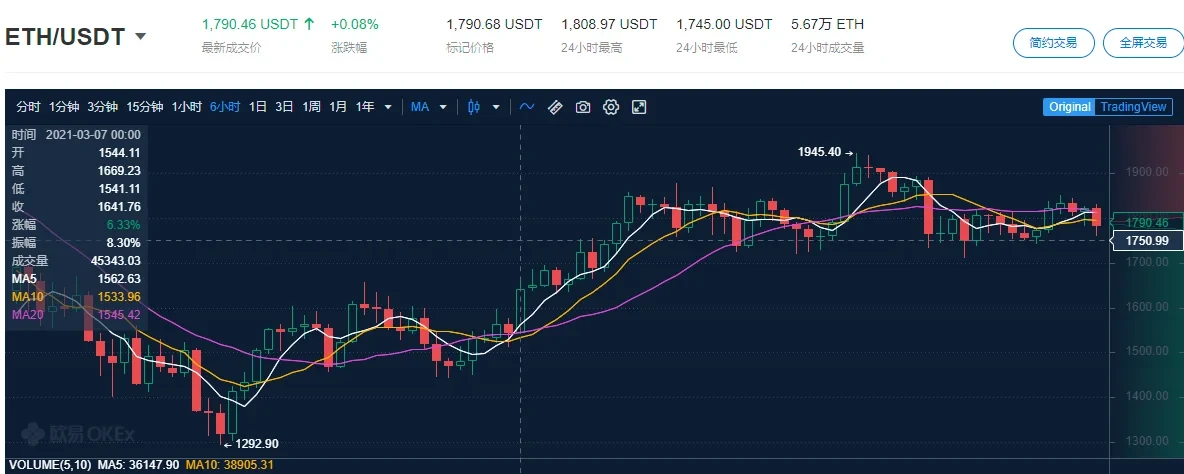
(ETH price trend, source: OKX)
Therefore, on the path to alleviating Ethereum network congestion, improving trading efficiency, and reducing fees, multiple approaches are still needed, seeking a balance of interests among all parties.
Shifting focus back to Rollups — if Rollups can push Ethereum's TPS above 2,000, the improvement to user experience would be like switching from an ox cart to a high-speed train. It also wouldn't harm miners' returns, making it seem like a better solution compared to the EIP-1559 proposal. But in reality, it's not that simple. Rollups are not a perfect, flawless solution. Like the Lightning Network, this method of bundling off-chain and then placing on-chain has also raised concerns about security and trust — in other words, does this deviate from blockchain's decentralization philosophy?
On one hand, the community is brainstorming ways to improve Ethereum's efficiency at this stage; on the other hand, developers are moving full steam ahead with the Ethereum 2.0 upgrade.
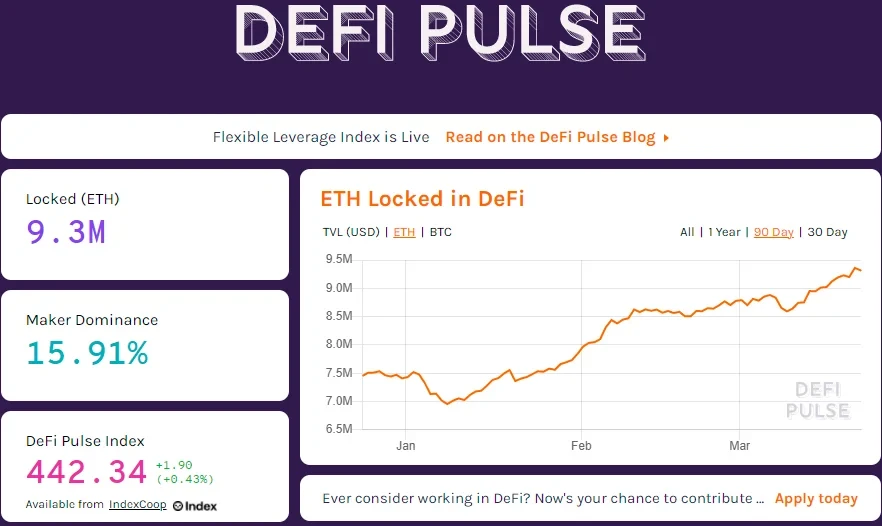
According to DeFi Pulse statistics, the amount of ETH locked in DeFi has reached 9.3 million, representing an increase of over 300% compared to the same period last year, which also demonstrates the community's confidence in Ethereum's future to a certain extent.
Therefore, before the full realization of Ethereum 2.0, the development team and community must ensure that Ethereum is safe and decentralized, absolutely reliable and trustworthy, while also improving transaction processing speed as much as possible, continuously growing the on-chain ecosystem, and retaining project developers and traders — this is indeed a formidable task.
However, as the leader in the public chain赛道, we have reason to give the Ethereum development team sufficient time and patience. Currently, the ETH 2.0 upgrade is proceeding as planned, and we have seen many highly innovative technical solutions, including the Casper consensus, sharding technology, and the new eWASM virtual machine — these are Ethereum's trump cards to maintain a leading edge in future blockchain infrastructure competition.
Disclaimer: Digital assets trading involves significant risk. This material should not be used as a basis for investment decisions, nor should it be construed as investment trading advice. Please ensure you fully understand the risks involved and invest cautiously. OKX Academy only provides information for reference and does not constitute any investment advice. All investment activities by users are unrelated to this site.
Disclaimer
This article may contain product content that does not apply to your region. This article is solely致力于提供一般性信息 and does not accept responsibility for any factual errors or omissions. This article represents only the author's personal opinion and does not reflect OKX's views. This article is not intended to provide any advice, including but not limited to: (i) investment advice or investment recommendations; (ii) offers or solicitations to purchase, sell, or hold digital assets; or (iii) financial, accounting, legal, or tax advice. Holdings in digital assets (including stablecoins) involve high risk and may fluctuate significantly or even become worthless. You should carefully consider whether trading or holding digital assets is appropriate for you based on your financial situation. For questions about your specific circumstances, please consult your legal/tax/investment professional. The information in this article (including market data and statistics, if any) is provided for general reference purposes only. Although we have taken all reasonable precautions in preparing this data and these charts, we assume no responsibility for any factual errors or omissions expressed herein. © 2025 OKX. This article may be reproduced or distributed in its entirety, or excerpts of 100 words or less may be used, provided that such use is non-commercial. Any reproduction or distribution of the full article must prominently state: "This article is copyrighted © 2025 OKX, used with permission." Permitted excerpts must cite the article title and include attribution, for example "Article title, [author name (if applicable)], © 2025 OKX". Some content may have been generated or assisted by artificial intelligence (AI) tools. Derivative works or other uses of this article are not permitted.
Show More
Recommended Reading
OKX Pay: Ushering in a New Era of Next-Generation Crypto Payments
The choice of tens of millions of users. Register with OKX to enjoy an exceptional trading experience and diverse wealth management products. A letter from OKX CEO Star: Today, we officially launch the first version of OKX Pay for over one hundred million global users. As the industry's first payment application to truly achieve non-custodial and compliant integration, OKX Pay will be embedded within the OKX App and is currently available in select markets, with a full rollout expected in the coming months.
March 22, 2026

A New Chapter: Building the Next Generation of Financial Infrastructure Together
The partnership between OKX and the Intercontinental Exchange (ICE) is a significant milestone for OKX, and equally meaningful for the evolution of the entire digital assets market. ICE builds and operates the world's most critical financial infrastructure, including the New York Stock Exchange and global derivatives and clearing platforms. This investment by ICE in OKX and its joining of our board reflects our shared belief that digital assets technology will transform financial markets.
March 10, 2026
Reflecting on Another Year of Building
As CEO of OKX and a builder who stays true to the original mission, I am proud to look back on the extraordinary growth and progress OKX has achieved this year. Despite challenges, 2024 was a year of focus, innovation, and resilience. We not only expanded and improved our products, but also made significant progress in launching transparent and regulation-compliant localized businesses, while further strengthening our global management team. It is worth noting that after experiencing
January 29, 2026

2025: Steady Progress Toward Financial Freedom
— An End-of-Year Letter to Global Users from Star, Founder and CEO of OKX "Financial freedom" is often misunderstood. It doesn't mean the absence of rules, but rather having the freedom of choice even when rules exist — and when the system is truly put to the test, it remains reliable and effective. This has been our unwavering focus throughout 2025. First and foremost, I would like to express our sincere gratitude to global customers, partners, and regulators for
January 16, 2026

OKX Officially Launches in Germany and Poland
By Erald Ghoos, CEO of OKX Europe Today is a significant day for OKX — and for crypto users across Europe. We have officially launched a fully compliant centralized cryptocurrency trading platform in Germany and Poland! For us, this is not just a geographic expansion, but a commitment to building the future of cryptocurrency the right way: safe, transparent, and tailored to local needs. If you are in Germany
October 21, 2025
Partnership Upgrade! OKX and Standard Chartered Expand into Europe
On October 15, Erald Ghoos, CEO of OKX Europe, stated that OKX is expanding its strategic partnership with Standard Chartered into the European Economic Area (EEA). Earlier this year, OKX first partnered with Standard Chartered in the UAE, launching the Collateral Mirroring initiative — a
October 15, 2025