Ethereum Outperforms Bitcoin Across Multiple Metrics, Poised to Become the First "Hyper-Perceive Assets
OKX market data shows that Bitcoin closed May at $36,965.2, with a monthly decline of 35.31% and a fluctuation range of 53.45%. In contrast, Ethereum, the second-largest cryptocurrency by market cap, closed May at $2,637.93, with a monthly decline of only 3.59% but a fluctuation range of 96.61%.
There are two reasons for this phenomenon. First, Ethereum "decoupled" from Bitcoin at the beginning of the month, showing strong price performance and rallying to an all-time high of $4,371.96 on May 12. Second, cryptocurrencies saw consecutive declines in mid-to-late May, market confidence was lacking, and many altcoins plummeted. While Ethereum's decline exceeded that of Bitcoin, once Bitcoin showed signs of bottoming, Ethereum rebounded better than Bitcoin.
In addition, as May came to a close, various monthly summaries of the crypto market were released. According to The Block data, Ethereum outperformed Bitcoin across multiple metrics, including on-chain trading volume, miner revenue, and futures and options growth rates.
Some commentators suggest that Ethereum has become the primary driver of current market trends. Given the upcoming launch and refinement of Layer 2, the implementation of EIP-1559, and Ethereum's transition from Proof of Work (PoW) to the more energy-efficient Proof of Stake (PoS), ETH is positioned to further capture on-chain value and is expected to become the first "triple-point" asset that combines store of value, consumable assets, and capital assets.
Miners Earn $2.35 Billion — Ethereum Outperforms Bitcoin Across Multiple Metrics
According to OKX market data, as of press time, Ethereum's price stands at $2,629.96, down 39.84% from its all-time high of $4,371.96. Bitcoin is currently quoted at $36,725.30, down 43.37% from its all-time high of $64,846.90.
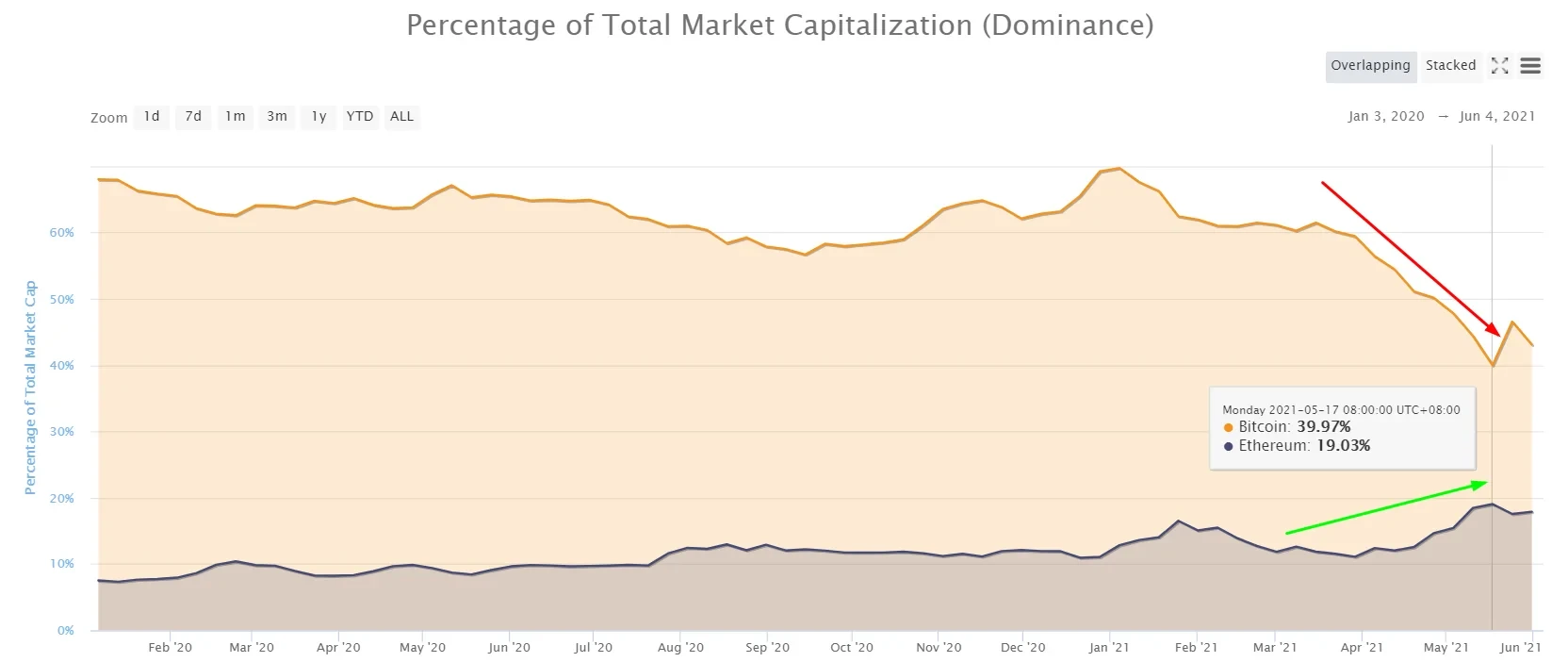
According to CoinMarketCap data, Bitcoin's current total market cap is $705.276 billion, while Ethereum's total market cap is $316.636 billion — Bitcoin is 2.23 times that of Ethereum. However, looking at the market dominance chart, the gap between Ethereum and Bitcoin is gradually narrowing.
On June 1, The Block data analyst Lars shared key May data on Twitter, noting that Ethereum outperformed Bitcoin across multiple metrics. One particularly striking data point was: "Bitcoin miner revenue continued to decline by 15.0% to $1.45 billion, while Ethereum miner revenue grew by 42.8% to $2.35 billion."
As we know, the revenue for Bitcoin and Ethereum miners currently consists of two main components: block rewards and transaction fees. Looking at May data, Ethereum miners' fee revenue was $1.03 billion, accounting for 43.8% of total revenue, while Bitcoin miners' fee revenue was close to $124 million, representing only 8.6% of total revenue.
According to data from The Block's official website, Ethereum miners' fee revenue has shown clear growth since August last year, even briefly surpassing block rewards in February this year. The primary reason for this phenomenon is the growth and expansion of DeFi on Ethereum, which led to a surge in on-chain activity.
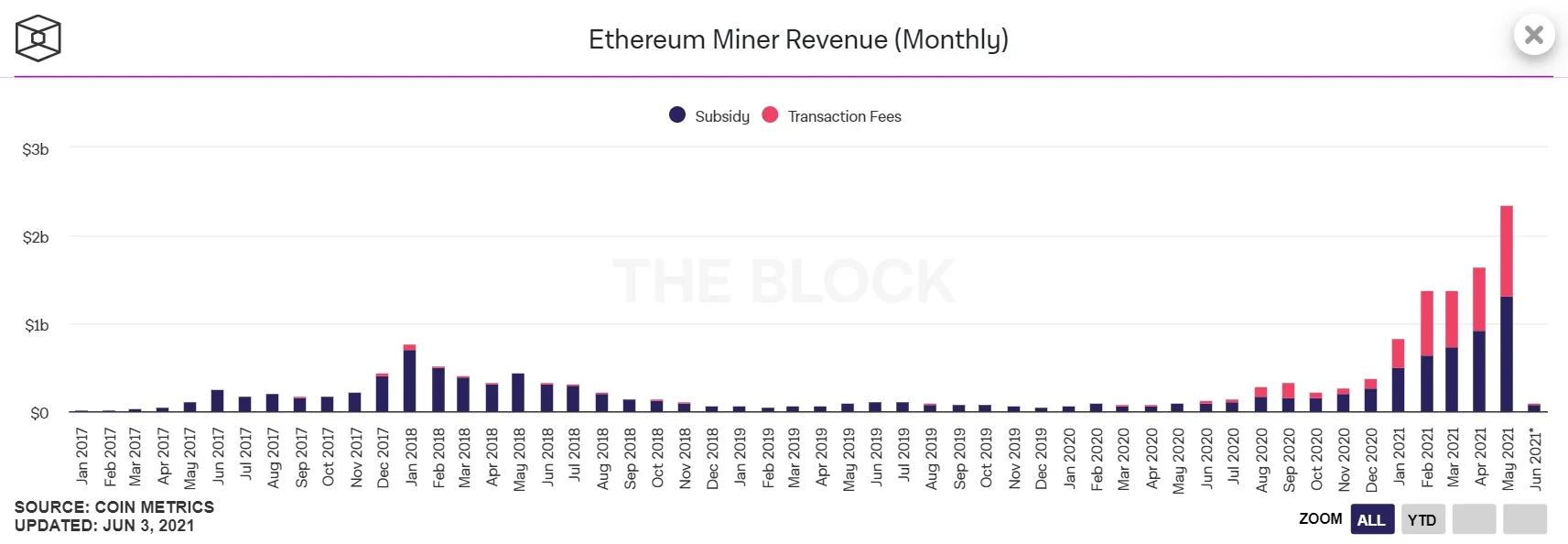
The shift in miner revenue from being primarily block-reward-based to a balanced mix of fees and block rewards aligns with Ethereum's broader transformation direction and is an inevitable outcome of Ethereum's development beyond Bitcoin's store-of-value properties in terms of infrastructure and use cases.
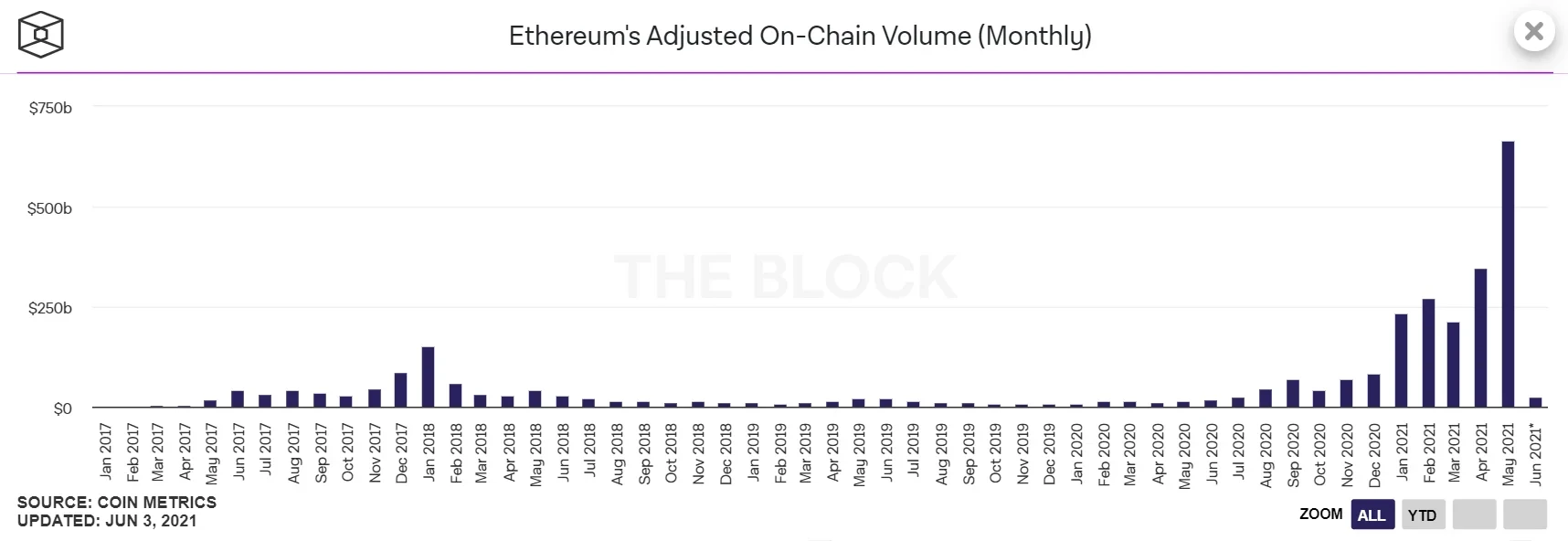
In addition to miner revenue hitting a new high in May, Ethereum's trading volume also surpassed Bitcoin in May, reaching a record high. Ethereum's adjusted on-chain trading volume in May was $666 billion, a 92.7% month-over-month increase from $345.6 billion the previous month.
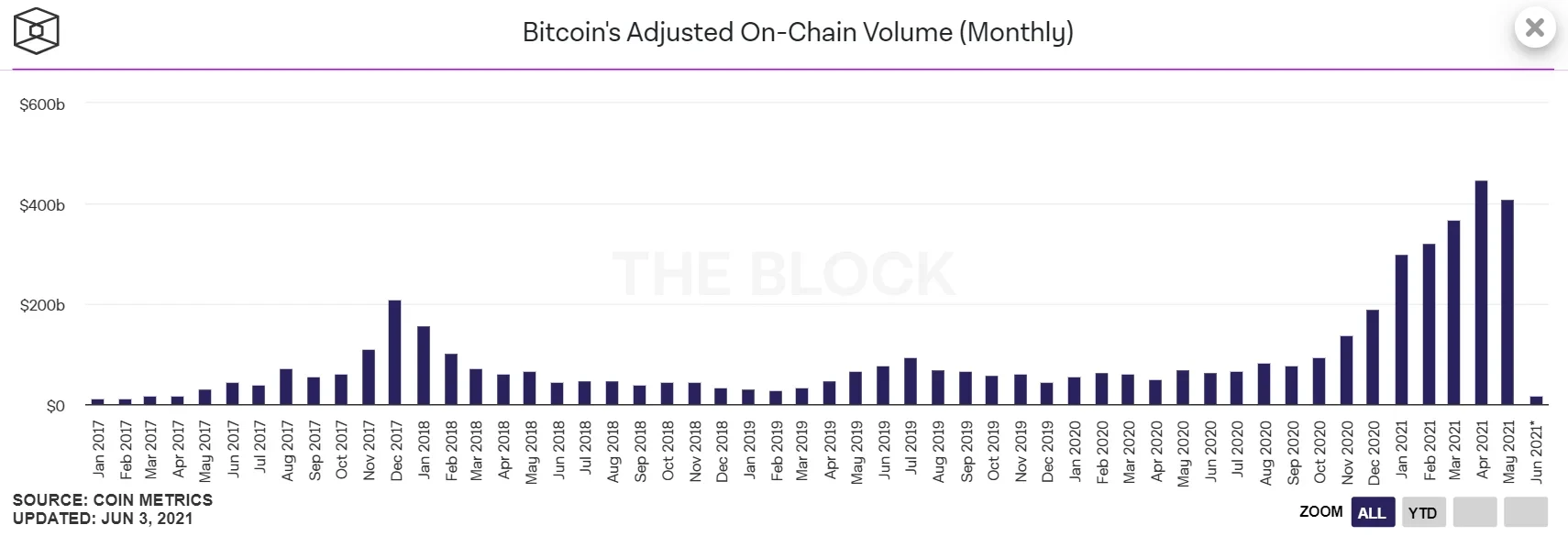
As for Bitcoin, its on-chain trading volume in May was $407.2 billion, down 8.9% from $446.8 billion in April. Currently, Ethereum's on-chain trading volume is growing rapidly, while Bitcoin's trading volume growth is slower than Ethereum's. As Ethereum's on-chain ecosystem continues to develop, Ethereum is expected to further widen the gap with Bitcoin in this metric.
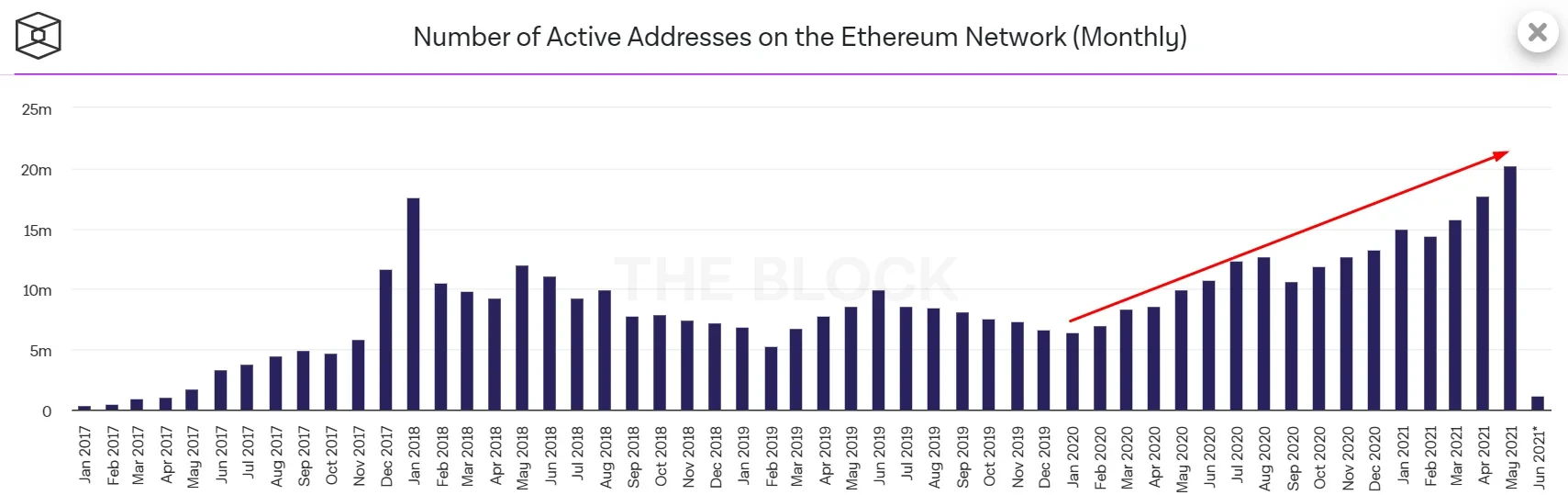
It is worth noting that the number of active addresses on Ethereum also hit a record high in May. According to The Block data, Ethereum had 20.24 million active addresses in May, a 14.6% month-over-month increase.
In addition, both Ethereum's futures and options trading volumes saw significant growth. Ethereum's futures trading volume in May surged 94.7% to reach a record high of $1.76 trillion, while Bitcoin's monthly increase was 31.3%.
Looking back over the past year from May last year, Ethereum's futures trading volume grew from $73 billion to the current $1.76 trillion, a 23-fold increase. Bitcoin grew from $515.18 billion in May last year to $2.56 trillion in May this year, an increase of approximately 4x. Ethereum's futures trading volume has grown from just 14.17% of Bitcoin's futures trading volume to now representing 68.75% of Bitcoin's futures trading volume.
On the options side, interest in Ethereum options has increased. Ethereum's options trading volume in May reached a record high of $16.51 billion, a 110.32% month-over-month increase. According to The Block's recorded data, Ethereum options have surged from $53.57 million in July last year to $16.51 billion now, a 300-fold increase. This has caused Ethereum options to rapidly rise from just 1.28% of Bitcoin's options trading volume in July last year to now nearly 60% of Bitcoin's options trading volume.
Based on Ethereum's May data, Ethereum is clearly on an upward trajectory across all metrics — whether in on-chain trading volume, miner revenue, active address count, or futures and options growth.
Ethereum's Upgrades Will Further Drive ETH Price Growth
On June 2, Bloomberg published the "2021 Bloomberg Cryptocurrency Outlook." In this report, Bloomberg's Chief Commodity Strategist Mike McGlone emphasized the benefits of diversification in emerging asset classes like cryptocurrency. McGlone noted that the longer-term trend is Ethereum gaining greater market share relative to Bitcoin. Both have a bullish foundation, but Ethereum's infrastructure and use cases strongly complement Bitcoin's broader store-of-value properties. In his view, Ethereum is to fintech what Bitcoin is to gold.
Ethereum's value support primarily stems from three layers. First, the applications of DeFi, NFT, and DAO on Ethereum have enabled Ethereum's use cases to truly take root. Second, the upcoming implementation of EIP-1559 and the transition to Ethereum 2.0 could bring expectations of reduced supply or even deflation. Third, Ethereum's narrative has become mainstream and grand. As a leader in innovative crypto technology, this chain attracts most of the crypto world's top developers. Ethereum's technological development represents, to a certain extent, the future direction of the crypto world. Beyond its identity as a cryptocurrency, Ethereum also serves as a world computer function — a key building block for financial digitalization. This is why Ethereum enthusiasts compare Ethereum to a fintech behemoth. As fintech rapidly digitalizes, Ethereum's foundation will become even more solid.
Take applications as an example: according to OK Link data, over the course of a year, the total value locked (TVL) in DeFi on Ethereum grew 63.5x from $1.22 billion to $78.63 billion. The 24-hour trading volume of decentralized exchanges like Uniswap increased nearly 54x to $4.02 billion. Stablecoin circulation grew from $7.18 billion to $71.83 billion, a 10x increase. Currently, approximately 242,500 BTC worth of wrapped Bitcoin is circulating on Ethereum. While the total trading volume of NFT art on Ethereum declined compared to the previous two months, with May's trading volume at $59.3 million, this still represents a 143x expansion compared to $415,500 a year prior.
All of this is happening under the premise that Ethereum's scalability is insufficient and gas fees are high. This also means that if Ethereum's subsequent upgrades to address these issues can be successfully advanced, its future can only get better.
It is worth noting that more DeFi, NFT, and DAO activity represents rapid growth in on-chain activity, which also means higher trading fees. Looking at Ethereum's current fee structure, these returns flow into miners' pockets but do not accumulate to Ethereum holders. EIP-1559 completely transforms Ethereum's fee structure by dividing gas fees into a base fee and a tip paid to miners. The base fee is burned, while the tip incentivizes miners to prioritize processing trading during high-volume periods. Although we cannot yet determine the exact ratio between base fee and tip, some analysts believe that the base fee burn mechanism will significantly reduce Ethereum's net issuance and could even cause Ethereum to enter a deflationary state, thereby benefiting Ethereum's value capture.
The implementation of PoS represents an upgrade to the Ethereum network itself — a complete improvement in Ethereum's scalability, security, and sustainability. According to the Ethereum team, PoS will be more secure because validators are required to hold Ethereum. If they attempt malicious behavior, Ethereum's price would be damaged and their assets would face slashing penalties.
In an article titled "Ethereum: A New Model for Money," David Hoffman outlined three asset characteristics:
1) Capital assets are productive and generate value or cash flow, such as stocks, bonds, or real estate for rent;
2) Convertible/consumable assets generate economic returns through transformation, such as energy and commodities;
3) Store of value assets have scarcity attributes, with value persisting over time and space, such as gold, art, and Bitcoin;
Hoffman believes that after EIP-1559 and Ethereum 2.0 upgrades, Ethereum will possess all three characteristics simultaneously. First, store of value: DeFi protocols allow users to obtain loans by collateralizing Ethereum or provide liquidity for DEXs, thereby generating new value. Second, the base fee from on-chain trading is burned, embodying the consumable asset attribute — through burning the base fee, overall supply is reduced. Finally, owning Ethereum means owning a share of the Ethereum network. Once users stake Ethereum and become validators, their held Ethereum becomes the right to collect fees generated by the network.
Of course, these transformations will not happen overnight, and the transition process itself poses challenges for Ethereum. Fundamentally, the value of a base blockchain should exceed the value of all dApps built on top of it — this serves the best interests of all participants. If this is not the case, it incentivizes bad actors to spend time attacking the blockchain to deplete the value of its dApps. Currently, Ethereum is in a transitional period, and ETH cannot yet fully capture on-chain value. Additionally, many public chains are leveraging Ethereum's high fees to create opportunities for themselves. Furthermore, the development of Ethereum scaling solutions such as Layer 2, sidechains, and state channels may cause fragmentation of the Ethereum ecosystem in the early stages. Therefore, although Ethereum enthusiasts are calling for Ethereum's market cap to surpass Bitcoin and Bitcoin's first-mover advantage seems fragile, Ethereum still has many thorny issues to resolve at present.
Disclaimer
This article may contain product-related content not applicable to your region. This article is only intended to provide general information and makes no representation as to any factual errors or omissions. This article represents the author's personal views and does not constitute the views of OKX. This article is not intended to provide any advice, including but not limited to: (i) investment advice or investment recommendations; (ii) offers or solicitations to purchase, sell, or hold digital assets; or (iii) financial, accounting, legal, or tax advice. Holdings in digital assets (including stablecoins) involve high risk and may fluctuate significantly, or even become worthless. You should carefully consider whether trading or holding digital assets is appropriate for you based on your financial situation. For questions specific to your circumstances, please consult your legal/tax/investment professional. The information contained in this article (including market data and statistics, if any) is for general reference purposes only. While we have taken all reasonable precautions in preparing such data and charts, we accept no responsibility for any factual errors or omissions expressed herein. © 2025 OKX. This article may be reproduced or distributed in its entirety or in excerpts of 100 words or less, provided that such use is for non-commercial purposes. Any reproduction or distribution of the full article must prominently state: "This article is copyrighted © 2025 OKX, used with permission." Permitted excerpts must cite the article title and include attribution, for example, "Article title, [author name (if applicable)], © 2025 OKX." Some content may have been generated or assisted by artificial intelligence (AI) tools. Derivative works and other uses of this article are not permitted.
Show More
Recommended Reading
OKX Pay: Ushering in a New Era of Next-Gen Crypto Payments
Join tens of millions of users. Register with OKX and enjoy an exceptional trading experience and a diverse range of wealth management products. A letter from OKX CEO Star: Today, we officially launch the first version of OKX Pay for over 100 million global users. As the industry's first truly non-custodial and compliant payment application, OKX Pay will be embedded within the OKX App and is currently available in select markets, with full availability expected within
March 22, 2026

A New Chapter: Building the Next Generation of Financial Infrastructure Together
The partnership between OKX and the Intercontinental Exchange (ICE) marks a significant milestone for OKX and holds equally profound meaning for the evolution of the entire digital assets market. ICE builds and operates the world's most critical financial infrastructure, including the New York Stock Exchange and global derivatives and clearing platforms. This investment by ICE Select in OKX and its joining of our Board of Directors reflects our shared belief that digital assets technology will transform financial markets.
March 10, 2026
To Another Year of Building
As CEO of OKX and a builder who stays true to the original mission, I take great pride in reflecting on the extraordinary growth and progress OKX has achieved this year. Despite formidable challenges, 2024 was a year marked by focus, innovation, and resilience. Not only did we expand and optimize our products, but we also made significant strides in launching transparent and regulation-compliant localized businesses, while further strengthening our global management team. Notably, after going through
January 29, 2026

2025: A Steady Progression Toward Financial Freedom
— Year-End Letter from OKX Founder & CEO Star to Global Users "Financial freedom" is often misunderstood. It does not mean the absence of rules, but rather having the freedom to choose even when rules exist — and when the system is truly put to the test, it remains reliable and effective. This has been our unwavering focus throughout 2025. First and foremost, I want to extend my sincere gratitude to our global customers, partners, and regulators.
January 16, 2026

OKX Officially Launches in Germany and Poland
By Erald Ghoos, CEO of OKX Europe Today is a momentous day for OKX — and for crypto users across Europe. We have officially launched our fully compliant centralized cryptocurrency trading platform in Germany and Poland! For us, this is more than just a geographic expansion — it is a commitment to building the future of cryptocurrency the right way: secure, transparent, and tailored to local needs. If you are in Germany
October 21, 2025

Partnership Upgrade! OKX and Standard Chartered Bank Expand into Europe
On October 15, OKX Europe CEO Erald Ghoos stated that OKX is expanding its strategic partnership with Standard Chartered Bank into the European Economic Area (EEA). Earlier this year, OKX and Standard Chartered first partnered in the UAE, launching a collateral mirroring program — a
October 15, 2025