
Can Ethereum's Total Market Cap Surpass Bitcoin?
AAVE+0. 04%
On Tuesday of this week, Goldman Sachs stated in a report to its clients that Ethereum is the blockchain with the highest "real-use potential." The prominent US tech media outlet Business Insider further interpreted this as, "Goldman Sachs predicts that Ethereum's total market cap may exceed that of Bitcoin in the coming years."
In fact, ever since Ethereum's smart contract programmability, convenience, and other multiple advantages were discovered during the 2017 bull market, discussions within the crypto community about "when Ethereum will surpass Bitcoin" have continued unabated. One of the more well-known examples is Roger Ver, known as "Bitcoin Jesus," who stated in an interview in early 2018 that "(In 2018), by year's end, we will see Ethereum surpass Bitcoin and take the crown of crypto assets." At that time, the market was nearing the end of the previous bull cycle, with ETH prices reaching a record high of $1,400. Looking back now, Roger Ver's prediction was clearly overly optimistic, as to date, Ethereum's market cap has yet to reach 50% of Bitcoin's. However, with Ethereum's ecosystem once again delivering stunning performance in this current bull market, voices in the crypto community that are bullish on Ethereum surpassing Bitcoin in the future are also rising once more.
Therefore, in this article, we will focus on comparing Ethereum and Bitcoin from the perspectives of fundamentals and ecosystem development progress, and jointly explore whether Ethereum has the potential to surpass Bitcoin's market cap in the future.
Let's first take a look at the key data and information for both Ethereum and Bitcoin.
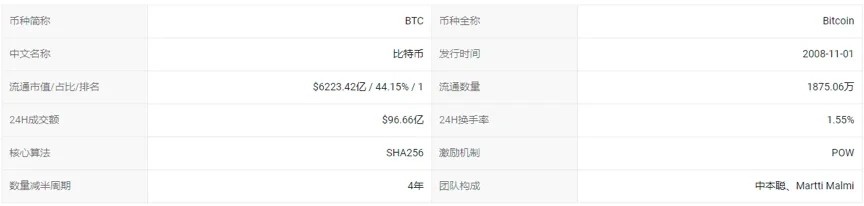
Bitcoin basic information, source qkl123
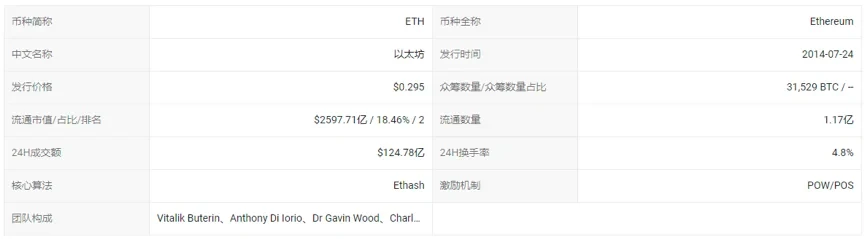
Ethereum basic information, source qkl123
From the two charts above, we can see that the current circulating supply of Bitcoin is approximately 18.7506 million coins, while Ethereum's circulating supply is approximately 117 million coins. Referencing the latest quotes on OKX, BTC is trading at around $33,000 and ETH is currently quoted at $2,220. Based on these figures, Bitcoin's total market cap is $618.77 billion, and Ethereum's total market cap is $259.74 billion — Ethereum's market cap represents approximately 42% of Bitcoin's, still less than half.
However, since we are on the topic of price, let's also take a look at the ETH/BTC exchange rate trends. In the crypto market investment process, the performance of a crypto asset's trading pair against Bitcoin is often regarded by traders as an important indicator for evaluating that asset's investment potential. In other words, if a particular asset consistently outperforms Bitcoin in the secondary market over a medium-to-long-term cycle, it can be considered a quality investment target worthy of serious attention.
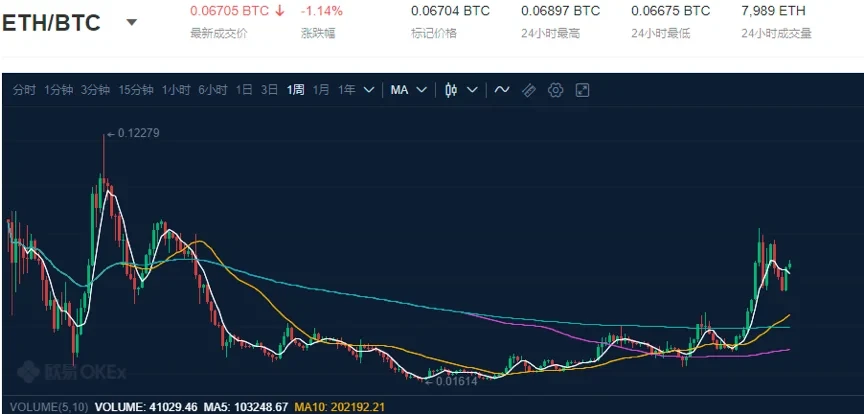
ETH/BTC exchange rate trend over the past 4 years, source OKX
Looking at the ETH/BTC exchange rate trend over the past four years, during the previous bull market, Ethereum's performance far exceeded Bitcoin's, with the exchange rate rising from 0.023 to 0.122 — a gain of more than 5x. This was likely one of the key indicators Roger Ver referenced when he predicted Ethereum would surpass Bitcoin by the end of 2018. Subsequently, during the three-year bear market that followed, ETH/BTC continued to weaken, remaining below 0.04 for over a year, until this current bull market when it recovered to around 0.08. However, it has yet to break through the exchange rate record set during the previous bull market. That said, it is worth noting that in the recent sluggish market conditions over the past two months in the crypto market, compared to the maximum price decline of BTC (49.1%) or ETH (50.2%), we can clearly see that the ETH/BTC exchange rate did not experience a significant pullback — it remains above 0.06, with a decline from its high of only 14.5%, far less than the decline at the end of the previous bull market and far less than other crypto assets in the top ten by market cap. From this, we can conclude that after four years of development, Ethereum has demonstrated stronger downside resilience in declining markets (setting aside whether the recent decline signals the end of the bull market or a mid-cycle correction) — a testament to the resilience of the Ethereum ecosystem.
Next, let's look at changes in on-chain address counts for both networks. As we all know, in a blockchain network, the number of on-chain addresses can, to a certain extent, reflect investor preference patterns. Blockchains with a large number of on-chain addresses and high activity typically indicate a stronger consensus foundation and greater development potential.
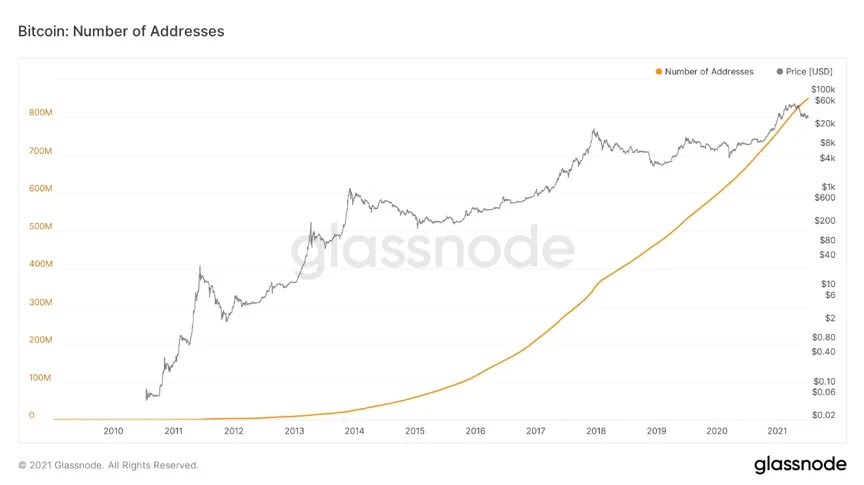
Bitcoin network on-chain address count, source glassnode
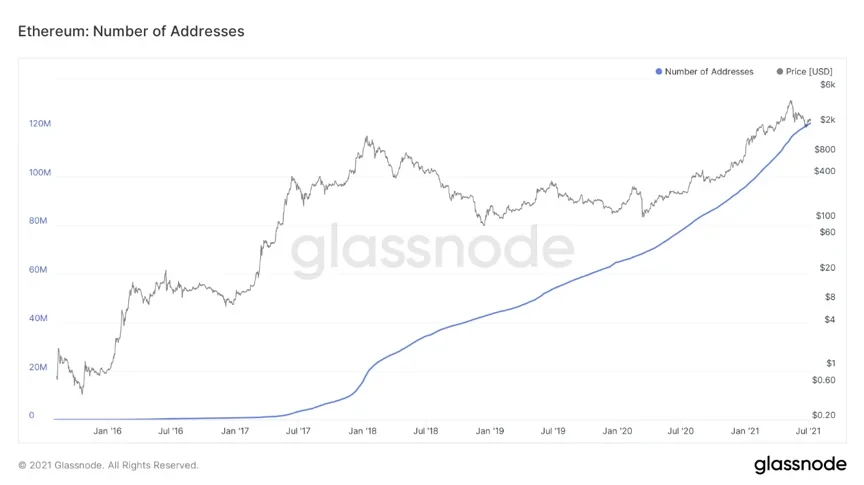
Ethereum network on-chain address count, source glassnode
Comparing data from glassnode, the current total Bitcoin network address count is approximately 849 million, while the Ethereum network total address count is approximately 122 million. In absolute terms, Bitcoin has a clear advantage, with a total address count 6.96 times that of Ethereum. However, considering that the Ethereum network launched approximately five years after Bitcoin, for a fair comparison, let's select data from January 1, 2017 to the present for comparison.
Using the glassnode data cited above, on January 1, 2017, the Bitcoin network's on-chain address count had already reached 210 million, while Ethereum's on-chain address count was only 2.06 million. In other words, over the subsequent four-plus years, the Bitcoin network's on-chain address count increased by a factor of 4.04x, whereas Ethereum's on-chain address count surged by a factor of 59.22x. From this perspective, Ethereum's growth performance has been exceptionally impressive.
Of course, on the fundamentals dimension, in addition to the total market caps of BTC and ETH, on-chain address counts, and the relative exchange rate changes between the two mentioned above, there is another piece of information at the micro level that deserves attention — namely, capital flow dynamics. This information is even more直观 than changes in on-chain address counts on the blockchain network, because it directly reflects the results of investors "voting with their feet" — staying or leaving.
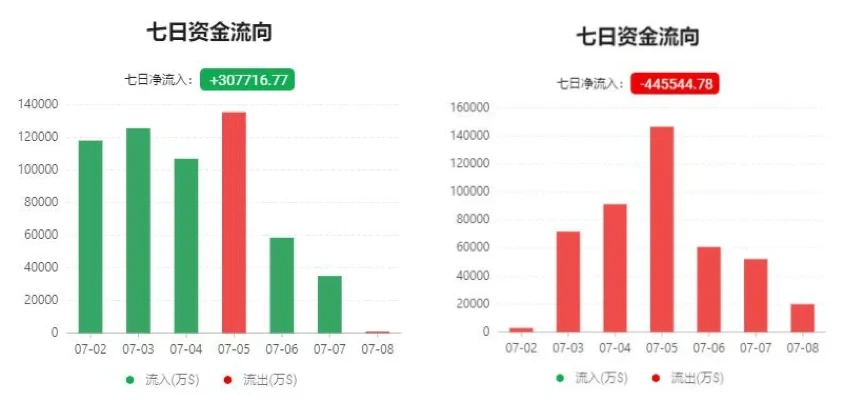
Bitcoin (left) and Ethereum (right) capital flow over the past 7 days, source qkl123
According to statistics from qkl123, a comprehensive blockchain information website, over the past seven days, Bitcoin saw a net inflow of $3.07 billion in capital, while Ethereum experienced a net outflow of over $4.45 billion during the same period, with net outflows recorded for all seven days. Although this is only a short-cycle statistical data point, we can still gain insight into the markedly different preferences of capital in the market between Bitcoin and Ethereum under current weak market conditions. So why does this situation arise?
This brings us to the differences in the ecosystem development roadmaps of the two.
As Goldman Sachs pointed out in its report to clients: "Ethereum is the native crypto asset and the most popular smart contract application development platform. Smart contracts include software capable of automatically executing digital agreements, a technology that has fueled the growth of DeFi protocols and crypto-powered DApps." "Bitcoin's first-mover advantage has given it a stronger backdrop, but Bitcoin lacks some of Ethereum's use cases and has slower transaction speeds. Due to its focus on hard currency and network security, Bitcoin has not yet offered the same level of functionality as Ethereum."
Goldman Sachs' analysis in the report appropriately explains the question we raised above. In simple terms, during weak market conditions in the crypto assets industry, Bitcoin tends to serve more as a safe-haven asset similar to gold within this market, thereby attracting continuous capital inflows. Ethereum is different — its focus is on applications rather than value storage. Just as the boom in Ethereum's ecosystem over the past year has been largely driven by the explosion of DeFi and NFTs, when the development pace of various Ethereum-based applications — particularly DeFi — slows down, capital outflows from Ethereum are to be expected.
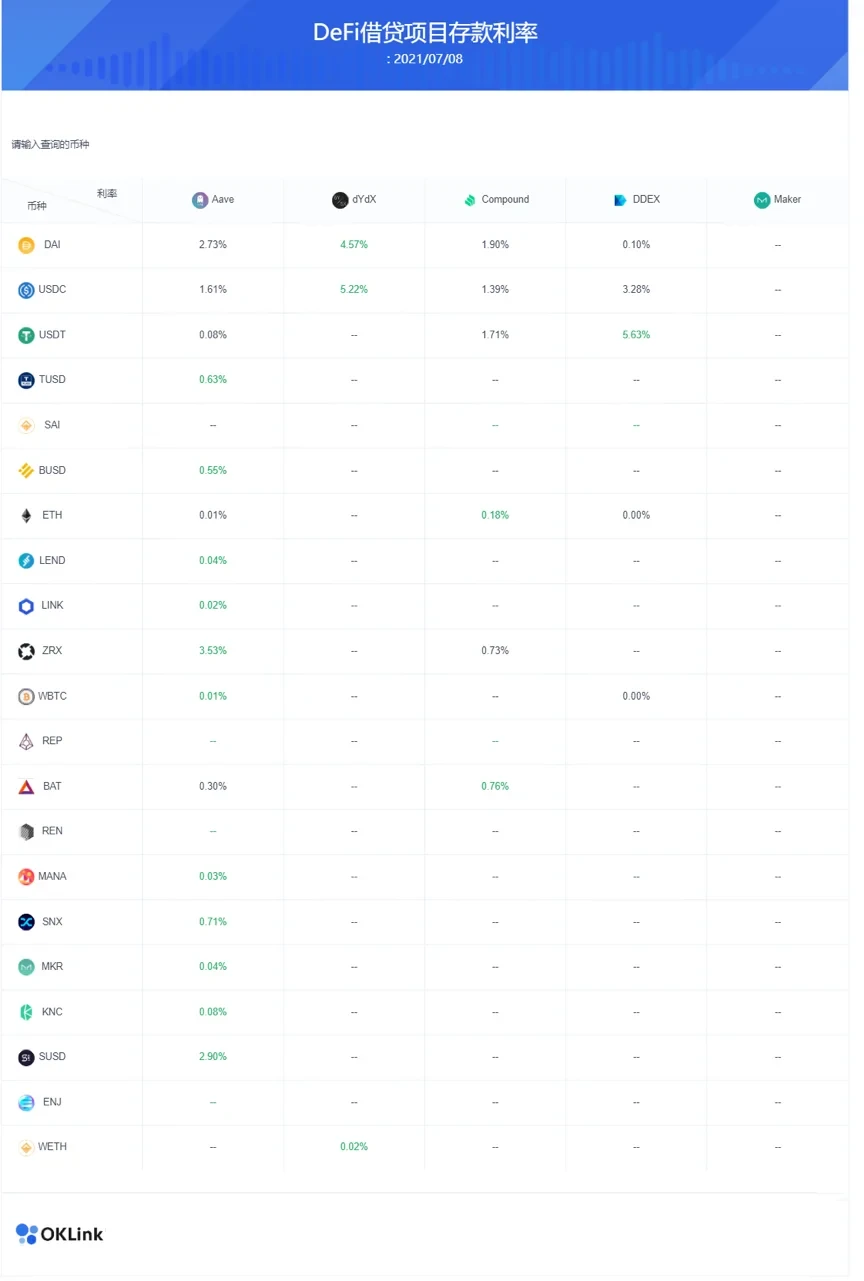
Current DeFi lending project deposit rates, source OKLink
Taking DeFi lending project deposit rates as an example, in most mainstream DeFi lending projects currently, the majority of deposit rates have fallen below 3%, and AAVE's ETH deposit rate is as low as 0.01%.
However, it is undeniable that although DeFi protocols on Ethereum have essentially entered a stagnation phase, since June 2020, the concentrated explosion of DeFi has brought a large number of new users and incremental capital to Ethereum, along with future development potential that should not be underestimated. In our previous article "Reviewing DeFi Summer's One-Year Anniversary: Six Key Data Points You Need to See," we calculated in detail the increase in DeFi protocol TVL over the past year: "The TVL of Ethereum-based DeFi protocols grew from $1.92 billion at the end of June 2020 to a peak of approximately $113.57 billion (May 11, 2021), a peak increase of approximately 5,815.1%."
Moreover, in our market cap comparison between Ethereum and Bitcoin above, we calculated only the circulating market cap of ETH and BTC. From a broader perspective, Ethereum's total market cap should also include DeFi protocols, NFTs, and other ecosystems built on the Ethereum blockchain. According to CoinGecko's statistics, the current total market cap of DeFi is approximately $74.7 billion, and NFTs' total market cap is approximately $16 billion. Combined with Ethereum's total market cap of $259.74 billion mentioned above, this exceeds $350 billion — representing 56.57% of Bitcoin's total market cap of $618.77 billion.
Additionally, it is evident that since the Ethereum blockchain launched, its development team has never stopped improving and upgrading the Ethereum network. Whether it's the EIP-1559 proposal aimed at reducing current high transaction fees and various rollup solutions, or the ongoing ETH 2.0 upgrade that will comprehensively transition the Ethereum network to a PoS mechanism — all of these give us new reasons for optimism beyond just market prices. In contrast, the Bitcoin network has clearly lagged behind Ethereum in terms of underlying upgrades. The last major technical upgrade discussion for the Bitcoin network likely traces back to the 2017 scaling debate. While the upcoming technical upgrade in November — the Taproot upgrade — will bring significant improvements to Bitcoin's privacy and flexibility, it does not seem to have garnered widespread industry attention.
Conclusion:
Recently, Kevin Hu, General Partner, and Celia Wan, Principal, at crypto risk investment firm Dragonfly Capital, wrote in their report: "As institutional investors have invested in BTC, its store of value narrative has gone mainstream."
JPMorgan CEO Jamie Dimon also stated in a report this week that as running the Ethereum blockchain becomes increasingly popular, staking (Staking) will become a source of income for institutional and retail investors alike. According to the report, staking currently generates approximately $9 billion in annual revenue for the cryptocurrency industry. The authors predict that after the long-anticipated ETH 2.0 launches next year, Ethereum's transition to PoS will accelerate the adoption of alternatives to the PoW consensus mechanism, and could cause staking value to surge to $20 billion within a few quarters of ETH 2.0's launch, reaching $40 billion by 2025.
Therefore, we may be able to predict that 2021–2022, around the time of the ETH 2.0 upgrade, will become a pivotal node for Ethereum entering its next major development period. At that time, Ethereum will increasingly take on the role of a new type of infrastructure for the future internet world, spawning an even more vibrant and imaginative ecosystem.
Disclaimer
This article may contain product-related content that may not be applicable to your region. This article is only committed to providing general information and does not accept responsibility for any factual errors or omissions. This article represents the author's personal views only and does not represent the views of OKX. This article is not intended to provide any advice, including but not limited to: (i) investment advice or investment recommendations; (ii) offers or solicitations to buy, sell, or hold digital assets; or (iii) financial, accounting, legal, or tax advice. Holdings of digital assets (including stablecoins) involve a high degree of risk, may fluctuate significantly, and could even become worthless. You should carefully consider whether trading or holding digital assets is appropriate for you based on your financial situation. For questions specific to your circumstances, please consult your legal/tax/investment professional. The information contained in this article (including market data and statistics, where applicable) is provided for general reference purposes only. Although we have taken all reasonable precautions in preparing such data and charts, we do not accept any responsibility for factual errors or omissions expressed herein. © 2025 OKX. This article may be reproduced or distributed in full, or excerpts of 100 words or less may be used, provided that such use is non-commercial in nature. Any reproduction or distribution of the full article must prominently state: "This article is copyrighted © 2025 OKX, used with permission." Permitted excerpts must cite the article title and include attribution, e.g., "Article Title, [Author Name (if applicable)], © 2025 OKX." Some content may have been generated or assisted by artificial intelligence (AI) tools. Derivative works and other uses of this article are not permitted.
Show More
Recommended Reading
OKX Pay: Ushering in a New Era of Next-Generation Cryptocurrency Payments
The choice of tens of millions of users. Register with OKX to enjoy an exceptional trading experience and a diverse range of wealth management products. A letter from OKX CEO Star: Today, we are officially launching the first version of OKX Pay to over 100 million global users. As the industry's first truly non-custodial and compliant payment application, OKX Pay will be embedded directly within the OKX App, currently available in select markets with a full global rollout expected in the coming months.
2026年3月22日

A New Chapter: Building the Next Generation of Financial Infrastructure Together
The partnership between OKX and Intercontinental Exchange (ICE) represents a significant milestone for OKX — and is equally meaningful for the evolution of the entire digital assets market. ICE builds and operates the world's most critical financial infrastructure, including the New York Stock Exchange and global derivatives and clearing platforms. ICE's decision to invest in OKX and join our Board of Directors reflects our shared belief that digital assets technology will transform financial markets.
2026年3月10日

Reflecting on Another Year of Building
As the CEO of OKX and a builder who stays true to the original mission, I am proud to look back on the extraordinary growth and progress OKX has achieved this year. Despite challenges along the way, 2024 was a year defined by focus, innovation, and resilience. Not only did we expand and improve our products, but we also made significant strides in launching transparent and regulation-compliant localized businesses, while further strengthening our global management team. It is worth noting that after experiencing.
2026年1月29日

2025: Steady Progress Toward Financial Freedom
— An End-of-Year Letter to Global Users from Star, Founder and CEO of OKX "Financial freedom" is often misunderstood. It doesn't mean the absence of rules, but rather the right to make choices within those rules — and when the system is truly put to the test, it remains reliable and effective. This is precisely what we remained focused on throughout 2025. First and foremost, I would like to express my sincere gratitude to our global customers, partners, and regulators.
2026年1月16日

OKX Officially Launches in Germany and Poland
By Erald Ghoos, CEO of OKX Europe. Today is a significant day for OKX — and for crypto users across Europe. We have officially launched a fully compliant centralized cryptocurrency trading platform in Germany and Poland! For us, this is not just a geographic expansion, but a commitment to building the future of cryptocurrency the right way: safe, transparent, and tailored to local needs. If you are in Germany.
2025年10月21日

Partnership Upgrade! OKX Joins Forces with Standard Chartered to Expand into Europe
On October 15th, Erald Ghoos, CEO of OKX Europe, stated that OKX is expanding its strategic partnership with Standard Chartered to the European Economic Area (EEA). Earlier this year, OKX first partnered with Standard Chartered in the UAE to launch the Collateral Mirroring program — a.
2025年10月15日