Understanding the Recently Hot Modular Blockchains
Recently, modular blockchains have gradually become a hot topic in the industry. Literally understood, modular blockchains refer to modularizing blockchain technology, applications, rules, and standards, making it convenient for different project developers to match solutions based on personalized needs.
Of course, modular blockchains are essentially a concept proposed around scalability solutions, and there have been no completely successful experimenters in the current technical environment. Therefore, for projects currently promoting this concept, whether investors or developers, should carefully screen and make rational choices.
In addition, given that this concept is not yet mature and industry interpretations vary, this article only aims to introduce its core principles in the simplest and most understandable language while ensuring macro-logical accuracy.
I. Concept Suite Based on Layer 2
Specifically, modular blockchains aim to split the system into multiple module components, giving them blockchain properties, and they can even have subdivided functions such as DEX application chains, stablecoin application chains, NFT application chains, and derivative application chains. Developers can extract these new modules and combine them in any order to achieve more advanced functions. In addition, modular blockchains have their own unique logic, attempting to weaken the "impossible triangle" problem and practice the core spirit of blockchain technology. We will discuss the details below.
In fact, the concept of modular blockchains was mentioned as early as a few years ago, but was quickly overshadowed by other hot topics. Since the second half of last year, modular blockchains have been repeatedly mentioned by influencers because Ethereum Layer 2 solutions began to gain traction then, and Layer 2 is an important foundation and prerequisite for blockchain modularization. It should be noted that modular blockchains are mainly solutions proposed for Ethereum upgrades, with their narrative logic revolving around Ethereum. However, there are also projects on other chains using this as a reference for performance improvements.
As everyone knows, the "impossible triangle" of blockchain technology has always been a concern for developers and users, and solutions like Layer 2 were created specifically to address this core pain point. Layer 2's specific approach is to move data computation and processing to Ethereum's second-layer network, with the first-layer network focusing on security, or consensus. Modular blockchains go further by dividing blockchain into three layers: the execution layer, settlement layer, and data availability layer.
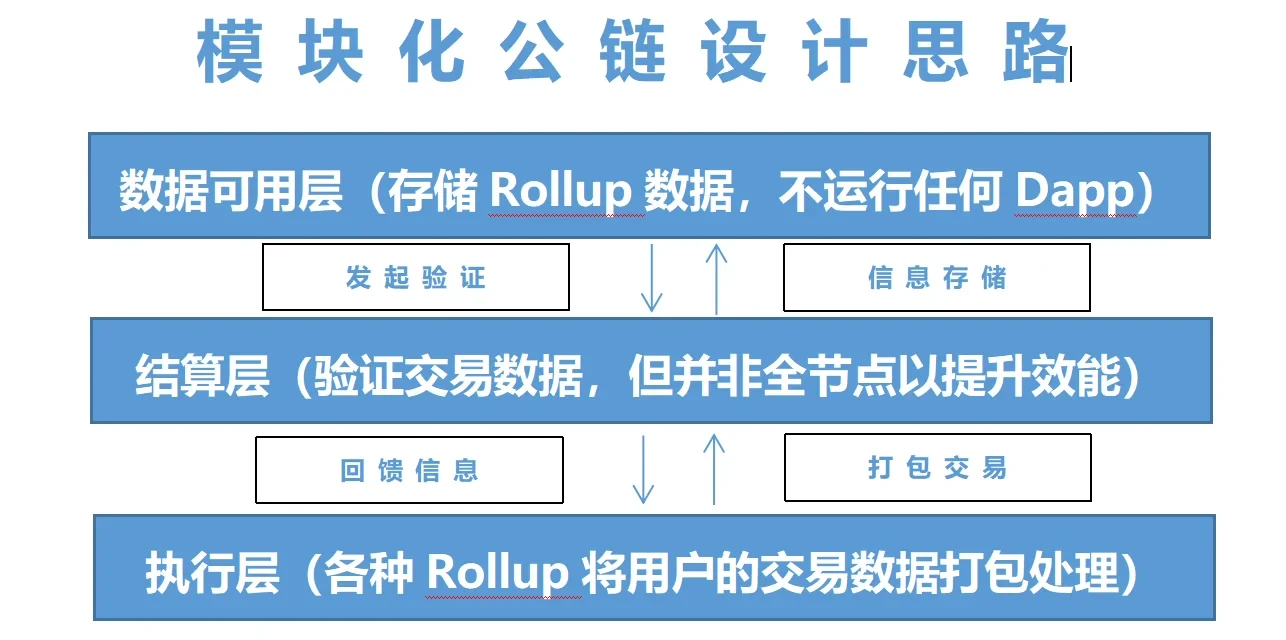
Typically, the above three layers have long existed, but they are coupled within the Ethereum network without very clear boundaries and divisions of labor. What modular blockchains aim to do is decouple, first using Layer 2 applications as the technical environment to categorize and refine functions such as privacy security, node verification, transaction confirmation, data storage, and fraud proofs, achieving overall on-chain scaling. Below, we'll provide a detailed interpretation around these three layers.
II. Deep Collaboration of 3-Layer Network, Prioritized Processing of Transaction Data
First, let's look at the execution layer, which mainly faces the user side, that is, various Layer 2 Rollup applications such as Arbitrum and Optimism. Its core function is to quickly package and process user transactions. This layer is relatively easy to understand and is also the primary function of on-chain applications. However, doubts about various Rollup solutions sacrificing decentralization to pursue performance have never ceased. In extreme environments, could the high rate of the modular blockchain execution layer come at the cost of large nodes collaborating maliciously? This question will be resolved by the settlement layer.
The settlement layer is mainly responsible for verifying the security of transaction information, also known as the consensus layer. Bitcoin and Ethereum's operating rates are widely criticized, but this is brought about by the full node verification model under the PoW consensus mechanism. Therefore, Bitcoin and Ethereum are recognized as the most secure public chains in the entire network. Many high-performance public chains currently ranking high in TVL have partially abandoned decentralization to achieve performance breakthroughs.
In modular blockchain design, transaction data packaged by the execution layer is submitted to thousands of nodes in the Ethereum settlement layer for joint processing and verification, and anti-fraud proof technology will play a role in this. This itself can significantly weaken the risk of some nodes acting maliciously and hedge against the hidden danger of centralization on the Rollup side. Of course, Rollup itself is also constantly iterating on the technical side to further embrace decentralization.
However, with the surge in transaction data, Ethereum under the full node verification model will inevitably become more congested, which will further test users' patience. In this regard, the approach given by modular blockchains is to prioritize verification data by importance, with more important data having higher priority and being verified by more nodes earlier. Small peer-to-peer transfer data between individual users does not need to mobilize most nodes to participate in processing. This can greatly reduce Ethereum's on-chain load and increase operating speed.
It is worth noting that Ethereum's consensus mechanism transitioned from PoW to PoS in the second half of this year, creating conditions for this. It can be said that the settlement layer's structured, differentiated, prioritized, and categorized processing of transaction data is the soul of modular blockchains.
Finally, let's look at the data availability layer, which is the storage layer for Rollup data, used to store the most primitive transaction data. We can understand it as a data backup chain. Its function is very single, only storage, without executing any smart contract protocols and completely without involving computation. Its core function is to ensure transaction data is correct and available, providing materials for fraud proofs, or helping users trace assets with original data in case of network attacks to reduce losses.
Another point that cannot be ignored is that storing data on the L1 layer (settlement layer) would be very expensive, and dedicating a chain solely for storage might be a cost-effective choice. Therefore, the data availability layer is a supplement to the entire public chain system and can provide double insurance for information security.
III. Some Players Launch Exploration, Expecting the Concept to Finally Materialize
The reason why modular blockchains have become hot recently is mainly driven by a series of related projects such as Celestia.
On February 7, Cosmos officially announced that its modular blockchain network Celestia's first public testnet will launch in the second quarter of 2022, with mainnet going live by the end of the year. However, Celestia has not issued a token nor published an economic model. Avail, which has similar technical logic to Celestia, was launched by Polygon at the end of June last year. The commonality between the two is that technically, they play the role of a separate data availability layer or consensus layer to assist the operation of the entire system. Most importantly, Celestia and Avail are pluggable and have very small memory footprint, with functions limited to transaction ordering, but this also provides flexibility for the modularization of the entire system. Interestingly, when Avail was launched last year, it was accused by Celestia of plagiarism.
In addition, the public chain project IOTA, which has been dormant in the industry for many years, has also actively attempted to transform into modular. At the end of last year, IOTA developed a new chain called Assembly. Assembly has scalability and can continuously deploy new contract chains and is compatible with EVM. Some analysis believes that Assembly can be seen as Layer 1.5, which is a smart contract architecture layer, and the various smart contract chains built on Assembly are the real Layer 2.
It cannot be ignored that starting this year, the Ethereum community stopped using "Eth1" and "Eth2," instead using "execution layer" and "consensus layer" to describe the upcoming Ethereum upgrade. This change in terminology seems to inadvertently endorse modular blockchains. At least these two events roughly coincide in when they received outside attention, also implying a coincidence.
It should be noted that this change is also accompanied by Ethereum's approaching transition to PoS consensus mechanism, and technical performance may decline accordingly. The specific technical logic has been detailed in "ETH 2.0 Reinvented: What Impact Will the June Upgrade Have?". Welcome to click and view. At this time, the popularity of the modular blockchain concept implies increasingly clear meaning and direction.
Although there are currently some capable players who have made attempts at blockchain modularization, whether they can successfully land applications still needs time to verify. Although these public chains are all high-performance public chains with different technical logic and mechanism designs from Ethereum, and even limited by their transaction volume and number of nodes, there is still no need to build Layer 2, but there is no doubt that the industry is developing and users are growing. More flexible modular public chains may better adapt to the needs of the future multi-chain era, which is also a proactive measure.
In summary, the core idea of modular blockchains is to divide the network structure into three layers—transaction packaging, node verification, and data storage—based on functions on top of Layer 2, and automatically identify transaction data attributes to differentially mobilize node power, achieving efficient, decentralized operation, and increasing the number of nodes in this ideal virtuous cycle system to achieve scaling of the entire on-chain system.
It can be said that the vision is beautiful and the logic is rigorous, but the technical implementation difficulty is still very large. Therefore, whether it can truly land cannot be determined at present. However, in the "impossible triangle" pain point, there seems to be no perfect solution, but the modular blockchain concept demonstrates a pragmatic spirit of seeking balance between the three points, which is worthy of recognition.
Whether successful or not, modular blockchains are also a hope for promoting the deep development of the industry, and users look forward to seeing related technologies and solutions achieve real breakthroughs.
Disclaimer
This article may contain content related to products that are not available in your region. This article is committed to providing general information only and assumes no responsibility for any factual errors or omissions contained herein. This article represents only the author's personal views and does not represent the views of OKX. This article is not intended to provide any advice, including but not limited to: (i) investment advice or investment recommendations; (ii) offers or solicitations to buy, sell, or hold digital assets; or (iii) financial, accounting, legal, or tax advice. Holding digital assets (including stablecoins) involves high risk, may fluctuate significantly, and may even become worthless. You should carefully consider whether trading or holding digital assets is suitable for you based on your financial situation. For questions about your specific situation, please consult your legal/tax/investment professional. The information appearing in this article (including market data and statistics, if any) is for general reference only. Although we have taken all reasonable precautions in preparing these data and charts, we assume no responsibility for any factual errors or omissions expressed herein. © 2025 OKX. This article may be reproduced or distributed in its entirety, or excerpts of 100 words or less from this article may be used, provided that such use is non-commercial. Any reproduction or distribution of the entire article must also prominently state: "This article is copyrighted © 2025 OKX, used with permission." Permitted excerpts must cite the article name and include attribution, for example "Article Name, [Author Name (if applicable)], © 2025 OKX". Some content may be generated or assisted by artificial intelligence (AI) tools. Derivative works or other uses of this article are not permitted.
Show More
Recommended Reading
OKX Pay: Opening a New Era of Next-Generation Crypto Payments
The choice of tens of millions of users. Register with OKX to enjoy the ultimate trading experience and diverse wealth management products. A letter from OKX CEO Star: Today, we are officially launching the first version of OKX Pay to over 100 million global users. As the industry's first payment application to truly achieve non-custodial and compliant integration, OKX Pay will be embedded in the OKX App, currently available to some markets and expected to fully
March 22, 2026

New Chapter: Building Next-Generation Financial Infrastructure Together
OKX's partnership with Intercontinental Exchange (ICE) is an important moment for OKX and equally significant for the evolution of the entire digital assets market. ICE establishes and operates the world's most important financial infrastructure, including the New York Stock Exchange and global derivatives and clearing platforms. This investment by ICE in OKX and joining our board reflects both parties' shared belief—digital assets technology will be in the financial markets
March 10, 2026
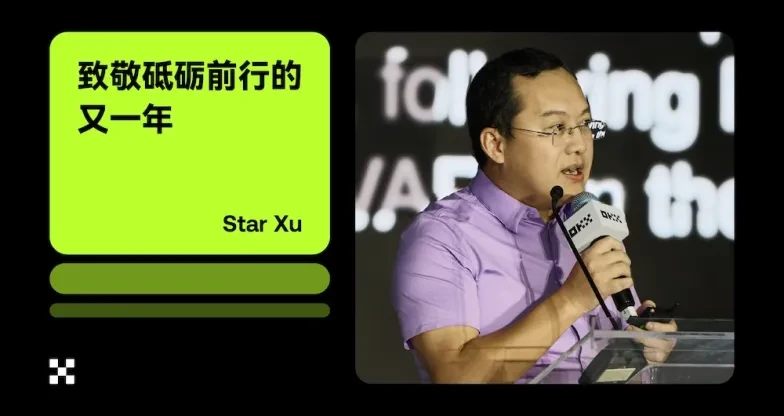
Tribute to Another Year of Forging Ahead
As OKX's CEO and a builder who never forgets the original intention, I am proud to look back on OKX's extraordinary growth and progress this year. Despite many challenges, 2024 was still a year filled with focus, innovation, and resilience. We not only expanded and optimized our products but also made important progress in launching transparent and regulatory-compliant localized businesses, while further strengthening our global management team. Notably, after experiencing
January 29, 2026

2025: Steady Progress Towards Financial Freedom Together
— Year-end letter from OKX Founder and CEO Star to global users "Financial freedom" is often misunderstood. It does not mean no rules, but rather having the right to choose when rules exist—and when the system is truly tested, it remains reliable and effective. This is exactly what we have been focused on throughout 2025. First, I would like to extend my sincere gratitude to global clients, partners, and regulatory authorities
January 16, 2026
OKX Officially Launches in Germany and Poland
Author: Erald Ghoos, CEO of OKX Europe Today is significant for OKX—and for crypto users across Europe. We have officially launched our fully compliant centralized cryptocurrency trading platform in Germany and Poland! For us, this is not just a geographic expansion, but a commitment to building the cryptocurrency future the right way: secure, transparent, and meeting local needs. If you are in Germany
October 21, 2025
Partnership Upgrade! OKX Partners with Standard Chartered to Expand European Market
On October 15, OKX Europe CEO Erald Ghoos stated that OKX is expanding its strategic partnership with Standard Chartered to the European Economic Area (EEA). Earlier this year, OKX first partnered with Standard Chartered in the UAE to launch the collateral mirroring program—this is a
October 15, 2025