Quick Guide to Arbitrage Order Strategy
1. What is Arbitrage?
Arbitrage generally refers to the method of using hedging or swapping to earn spreads between different markets with extremely low risk. Common arbitrage trading methods include funding rate arbitrage, futures-spot arbitrage, and inter-delivery arbitrage.
1.1 Funding Rate Arbitrage: Simultaneously executing two trades in opposite directions with equal amounts in the spot market and perpetual contracts, where profits and losses offset each other, with the goal of earning the funding rate returns from perpetual contract trading.
1.2 Futures-Spot Arbitrage: When there is a significant price difference between futures contracts and spot of the same asset, buy the lower-priced side and sell the higher-priced side, then close the position when the spread narrows to capture profits from the spread reduction.
1.3 Inter-Delivery Arbitrage: Buying and selling contracts of the same asset with different delivery dates, profiting from their price spread movements. However, inter-delivery spreads do not necessarily regress to 0, so the risk is slightly higher than futures-spot arbitrage.
Quick Access to Arbitrage Orders
2. What is OKX's Arbitrage Order Strategy?
Arbitrage users need to monitor two markets simultaneously and place orders at the same time during arbitrage trading, and both orders need to be filled as close together as possible to avoid slippage. Therefore, OKX provides this strategy tool to help users improve efficiency and fill accuracy during arbitrage.
3. How to Use the Arbitrage Order Strategy? (Using Web as Example)
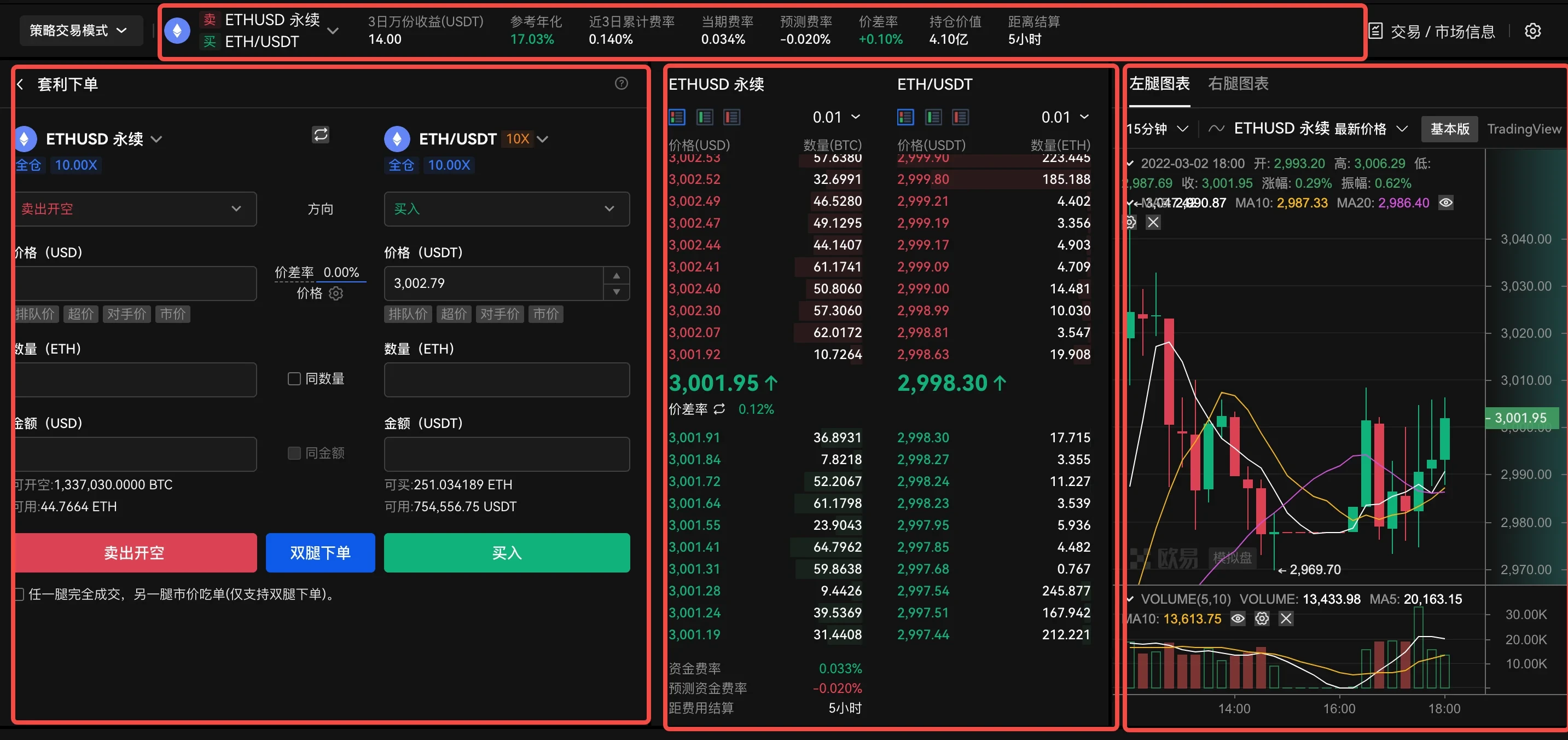
3.1 Module divisions of OKX's arbitrage order tool:
Divided into 4 main areas: The top section shows arbitrage pair information. Below the information area, the left is the order area, the center is the order book area, and the right is the K-line chart area.
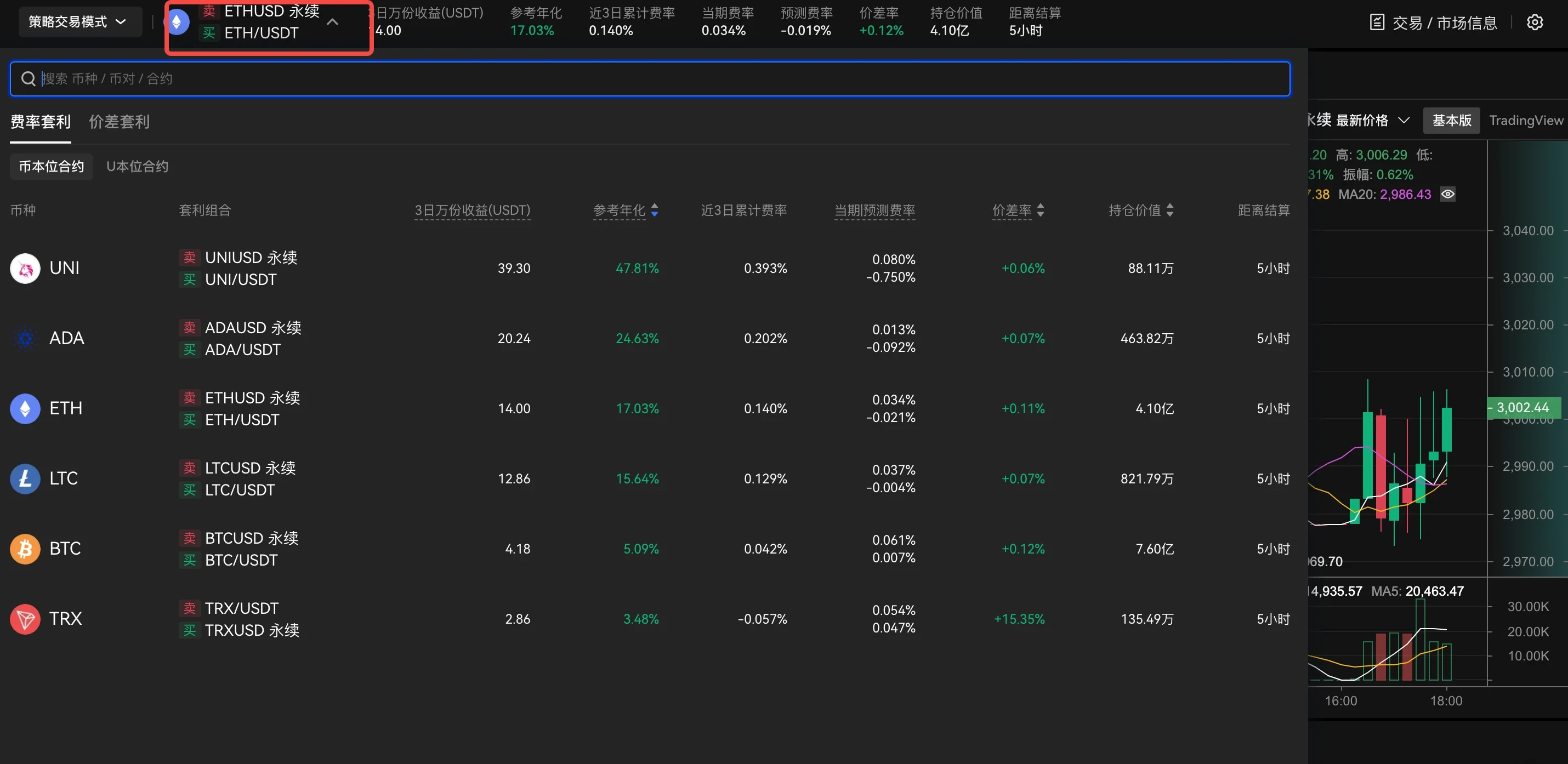
3.2 During actual arbitrage, users can select the appropriate arbitrage pair based on the arbitrage order information calculated by the platform.
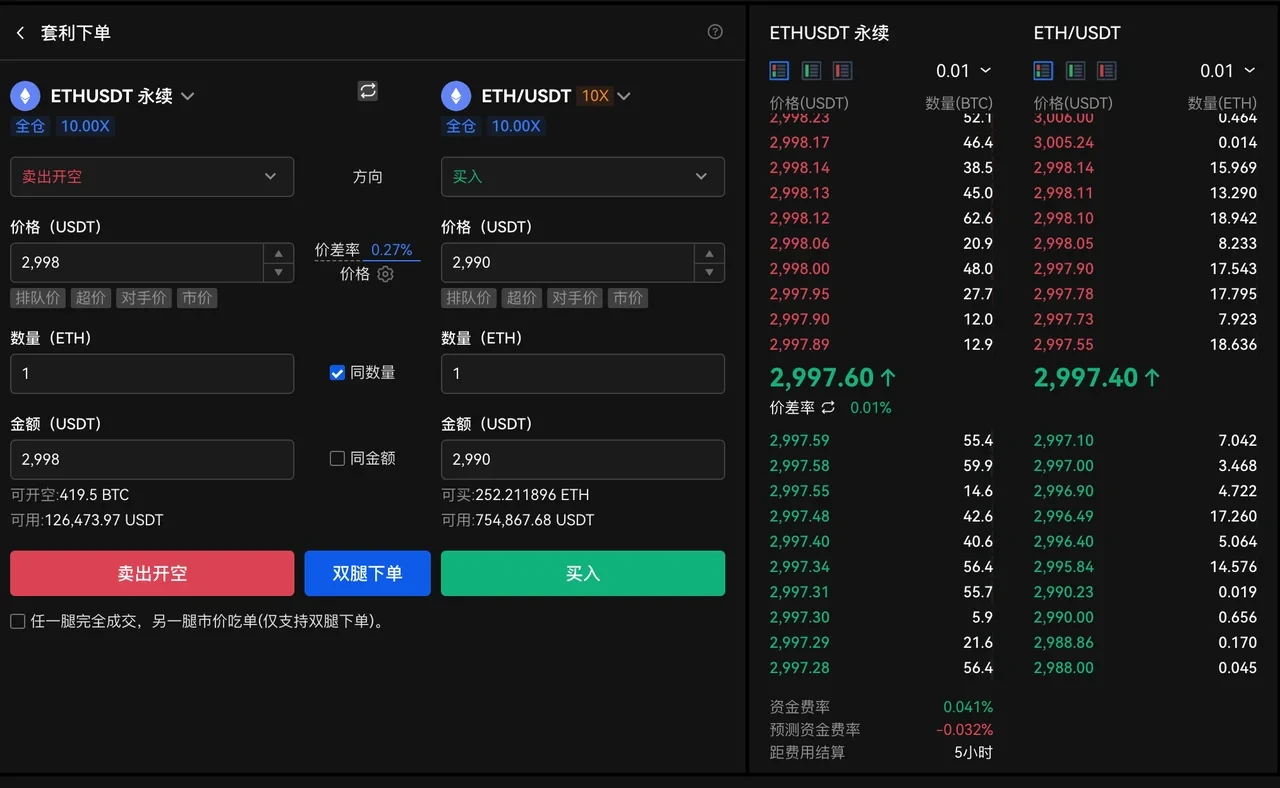
3.3 After selection, the two underlying instruments of the arbitrage pair are loaded into their respective order areas, with the corresponding arbitrage direction already selected.
Users can select limit price, market price, or opponent price and other price types to place orders on both legs. Then enter the quantity or amount and submit the order.
Auxiliary features:
a. The switch button next to the instrument can help swap the positions of the left and right legs in the order area, depth area, and chart area.
b. When entering prices, the spread ratio tool in the center of the price area helps calculate the spread ratio between the two prices, helping users understand the spread situation at execution, i.e., the arbitrage cost. Users can also enter the left leg price and spread ratio to inversely calculate the right leg price.
c. By checking "Same Quantity" or "Same Amount," the unfilled leg can be made to match the quantity/amount of the already-filled leg.
d. By checking "When one leg is fully filled, the other leg takes market orders," you can ensure that once one leg is filled, the other leg can be filled promptly to avoid slippage.
Explanation of the 5 price types:
a. Limit price, market price, and opponent price follow the same logic as manual Trading. Limit price means the user enters the price; market price is the reasonable price for quick execution at the current market price; opponent price is the best bid or best ask price on the opposing side of the order's buy/sell direction.
b. Move Over:
Buy: Entrust price = Best bid + Order size range × Minimum price increment, with the order size range set by the user
Sell: Entrust price = Best ask - Order size range × Minimum price increment
c. Queue Price:
Buy: Entrust price = Best bid - Posting range × Minimum price increment, with the posting range set by the user
Sell: Entrust price = Best ask + Posting range × Minimum price increment
【Auto Order Chase】, Optional in settings
If auto order chase is enabled, the system checks orders at each【Time Interval】. If at the time of checking the order is still unfilled or partially filled, and the current posting price is far from the queue price range, the system will cancel the order and re-entrust at the latest queue price.
【Pause Order Chase】, Optional in settings. If pause order chase is enabled, when the latest calculated queue price is far from the initial posting price by the【Pause Threshold】*, the order chase will be paused.
3.4 After successful order placement, you can view order fill status or stop orders in the strategy entrustment list. Additionally, sub-orders can still be viewed and operated in the current entrustments or historical entrustments of manual trading.

3.5 After completing the above operations, a hedged arbitrage position is established. For funding rate arbitrage, funding fees are settled daily to your trading account; for futures-spot arbitrage, you need to close the position in a timely manner when the price spread between the two legs converges to capture profits. See the following closing process for reference.
3.6 About closing arbitrage positions. When the funding rate returns in funding rate arbitrage meet expectations or lose profitability, or when the spread in futures-spot or inter-delivery arbitrage converges and the generated profits meet expectations, you can close positions in a timely manner to capture arbitrage profits. This means closing the existing position by placing orders in the opposite direction of the initial arbitrage opening. The specific operation is the same as the opening process described above. Please pay attention to controlling slippage. After fully closing the position, one complete arbitrage trade is finished.
Appendix: Detailed explanations of the three arbitrage strategies:
1. Funding Rate Arbitrage: Simple Three Steps to Enjoy 500% Annualized Returns — Funding Rate Arbitrage Strategy
2. Futures-Spot Arbitrage: Asset Portfolio Generates 150% Annualized Returns — Futures-Spot Arbitrage Strategy
3. Inter-Delivery Arbitrage: Contract Spread Reaches 6000 U — How to Arbitrage? — Inter-Delivery Arbitrage Strategy
Disclaimer
This article may contain product-related content that does not apply to your region. This article is committed to providing general information only and does not accept responsibility for any factual errors or omissions. This article represents the author's personal views only and does not constitute the views of OKX. This article is not intended to provide any advice, including but not limited to: (i) investment advice or investment recommendations; (ii) offers or solicitations to purchase, sell, or hold digital assets; or (iii) financial, accounting, legal, or tax advice. Holding digital assets (including stablecoins) involves high risk and may experience significant volatility or even become worthless. You should carefully consider whether trading or holding digital assets is suitable for you based on your financial situation. For questions regarding your specific circumstances, please consult your legal/tax/investment professionals. The information in this article (including market data and statistical information, if any) is for general reference purposes only. Although we have taken all reasonable precautions in preparing such data and charts, we do not accept any responsibility for factual errors or omissions expressed herein. © 2025 OKX. This article may be reproduced or distributed in its entirety, or excerpts of 100 words or less may be used, provided that such use is non-commercial in nature. Any reproduction or distribution of the full article must prominently state: "This article is copyrighted © 2025 OKX, used with permission." Permitted excerpts must cite the article title and include the source, for example, "Article Title, [Author Name (if applicable)], © 2025 OKX". Some content may have been generated or assisted by artificial intelligence (AI) tools. Derivative works and other uses of this article are not permitted.
Show More
Recommended Reading

OKX Upgrades Iceberg Strategy: A Smarter and More User-Friendly Large Order Split Trading Tool
For institutional investors or investors with large capital, conducting large orders involves facing many trading challenges, such as causing market follow-through, driving up or pushing down market prices, thereby increasing trading costs, or after trading intentions are exposed, revealing capital strength, making them vulnerable to being targeted by counterparties, putting trading in a passive position. Therefore, splitting large orders into smaller batches posted to the market has become the primary method for large-volume trading. The iceberg entrustment strategy is precisely such a large-order
February 27, 2025

Quick Guide to Time-Weighted Strategy
1. What is the Time-Weighted Strategy?
April 25, 2024

What is the Safest Strategy for Making Large Trades in a Highly Volatile Crypto Market?
The volatility and risk of the crypto market hardly need further elaboration. Among them, large buy and sell operations executed by whales can directly disrupt the market, bringing short-term extreme price surges or crashes — this is also one of the significant risk sources in the crypto market. However, the above scenarios may be too remote for novice users for now. But novices who do not aspire to become large players will never be able to make money in the market. Since the goal is to become a large player, let us take a look at how large players execute related operations
April 25, 2024