
Detailed Explanation of Protective Put Option Strategy
I. Definition:
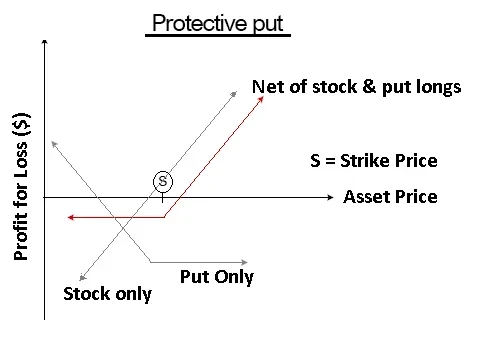
The protective put option strategy is an options trading strategy. As the name suggests, this is a risk-hedging trading strategy. Specifically, this strategy involves a trader buying 1 unit of the underlying asset while simultaneously purchasing 1 put option on that same asset. This operation is designed to provide protection against a decline in the price of the purchased asset.
II. Strategy Details:
The protective put option strategy is typically used when a buyer expects the price of an already-purchased spot asset to rise, but is concerned that market volatility may cause the price to fall instead. Through the protective put option strategy, the spot position will have a capped loss, with the loss ceiling set at the strike price of the underlying put option. Therefore, the buyer employing this strategy faces unlimited profit potential and limited risk.
Generally, buyers purchase an at-the-money underlying put option to hedge potential losses on the spot position. An at-the-money put option is typically purchased alongside the spot asset, providing comprehensive protection until the option expires. The minimum price of this put strategy equals the strike price minus the cost of purchasing the option. When using options to protect existing or anticipated positions, if the held spot asset's price continues to rise, the option will not be exercised. This more flexible execution condition makes options more suitable than futures products for protecting spot positions in the same asset.
In summary, this strategy offers unlimited returns with limited risk. The maximum loss equals: strike price - underlying purchase price + premium. The strategy's characteristics are as follows:
1) Locks in the minimum net proceeds and minimum net profit/loss;
2) Reduces net profit/loss expectations; when the stock price rises, the returns are lower than those from a single investment in the underlying asset;
3) Combined net profit/loss = combined net proceeds at expiration - initial investment
When the underlying asset price < strike price:
Combined net profit/loss = strike price - (initial underlying purchase price + option purchase price)
When the underlying asset price > strike price:
Combined net profit/loss = underlying asset sale price - (initial underlying purchase price + option purchase price)
Institutional investors can also use the protective put option strategy to gain protection in the event of a decline in the underlying asset price.
III. Trading Details:
The following conditions must be met to execute this strategy:
1) Regarding legs:
There can only be two legs, and Leg 1's buy/sell direction = Leg 2's buy/sell direction — both must be buys. Additionally, Leg 1's underlying = Leg 2's underlying. In other words, the protective put option strategy can only consist of one spot position and one underlying put option.
2) Regarding instrument types:
Instrument type = put option / spot
Instrument type ≠ call option / option / perpetual contract / leverage
3) Regarding notional value:
The notional value of the base currency in the put option = the spot notional value, meaning the notional value of the base currency in the put option must be the same as the spot notional value.
4) Regarding net strategy price:
Net strategy price = put option premium + spot purchase price at entry
5) Regarding margin:
No additional margin requirements.
IV. Specific Trading Examples:
Assume the protective put option strategy is currently being executed. The trading details are as follows:
Leg 1 (+1): Buy BTCUSD-20221126-P-50,000
Leg 2 (+1): Buy BTCUSDT-S-50,000
Leg 1 price: 20
Net strategy price: 50,000 + 20 = 50,020
The following two scenarios will occur:
Scenario 1: The price at expiration equals or falls below Leg 1's strike price
BTC price on the put option expiration date = 45,000
At expiration, Leg 1 is in-the-money; the buyer profits from Leg 1 but must pay for losses incurred from Leg 2:
(Underlying price at put option expiration - spot purchase price) + (put option strike price - underlying price at put option expiration) - put option premium
Scenario 2: The price at expiration is above Leg 1's strike price
BTC price on the put option expiration date = 55,000
At expiration, Leg 1 is out-of-the-money; the buyer profits from Leg 2 but must pay for losses incurred from Leg 1:
(Underlying price at put option expiration - spot purchase price) - put option premium

Disclaimer
This article may contain product-related content that does not apply to your region. This article is dedicated to providing general information only and does not accept responsibility for any factual errors or omissions herein. This article represents the author's personal views only and does not constitute the views of OKX. This article is not intended to provide any advice, including but not limited to: (i) investment advice or investment recommendations; (ii) offers or solicitations to buy, sell, or hold digital assets; or (iii) financial, accounting, legal, or tax advice. Holding digital assets (including stablecoins) involves a high level of risk, may be subject to significant volatility, and may even become worthless. You should carefully consider whether trading or holding digital assets is appropriate for you based on your financial situation. For questions regarding your specific circumstances, please consult your legal/tax/investment professional. The information contained in this article (including market data and statistics, where applicable) is provided for general reference purposes only. Although all reasonable precautions have been taken in preparing such data and charts, we assume no responsibility for any factual errors or omissions expressed herein. © 2025 OKX. This article may be reproduced or distributed in its entirety or with excerpts of 100 words or less, provided that such use is non-commercial in nature. Any reproduction or distribution of the full article must prominently state: "This article is copyrighted © 2025 OKX, used with permission." Permitted excerpts must cite the article title and include attribution, for example "Article Title, [Author Name (if applicable)], © 2025 OKX." Some content may have been generated or assisted by artificial intelligence (AI) tools. Derivative works and other uses of this article are not permitted.
Show More
Recommended Reading

Detailed Explanation of Bull Call Spread Strategy
I. Definition: The long bull call spread strategy refers to a trading strategy in the options market where a trader buys a call option at a lower strike price and sells a call option at a higher strike price. II. Profit method: For buyers, if executing this strategy, buying at the lower strike price and selling at the higher strike price allows them to profit from the price difference. Of course, the maximum returns are also capped by the higher strike price. Generally, traders...
April 25, 2024

Detailed Explanation of Bear Put Spread Strategy
I. Definition: The bear put spread strategy refers to a strategy in the options market where a buyer reduces the holding cost of corresponding option products because they anticipate the underlying asset's price will experience a moderate or significant decline. II. Profit method: The spread in this strategy is achieved by buying a put option while simultaneously selling a put option on the same underlying asset with a lower strike price, the same expiration date, and the same quantity. The maximum profit generated by this strategy equals the difference between the two strike prices...
April 25, 2024

Contract Spread Strategy
I. Definition: The contract spread trading strategy refers to a strategy where, in contract trading, a trader simultaneously buys and sells two related contracts. For example, a trader buys a BTC/USD contract expiring in September while selling a BTC/USD contract expiring in December. This is a market-neutral strategy. Simply put, executing this strategy involves the trading party profiting from the price difference between the two contracts. II. Profit method: It is easy to understand that compared to the previous strategies...
April 25, 2024

Collar Trading Strategy
I. Definition: The collar strategy is a strategy in options trading that involves purchasing one put option contract while simultaneously selling one out-of-the-money (OTM) call option contract. Both contracts have equal quantities, and the put option's strike price is below the call option's strike price. Typically, traders employing the collar strategy already hold a long or short position in the underlying asset, and executing this strategy protects the returns on the underlying asset position and hedges against risk.
April 25, 2024

Detailed Explanation of Butterfly Strategy
I. Definition: The butterfly strategy is a common options trading strategy, named for the shape of its profit/loss diagram resembling a butterfly. The butterfly strategy is generally suitable for periods of low market volatility. More precisely, when an investor combines micro and macro factors and comprehensively determines that significant price movements in either direction are unlikely, the butterfly strategy is relatively an ideal choice. II. Strategy Details: Based on contract types, long butterfly strategies can be divided into long call butterfly strategies and long put butterfly strategies...
April 25, 2024

Strangle Arbitrage Trading Strategy
I. Definition: The strangle trading strategy refers to a strategy in the options market where a trader buys a put option at a low price level and buys a call option on the same underlying asset at a high price range. II. Profit method: Trading parties can be divided into buyers and sellers, each executing opposite operations. The profit logic of this strategy is largely similar to that of the long straddle strategy. That is, during actual trading, if a buyer executes this strategy, regardless of which direction the underlying price moves...
April 25, 2024