
The Ultimate Tool for Bottom Divers – Martingale Strategy
DCA, short for Dollar Cost Averaging, is more commonly known in China as the Martingale strategy, which is frequently used in the foreign exchange market of traditional finance.
If you're always worried about missing the bottom, or if after buying at a low point the investment target continues to fall, then understanding and using the Martingale strategy will be of significant help to your investment in the crypto market.
The basic principle of the Martingale strategy is that in a two-way market where you can buy long or short, you generally only bet on one side. If you get it wrong, you keep adding positions in the opposite direction. This continues until the market pulls back, allowing you to profit from buying low and selling high. Currently, the Martingale strategy has been gradually widely used by various investors due to its series of advantages. However, given the market's risk, this strategy cannot guarantee capital preservation, and investors need to control risk.
In addition, with the diversification of user needs, OKX has officially launched the crypto asset spot trading version of the Martingale strategy. OKX's spot Martingale strategy follows the basic ideas of the traditional version of this strategy, and combined with the characteristics of the crypto space, has made a series of operational optimizations. It is an automated, batch-based, low-position bottom-diving strategy.
In short, whether ordinary investors or experienced investors, through OKX's optimized Martingale strategy, can find an operating mode that suits their trading style, achieving automated operation without needing to constantly monitor the market. Below, we will introduce the Martingale strategy in detail.
1. Strategy Introduction
Before diving deep into the Martingale strategy, it's worth understanding fixed investment first. Fixed investment is an operation where investors buy assets at regular intervals regardless of market conditions. This operation is typically widely used by conservative retail investors and financial institutions pursuing stable returns.
Under normal circumstances, the average cost of fixed investment over a complete cycle is often lower than the cost of a one-time full purchase, which expands the overall return space. Additionally, compared to the risk of a potential crash after a one-time full position purchase, the batch-buying nature of fixed investment disperses the risk of a one-time explosion, indirectly protecting the trader's rights.
Compared to fixed investment where you buy a fixed amount of coins at regular intervals, the Martingale strategy is more flexible in cost control because the Martingale strategy involves buying each time the price drops by a fixed percentage value over a longer or shorter market cycle. When the market reverses and reaches an appropriate selling point, the Martingale strategy automatically executes the sell operation. In oscillating or highly volatile markets, this strategy offers more steady overall returns with relatively controllable risk.
It should be noted that Martingale is suitable for most market conditions except one-way markets, especially medium-to-long-term oscillating markets.
In medium-to-long-term oscillating markets, the Martingale strategy will continuously buy, executing operations similar to swing bottom-diving. Traders can also choose to amplify the buy amount multiplier to better capture opportunities during brief declines. Once the market bounces back, they can sell in one go to profit.
For example, an investor using the Martingale strategy might buy the first order (initial order) when Bitcoin is at $10,000, and buy the next order (position-adding order) every time it drops 1%, meaning the second order (position-adding order) at $9,900, the third order (position-adding order) at $9,801, and so on, continuously lowering the overall average buy cost.
If the Bitcoin price rises and reaches the take-profit price set by the strategy, the system will automatically execute the sale, completing a trading cycle. It should be noted that the take-profit price adjusts dynamically based on the take-profit target.
Before starting the strategy, investors need to determine a take-profit percentage based on personal expectations – that is, the expected profit ratio.
The higher the price at which investors expect to sell, the longer the strategy cycle may be, meaning it will take longer to sell. For example, in the above case, if the investor sets a 10% take-profit target, the take-profit price will dynamically adjust based on the average buy cost after multiple orders. Once the return rate reaches 10%, it will immediately automatically execute the sell operation and end this trading cycle.
This simple case involves several concepts including trading cycle, initial order, position-adding orders, and dynamic take-profit, which will be introduced in detail below. Most of these concepts are core highlights of OKX's version of the Martingale strategy compared to other similar platforms.
2. Details of OKX's Martingale Strategy
OKX's spot version of the Martingale strategy (hereinafter uniformly referred to as "the strategy") builds on the operational approach of the traditional version, combined with the habits and characteristics of crypto space users, making greater degree optimizations. While ensuring user experience, the strategy is committed to helping investors maximize returns.
Below, by outlining several essential elements of OKX's spot Martingale strategy, we can more intuitively restore the operating principle of the Martingale strategy.
1. Creation Modes:
OKX's Martingale strategy offers two different creation modes for users with different experience levels: manual creation and smart creation.
Manual creation is where traders set parameters based on their personal judgment of market conditions. This is mainly suitable for investors with extensive trading experience and substantial capital. Ordinary users are advised to use the smart creation mode.
Smart creation is where users select system-recommended parameters based on their personal risk preferences to set investment amounts and buying rhythm. It's worth mentioning that the system-recommended parameters are calculated using OKX's backend algorithms based on historical market data and asset volatility, possessing a considerable degree of authority and providing reliable investment references for traders. Additionally, borrowing from the practice of traditional securities investment in stratifying traders, the smart creation mode combines user asset status and risk tolerance to recommend parameters with different risk levels across three tiers: conservative, balanced, and aggressive.

For conservative investors, the primary consideration is capital preservation rather than returns, and they have weaker risk resistance. Therefore, under the conservative strategy parameter settings, there are fewer buy orders with larger price differences between each buy operation. The trading attitude is more cautious, capable of hedging against extreme market conditions, making it more suitable for novice users trying the strategy for the first time.
For aggressive investors, they typically have stronger risk tolerance, dare to take risks, and have more substantial asset status. Therefore, under the aggressive strategy parameter settings, there are more buy orders with smaller price differences between each buy operation, and relatively more buy occurrences. The trading attitude is more aggressive, aiming to continuously earn multiple rounds of profits through high-frequency trading, accumulating small gains into larger ones for sustained profits, making it more suitable for experienced users with high trading frequency.
For balanced investors, they typically neither dislike risk nor pursue risk, and are relatively rational about any investment. Therefore, the risk preferences and aggressiveness corresponding to the balanced strategy parameters fall between the two, showing relatively moderate performance.
2. Position-Adding Parameters:
In specific trading scenarios, each position-adding order is determined by the position-adding parameters set in advance by the user. For example, the price difference between different position-adding orders is determined by the user's setting of "buy when price drops by how much" (price difference).
Among these, there are two multipliers to remember. One is that users can set a multiplier for "buy when price drops by how much," meaning buying in batches after the price drops 2, 4, or 8 points. This is the concept of the position-adding price difference multiplier. In other words, the larger the position-adding price difference multiplier, the larger the difference between subsequent position-adding order prices, and the average buy cost continues to decrease from this, which is more suitable for conservative investors.
At the same time, the buy amounts corresponding to different position-adding orders are not fixed either. Users can also set corresponding multipliers, which involves the concept of the position-adding amount multiplier.
The position-adding amount multiplier means that as the price falls, the buy amounts for subsequent position-adding orders become larger. For example, if the initial order's buy amount is $10,000, the next position-adding order is $20,000, and the one after that is $40,000, and so on – the more it falls, the larger the buy amount.
3. Trading Cycle and Take-Profit Target:
Literal understanding suggests that a trading cycle is the process from buying to selling in a trade. In the Martingale strategy, the trading cycle consists of initial orders, position-adding orders, and take-profit orders.
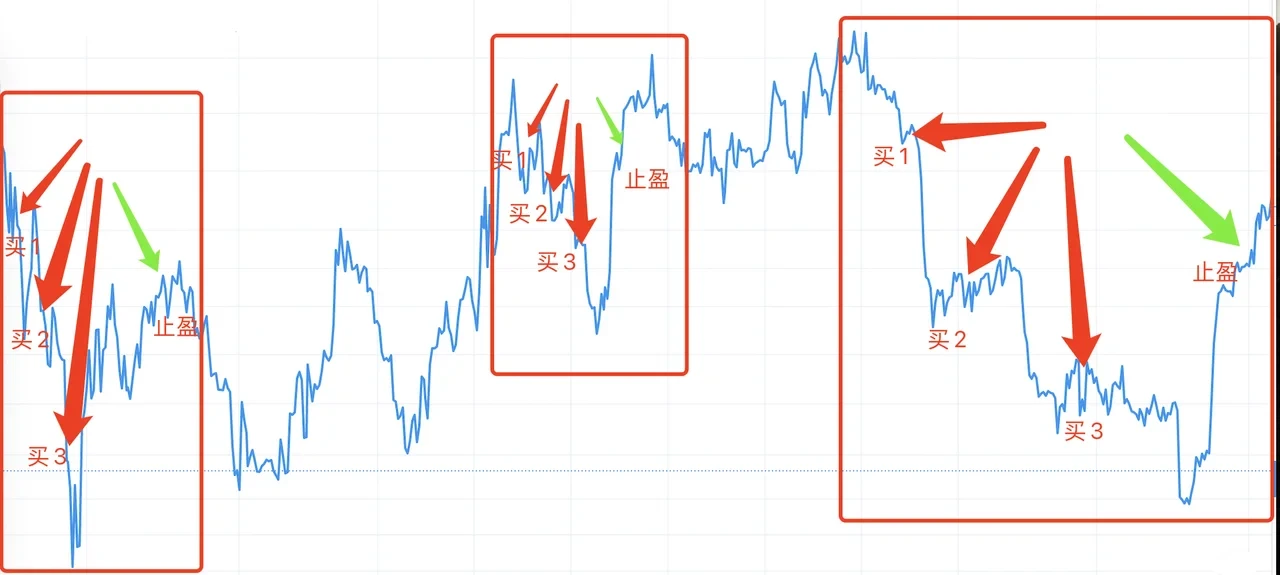
As the name implies, the initial order is the first buy order. Position-adding orders are subsequent buy orders. Their significance is to lower the average buy cost through batch buying within each trading cycle, helping investors achieve take-profit targets faster. From another perspective, position-adding orders are also a way to protect investors in falling price conditions.
The take-profit order is the sell order, which is the last order in this trading cycle. It should be noted that a trading cycle has at least one initial order and one take-profit order. The more position-adding orders that are executed, the lower the average buy cost within the trading cycle. The number of position-adding orders depends on the maximum number of position additions set by the user.
Besides the above concepts, the following two concepts are what users are more concerned about because they directly relate to the size of returns: single take-profit target and take-profit price.
Simply put, the single take-profit target is the return that users hope to earn within a trading cycle, expressed as a percentage, such as 10%. Assuming a user buys Bitcoin at $10,000, meaning the initial order is $10,000, and subsequently the coin price rises steadily with only the initial position and no additional position additions, then when the Bitcoin price rises 10% to reach $11,000, the take-profit price is reached and it automatically sells for profit.
If after buying, the coin price falls and triggers position-adding behavior, the average buy cost will be lowered, and the take-profit price will also dynamically adjust downward. As long as the 10% target is reached, it will automatically take profit.
The detailed calculation formula is: Take-profit price = Current cycle average holding cost × (1 + Single take-profit target).
Therefore, the Martingale strategy can help users complete the goal of dynamic take-profit, meaning based on users' expected targets, combined with real-time market trends, to complete selling for profit as soon as possible. It should be explained that when the system triggers the take-profit price, all unexecuted position-adding orders will be immediately canceled. After waiting for the take-profit order to be fully executed and sold, the current round's trading cycle immediately ends. At this point, based on the start conditions set by the user, it will directly immediately trigger entry into the next round, or wait for technical indicator signals to enter the next round.
4. Strategy Stop Loss:
In addition, opposite to the single take-profit target is the stop-loss target. When the price falls to the position that triggers the stop-loss target, it will automatically execute the sell, and the strategy will also immediately stop, achieving the goal of timely stop loss. The actual stop-loss price for each cycle is determined based on the execution price of the initial order, avoiding triggering the stop-loss price set during the early stage of strategy creation too early during violent market fluctuations.
The detailed calculation formula is: Stop-loss price = Current cycle initial order execution price × (1 – Stop-loss percentage).
5. Reserved Funds:
After the Martingale strategy is created, the default option for trading fund usage is to reserve sufficient funds in advance. After clicking Confirm, the buy funds required for all orders within the trading cycle will be pre-occupied. The funds prepared for trading will also be transferred from the main account to an independent strategy account. At this point, this portion of reserved funds can be considered locked and cannot be used for other purposes.
For advanced users, if the set position-adding price difference multiplier or position-adding amount multiplier is large, then the trigger prices for subsequent position-adding orders will be further from the limit price (that is, the expected price after decline), so the probability of automatic buy execution is smaller. Combined with the factor of large buy order amounts, the issue of large funds being occupied for a long time becomes more obvious. Therefore, for investors with higher requirements on fund utilization rates or those who set larger position-adding multipliers, they can optionally choose not to pre-lock. In this case, the Martingale strategy will only occupy the funds for the initial order and the first position-adding order, and traders can freely dispose of the remaining funds.
However, when subsequent market conditions show signs of falling and then bouncing, users who haven't reserved sufficient funds in advance may be unable to place orders due to insufficient funds, thereby missing bottom-diving opportunities. Therefore, for ordinary investors, it's recommended to choose to reserve sufficient funds in advance. This way, you can more fully leverage the advantages of the Martingale strategy and be more likely to achieve return maximization.
6. Trigger Conditions:
The trigger conditions for the Martingale strategy are divided into two types: immediate trigger and signal trigger.
Immediate trigger means that after traders choose to create the Martingale strategy, a new trading cycle begins immediately. The initial order will launch accordingly, and the subsequent position-adding orders set according to the parameters will also be completed one by one until the final sale.
Signal trigger means that after the strategy is created, the system uses the set technical indicators as signals. Once a definite signal appears, it can automatically buy. In other words, from strategy creation to the occurrence of the initial order, you need to wait for a signal to be issued before executing the first buy operation. This is the difference between signal trigger and immediate trigger.
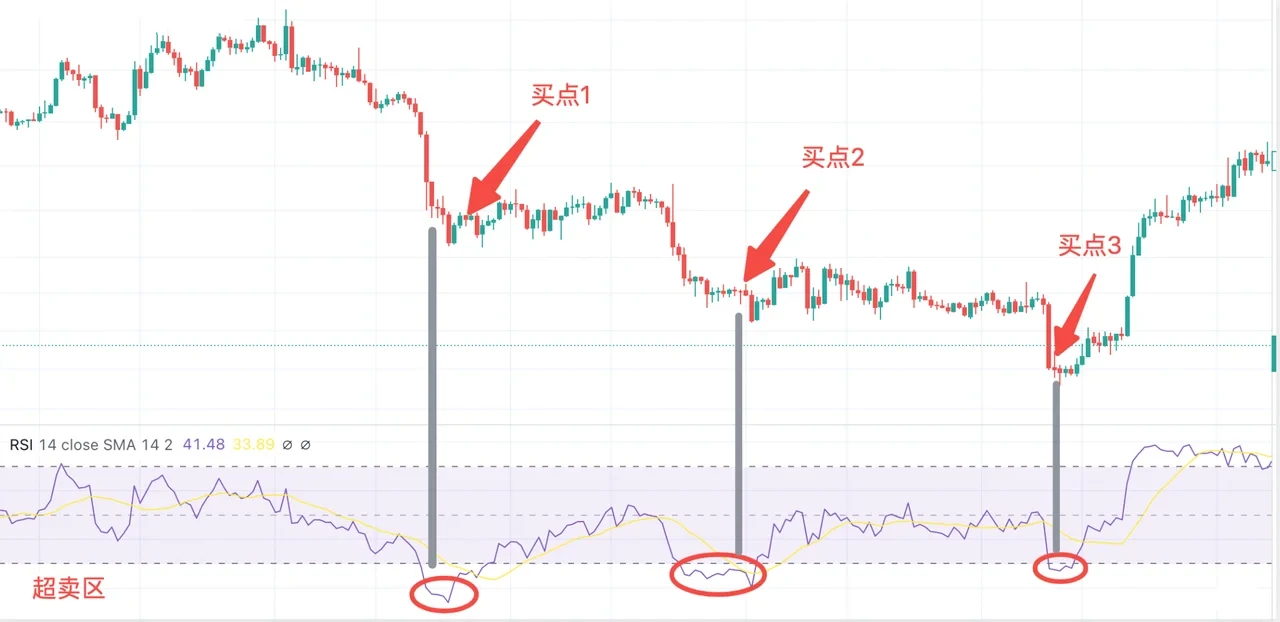
As a leading exchange, OKX is industry-leading in trading algorithm research and technical indicator research, and therefore can provide traders with higher accuracy buy signals. Among these, the RSI indicator is one of the most representative buy signal reference standards. Simply put, the RSI indicator can more precisely combine the location of oversold points with relevant market conditions, helping traders enter the market with one click to capture rebound movements and earn larger price differences.
After users select the signal trigger mode, the system will pop up an interface with oversold line and K-line period options at the bottom, as well as the number of triggers in the past period for reference.
Taking the oversold line as an example, when the asset price reaches the oversold zone formed by the oversold line – meaning the indicator's price continues to fall to a certain low point and selling power is basically exhausted – this is usually a signal indicating it's suitable for investors to build positions. If the user sets and selects the oversold line value as the signal, the strategy will execute after the oversold line reaches a certain point.
The K-line period represents the time span of the oversold line, making it convenient for users to capture position-building signals from multiple methods including short-term, medium-term, and medium-to-long-term.
Because this is comprehensively calculated by the system based on technical indicators and dynamic market conditions, compared to users' personal judgment, it has higher precision in capturing rebound movements.
3. Summary of Advantages and Precautions of OKX's Martingale Strategy
1. Advantages Summary:
(1) Accumulate at Low Positions, Precise Bottom Diving:
After selecting the Martingale strategy, traders can possibly perform accumulation operations during short-term declining market conditions. When the number of position-adding orders is larger, the average cost will be continuously lowered, and traders can take advantage of this to earn the entire amplitude of the rebound movement.
(2) Personalized Customization, Controllable Risk:
Traders can adjust various parameters of the Martingale strategy based on their own trading habits and risk preferences, such as single take-profit target, position-adding amount multiplier, etc., making risk controllable.
For ordinary traders, you can experience this strategy with a lower threshold. In smart creation mode, users can choose according to the types classified by the system, mainly the three types mentioned earlier: conservative, balanced, and aggressive, without having to struggle with entering various parameters from the start.
(3) Capture Oversold Conditions, Signal Trigger:
OKX's version of the Martingale strategy is the first among similar platforms to launch a truly Martingale strategy suitable for crypto space traders. Relying on the trading platform's powerful technical indicator research capabilities, through exclusive features such as start conditions and signal trigger, it can help users more precisely capture opportunities in rebound movements and achieve greater degrees of returns. In the future, OKX will continue to launch richer strategy trigger signals to meet investors' customized investment needs.
2. Precautions:
** (1) Non-Capital-Guarantee Attribute Notice: ** The Martingale strategy itself is not a capital-guarantee strategy. In extreme one-way declining markets, there still exists certain loss risk, which investors need to be clear about.
(2) Trading Account Risk Notice: After the strategy is created, the invested funds will be isolated from the trading account. Please pay attention to the position liquidation risk caused by asset changes in the trading account.
** (3) Abnormal Situation Notice: ** If during strategy operation, assets encounter unforeseeable abnormal situations such as trading suspension or delisting, the strategy will automatically stop.
** (4) Self-Borne Risk Notice: ** It's recommended that you carefully read the OKX Martingale Trading Product Instructions, reasonably assess your own risk tolerance, and make rational decisions.
4. Case Analysis:
Below is a practical example of the Martingale strategy, using the **BTC/USDT trading pair** as an example, divided into several steps in sequence**
1. Trigger Conditions:
Trigger Type: Immediate trigger
Position-Adding When Price Drops: 5.00%
Single Take-Profit Target: 10.00%
2. Investment Amount:
Initial Order Amount: 100 USDT
Position-Adding Order Amount: 200 USDT
Maximum Position-Adding Times: 4 times
3. Position-Adding Details (Advanced Parameters):
Position-Adding Price Difference Multiplier: 1.5x
Position-Adding Amount Multiplier: 2.0x
User Funds: 3,100 USDT
4. Strategy Operation
T0 – Initial Order Placement: When the strategy is created, the BTC/USDT price is: 20,000 USDT. The user selects the strategy start condition as immediate trigger, so the system will place a market order based on the initial order amount when the strategy is created. The order quantity is 100 USDT. At the same time, it will place the following as limit orders
Held Trading Currency Quantity: 100 / 20,000 = 0.005 BTC
Held Pricing Currency Quantity: 3,100 – 100 = 3,000 USDT
Average Holding Cost = 20,000 USDT
Current Trading Cycle Take-Profit Price = 20,000 × (1 + 10.00%) = 22,000 USDT
Position-Adding Order #1: Trigger price is 20,000 × (1 – 5%) = 19,000 USDT, order quantity is 200 USDT
Position-Adding Order #2: Trigger price is 20,000 × (1 – 5% – 5% × 1.5) = 17,500 USDT, order quantity is 200 × 2.0 = 400 USDT
Position-Adding Order #3: Trigger price is 20,000 × (1 – 5% – 5% × 1.5 – 5% × 1.5^2) = 15,250 USDT, order quantity is 200 × 2.0^2 = 800 USDT
Position-Adding Order #4: Trigger price is 20,000 × (1 – 5% – 5% × 1.5 – 5% × 1.5^2 – 5% × 1.5^3) = 11,875 USDT, order quantity is 200 × 2.0^3 = 1,600 USDT
T1 – Brief Price Decline: BTC/USDT price falls to 15,000 USDT. At this point, position-adding orders #1, #2, and #3 have all been fully executed, while position-adding order #4 has not been executed.
Held Trading Currency Quantity: 100 / 20,000 + 200 / 19,000 + 400 / 17,500 + 800 / 15,250 = 0.0908 BTC
Held Pricing Currency Quantity: 3,000 – 1,400 = 1,600 USDT
Average Holding Cost = (100 + 200 + 400 + 800) / 0.0908 = 16,512.10 USDT
Current Trading Cycle Take-Profit Price = 16,512.10 × (1 + 10.00%) = 18,163.31 USDT
T2 – Price Rebound: BTC/USDT price take-profit price 18,163.31 USDT. At this point, the take-profit price for this trading cycle has been reached, all positions will be sold and the current trading cycle ends
Held Trading Currency Quantity: 0 BTC
Held Pricing Currency Quantity: 1,600 + 18,163.31 × 0.0908 = 3249.23 USDT
Disclaimer
This article may contain product-related content not applicable to your region. This article is only intended to provide general information and does not assume responsibility for any factual errors or omissions contained herein. This article represents only the author's personal views and does not represent the views of OKX. This article is not intended to provide any of the following advice, including but not limited to: (i) investment advice or investment recommendations; (ii) offers or solicitations to purchase, sell, or hold digital assets; or (iii) financial, accounting, legal, or tax advice. Holding digital assets (including stablecoins) involves high risk, may fluctuate significantly, and even become worthless. You should carefully consider whether trading or holding digital assets is suitable for you based on your financial situation. For questions about your specific situation, please consult your legal/tax/investment professional. The information appearing in this article (including market data and statistics, if any) is for general reference only. Although we have taken all reasonable precautions in preparing these data and charts, we assume no responsibility for any factual errors or omissions expressed herein. © 2025 OKX. This article may be reproduced or distributed in full, or excerpts of 100 words or less from this article may be used, provided such use is non-commercial. Any reproduction or distribution of the entire article must also prominently state: "This article is copyrighted © 2025 OKX, used with permission." Permitted excerpts must cite the article name and include attribution, for example "Article Name, [Author Name (if applicable)], © 2025 OKX". Some content may be generated or assisted by artificial intelligence (AI) tools. Derivative works or other uses of this article are not permitted.
Show More
Recommended Reading

Quick Understanding of Spot Grid Strategy
### I. What is the Spot Grid Strategy? The spot grid
October 28, 2024

Futures Martingale: Leverage Supported, Two-Way Trading Enabled
DCA, short for Dollar Cost Averaging, is more commonly known in China as the Martingale strategy, which is frequently used in the foreign exchange market of traditional finance. If you're always worried about missing the bottom, or always missing opportunities to profit from catching pullbacks through short selling, then understanding and using the Martingale strategy will be of significant help to your investment in the crypto market. The basic principle of the Martingale strategy is
June 20, 2024

HODL Strategy Feature Upgrade: More Intelligent, User-Friendly, and Convenient Profit Tool
OKX's HODL strategy roughly
May 6, 2024

Strategy Tool Favored by Long-Term Traders – Fixed Investment
The fixed investment strategy is one of the most classic strategies in strategy trading. Simply understood, strategy trading is a tool that helps users perform automated trading, offering advantages such as lowering risk and simplifying operations compared to manual trading. The fixed investment strategy is a method of regular fixed-amount trading that disperses the risk of one-time market entry and smooths trading costs. By persisting in fixed-amount trading over the long term, it uses the effect of time compounding to achieve profit goals. OKX Spot Fixed Investment invests at fixed time cycles, investing
April 25, 2024

Quick Understanding of Futures Grid Strategy
### I. What is the Futures Grid Strategy? The futures grid strategy is
April 25, 2024