
Covered Call Strategy Explained
1. Definition:
In options trading, a covered call refers to a strategy where a trader buys an underlying asset while simultaneously selling the same quantity of call options on the same underlying asset. Typically, the trader sells at a higher price to generate profit, with the strike price set out of the money (OTM).
2,Profit Mechanism:
Traders executing this strategy generally expect the underlying asset price to rise, but not beyond the call option's strike price. However, if the trader's judgment is wrong and the underlying asset price falls, there is a risk of loss.
Nevertheless, because selling the call option generates premium income, the trader executing this strategy can still establish a long position in the asset at a discounted price.
If the underlying asset price remains stable or fluctuates slightly, the trader's returns are unaffected, as they can profit from both asset appreciation and option premiums. Once the asset price exceeds the option's strike price, the strategy holder's profit becomes capped.
For the seller executing this strategy, profit comes from situations where the asset price falls. In this case, the seller only needs to cover the cost of purchasing the call option, and can achieve unlimited profit. If the asset price rises, they face only limited downside risk and corresponding losses, as the returns generated by the call option hedge against losses from the underlying asset's price decline.
3,Trading Details:
This strategy is generally suitable for the early and tail phases of a bull market, not the peak. Assuming buying 1 unit of asset as leg 1, and selling 1 unit of call option as leg 2 (typically out of the money — OTM), then:
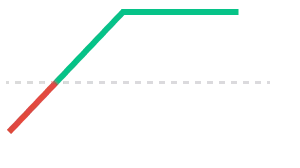
Maximum loss is unlimited, maximum profit is limited. As compensation for the limited profit, traders can participate in the market at a lower cost. The returns from selling the higher strike price call option reduce the overall strategy cost.
This strategy requires the following conditions:
1) Number of legs = 2, meaning this strategy has only 2 legs
2) Leg 1 trading instrument ≠ Leg 2 trading instrument, meaning one leg must be spot or an option, and the other leg must be the call option of that instrument
3) Leg 1 quantity = Leg 2 quantity, meaning the spot leg quantity = the call option notional quantity, and the option leg quantity = the call option quantity
4) Leg 1 trading direction ≠ Leg 2 trading direction, meaning legs 1 and 2 have opposite trading directions — one is buy, the other is sell
5) Both legs have the same underlying asset
Tip 1: Net Strategy Price
Long net strategy price = Leg 1 asset price (seller's quote) - Leg 2 call option premium (buyer's quote)
Short net strategy price = Leg 1 asset price (buyer's quote) - Leg 2 call option premium (seller's quote)
Tip 2: Margin Rules
Long: No additional margin requirement (long spot hedges losses from the short call)
Short: No additional margin requirement (long call option hedges maximum loss)
Tip 3: Returns Curve Chart
4. Specific Trading Examples:
Traders would execute the covered call strategy under the following circumstances:
They expect the spot price to rise slightly before expiration
Or the spot price may decline in the short to medium term but ultimately rise, in which case the trader temporarily sells call options to raise funds
Assuming the following specific operations —
Leg 1: Buy 1 Bitcoin at $50,000
Leg 2: Sell 1 Bitcoin call option for $6,000, with a strike price of $52,000 and expiration date of November 26, 2021
Total cost of this operation: $44,000
The corresponding profit and loss scenarios are as follows —
**Case 1: **Spot price drops significantly
Bitcoin expiration price = $42,000
Leg 1 returns: $42,000 – $50,000 = -$8,000
Leg 2 returns: Option premium = $6,000
Total returns: $6,000 – $8,000 = – $2,000
**Note: **Leg 1 spot price has declined, and leg 2 option expires out of the money (OTM). The strategy buyer's loss in spot trading is diluted by the returns from selling the option.
**Case 2: **Spot price drops slightly
Bitcoin expiration price = $47,000
Leg 1 returns: $47,000 – $50,000 = -$3,000
Leg 2 returns: Option premium = $6,000
Total returns: $6,000 – $3,000 = $3,000
The user's loss in spot trading is less than the option premium income, so total returns are positive
**Case 3: **Spot price rises slightly
Bitcoin expiration price = $51,000
Leg 1 returns: $51,000 – $50,000 = $1,000
Leg 2 returns: Call premium = $6,000
Total returns: $6,000 + $1,000 = $7,000
The user generates returns from both spot and options trading
**Case 4: **Spot price rises significantly
Bitcoin spot price on option expiration date = $60,000
Leg 1 returns: $60,000 – $50,000 = $10,000
Leg 2 returns: Option premium – (spot price – strike price) = $6,000 – ($60,000 – $52,000) = -$2,000
Total returns: -$2,000 + $10,000 = $8,000
On the option expiration date, if the spot price exceeds the strike price of $52,000, the total returns are $8,000. Therefore, this strategy has a maximum returns cap. In our example, returns cannot exceed $8,000.
Disclaimer
This article may contain product-related content that does not apply to your region. This article is intended solely to provide general information and makes no responsibility for any factual errors or omissions. This article represents the author's personal views only and does not constitute the views of OKX. This article is not intended to provide any advice, including but not limited to: (i) investment advice or investment recommendations; (ii) offers or solicitations to buy, sell, or hold digital assets; or (iii) financial, accounting, legal, or tax advice. Holding digital assets (including stablecoins) involves high risk and may be subject to significant volatility, or may even become worthless. You should carefully consider whether trading or holding digital assets is suitable for you based on your financial situation. For questions specific to your circumstances, please consult your legal/tax/investment professional. The information contained in this article (including market data and statistical information, if any) is provided for general reference purposes only. While we have taken all reasonable precautions in preparing such data and charts, we accept no responsibility for any factual errors or omissions expressed herein. © 2025 OKX. This article may be reproduced or distributed in its entirety, or excerpted in portions of 100 words or less, provided that such use is non-commercial. Any reproduction or distribution of the full article must prominently state: "This article is copyrighted © 2025 OKX, used with permission." Permitted excerpts must cite the article title and include attribution, for example "Article Title, [Author Name (if applicable)], © 2025 OKX". Some content may be generated or assisted by artificial intelligence (AI) tools. Derivative works and other uses of this article are not permitted.
Show More
Recommended Reading

Bull Call Spread Strategy Explained
1. Definition: The bull call spread options trading strategy refers to a strategy where a trader buys a call option at a lower strike price and sells a call option at a higher strike price in the options market. 2. Profit Mechanism: For the buyer, executing this strategy means buying at a lower strike price and selling at a higher strike price, generating profit in the form of the price difference. Of course, maximum profit is capped by the higher strike price. Generally, traders
April 25, 2024

Bear Put Spread Strategy Explained
1. Definition: The bear put spread strategy refers to a strategy where a buyer anticipates a moderate to significant decline in the underlying asset's price and reduces the holding cost of the corresponding option product. 2. Profit Mechanism: The spread is created by buying a put option while simultaneously selling a put option on the same underlying asset with a lower strike price, same expiration date, and same quantity. The maximum profit generated by this strategy equals the difference between the two strike prices
April 25, 2024

Futures Spread Strategy
1. Definition: The futures spread trading strategy refers to a strategy where a trader simultaneously buys and sells two related futures contracts in futures trading. For example, a trader buys a BTC/USD contract expiring in September and sells a BTC/USD contract expiring in December. This is a market-neutral strategy. Simply put, executing this strategy means the trader is capturing the spread between the two contracts. 2. Profit Mechanism: This is straightforward — compared to the previous strategies
April 25, 2024

Collar Trading Strategy
1. Definition: The collar strategy is a strategy in options trading that involves purchasing a put option contract while simultaneously selling an out-of-the-money (OTM) call option contract, where both contracts have equal quantities and the put option's strike price is lower than the call option's strike price. Typically, traders using the collar strategy already hold a long or short position in an underlying asset, and executing this strategy protects the position's returns and hedges risk.
April 25, 2024

Butterfly Strategy Explained
1. Definition: The butterfly strategy is a common options trading strategy, named for the shape of its profit and loss diagram resembling a butterfly. The butterfly strategy is generally suitable for markets with low volatility. Specifically, when an investor combines micro and macro factors and comprehensively judges that significant price movements are unlikely, the butterfly strategy is relatively an ideal choice. 2. Strategy Details: Based on contract type, buying the butterfly strategy can be divided into buying a bull call butterfly strategy and buying a bear put butterfly strategy
April 25, 2024

Strangle Arbitrage Trading Strategy
1. Definition: The strangle trading strategy refers to a strategy where a trader buys a put option at a lower price level and buys a call option at a higher price range on the same underlying asset in the options market. 2. Profit Mechanism: Both parties in the trade can be divided into buyers and sellers, each executing opposite operations. The profit logic of this strategy is largely similar to the long straddle arbitrage strategy. That is, during actual trading, if the buyer executes this strategy, regardless of which direction the underlying price moves
April 25, 2024