
Butterfly Strategy Explained
1. Definition:
The butterfly strategy is a common options Trading strategy, named for the shape of its profit/loss diagram, which resembles a butterfly. The butterfly strategy is generally used when the market is expected to experience low volatility. More precisely, when investors combine micro and macro factors to determine that significant price movements are unlikely in the near term, the butterfly strategy is a relatively ideal choice.
2. Strategy Details:
Depending on the contract type, buying butterfly strategies can be divided into long call butterfly strategies and long put butterfly strategies.
A long call butterfly strategy consists of buying one call option with a lower strike price, buying one call option with a higher strike price, and simultaneously selling two call options at the middle strike price.
A long put butterfly strategy consists of buying one put option with a lower strike price, buying one put option with a higher strike price, and simultaneously selling two put options at the middle strike price.
Both the returns and risk of this strategy are limited. If the underlying asset price remains relatively unchanged from the time of buying or selling until expiration, there is a relatively high probability of profitability.
A butterfly strategy consists of 4 options: 1 lower strike price option, 2 middle strike price options, and 1 higher strike price option. In other words, executing a butterfly strategy requires at least 3 strike prices and 4 contracts. All four options must have the same type, underlying asset, and expiration date, and the price spacing between the lower, middle, and higher strike prices must also be identical.
How to select strike prices is relatively important, as the butterfly strategy is best suited for scenarios where the buyer expects the underlying asset price to oscillate within a narrow range. The judgment of the short-term highest and lowest prices of the underlying asset determines the spacing between the lower, middle, and higher strike prices in the butterfly strategy. The wider the spacing, the higher the maximum profit at expiration, but also the lower the maximum loss at expiration. The spread of the butterfly strategy is mainly affected by three factors: expiration price, market volatility, and time to expiration.
The butterfly strategy is a neutral strategy. From the buyer's perspective, they expect future market volatility to be very low, and if the underlying asset price remains unchanged before the options expire, the returns will be maximized. While the buyer faces limited risk, there is also a cap on profits. The seller's perspective is the opposite — the seller loses in low volatility and profits in high volatility, with maximum returns being the net premium received.
3. Trading Details:
Executing this strategy requires the following conditions:
1) Tip 1: Regarding the number of legs
A total of 3 legs, including 1 lower strike price option, 1 higher strike price option, and 2 middle strike price options (accounted as 1 leg).
The long call butterfly strategy includes: buying 1 in-the-money (ITM) call option (lower strike price), buying 1 out-of-the-money (OTM) call option (higher strike price), and selling 2 at-the-money (ATM) call options (middle strike price).
The long put butterfly strategy includes: buying 1 out-of-the-money (OTM) put option (lower strike price), buying 1 in-the-money (ITM) put option (higher strike price), and selling 2 at-the-money (ATM) put options (middle strike price).
2) Tip 2: Regarding the relationships between legs
1, Number of legs = 3, meaning each butterfly strategy must have exactly 3 legs
2, Leg 1 option type = Leg 2 option type = Leg 3 option type, meaning all legs must belong to the same option type, either all calls or all puts
3, Leg 1 expiration date = Leg 2 expiration date = Leg 3 expiration date, meaning all options must have the same expiration date
4, Leg 1 quantity = Leg 3 quantity, Leg 2 quantity = 2 * Leg 1 quantity = 2 * Leg 3 quantity, meaning Leg 1 and Leg 3 must have the same quantity, and Leg 2 quantity is double that. In other words, Leg 2 quantity must be an even number, and the total contract quantity must be a multiple of 4
5, Leg 1 strike price ≠ Leg 2 strike price ≠ Leg 3 strike price, meaning all legs must have different strike prices
6, Leg 1 buy/sell direction = Leg 3 buy/sell direction ≠ Leg 2 buy/sell direction, meaning Leg 1 and Leg 3 must have the same buy/sell direction, and Leg 2 must have the opposite direction
7, Leg 1 underlying = Leg 2 underlying = Leg 3 underlying
3) Regarding the net strategy price:
1, Buyer: Leg 1 premium (seller's quote) - 2 * Leg 2 premium (buyer's quote) + Leg 3 premium (seller's quote)
2, Seller: Leg 1 premium (buyer's quote) - 2 * Leg 2 premium (seller's quote) + Leg 3 premium (buyer's quote)
4) Regarding trading intentions:
1, Buyer:
Maximum returns have a cap. When the underlying asset price at expiration equals the Leg 2 strike price, maximum returns are achieved.
Maximum loss has a cap. When the underlying asset price at expiration falls below Leg 1 strike price or rises above Leg 3 strike price, maximum loss is incurred.
2, Seller:
Maximum returns have a cap. When the underlying asset price at expiration falls below Leg 1 strike price or rises above Leg 3 strike price, maximum returns are achieved.
Maximum loss has a cap. When the underlying asset price at expiration equals the Leg 2 strike price, maximum loss is incurred.
5) Regarding margin rules:
1, Buyer: Must meet the initial margin and maintenance margin rate requirements for selling call or put options (Leg 2)
2, Seller: Must meet the initial margin and maintenance margin rate requirements for selling call or put options (Leg 1 and Leg 3)
Note: Margin requirements may be reduced under portfolio margin mode
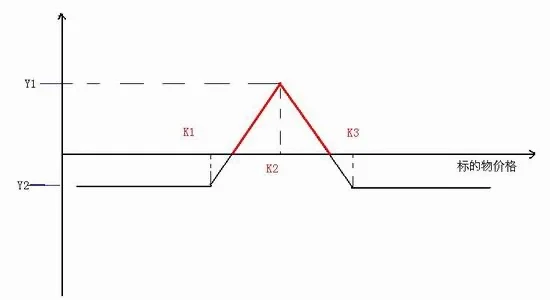
Returns curve chart (Long)
4. Specific Trading Examples:
Assume we buy both long call and long put butterfly strategies, with trading details as follows:
1) Call Options:
Leg 1 (+1): Buy BTCUSD-20221126-C-50,000
Leg 2 (-2): Sell BTCUSD-20221126-C-55,000
Leg 3 (+1): Buy BTCUSD-20221126-C-60,000
Leg 1 price: 20.14
Leg 2 price: 3.5
Leg 3 price: 0.06
Total strategy value: 0.06 – 7 + 20.14 = 13.2
2) Put Options:
Leg 1 (+1): Buy BTCUSD-20221126-P-50,000
Leg 2 (-2): Sell BTCUSD-20221126-P-55,000
Leg 3 (+1): Buy BTCUSD-20221126-P-60,000
Leg 1 price: 0.01
Leg 2 price: 3.35
Leg 3 price: 19.85
Total strategy value: 19.86 – 6.7 + 0.01 = 13.17
For the buyer, the following three possible trading scenarios may occur:
Scenario 1 – The expiration price is below Leg 1 strike price:
BTC price at expiration = 49,000
Calls:
All legs expire out of the money; the buyer loses the premiums paid for Leg 1 and Leg 3, but retains the premium income from Leg 2
Puts:
All legs expire in the money; the buyer profits from Leg 1 and Leg 3, and pays for losses from Leg 2, calculated as:
(Leg 1 strike price – expiration price) * Leg 1 quantity – (Leg 2 strike price – expiration price) * Leg 2 quantity + (Leg 3 strike price – expiration price) * Leg 3 quantity
Scenario 2 – The expiration price is between Leg 1 and Leg 3 strike prices:
BTC price at expiration = 56,000
Calls:
At expiration, Leg 1 and Leg 2 are in the money, and Leg 3 is out of the money. Buyer's returns: (expiration price – Leg 1 strike price) * Leg 1 quantity – (expiration price – Leg 2 strike price) * Leg 2 quantity
Puts:
At expiration, Leg 3 is in the money, and Leg 1 and Leg 2 are out of the money. Buyer's returns: (Leg 3 strike price – expiration price) * Leg 3 quantity
Scenario 3 – The expiration price is above Leg 3 strike price:
BTC price at expiration = 61,000
Calls:
All legs expire in the money; the buyer profits from Leg 2 and pays for losses from Leg 1 and Leg 3:
(expiration price – Leg 1 strike price) * Leg 1 quantity – (expiration price – Leg 2 strike price) * Leg 2 quantity + (expiration price – Leg 3 strike price) * Leg 3 quantity
Puts:
All legs expire out of the money at expiration; the buyer loses the premiums paid for Leg 1 and Leg 3, but retains the premium income from Leg 2
Disclaimer
This article may contain product-related content that does not apply to your region. This article is dedicated to providing general information only and does not accept responsibility for any factual errors or omissions contained herein. This article represents the author's personal views only and does not represent the views of OKX. This article is not intended to provide any advice, including but not limited to: (i) investment advice or investment recommendations; (ii) offers or solicitations to buy, sell, or hold digital assets; or (iii) financial, accounting, legal, or tax advice. Holding digital assets (including stablecoins) involves a high level of risk, may fluctuate significantly, or may even become worthless. You should carefully consider whether Trading or holding digital assets is appropriate for you based on your financial situation. For questions specific to your circumstances, please consult your legal/tax/investment professionals. The information contained in this article (including market data and statistical information, where applicable) is for general reference purposes only. While all reasonable precautions have been taken in the preparation of such data and charts, we assume no responsibility for any factual errors or omissions expressed herein. © 2025 OKX. This article may be reproduced or distributed in its entirety, and excerpts of 100 words or less may be used, provided that such use is for non-commercial purposes. Any reproduction or distribution of the full article must prominently state: "This article is copyrighted © 2025 OKX, used with permission." Permitted excerpts must cite the article title and include attribution, for example, "Article title, [author name (if applicable)], © 2025 OKX". Some content may be generated or assisted by artificial intelligence (AI) tools. Derivative works and other uses of this article are not permitted.
Show More
Recommended Reading

Bull Call Spread Strategy Explained
1. Definition: The long bull call spread trading strategy refers to an investor buying a call option at a lower strike price and selling a call option at a higher strike price in the options trading market. 2. Profit method: For buyers, following this strategy means buying at the lower strike price and selling at the higher strike price to earn the price difference as returns. Of course, the maximum returns are also capped by the higher strike price. Generally, trading
April 25, 2024

Bear Put Spread Strategy Explained
1. Definition: The bear put spread strategy refers to a buyer's action in the options trading market to reduce the holding cost of corresponding option products when they anticipate the underlying asset price will fall moderately or significantly. 2. Profit method: The spread of this strategy is achieved by buying a put option while simultaneously selling a put option on the same underlying asset with a lower strike price, same expiration date, and same quantity. The maximum profit generated by this strategy equals the difference between the two strike prices
April 25, 2024

Protective Put Strategy Explained
1. Definition: The protective put strategy is an options trading strategy. As the name suggests, this is a trading strategy with risk-hedging characteristics. Specifically, this strategy involves the trader buying 1 unit of the underlying asset while also purchasing 1 put option on that asset, with the aim of providing downside protection for the purchased asset. 2. Strategy details: The protective put strategy is typically used when the buyer expects the price of a purchased spot asset to rise
April 25, 2024

Contract Spread Strategy
1. Definition: The contract spread trading strategy refers to a trader simultaneously buying and selling two related contracts in contract trading. For example, a trader buys a BTC/USD contract expiring in September while selling a BTC/USD contract expiring in December. This is a market-neutral strategy. Simply put, executing this strategy involves the trader profiting from the spread between the two contracts. 2. Profit method: It is easy to understand that, compared to the previous strategies
April 25, 2024

Collar Trading Strategy
1. Definition: The collar strategy is a strategy in options trading that involves purchasing one put option contract while simultaneously selling one out-of-the-money (OTM) call option contract, where both contracts have equal quantities and the put option's strike price is lower than the call option's strike price. Typically, traders using the collar strategy already hold a long or short position in an underlying asset, and executing this strategy can protect the position returns of the underlying asset and hedge risk.
April 25, 2024

Strangle Arbitrage Trading Strategy
1. Definition: The strangle strategy refers to a trader in the options trading market buying a put option at a lower price level and buying a call option on the same underlying asset within a higher price range. 2. Profit method: Trading parties can be divided into buyers and sellers, each executing opposite operations. The profit logic of this strategy is roughly similar to that of the long straddle strategy. That is, during actual trading, if a buyer executes this strategy, regardless of which direction the underlying price moves
April 25, 2024