
Contract Martingale Strategy: Leveraged Trading with Two-Way Trading
DCA, short for Dollar Cost Averaging, is more commonly known as the Martingale strategy in the Chinese market, and is frequently used in the foreign exchange market within traditional finance.
If you always worry about missing the bottom, or consistently miss opportunities to profit from shorting during pullbacks, then understanding and using the Martingale strategy will be of significant help with your cryptocurrency investments.
The fundamental principle of the Martingale strategy is as follows: in a bilateral market where you can go long or short, you fundamentally bet on only one direction. If the trade goes against you, you continuously add to the position in the opposite direction until the market pulls back, allowing you to profit from buying at the low and selling at the high. Currently, the Martingale strategy has been widely adopted by various types of investors thanks to a range of advantages. However, given the risks inherent in the market, this strategy cannot guarantee principal protection—investors should exercise risk control.
As user needs become increasingly diverse, OKX has officially launched a cryptocurrency contract trading version of the Martingale strategy. OKX's contract Martingale strategy supports two-way trading, meaning both going long and going short can be used to buy the dip or capture pullback profits. Additionally, the contract Martingale strategy allows customizable leverage and cycle-based profit-taking, providing traders with more trading opportunities and flexibility.
Whether you are a regular investor or a seasoned one, the upgraded Martingale strategy on OKX enables you to find an operating mode that suits your trading style, achieving automated execution without the need to constantly monitor the markets. Below, we will provide a detailed introduction to the Martingale strategy.
➡ Contract Martingale Strategy Quick Access
1. Introduction to the Martingale Strategy
Before diving deep into the Martingale strategy, it may help to understand DCA first. Dollar-cost averaging refers to the practice of investors purchasing assets at regular intervals regardless of market conditions. This approach is widely used by conservative retail investors and financial institutions seeking steady returns.
In general, the average cost per unit under a complete DCA cycle tends to be lower than the cost of a single lump-sum purchase, which expands the overall return potential. Additionally, compared to the risk of a sharp crash that could occur after a one-time full position purchase, batch-buying through DCA disperses the risk of a single catastrophic event, effectively protecting traders' interests.
Compared to DCA, which involves buying a fixed amount of cryptocurrency at set intervals, the Martingale strategy offers greater flexibility in cost control. This is because the Martingale strategy involves purchasing at fixed percentage price drops during one or more market cycles. When the market reverses and reaches an appropriate sell point, the Martingale strategy automatically executes the sell order. In range-bound or highly volatile markets, this strategy delivers relatively steadier overall returns with manageable risk.
It is important to note that Martingale is suitable for most market conditions except for unidirectional trending markets, particularly medium-to-long-term range-bound markets.
Taking long trading as an example: in a medium-to-long-term range-bound market, the Martingale strategy will continuously buy, executing a pattern akin to swing-based dip-buying. Traders can also choose to multiply the buy amount to better capture opportunities during brief downturns, then sell all at once when the market rebounds for a profit.
For instance, an investor using the Martingale strategy might buy the first order (initial order) when Bitcoin is at $10,000, buy the second order (DCA order) when the price drops 1% to $9,900, buy the third order at $9,801, and so on—continuously lowering the overall average buy-in cost.
If the Bitcoin price rises and reaches the take-profit price set by the strategy, the system will automatically execute the sell, completing one trading cycle. It is important to note that the take-profit price dynamically adjusts based on the take-profit target.
Before activating the strategy, investors need to set a take-profit percentage based on their personal expectations—that is, the profit margin they aim to achieve.
The higher the price at which an investor expects to sell, the longer the strategy cycle may be, meaning it will take more time to sell. For example, in the scenario above, if an investor sets a 10% take-profit target, the take-profit price will dynamically adjust based on the average buy-in cost after multiple orders are placed. Once the return rate reaches 10%, the system will immediately execute the automatic sell and conclude the trading cycle.
This simple example involves several key concepts: trading cycle, initial order, DCA order, and dynamic take-profit, which will be detailed below. Most of these concepts represent core differentiating advantages of OKX's contract Martingale strategy compared to other similar platforms.
2. OKX Contract Martingale Strategy Details
OKX's contract Martingale strategy (hereinafter referred to as "the strategy") builds upon the traditional version's approach with further optimization tailored to the habits and characteristics of cryptocurrency users. While ensuring a quality user experience, the strategy is dedicated to helping investors maximize returns. Below, by outlining the essential elements of OKX's contract Martingale strategy, we will provide a more intuitive explanation of how the Martingale strategy operates.
1. Creation Mode:
-
Manual creation allows traders to set parameters based on their personal market analysis. This is primarily suitable for experienced traders with strong capital resources. Ordinary users are advised to use the Smart Creation mode.
-
Smart Creation enables users to set investment amounts and buy-in rhythms by selecting system-recommended parameters based on their risk tolerance. It should be noted that the system-recommended parameters are calculated using OKX's backend algorithm, synthesized from historical market data and asset volatility, offering a considerable degree of authority and providing traders with reliable investment references. Additionally, drawing on the practice of categorizing traders used in traditional securities investing, the Smart Creation mode classifies users into different tiers based on their asset status and risk tolerance—conservative, balanced, and aggressive—in order to manage risk as effectively as possible, recommending parameters with varying risk levels to each group.

For conservative investors, the primary consideration is capital preservation rather than returns, and their risk tolerance is relatively low. Therefore, conservative strategy parameter settings involve fewer buy orders, wider price gaps between each buy operation, and a more cautious trading approach. This can hedge against the impact of extreme market conditions and is more suitable for beginners trying the strategy for the first time.
For aggressive investors, risk tolerance is generally stronger, they are more willing to take risks, and their asset base tends to be more substantial. Therefore, aggressive strategy parameter settings involve more buy orders, narrower price gaps between each buy operation, and a higher frequency of buys. The trading approach is more aggressive, aiming to continuously earn multi-round profits through high-frequency trading, accumulating small gains over time for sustained profitability. This is more suitable for experienced users with high trading frequency.
For balanced investors, they typically neither dislike risk nor seek it, and are rational about all investments. Therefore, the risk preference and aggressiveness of the balanced strategy parameters fall somewhere between the two aforementioned types, with relatively moderate performance.
2. Trading Direction, Leverage Ratio, Trading Cycle, and Cycle Profit:
Within a contract trading cycle, it is necessary to first clarify the concepts and parameter settings for trading direction, leverage ratio, and cycle profit targets.
Trading Direction (Long/Short)
- Long trading direction: For long contract DCA bots, the bot first purchases cryptocurrency via the initial order and DCA orders (if applicable, as the price continues to drop), and sells them when the price rises and reaches the take-profit target.
- Short trading direction: For short contract DCA bots, it first sells cryptocurrency via the initial order and DCA orders (if applicable, as the price continues to rise), and repurchases cryptocurrency at a lower price when the profit target is reached.
Leverage Ratio
- This leverage ratio applies to both the initial order and DCA orders. In other words, users cannot specify different leverage ratios for each order within a contract DCA strategy.
- Currently, the contract Martingale strategy supports up to 100x leverage (subject to specific trading pairs and tier brackets). High-leverage contracts are suitable for high-risk speculative investors.
Trading Cycle and Profit Per Cycle
A trading cycle refers to the process from buying to selling in a single trade. In contract Martingale, a trading cycle consists of the initial order, DCA orders, and the take-profit order.
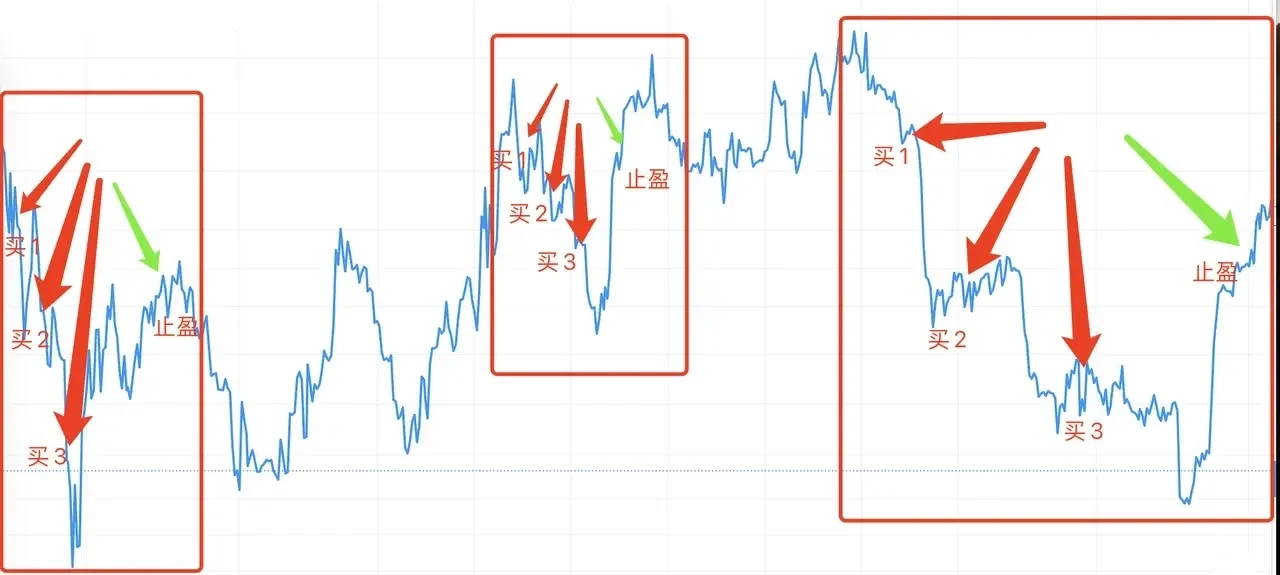
The initial order is the first buy order placed. DCA orders are used when going long/short—price drops/rises are met with batch purchases to lower the average buy-in cost, helping investors reach their take-profit target more quickly within the trading cycle. From another perspective, DCA orders are also a protective mechanism for investors in a declining market.
The take-profit order is the sell order, and is the final order in a trading cycle. It should be noted that a trading cycle must include at least one initial order and one take-profit order. The more DCA orders that are filled, the lower the average buy-in cost within the trading cycle.
The profit an investor earns within a trading cycle is called Take-Profit per Cycle (TPLMT).
In the contract Martingale strategy, when a user is in an active trading cycle and configuring strategy parameters, they can specify the profit per cycle as a percentage in the settings panel.
Beyond the concepts above, there are two concepts that users tend to pay more attention to, as they directly affect the size of returns: single take-profit target and take-profit price.
Simply put, the single take-profit target is the return an investor aims to earn within a trading cycle, expressed as a percentage (e.g., 10%). Assuming an investor buys Bitcoin at $10,000—the initial order is $10,000—and the price subsequently rises steadily with only the initial position and no additional orders, then when Bitcoin rises 10% to $11,000, the take-profit price is reached and the order is automatically sold for a profit.
If the price drops after buying, triggering a DCA order, the average buy-in cost will decrease, and the take-profit price will also dynamically adjust downward. The system will automatically take profit once the 10% target is reached.
The detailed calculation formula is:
When going long:
Take-profit price = Current cycle average position cost × (1 + Single take-profit target).
When going short:
Take-profit price = Current cycle average position cost × (1 - Single take-profit target).
Therefore, the Martingale strategy helps users achieve the goal of dynamic take-profit—executing sell orders for profit as quickly as possible, based on user-set expectations combined with real-time market movements. It should be noted that when the system triggers the take-profit price, all unfilled DCA orders will be immediately cancelled. After the take-profit order is fully filled and the sell is complete, that trading cycle ends immediately. At this point, based on the start conditions set by the user, the next cycle will either begin immediately or wait for a technical indicator signal to start.
4. Strategy Stop-Loss:
Additionally, a stop-loss target must be set when using the Martingale strategy. When the average cost falls to the stop-loss trigger level, the system will automatically sell and close the position according to the user's selected stop-loss mode (market/limit), and the strategy will immediately stop, achieving the purpose of timely loss-cutting.
The detailed calculation formula is:
When going long:
Stop-loss price = Current cycle initial order fill price × (1 – Stop-loss percentage).
When going short:
Stop-loss price = Current cycle initial order fill price × (1 + Stop-loss percentage).
5. Trigger Conditions:
The trigger condition for the contract Martingale strategy is immediate trigger.
Immediate trigger initiates a new trading cycle immediately after the trader selects to create a Martingale strategy. The initial order will start immediately, and subsequent DCA orders will be filled sequentially according to the set parameters, until the final sell is executed.
3. OKX Contract Martingale Strategy Advantages and Precautions
1. Advantages Summary:
(1) Two-Way Trading, Profitable in Both Bull and Bear Markets After selecting the contract Martingale strategy, traders can profit from buying the dip or capturing pullbacks through both going long and going short.
(2) Customizable, Controllable Risk Traders can adjust various parameters of the Martingale strategy—such as single take-profit targets and DCA amount multipliers—based on their own trading habits and risk tolerance, keeping risk under control.
For ordinary traders, this strategy can be accessed at a lower barrier. In Smart Creation mode, users can select from the system-defined types, primarily the three categories mentioned above: conservative, balanced, and aggressive, sparing them from the hassle of having to configure all kinds of parameters right from the start.
(3) Leveraged Trading, Amplified Returns OKX's contract Martingale strategy supports up to 100x leverage, allowing traders to use low capital to control larger funds, catering to traders with varying risk preferences.
2. Precautions:
- Market prices fluctuate significantly. If the price continues to move in the opposite direction, the held position may incur floating losses or even face liquidation risk. Therefore, it is recommended to set a reasonable stop-loss price based on market analysis when creating the strategy, so as to cut losses in a timely manner.
- Funds invested after creating a contract Martingale strategy will be isolated from the trading account and used exclusively within the contract Martingale strategy. Therefore, users should monitor the risk that the transferred funds may bring to the overall positions in the trading account.
- If the trading pair encounters trading halts, delisting, or other unforeseeable abnormal situations during the operation of the contract Martingale strategy, the strategy will automatically stop.
- If insufficient available margin causes a margin shortfall after creating a contract Martingale strategy, DCA orders will be cancelled to cover the margin fees, and no new DCA orders will be generated for that cycle of the strategy.
- If a position carries excessive risk and faces liquidation risk after creating a contract Martingale strategy, the system will cancel orders to reduce position risk, which may result in a risk-control stop.
Disclaimer
This article may contain product-related content not applicable to your region. This article is intended to provide general information only and makes no responsibility for any factual errors or omissions herein. This article represents the author's personal views only and does not constitute the views of OKX. This article is not intended to provide any advice, including but not limited to: (i) investment advice or investment recommendations; (ii) offers or solicitations to buy, sell, or hold digital assets; or (iii) financial, accounting, legal, or tax advice. Holding digital assets (including stablecoins) involves a high degree of risk and may fluctuate significantly, or even become worthless. You should carefully consider whether trading or holding digital assets is appropriate for you based on your financial situation. For questions specific to your circumstances, please consult your legal/tax/investment professional. The information contained in this article (including market data and statistical information, if any) is for general reference purposes only. Although all reasonable precautions have been taken in preparing this data and these charts, we assume no responsibility for any factual errors or omissions expressed herein. © 2025 OKX. This article may be reproduced or distributed in its entirety, or excerpts of 100 words or less may be used, provided that such use is non-commercial in nature. Any reproduction or distribution of the full article must prominently state: "This article is copyrighted © 2025 OKX, used with permission." Permitted excerpts must cite the article name and include the source, for example "Article name, [author name (if applicable)], © 2025 OKX". Some content may have been generated or assisted by artificial intelligence (AI) tools. Derivative works and other uses of this article are not permitted.
Show More
Recommended Reading

Quick Guide to Spot Grid Strategy
### 一. What是现货网格策略? 现货网
2024年10月28日

Coin-Accumulation Strategy Upgrade: A Smarter, More User-Friendly, and Convenient Profit Tool
OKXOKX屯币宝策略大致
2024年5月6日

DCA—A Strategy Tool Favored by Long-Term Traders
DCA is one of the most classic strategies in strategy trading. Put simply, strategy trading is a tool that helps users execute automated trades, offering advantages over manual trading such as risk reduction and simplified operations. DCA is a method of investing fixed amounts at regular intervals, dispersing the risk of a lump-sum market entry and smoothing trading costs. Through consistent fixed-amount investing over time, the compounding effect of time is leveraged to achieve profitability. OKX spot DCA invests a fixed amount at set time intervals.
2024年4月25日

The Martingale Strategy—A Universal Tool for Dip-Buyers
DC
2024年4月25日

Quick Guide to Contract Grid Strategy
一. What是合约网格策略? 合约网格策略是
2024年4月25日