OKX Upgrades Iceberg Strategy: A Smarter and More User-Friendly Large Order Splitting Trading Tool
For institutional investors or investors with large fund volumes, executing large orders presents numerous trading challenges, such as triggering market follow-up, driving up or suppressing market prices, thereby increasing trading costs. Alternatively, after trading intentions are exposed, revealing fund strength makes it easy for counterparties to target, putting trading in a passive position. Therefore, splitting large orders into multiple batches for market placement has become the primary method for large-scale trading.
The iceberg order strategy is precisely such a strategy that splits large orders and places them in batches. When users execute large-scale trading, to avoid causing excessive market impact, the system automatically splits large orders into multiple smaller orders. Therefore, it also features characteristics like hiding trading intentions and reducing slippage, becoming one of the preferred strategies for large-scale trading users in the market.
OKX has always supported the iceberg order strategy and recently performed a comprehensive upgrade, making it smarter and more user-friendly. This article will introduce you in detail to OKX's new iceberg strategy.
Introduction to OKX's New Iceberg Strategy
How Does the Iceberg Strategy Work?
How does the iceberg strategy split large orders? Based on the current best bid/best ask price and user-configured order placement preferences, it determines order placement positions, then automatically executes small order placements for trading. When orders are fully executed or price levels change, it automatically re-submits orders, thereby completing the buy or sell operation for large orders.
In short, like an iceberg, only a small portion visible on the water surface—orders displayed on the order book—won't expose trading intentions, won't significantly impact market prices, and won't cause substantial price slippage. Hidden positions, after displayed positions are executed, automatically surface to place orders in the market. This ensures low trading costs while successfully completing large order execution.

OKX Upgrades Iceberg Strategy - Iceberg png
What Did OKX's New Iceberg Strategy Upgrade?
"Dynamic order placement" is the biggest feature of OKX's new iceberg strategy.
Using buying as an example, traditional iceberg strategies typically use the best bid price minus a fixed price spread/ratio as the order price for placing small buy orders. When the price distance from the best bid price to that order exceeds the price spread, the system automatically cancels and re-submits the order, with new orders based on user order placement preferences combined with price levels.
OKX's new iceberg strategy employs a more dynamic and flexible order placement method. Rather than simply relying on price spreads or ratios for order placement, it calculates based on real-time dynamic prices like the order book's best bid, second best bid, best ask, second best ask, and places orders according to these calculations. This order placement method can significantly reduce slippage and achieve better concealment of trading intentions.
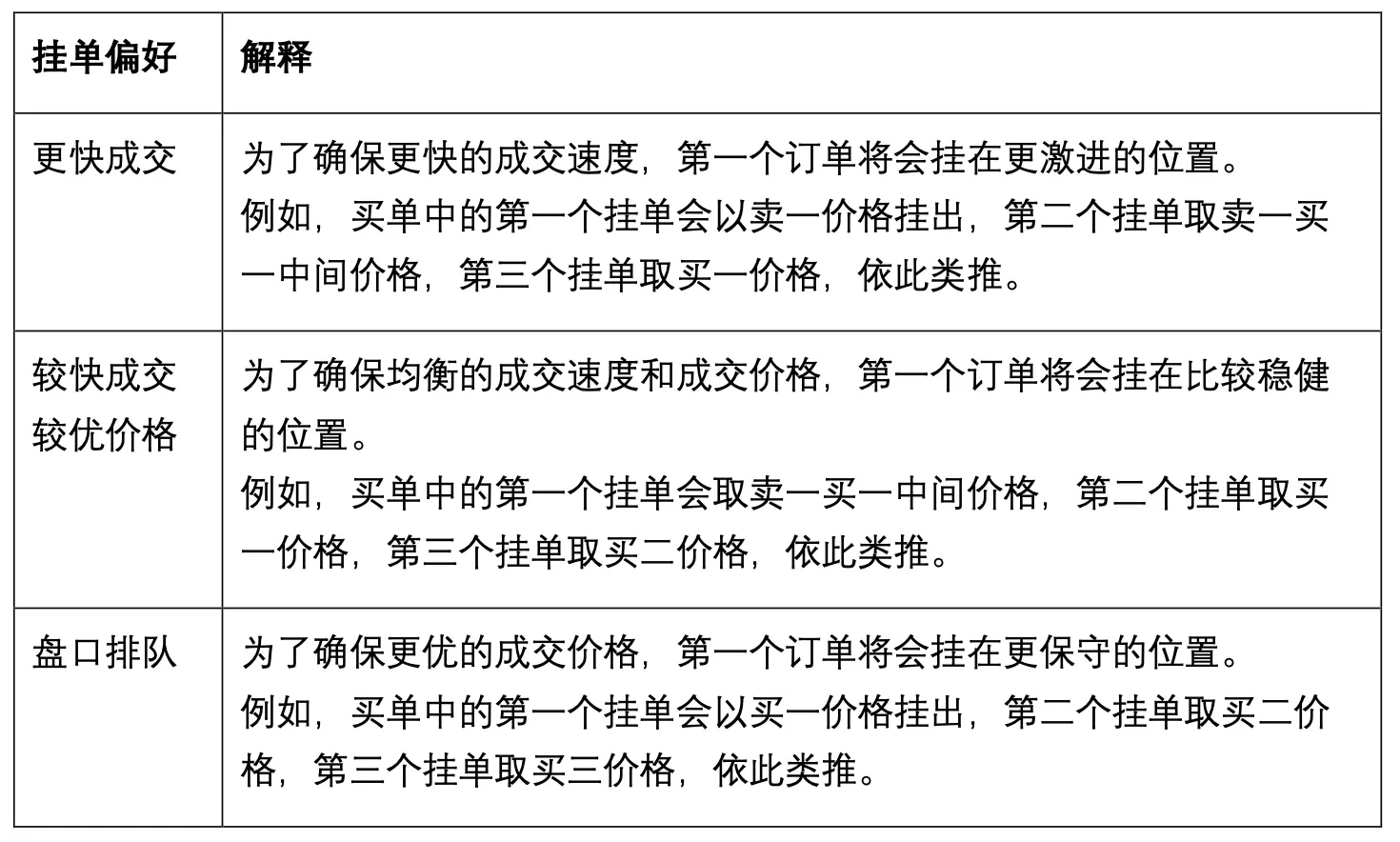
Additionally, OKX's new iceberg strategy provides multiple order placement methods, including three modes: faster execution, balanced execution speed, and better price. Users can select based on their preferences and needs.
Therefore, OKX's new iceberg strategy has these advantages: large order splitting, hidden trading, reduced slippage, customizable order placement preferences.
Terminology:
Price spread, ratio: Price spread means the price difference between each order's order price and the latest best bid/best ask price is a fixed value; ratio means the price difference between each order's order price and the latest best bid/best ask price is a fixed percentage change.
Order limit price: When buying/selling, the acceptable highest/lowest price. When buying, if the market's latest transaction price is higher than the order limit price, order placement pauses; when selling, if the market's latest transaction price is lower than the order limit price, order placement pauses.
OKX New Iceberg Strategy Trading Parameters Introduction
OKX's new iceberg strategy includes basic order placement parameters and advanced setting parameters
- Single order amount
Using a buy order as an example, when the latest transaction price is lower than the order limit price, small buy orders will be placed based on user-selected order placement preferences. Single order amount is the quantity of each order on the order book (the system will multiply by a random number between 0.5-1)
2. Number of orders per placement
The system dynamically adjusts to maintain the number of orders on the order book that the user wishes to maintain using the iceberg strategy's total order amount
3. Order placement preference
When placing orders, users can select from three order placement modes: faster execution, balanced execution speed, and better price
OKX Upgrades Iceberg Strategy - png1
4. Order limit price
If you are buying assets, when the pair's market price is below this price, the strategy begins placing small buy orders according to order placement preference settings. When market price is above the order limit price, the strategy pauses until price falls back.
If you are selling assets, when the pair's market price is above this price, the strategy begins placing small sell orders according to order placement preference settings. When market price is below the order limit price, the strategy pauses until price rises again.
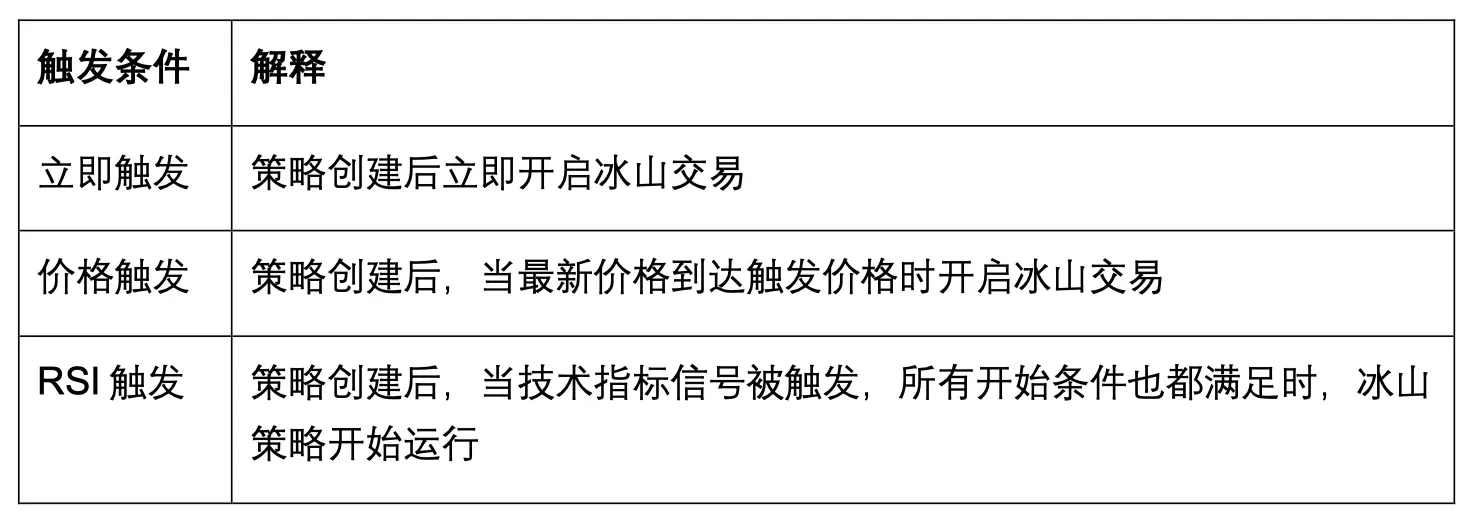
5. Start condition
The trigger condition type for starting the strategy, including "trigger immediately", "price trigger", and "RSI-14 trigger"
OKX Upgrades Iceberg Strategy - png2
How to Use OKX's New Iceberg Strategy
One, Enter OKX's New Iceberg Strategy
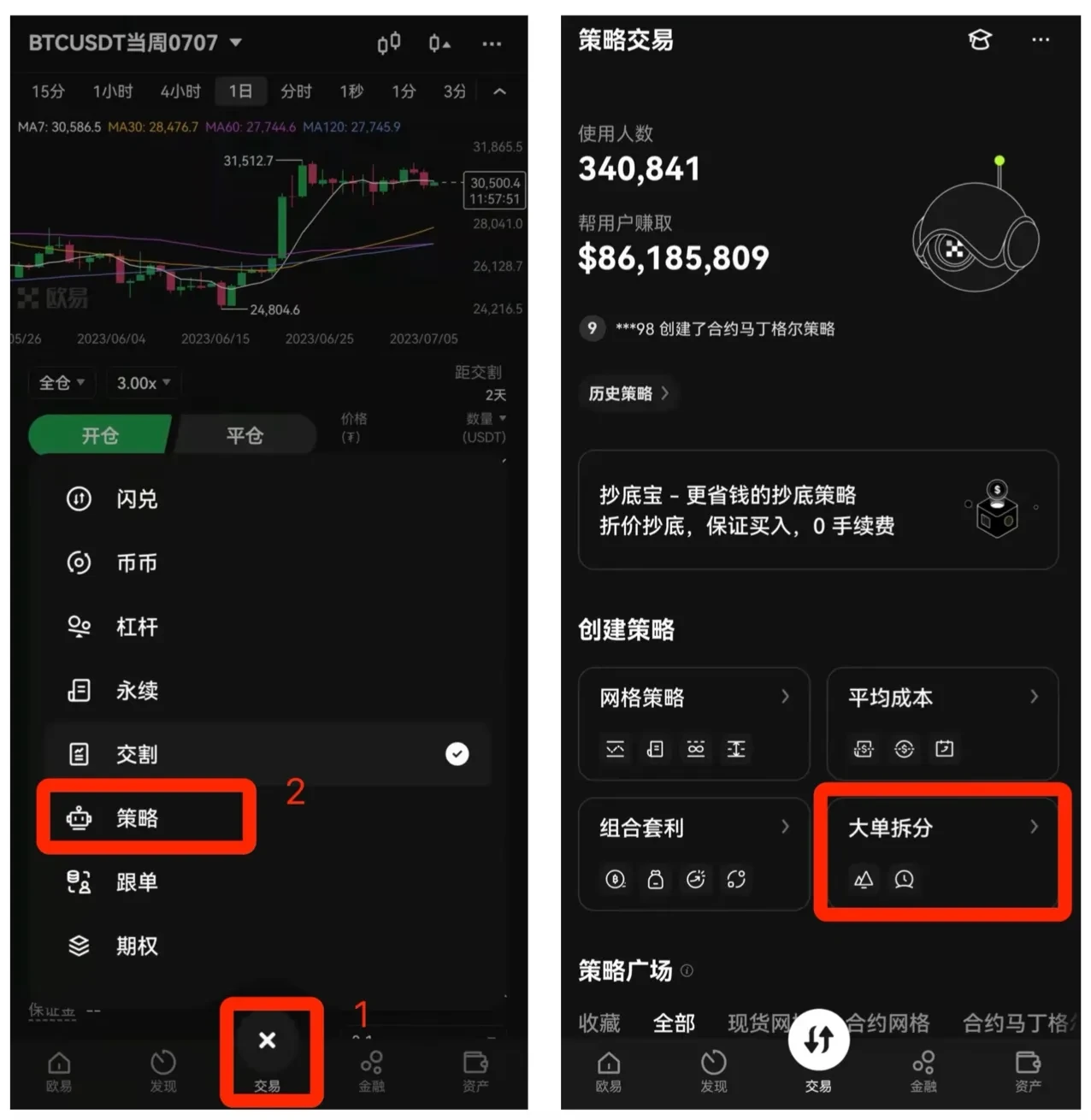
1) App Interface
Open the OKX APP, select the trading button at the bottom of the page, and click strategy to enter the strategy page. Click create strategy under large order splitting, and select iceberg strategy to enter the OKX new iceberg strategy page
OKX Upgrades Iceberg Strategy - png3
2) Web Interface
Open the OKX webpage, hover your mouse over the trading button in the navigation bar, select create strategy under strategy trading in the dropdown menu, then select iceberg strategy
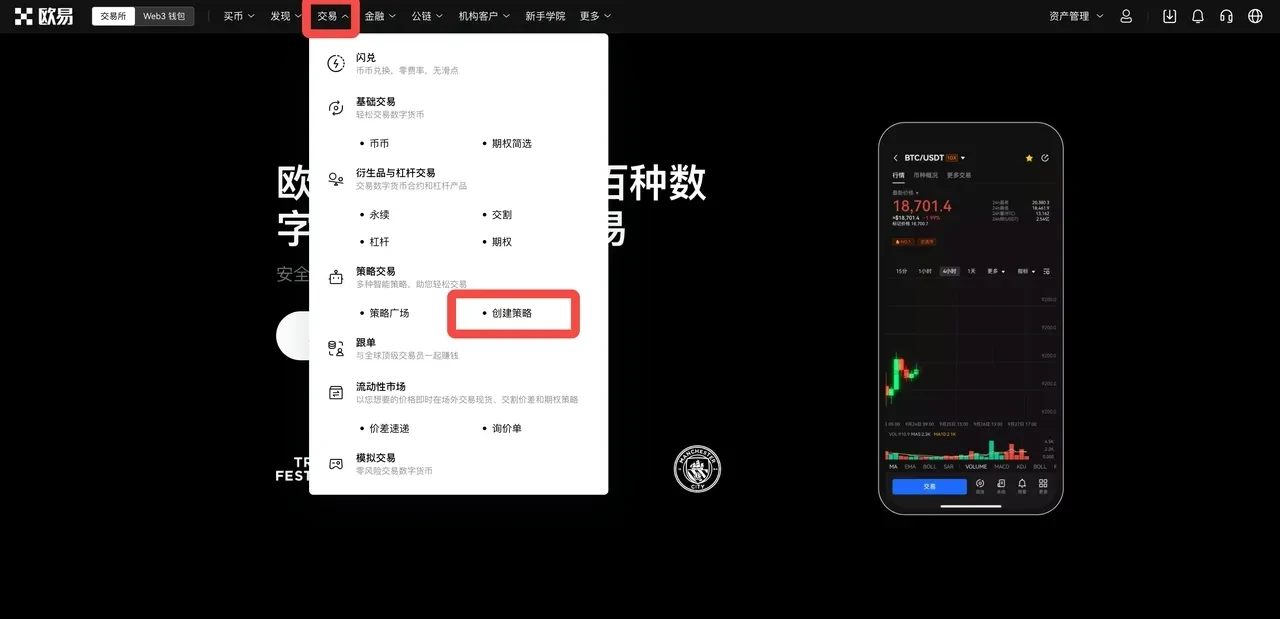
OKX Upgrades Iceberg Strategy - png4
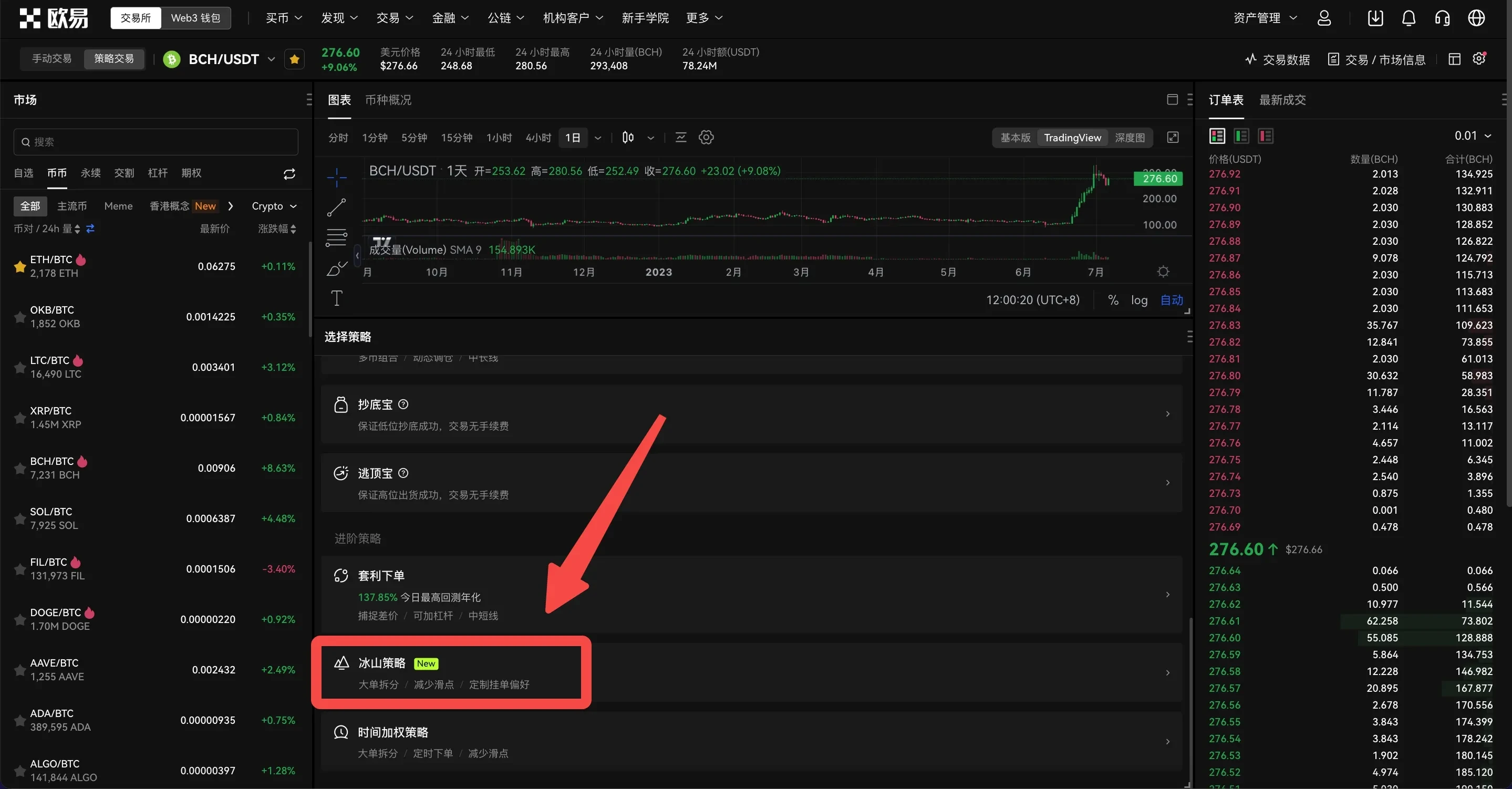
OKX Upgrades Iceberg Strategy - png5
Two, Using OKX's New Iceberg Strategy for Orders
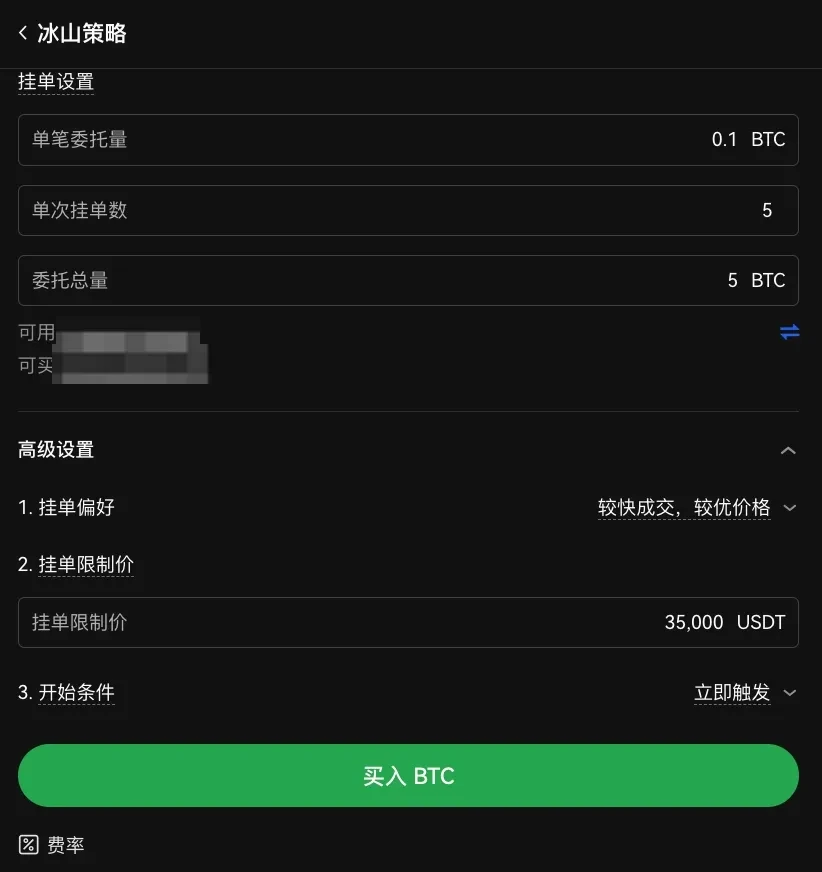
Example: A user wants to use the iceberg strategy to buy a total of 5 BTC when BTC is below 35,000 USDT, then can make the following settings and place buy orders
-
Set single order quantity to 0.1
-
Set number of orders per placement to 5
-
Set total order amount to 5 BTC
-
Set order placement preference to faster execution, better price
-
Set order limit price to 35,000 USDT
-
Set start condition to trigger immediately
OKX Upgrades Iceberg Strategy - png6
Since the start condition is trigger immediately, after placing the order, the system will immediately execute the strategy
-
Distribute and maintain 5 orders displayed on the order book
-
The first limit buy order will be placed at the midpoint between the best bid and best ask prices
-
The second limit buy order will be placed at the best bid price, the third at the second best bid, and so on
-
Each order is 0.1 BTC (multiplied by random number)
-
If price exceeds 35000, strategy pauses
-
If order is fully executed, place new limit orders based on latest price levels
-
If price changes cause price level changes, cancel original limit orders and place new limit orders based on latest order book
Disclaimer
This article may contain content about products that are not applicable in your region. This article is intended only to provide general information and is not responsible for any factual errors or omissions therein. This article represents only the author's personal views and does not represent OKX's views. This article is not intended to provide any of the following advice, including but not limited to: (i) investment advice or investment recommendations; (ii) offers or solicitations to buy, sell, or hold digital assets; or (iii) financial, accounting, legal, or tax advice. Holding digital assets (including stablecoins) involves high risk and may fluctuate significantly, even becoming worthless. You should carefully consider based on your own financial situation whether trading or holding digital assets is suitable for you. For questions about your specific situation, please consult your legal/tax/investment professional. Information appearing in this article (including market data and statistics, if any) is for general reference only. Although we have taken all reasonable care in preparing these data and charts, we assume no responsibility for any factual errors or omissions expressed herein. © 2025 OKX. This article may be reproduced or distributed in full, and excerpts of 100 words or less from this article may be used, provided such use is non-commercial. Any reproduction or distribution of the entire article must prominently state: "Copyright © 2025 OKX, used with permission." Permitted excerpts must cite the article title and include attribution, such as "Article Title, [Author Name (if applicable)], © 2025 OKX". Some content may be generated or assisted by artificial intelligence (AI) tools. Derivative works or other uses of this article are not permitted.
Show More
Introduction to OKX's New Iceberg Strategy
How to Use OKX's New Iceberg Strategy
Recommended Reading

Quickly Understand Arbitrage Order Strategy
One. What is arbitrage? Arb
February 27, 2025

Quickly Understand Time-Weighted Strategy
One. What is time-weighted strategy?
April 25, 2024

What Strategy is Most Secure for Large Trading in Highly Volatile Crypto Markets?
The volatility and risk of crypto markets need no further elaboration. Among these, large-scale buy and sell operations executed by whale wallets directly disturb the market, causing short-term surges and crashes, which is also one of the important sources of risk in crypto markets. However, the above scenario may be temporarily too distant for novice users, but novice users who don't want to become large players will never be able to make money in the market. Since we want to become large players, let's examine how large players execute related operations
April 25, 2024