9. Strategic Trading Series — Arbitrage Orders
Introduction:
Why does arbitrage trading exist?
From a market perspective, when the market experiences irrational volatility, prices may deviate from normal levels. Arbitrage funds joining the trading will promote faster price recovery to normal levels. During the process from anomaly to normalization, arbitrage funds can earn low-risk profits.
From a user trading perspective, in regular trading, once the market moves in the expected direction, you can earn excess returns. However, predicting market movements is extremely difficult. Once the market moves in the opposite direction to your expectation, losses will occur. Perpetual contract traders may even face liquidation risk. Users with large fund sizes or low risk tolerance cannot afford significant net value fluctuations caused by digital asset price volatility. They can use extremely low-risk arbitrage trading strategies to profit during periods of irrational market volatility.
Today, we will learn about arbitrage trading strategies.
1. What is Arbitrage Trading?
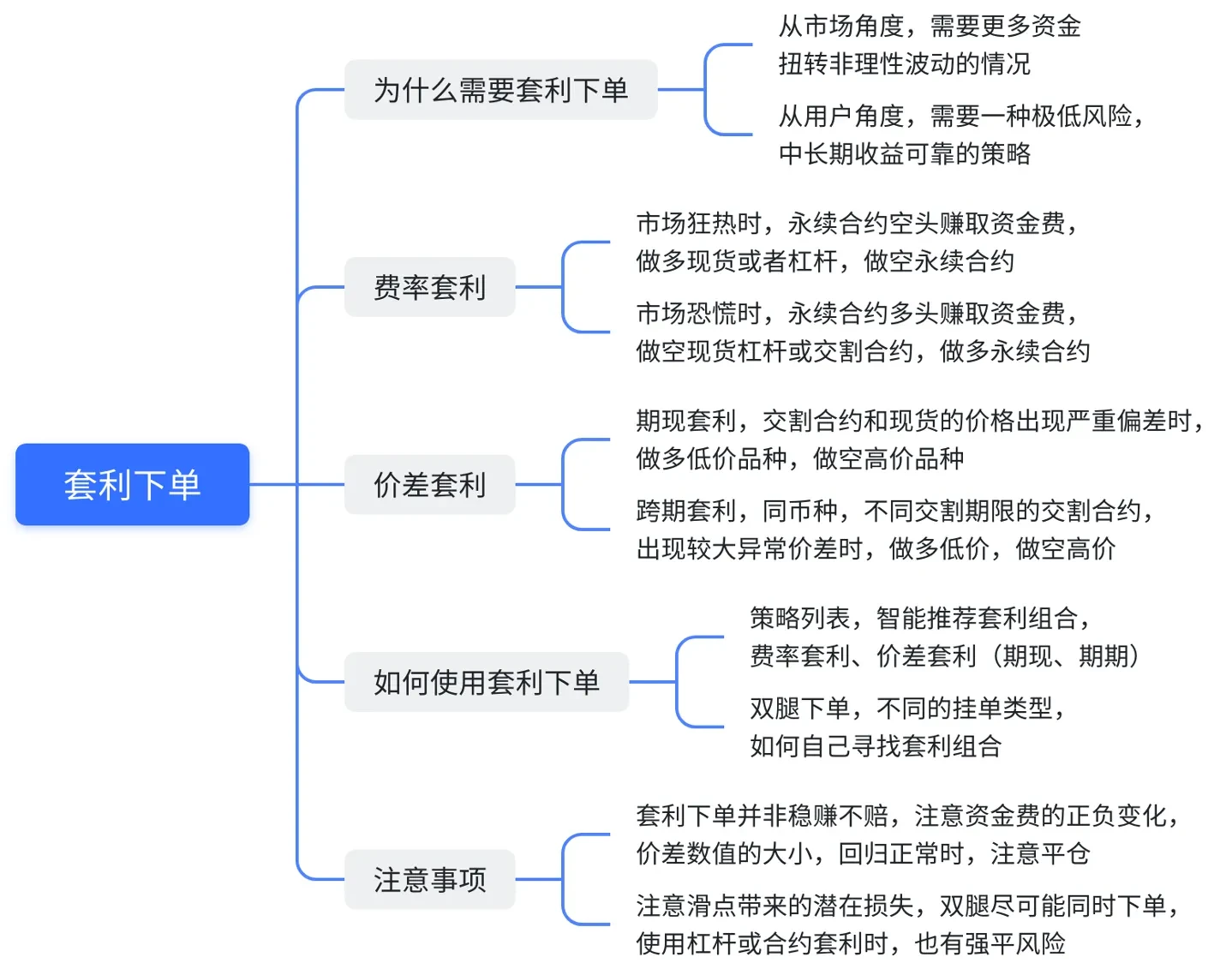
In traditional finance, we often hear terms like arbitrage and hedging. What do these mean? OKX's arbitrage trading strategy allows users to simultaneously observe two markets in real time during arbitrage trading and place orders on both sides. The goal is for both orders to be filled as close in time as possible, capturing funding fees or price spreads. It includes two main categories: funding rate arbitrage and spread arbitrage.
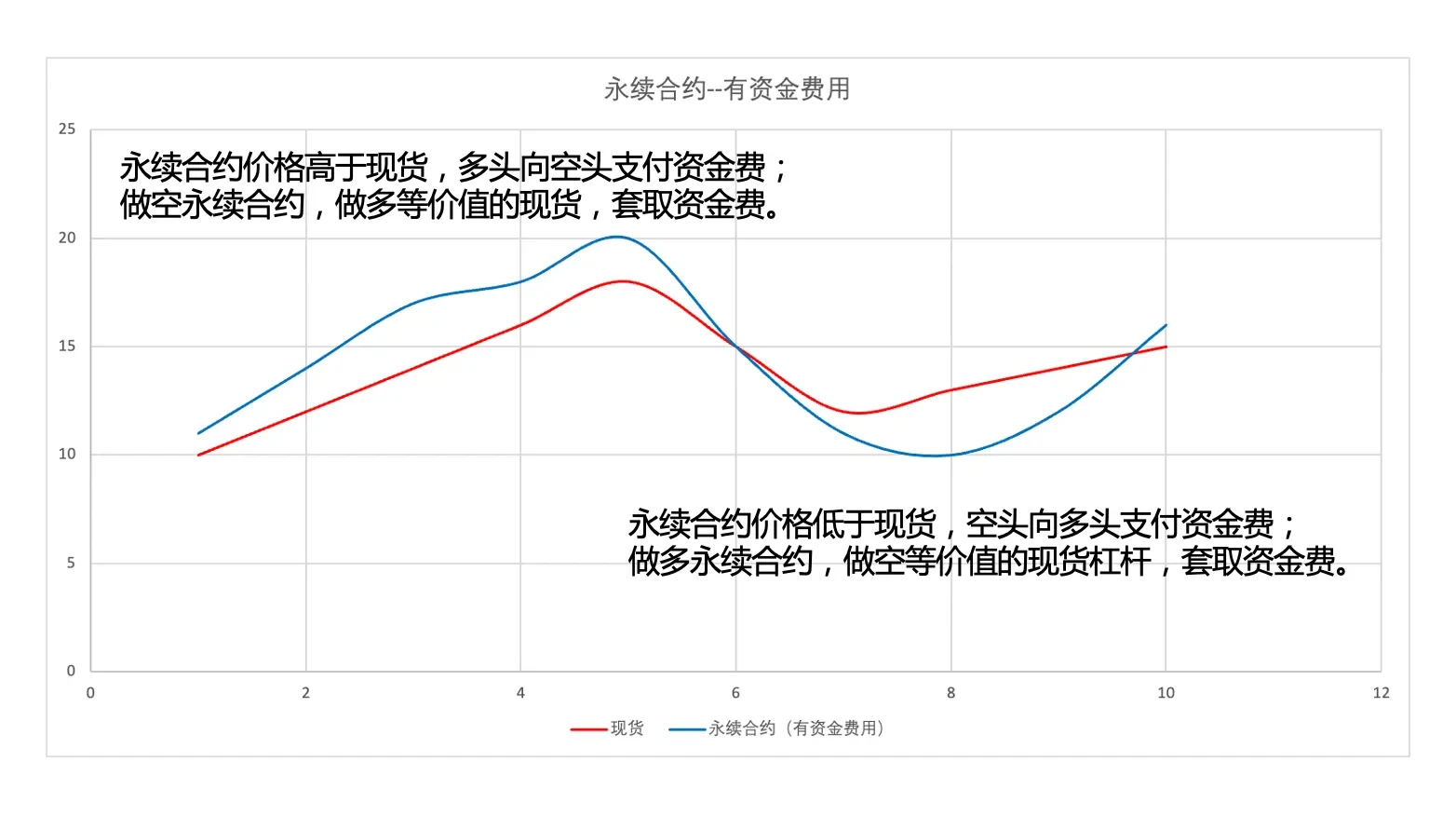
Markets can sometimes be irrational. For example, during a bull market when coins surge, many users enter long positions, even if they have to pay high funding fees on perpetual contracts. This presents an opportunity for users to earn funding fees. However, opening one-directional contract positions exposes you to significant price volatility risk. If you simultaneously hold an opposite-position spot or futures contract, you can avoid net value fluctuations caused by price changes while earning funding fees. This is one form of funding rate arbitrage.
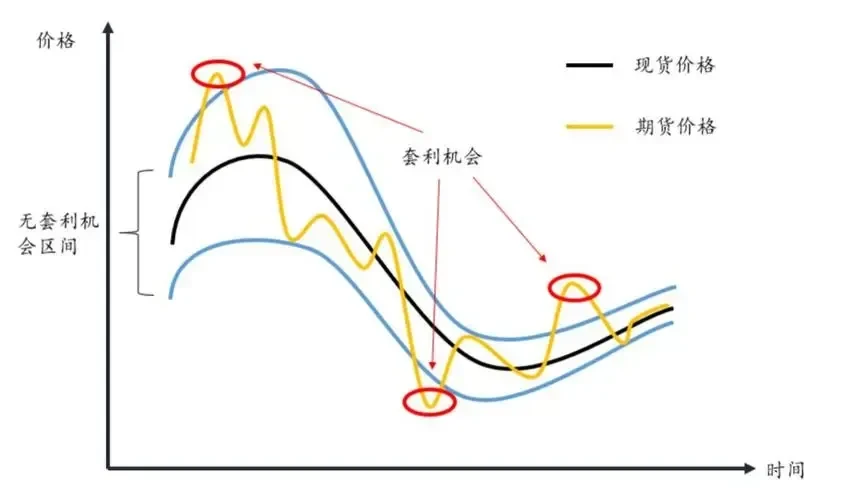
In traditional financial markets, arbitrage is also conducted when abnormal price spreads appear between different months or different commodities. For example, during a major bull market, the price of far-dated contracts may rise more significantly, causing the spread between near-term and far-term contracts of the same asset to abnormally widen. By simultaneously buying the relatively lower-priced near-term contract and selling the relatively higher-priced far-term contract, you can profit when the spread returns to normal levels. This is one form of spread arbitrage.
2. Funding Rate Arbitrage
Perpetual contracts use funding fees as a correction mechanism to balance long and short positions, keeping the contract price anchored to the spot price. By executing two opposite-direction trades with equal position values and offsetting profit and loss in spot and perpetual contracts simultaneously, you can earn funding fee returns from perpetual contract trading with minimal net value change. Funding fee rules: Funding fee = Position value × Funding rate (Funding fees are collected 3 times daily)
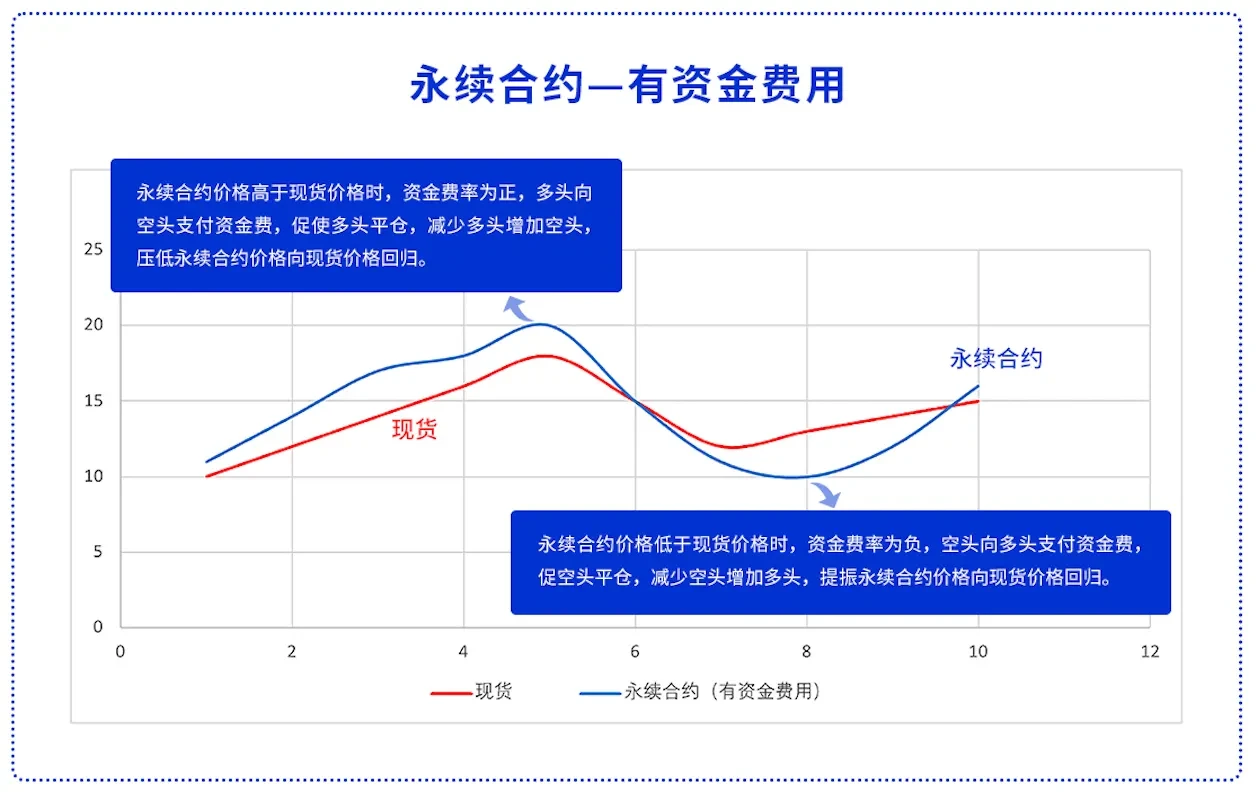
When the perpetual contract price is higher than the spot price, the funding rate is positive. Long positions pay funding fees to short positions, encouraging longs to close and reducing longs while increasing shorts, pushing the perpetual contract price down toward the spot price. This situation often occurs during relatively optimistic market sentiment. At this time, shorting perpetual contracts can earn funding fees. You can use the arbitrage combination of "buy spot — short perpetual contract." By simultaneously executing two opposite-direction trades with equal quantities and offsetting profit and loss, you can avoid price volatility risk while earning funding fee returns.
When the perpetual contract price is lower than the spot price, the funding rate is negative. Short positions pay funding fees to long positions, encouraging shorts to close and reducing shorts while increasing longs, lifting the perpetual contract price toward the spot price. This situation often occurs during relatively低迷 market sentiment. At this time, going long on perpetual contracts can earn funding fees. You need the arbitrage combination of "short spot — long perpetual contract." Since spot trading cannot be directly shorted, you need to introduce leverage or futures contracts. By simultaneously executing two opposite-direction trades with equal quantities and offsetting profit and loss, you can earn funding fee returns.
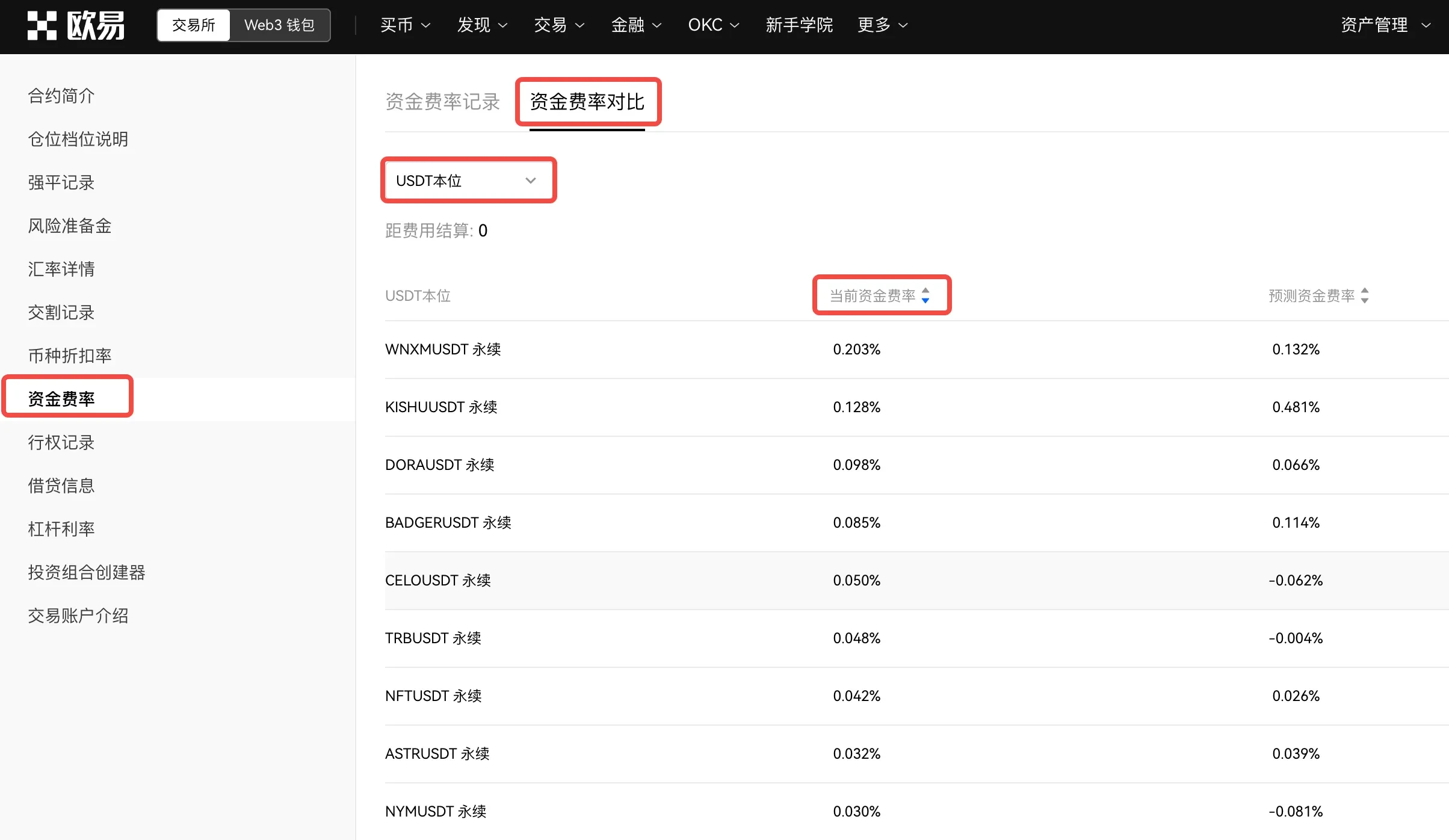
When using leverage and futures contracts, pay attention to the comparison between leverage borrowing interest rates and funding fees, as well as factors such as futures contract fees and delivery dates, as these can also affect arbitrage profits. When position values are equal, assets with higher funding rates have greater potential arbitrage opportunities. You can check the latest funding rates in the https://www.okx.com/trade-market/funding/swap and view the current funding rate rankings to select the most suitable arbitrage combinations from highest to lowest.
3. Spread Arbitrage
Depending on the arbitrage combination, spread arbitrage is divided into spot-futures arbitrage and futures-futures arbitrage. Spot-futures arbitrage refers to when there is a significant abnormal spread between futures contracts and spot of the same asset. By buying the lower-priced side and selling the same quantity of the higher-priced side, and closing both positions simultaneously when the spread narrows, you can profit from the spread reduction. Futures-futures arbitrage refers to when there is a significant spread between futures contracts with different delivery dates of the same asset. By buying the lower-priced side and selling the same quantity of the higher-priced side, and closing both positions simultaneously when the spread narrows, you can profit from the spread reduction. However, the spread of cross-delivery contract combinations does not necessarily return to 0, so the risk is slightly higher than spot-futures arbitrage.
When market sentiment is particularly greedy or fearful, the spread between far-dated and near-dated contracts may become abnormal, creating arbitrage opportunities. For example, on March 12, BTC dropped from $8,000 to a low of $3,800, a intraday decline exceeding 50%, with extreme market panic. At this time, futures contract prices fell more significantly relative to spot, causing the spread to widen sharply. This was an opportunity for spread arbitrage — you could buy the lower-priced futures contract and sell the higher-priced spot leverage, wait for the spread to normalize, and profit.
Here we mainly discuss arbitrage of the same asset. There is also cross-asset arbitrage, such as arbitrage between BTC and ETH, and cross-market arbitrage, such as the increasing correlation between BTC and U.S. stocks, or arbitrage between BTC and U.S. stock index futures, etc. These situations are more complex. If you are very interested, you can conduct in-depth research.
4. How to Use Arbitrage Orders?
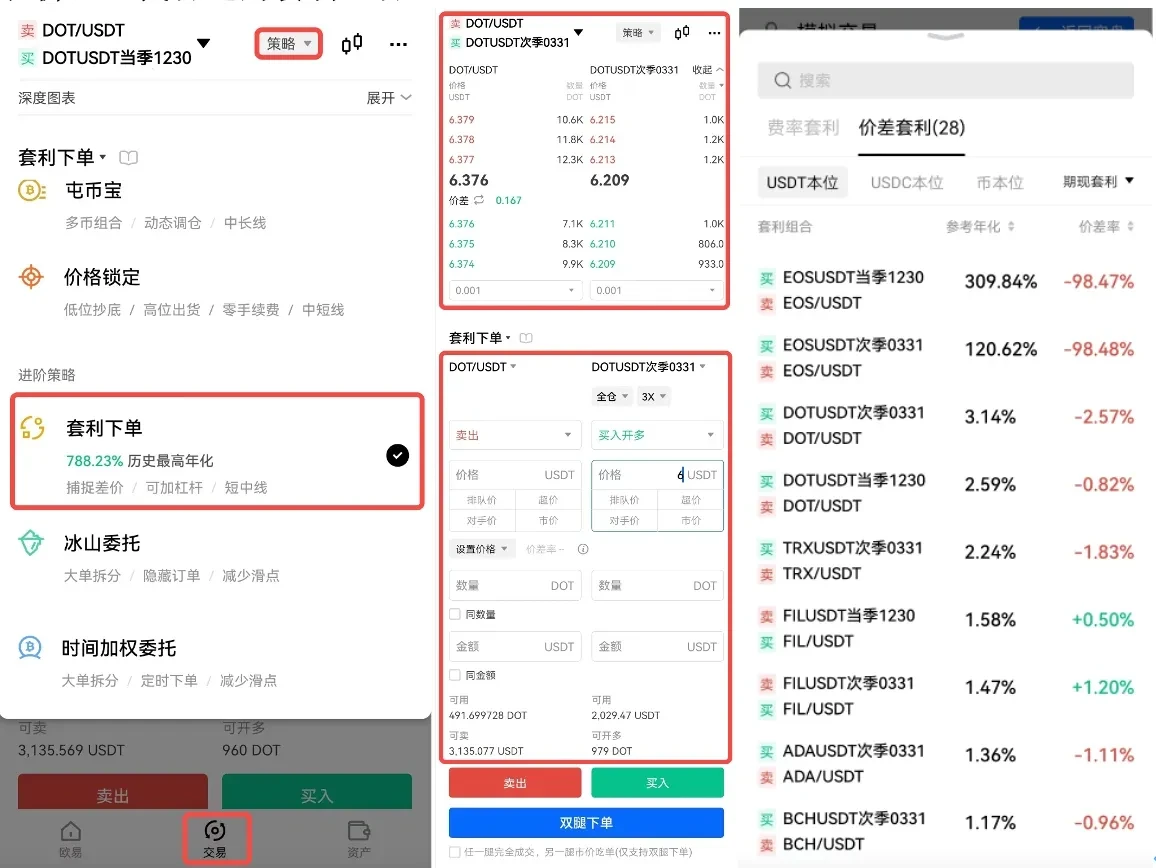
1. On the app, go to the Trading page and select【Strategy】. From the strategy list, select Arbitrage Orders. At the top of the Arbitrage Orders page, you will see the arbitrage combination and order book. The middle section is the order form, where you fill in different order parameters for the two trades. The bottom section is the order confirmation page. Dual-leg orders can minimize slippage as much as possible. On the upper left of the page, you can select different arbitrage trading pairs, divided into funding rate arbitrage and spread arbitrage. Both are intelligently recommended by the system, helping you quickly filter. You can also find suitable arbitrage combinations based on funding rates and spreads.
2. Taking ETHUSDT perpetual contract funding rate arbitrage as an example, in the depth chart, you can view the [Current Funding Rate]. When the funding rate is positive, longs pay funding fees to shorts. At this time, short the ETH perpetual contract while buying ETH spot with an equal position value to offset price volatility profit and loss, allowing you to earn the funding fee at the next settlement.
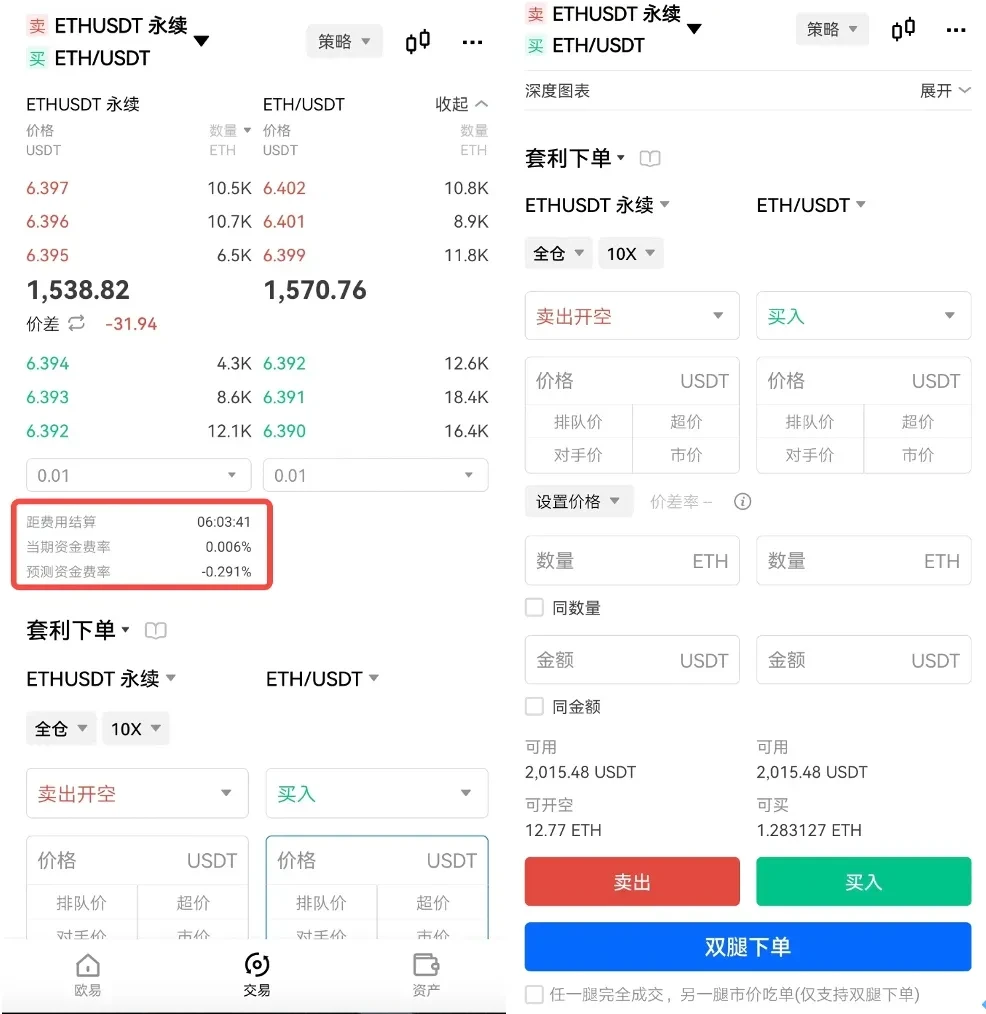
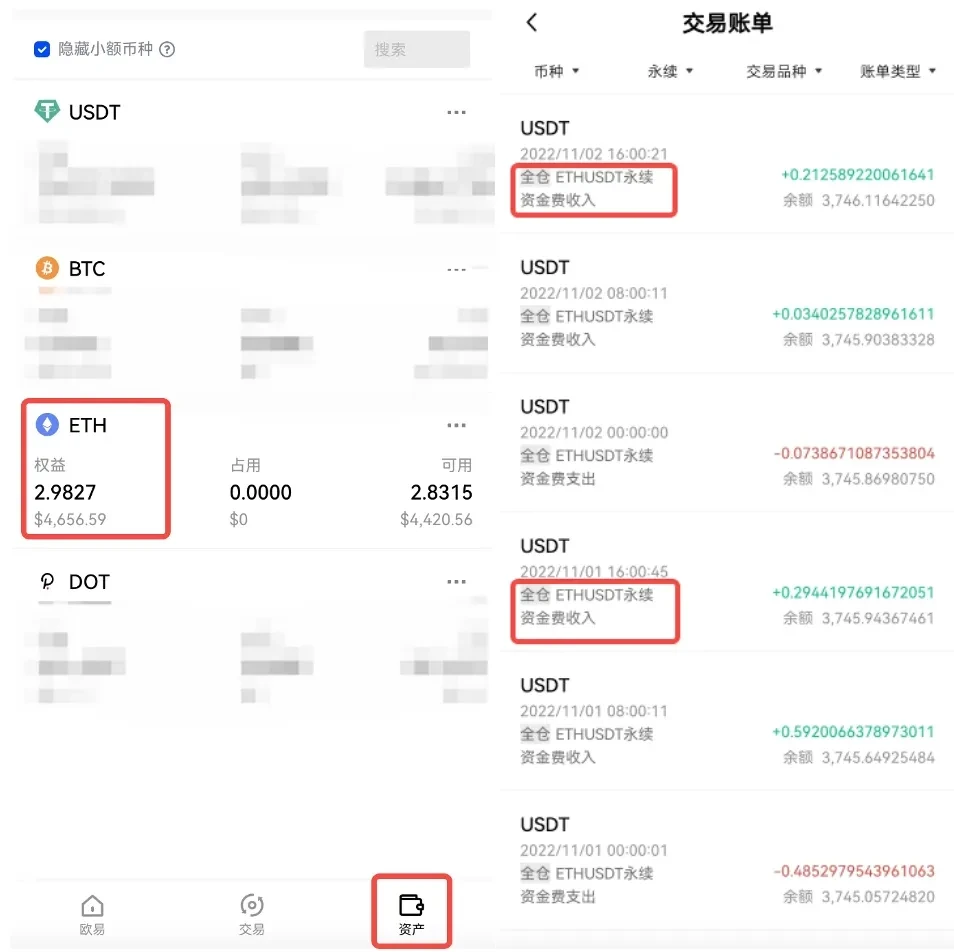
On the order form, fill in the order price, quantity, or amount for the left-side ETH perpetual contract. Select dual-leg orders at the bottom, and "if either leg is fully filled, the other leg uses market order," to ensure that once one leg is filled, the other leg can be filled promptly to avoid slippage. After successful order placement, you will buy ETH spot while holding a short position in ETH perpetual contracts. No matter how the price fluctuates, the profit and loss of the perpetual contract and spot offset each other. In the funding statement, you can view the funding fee income for each period.
5. Important Notes
1. Arbitrage orders do not guarantee profits. For example, in spread arbitrage, if the spot-futures spread continues to abnormally widen, you may also face losses. The intelligently recommended arbitrage combinations and annual return data are for reference only. 2. Perpetual contract funding rates are constantly changing, with positive-negative conversions and rate fluctuations. You need to regularly monitor rates and adjust your strategy based on changes. 3. In spread arbitrage, pay attention to the spread value. When the spread returns to normal, close positions promptly. 4. Pay attention to slippage control. When using different order types, try to place both legs' orders simultaneously. 5. When using arbitrage trading strategies with leverage and contracts for spread arbitrage, there is still liquidation risk.
Key Takeaways:
Disclaimer
This article may contain product-related content not applicable to your region. This article is intended to provide general information only and does not accept responsibility for any factual errors or omissions. This article represents the author's personal views only and does not constitute the views of OKX. This article is not intended to provide any advice, including but not limited to: (i) investment advice or investment recommendations; (ii) offers or solicitations to buy, sell, or hold digital assets; or (iii) financial, accounting, legal, or tax advice. Holding digital assets (including stablecoins) involves high risk and prices may fluctuate significantly or even become worthless. You should carefully consider whether trading or holding digital assets is suitable for you based on your financial situation. For questions specific to your circumstances, please consult your legal/tax/investment professional. The information in this article (including market data and statistics, if any) is for general reference only. Although we have taken all reasonable precautions in preparing such data and charts, we do not accept any responsibility for any factual errors or omissions expressed herein. © 2025 OKX. This article may be reproduced or distributed in its entirety, and excerpts of 100 words or less may be used, provided that such use is non-commercial in nature. Any reproduction or distribution of the full article must prominently state: "This article is copyrighted © 2025 OKX, used with permission." Permitted excerpts must cite the article title and include attribution, for example, "Article title, [Author name (if applicable)], © 2025 OKX." Some content may be generated or assisted by artificial intelligence (AI) tools. Derivative works and other uses of this article are not permitted.
Show More
Recommended Reading
Can You Profit Even When Bitcoin Drops? How to Trade Contracts
With the continuous expansion of the cryptocurrency market represented by Bitcoin, various forms of derivatives trading have gradually emerged beyond spot trading, serving as hedging tools. Among them, contract trading has attracted the most attention. What is contract trading? Contracts are the most common trading instrument in the cryptocurrency derivatives market. Digital asset contract trading refers to buyers and sellers agreeing to trade a specific asset at a designated price at a future time.
January 16, 2026
Easier Than Copying Strategies? Copy the Top Traders with One Click on OKX and Let Them Earn for You
Whether in traditional finance or the cryptocurrency market, strategy trading is a very important and critical component of the trading system. When facing complex trading environments and extreme market conditions, even with solid theoretical knowledge and rich trading experience, it is easy to miss trading opportunities or make wrong decisions due to emotions. Strategy trading is precisely an effective tool to solve these problems. Now that you have the trading tools, how do you make the most of them?
November 21, 2025

5. Strategic Trading Series — DCA Bot
Introduction: We often wonder: During a bull market, there are many digital assets that surge significantly. If you could continuously capture assets with large gains, such as catching one that doubles every month, your assets would become 2 to the 12th power, or 4,096 times, after a year. This is astonishing, but also nearly impossible to achieve, as it is difficult to continuously capture surging assets. This is a common problem many users face: During a bull market, although...
November 3, 2025

Which Countries/Regions Do Not Support OKX Registration
OKX currently does not provide services to customers in the following regions: Certain U.S. territories such as New York, Texas, Puerto Rico, American Samoa, Guam, Commonwealth of the Northern Mariana Islands, U.S. Virgin Islands (St. Croix, St. John, and St. Thomas), Cuba, Iran, North Korea, Crimea, Malaysia, Syria, Bangladesh, and Bolivia. For details, please refer to OKX Terms of Service.
April 25, 2024
Quick Guide to OKX Products and Features
OKX (www. okx. com) is one of the world's leading digital asset service platforms, primarily serving global users with Bitcoin, Ethereum, and other digital asset spot and derivatives trading services, while also exploring the world of DeFi, dApps, NFTs, and GameFi with users. On OKX, you can enjoy a seamless trading experience with spot, contracts, and more, stay updated on tokens in trending sectors/concepts first, and have access to a wide range of features.
April 25, 2024

Learn Candlestick Patterns from Zero | 5. Importance of K-Line Pattern Application
Trends dictate price movements — learn to read the language of price. Signals indicate when to buy and sell — goodbye to gut-feeling trading. Part 1: Bullish K-Line Patterns at Key Levels In the first two chapters of this section, we covered bullish and bearish K-line pattern applications. However, these patterns are not effective at every position. In this section, we will explain the importance of pattern location. Where do bullish patterns work best? The first scenario: In a clear uptrend, near the end of the preceding...
April 25, 2024