Bear Calendar Spread Strategy
1. Definition
The bear calendar spread strategy is a type of options trading strategy. It involves simultaneously buying a put option with a later expiration date and selling a put option with an earlier expiration date at the same strike price and quantity.
2. How It Profits
In the options trading market, the closer an option is to its expiration date, the greater the impact of time on price movement. Generally, the value of a short-dated option sold by a trader will decline faster than the value of a longer-dated option held by the trader (time decay), allowing the trader to profit from this difference. This relationship remains unchanged provided there are no significant changes in other external factors such as spot price, implied volatility, and time value.
Additionally, in general, volatility tends to rise over longer time horizons and decline over shorter time horizons. Changes in volatility across different expiration dates can lead to mispricing, which is broadly understood as the term structure of volatility: pricing varies based on volatility changes across different expiration dates for options on the same asset. This is also the traders' room for profit.
For buyers of the bear calendar spread strategy, under normal circumstances, traders will close their position when the short leg expires to mitigate the impact of approaching expiration and potential volatility from term structure changes. If the trade remains open until the long leg expires, the bear calendar spread strategy will automatically transform into a bear strategy, meaning the trader only expects to profit from price changes.
From the perspective of sellers of the bear calendar spread strategy, they may believe that forecasts on the volatility term structure are an overreaction. Traders can obtain higher premiums by selling this strategy but also face the risk that market movements go against their expectations.
Theoretically, under the influence of the term structure or volatility, there is no upper limit on the maximum returns or losses for this strategy.
These underlying principles are essentially the same as those of the bull calendar spread strategy.
3. Trading Details
The following conditions must be met to execute this strategy:
1) The two legs must have the same quantity, i.e.:
Buy 1 in-the-money put option (Leg 1)
Sell 1 in-the-money put option (Leg 2)
2) The two legs must have the same strike price but different expiration dates
Tip 1: Margin Rules
Long position: Must meet the initial margin and maintenance margin rate requirements for the short call option (Leg 2)
Short position: Must meet the initial margin and maintenance margin rate requirements for the short put option (Leg 1)
Portfolio margin mode: Since Leg 1 and Leg 2 are correlated, some risks are offset, and margin requirements are reduced
Tip 2: Net Strategy Value
Long position: Leg 1 premium (ask price) (later expiration) – Leg 2 premium (bid price) (earlier expiration)
Short position: Leg 2 premium (ask price) (earlier expiration) - Leg 1 premium (bid price) (later expiration)
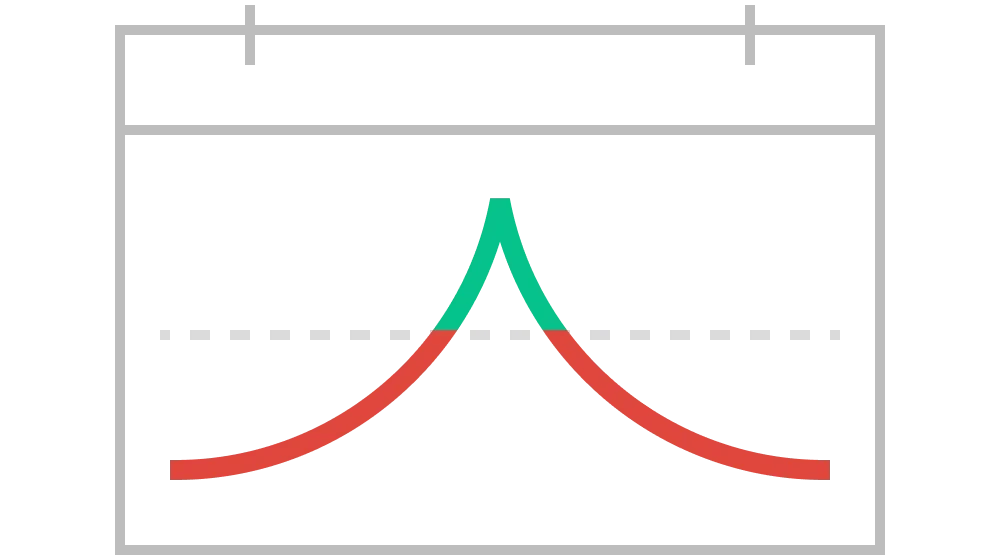
Tip 3: Returns Curve
4. Trading Example
Assume in a trade executing this strategy, the trading details are as shown in the table below:

Then, there will be three scenarios —
Scenario 1 (In-the-money scenario):
BTC price on Leg 2 expiration date: $18,000 USD, then:
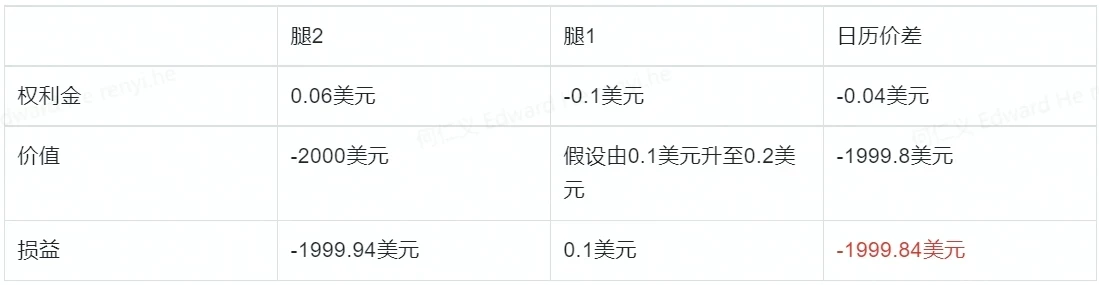
Under normal circumstances, traders close their positions as expected when the short leg expires, so on Leg 2 expiration date:
Total loss: Net strategy value + (strike price 2 – price 2 at expiration) – Leg 1 premium at Leg 2 expiration
Scenario 2 (No price movement):
BTC price on Leg 2 expiration date: $20,000 USD, then:
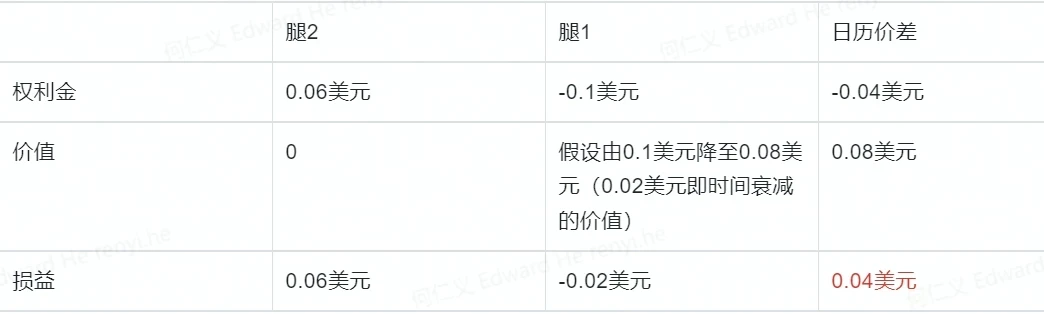
Since both legs are at-the-money (ATM), a loss on the net strategy value will occur. Traders typically close their positions at Leg 2 expiration, i.e.:
Total returns: Leg 1 premium at Leg 2 expiration – net strategy value
(Leg 1 premium at Leg 2 expiration: Leg 1 original price – Leg 1 time decay)
In this case, we assume all other indicators of Leg 1 remain largely unchanged and are greater than (not guaranteed) the premium of Leg 2. Traders can capture the spread caused by time decay between Leg 1 and Leg 2, thereby profiting from it.
Scenario 3 (Worst-case scenario):
When Leg 2 expires, the short leg is in-the-money (ITM) and the long leg is out-of-the-money (OTM)
BTC price on Leg 1 expiration date: $25,000 USD (price 1 at expiration)
BTC price on Leg 2 expiration date: $15,000 USD (price 2 at expiration), then:
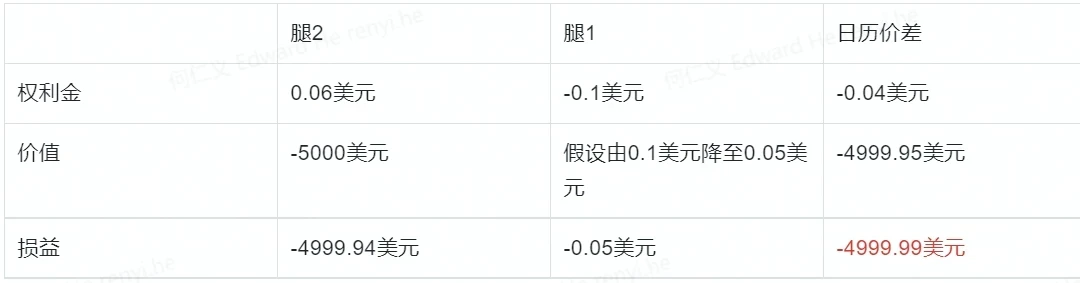
Under normal circumstances, traders close their positions as expected when the short leg expires, so on Leg 2 expiration date:
Total loss: Net strategy value + (strike price 2 – price 2 at expiration) – Leg 1 premium at Leg 2 expiration
Disclaimer
This article may contain product-related content not applicable to your region. This article is intended solely to provide general information and makes no representation as to any factual errors or omissions. The views expressed herein are solely those of the author and do not represent the views of OKX. This article is not intended to provide any advice, including but not limited to: (i) investment advice or investment recommendations; (ii) offers or solicitations to buy, sell, or hold digital assets; or (iii) financial, accounting, legal, or tax advice. Holding digital assets (including stablecoins) involves a high degree of risk, may be subject to significant volatility, and may even become worthless. You should carefully consider whether trading or holding digital assets is suitable for you based on your financial situation. For questions regarding your specific circumstances, please consult your legal/tax/investment professional. The information contained herein (including market data and statistics, if any) is provided for general reference purposes only. While reasonable precautions have been taken in preparing such data and charts, we assume no liability for any factual errors or omissions expressed herein. © 2025 OKX. This article may be reproduced or distributed in its entirety, or excerpts of 100 words or less may be used, provided that such use is non-commercial in nature. Any reproduction or distribution of the full article must prominently state: "© 2025 OKX. Used by permission." Permitted excerpts must cite the article title and include attribution, e.g., "Article title, [author name if applicable], © 2025 OKX". Some content may have been generated or assisted by artificial intelligence (AI) tools. Derivative works and other uses of this article are not permitted.
Show More
Recommended Reading
Profit from Bitcoin Declines? How to Trade Contracts
As the cryptocurrency market represented by Bitcoin continues to expand, various forms of derivatives trading have gradually emerged alongside spot trading, serving as risk hedging tools. Among them, contract trading has attracted the most attention. What is contract trading? Contracts are the most common form of trading contract in the cryptocurrency derivatives market. Digital assets contract trading refers to an agreement between buyers and sellers to trade a specific asset at a predetermined price at a future date.
January 16, 2026
Easier than Copying Strategies? Follow Top Traders with One Click on OKX and Let Them Make Money for You
Whether in traditional finance or the cryptocurrency market, strategic trading is a crucial component of the trading system. When facing complex trading environments and extreme market conditions, even with solid theoretical knowledge and extensive trading experience, it is easy to miss trading opportunities or make incorrect decisions and operations due to emotions. Strategic trading is precisely an effective tool to address these issues. Now that you have the trading tools, how do you maximize their potential?
November 21, 2025

5. Strategic Trading Series — DCA (Dollar-Cost Averaging)
Preface: We often wonder: In a bull market, there are many digital assets that surge in value. If you could consistently capture coins with significant gains, for example, catching a coin that doubles every month, after one year your assets would grow to 2 to the power of 12, which is 4,096 times — an astonishing result. Of course, this is nearly impossible to achieve because it is difficult to consistently catch coins that make big moves. This is a common problem many users face: In a bull market, although
November 3, 2025

Which Countries/Regions Do Not Support Registration on OKX
OKX currently does not support providing services to customers from the following regions: certain US territories such as New York, Texas, Puerto Rico, American Samoa, Guam, the Northern Mariana Islands, the US Virgin Islands (St. Croix, St. John, and St. Thomas), Cuba, Iran, North Korea, Crimea, Malaysia, Syria, Bangladesh, and Bolivia. For details, please refer to the OKX Terms of Service.
April 25, 2024
Quick Guide to OKX Products and Features
OKX (www.okx.com) is one of the world's renowned digital asset service platforms, primarily serving global users with Bitcoin, Ethereum and other digital asset spot and derivatives trading services, while also exploring the world of DeFi, dApp, NFT, and GameFi with its users. On OKX, you can enjoy a seamless trading experience with spot, contracts, and more, stay updated on tokens in trending sectors/concepts in real time, and much more.
April 25, 2024

Learn Candlestick Charts from Zero | The Importance of 5 Candlestick Pattern Applications
Trends drive price movements; understanding price language helps you read the market. Signals guide your trades; stop trading on instinct. Part 1: Bullish Candlestick Combinations at Key Levels In the previous two chapters of this section, we covered the applications of bullish and bearish candlestick combinations. However, these patterns are not effective at every location. In this section, we will explain the importance of where these combinations appear. Where do bullish combinations work best? First scenario: Near the end of a clear uptrend
April 25, 2024