Quick Overview of Accumulate Strategy
1. What is Accumulate Strategy?
Accumulate Strategy is an automated strategy that intelligently and dynamically rebalances a user-selected portfolio of cryptocurrencies. Dynamic rebalancing helps maintain constant proportions of each cryptocurrency in the user's portfolio. Users can select two rebalancing modes to trigger rebalancing: based on a fixed time period or based on the percentage change in market value of cryptocurrencies.
The advantage of this strategy is that it can leverage exchange rate fluctuations between different cryptocurrencies to earn and accumulate coins.
2. Scenarios Where Accumulate is Applicable
Rotation frequently occurs in the market between individual cryptocurrencies or sectors. After several cryptocurrencies rise and begin to pull back, other cryptocurrencies start to rise. If you simply hold without taking action, you may miss most of the profits due to price pullbacks. However, if you take profits in a timely manner when the first few cryptocurrencies rise, while buying other potential cryptocurrencies, you not only lock in profits but also increase your holdings of potential cryptocurrencies. This cycle can generate excess returns on this investment portfolio.
3. Accumulate Creation Steps, Related Parameters, and Tutorial Examples
3.1 Creation Steps:
(1) After entering OKX's Web or App, select "Strategy Trading" in the "Trading" page (Web: top left corner, App: top right corner), then select Accumulate.
(2) Enter parameters on the trading page, confirm investment amount, and you can create Accumulate. (Once created, the invested funds will be isolated from the Trading Account and used independently within the strategy)
(3) After creation is complete, you can view and manage the strategy under "Strategy" at the bottom of the trading page.
3.2 Related Terms and Parameters for Accumulate:
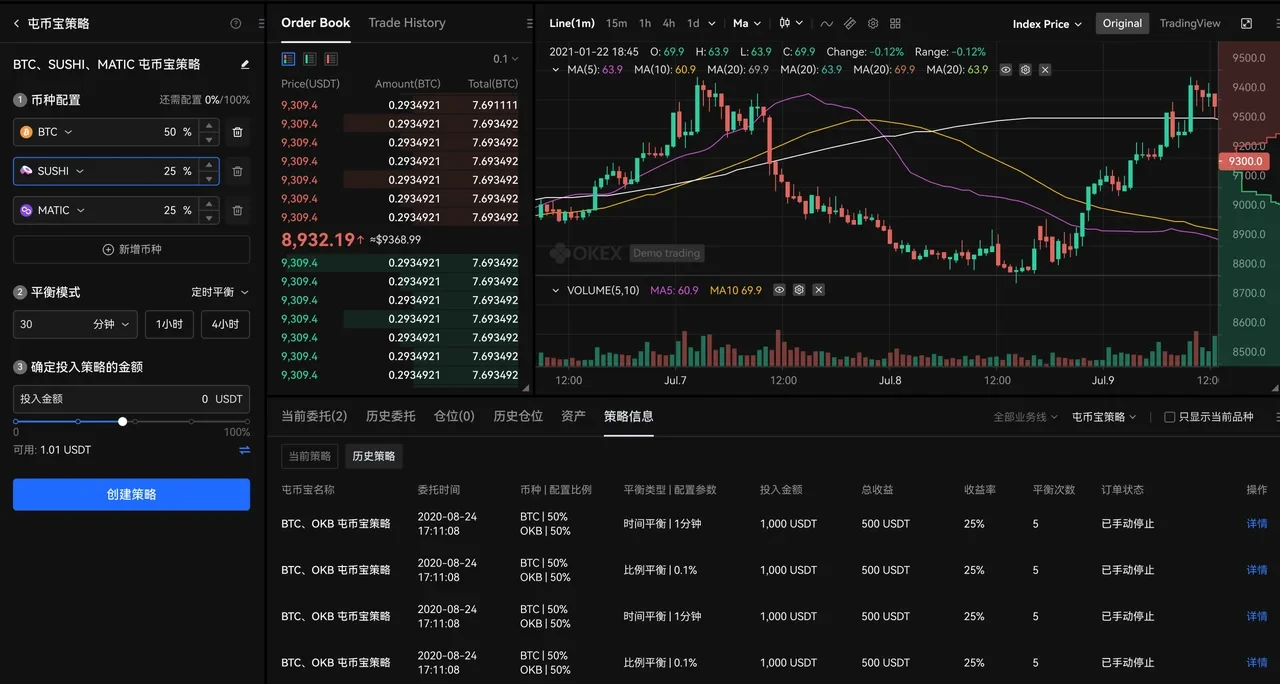
Portfolio Configuration: You can freely select the cryptocurrency portfolio for dynamic rebalancing, then determine the corresponding market value proportion for each cryptocurrency. The strategy will rebalance with this constant proportion as the target (up to 10 cryptocurrencies can be combined, currently only supports USDT-denominated pairs)
Rebalancing Mode: Divided into two types: percentage rebalancing and scheduled rebalancing
Percentage Rebalancing: Triggers rebalancing based on the percentage change in cryptocurrency market value. When one or more cryptocurrencies' market value proportions deviate from the preset proportion by more than the set threshold, rebalancing is triggered. (To avoid abnormally frequent rebalancing, percentage checks will be repeated at 5-minute intervals after one rebalancing)
Scheduled Rebalancing: Detects deviation and triggers rebalancing based on a fixed time period. After the preset time period elapses, it detects whether one or more cryptocurrencies' market value proportions deviate from the preset proportion by more than the set threshold. If so, rebalancing is triggered. (To avoid abnormally frequent rebalancing, deviation must exceed 3% to trigger rebalancing)
Investment Amount: The amount of funds invested in Accumulate. After investment, it will be traded and converted into cryptocurrencies in the portfolio.
3.3 Tutorial Examples
Example 1 - Percentage Rebalancing
Parameter Settings
Portfolio Configuration: BTC丨50%; ETH丨30%; SOL丨20%
Rebalancing Mode: Percentage Rebalancing丨10%
Investment Amount: 10,000 USDT
Strategy Execution
First Stage - Convert to Target Cryptocurrencies. The invested 10,000 is converted through smart trading into BTC worth 5,000 USDT (market price ₮1,000, i.e., 5 BTC), ETH worth 3,000 USDT (market price ₮500, i.e., 6 ETH), and SOL worth 2,000 USDT (market price ₮100, i.e., 20 SOL).
Second Stage - Trigger Rebalancing. Assuming BTC's market price rises to 1,500, while ETH and SOL prices remain unchanged, the market value proportions of each cryptocurrency are now: 60%: 24%: 16%. BTC's proportion has deviated by ≥10%, triggering rebalancing. At this point, the strategy sells 0.83334 BTC and buys 2.5 ETH and 5 SOL through smart trading to return market value proportions to the target ratio. After this rebalancing is complete, you hold 4.16666 BTC (market value 6,250 USDT), 7.5 ETH (market value 3,750 USDT), and 25 SOL (market value 2,500 USDT)
Example 2 - Scheduled Rebalancing
Parameter Settings
Portfolio Configuration: BTC丨50%; ETH丨30%; SOL丨20%
Rebalancing Mode: Time Rebalancing丨4 hours
Investment Amount: 10,000 USDT
Strategy Execution
First Stage - Convert to Target Cryptocurrencies. The invested 10,000 is converted through smart trading into BTC worth 5,000 USDT (market price ₮1,000, i.e., 5 BTC), ETH worth 3,000 USDT (market price ₮500, i.e., 6 ETH), and SOL worth 2,000 USDT (market price ₮100, i.e., 20 SOL).
Second Stage - Trigger Rebalancing. Assuming after 4 hours, BTC's market price rises to 1,500 USDT, while ETH and SOL prices remain unchanged, the market value proportions of each cryptocurrency are now: 60%: 24%: 16%. BTC's proportion has deviated by ≥3%, triggering rebalancing. At this point, the strategy sells 0.83334 BTC and buys 2.5 ETH and 5 SOL through smart trading to return market value proportions to the target ratio. After this rebalancing is complete, you hold 4.16666 BTC (market value 6,250 USDT), 7.5 ETH (market value 3,750 USDT), and 25 SOL (market value 2,500 USDT)
4. Important Notes
4.1. Once the Accumulate strategy is created, the invested funds will be isolated from the Trading Account and used independently within the strategy. Therefore, users need to pay attention to the risk this transfer of funds poses to the overall position in the Trading Account.
4.2. If during the operation of the Accumulate strategy, a cryptocurrency encounters unforeseen abnormal circumstances such as trading suspension or delisting, the Accumulate strategy will automatically stop.
Disclaimer
This article may contain product-related content that is not applicable to your region. This article is intended only to provide general information and does not assume responsibility for any factual errors or omissions herein. This article represents only the author's personal views and does not represent the views of OKX. This article is not intended to provide any of the following advice, including but not limited to: (i) investment advice or investment recommendations; (ii) offers or solicitations to buy, sell, or hold digital assets; or (iii) financial, accounting, legal, or tax advice. Holding digital assets (including stablecoins) involves high risk, may fluctuate significantly, and may even become worthless. You should carefully consider whether trading or holding digital assets is suitable for you based on your financial situation. For questions regarding your specific situation, please consult your legal/tax/investment professional. The information appearing in this article (including market data and statistics, if any) is for general reference only. Although we have taken all reasonable precautions in preparing these data and charts, we assume no responsibility for any factual errors or omissions expressed herein. © 2025 OKX. This article may be reproduced or distributed in its entirety, or excerpts of 100 words or less from this article may be used, provided such use is non-commercial. Any reproduction or distribution of the entire article must also prominently state: "Copyright © 2025 OKX. Used with permission." Permitted excerpts must cite the article title and include attribution, for example "Article Name, [Author Name (if applicable)], © 2025 OKX". Some content may be generated or assisted by artificial intelligence (AI) tools. Derivative works or other uses of this article are not permitted.
Show More
Recommended Reading
Profit Even When Bitcoin Drops? How to Trade Contracts
With the continuous expansion of the cryptocurrency market represented by Bitcoin, various forms of derivatives trading have gradually emerged beyond spot trading as tools to hedge risk. Among these, contract trading receives the most attention. What is contract trading? Contracts are the most common trading contract form in the cryptocurrency derivatives market. Digital asset contract trading refers to buyers and sellers agreeing to trade a specific asset at a specified price at a future time.
January 16, 2026
Simpler Than Copy Trading? One-Click Follow Top Strategy Traders on OKX, Let Traders Earn for You
Whether in traditional finance or the cryptocurrency market, strategy trading is a very important and crucial method in the trading system. When facing complex trading environments and extreme market conditions, even with solid theoretical knowledge and extensive trading experience, it's easy to miss trading opportunities or make incorrect judgments and operations due to emotional influence. Strategy trading is precisely an effective tool that can solve these problems. With trading tools available, how do you use them
November 21, 2025

Five, Strategy Trading Series Course — Accumulate
Preface: We often have this speculation: In bull markets, there are many digital assets with significant gains. If we could continuously capture cryptocurrencies with large increases, for example catching a doubled digital asset every month, your assets would become 2 to the power of 12 after one year, i.e., 4096 times. This is very impressive, of course, but it's also almost impossible to achieve because it's very difficult for us to continuously catch surging cryptocurrencies. This is also a problem many users encounter: In bull markets, although
November 3, 2025

Which Countries/Regions Do Not Support Registration on OKX
OKX currently does not provide services to customers in the following regions: Certain US territories, such as New York, Texas, Puerto Rico, American Samoa, Guam, Commonwealth of the Northern Mariana Islands, US Virgin Islands (St. Croix, St. John, and St. Thomas), Cuba, Iran, North Korea, Crimea, Malaysia, Syria, Bangladesh, and Bolivia. For details, please refer to the OKX Terms of Service.
April 25, 2024

Quick Overview of Common OKX Products and Features
OKX (www.okx.com) is one of the globally renowned digital asset service platforms, primarily providing Bitcoin, Ethereum, and other digital asset spot and derivatives trading services to global users, while also exploring the world of DeFi, dApps, NFTs, and GameFi together with users. On OKX, you can enjoy smooth trading experiences such as spot and contract trading, stay updated on token information in hot sectors/concepts, and also
April 25, 2024

Zero Basic Candlestick Chart Learning | 5 Importance of Candlestick Pattern Combinations
Trends have rises and falls; read the language of prices. Buy and sell have signals; say goodbye to emotional trading. I. Bullish Candlestick Combinations at Key Positions In the previous two sections of this chapter, we explained the applications of bullish and bearish candlestick combinations, but these combinations are not effective when they appear at any position. In this section, we will explain the importance of where combinations appear. In which positions can bullish combinations better play their role? The first situation: In a clear uptrend, near the previous
April 25, 2024