How to Use Take Profit & Stop Loss
1. What is Take Profit & Stop Loss
Take Profit & Stop Loss is a type of conditional order. Users can pre-set a trigger price and an order price. When the market price reaches the trigger price, the system will automatically place an order at the set order price. Users can use this order to close positions for profit or open positions based on trends. Take Profit & Stop Loss orders will freeze the user's margin or position. Depending on the number of preset directions, they are classified as one-way or two-way. With two-way Take Profit & Stop Loss, only one side of the margin or position is frozen. When one side is triggered, the other side automatically becomes invalid.
2. Term Definitions
1. Trigger Price: The pre-set order trigger condition. When the market price reaches the trigger price, the Take Profit & Stop Loss order is triggered.
2. Order Price: The price at which the order is sent to the market after being triggered. If "Market Price" is selected, the order will be placed at the best market price upon triggering, and will be filled immediately. (In extreme market conditions, immediate execution may not be guaranteed)
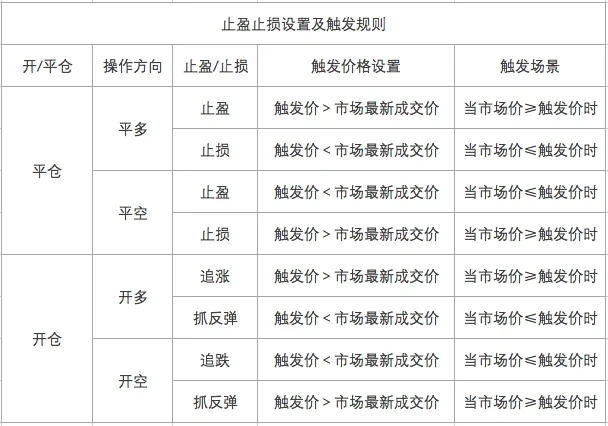
3. Take Profit Trigger Price / Stop Loss Trigger Price (Two-way): For sell orders, the take profit trigger price is greater than the latest transaction price, and the stop loss trigger price is less than the latest transaction price; For buy orders, the take profit trigger price is less than the latest transaction price, and the stop loss trigger price is greater than the latest transaction price.
3. How to Use Take Profit & Stop Loss
1. Case Studies
Case 1 (One-way Long Position Stop Loss):
The user holds a BTC contract long position with an average opening price of $9,000 USD. They expect to sell and close the long position when the market price drops to $8,000 USD to stop the loss. They can place the order with the following parameters:
【Trigger Price】 8000
【Order Price】 7950 (For sells, it is recommended to set the order price a certain distance below the trigger price to ensure immediate execution; or select Market Price)
If the price drops to 8000, the stop loss is triggered, and the long position is closed with a sell order at 7950. (If Market Price is selected for the order price, the position will be closed by buying at market price quickly)
If you want to take profit by closing the long position, you should set a sell order to close the long position at a trigger price above 9000.
Case 2 (One-way Short Position Stop Loss)
The user holds a BTC contract short position with an average opening price of $9,000 USD. They expect to buy and close the short position when the market price rises to $10,000 USD to stop the loss. They can place the order with the following parameters:
【Trigger Price】 10000
【Order Price】 10050 (For buys, it is recommended to set the order price a certain distance above the trigger price to ensure immediate execution; or select Market Price)
If the price rises to 10000, the stop loss is triggered, and the position is closed with an order at 10050. (If Market Price is selected for the order price, the position will be closed by buying at market price quickly)
If you want to take profit by closing the short position, you should set a buy order to close the short position at a trigger price below 9000.
Case 3 (Two-way Take Profit & Stop Loss for Long Positions)
The user holds a BTC contract long position with an average opening price of $9,000 USD. They expect to take profit by selling and closing the long position when the market price rises to $10,000 USD, and stop the loss when it drops to $8,000 USD. They can place the order with the following parameters:
【Take Profit Trigger Price】 10000
【Take Profit Order Price】 Select Market Price (or enter 9950, etc.)
【Stop Loss Trigger Price】 8000
【Stop Loss Order Price】 Select Market Price (or enter 7950, etc.)
If the price rises to 10000, take profit is triggered and the position is closed quickly at market price (if 9950 was entered, the order is placed at that price), and the stop loss triggered at 8000 automatically becomes invalid; If the price drops to 8000, stop loss is triggered and the position is closed quickly at market price (if 7950 was entered, the order is placed at that price), and the take profit triggered at 10000 automatically becomes invalid.
Case 4 (Two-way Take Profit & Stop Loss for Short Positions)
The user holds a BTC contract short position with an average opening price of $9,000 USD. They expect to take profit when the market price drops to $8,000 USD, and stop the loss by buying and closing the short position when the price rises to $10,000 USD. They can place the order with the following parameters:
【Take Profit Trigger Price】 8000
【Take Profit Order Price】 Select Market Price (or enter 8050, etc.)
【Stop Loss Trigger Price】 10000
【Stop Loss Order Price】 Select Market Price (or enter 10050, etc.)
If the price drops to 8000, take profit is triggered and the position is closed at market price (or 8050), and the stop loss triggered at 10000 automatically becomes invalid; If the price rises to 10000, stop loss is triggered and the position is closed at market price (or 10050), and the take profit triggered at 8000 automatically becomes invalid.
Case 5 (One-way Trend Following — Open Long):
The current market price of the BTC contract is $11,500 USD. The user believes that if the price breaks above 12000, there will be a significant upward trend. They can place an order to open a long position with the following parameters:
【Trigger Price】 12000
【Order Price】 Select Market Price (or enter 12050, etc.)
If the price rises to 12000, the trend-following long order is triggered and a long position is opened by buying at market price (or 12050).
Two-way Take Profit & Stop Loss can also be used for two-sided long position openings. When triggered at a higher level, it is a trend-following long entry; when triggered at a lower level, it is catching the price rebound.
Case 6 (One-way Trend Following — Open Short):
The current market price of the BTC contract is $6,500 USD. The user believes that if the price breaks below 6000, there will be a significant downward trend. They can place an order to open a short position with the following parameters:
【Trigger Price】 6000
【Order Price】 Select Market Price (or enter 5950, etc.)
If the price drops to 6000, the trend-following short order is triggered and a short position is opened by selling at market price (or 5950).
Two-way Take Profit & Stop Loss can also be used for two-sided short position openings. When triggered at a lower level, it is a trend-following short entry; when triggered at a higher level, it is catching the price rebound.
2. Take Profit & Stop Loss Settings Summary
4. Important Notes
- Before the Take Profit & Stop Loss order is successfully triggered, the position and margin will be frozen.
- Take Profit & Stop Loss orders may not be successfully triggered and may fail to place an order due to position limits, insufficient margin, the contract being in a non-trading state, system issues, etc. Successfully triggered limit orders work the same as regular limit orders and may not be filled. Unfilled limit orders will be displayed in the current open orders.
- If the order is filled, it will close your existing position or open a new position. If the order fails, your position and margin will remain intact.
- After triggering, if the order price set by the user triggers the limit price rule, the system will place the order using the highest or lowest market limit price at the time of triggering.
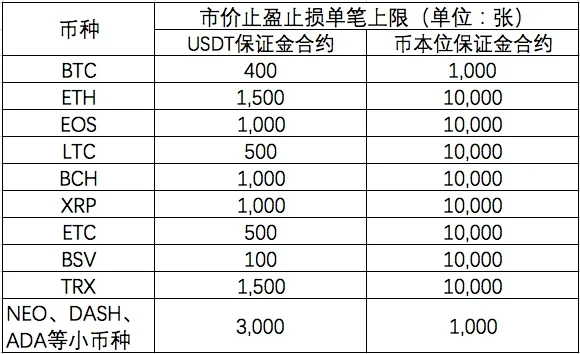
- Different contracts have different quantity limits for market price Take Profit & Stop Loss orders (these limits are subject to adjustment based on market changes)
Disclaimer
This article may contain product-related content that does not apply to your region. This article is dedicated to providing general information only and does not accept responsibility for any factual errors or omissions. This article represents the author's personal views only and does not constitute the views of OKX. This article is not intended to provide any advice, including but not limited to: (i) investment advice or investment recommendations; (ii) offers or solicitations to buy, sell, or hold digital assets; or (iii) financial, accounting, legal, or tax advice. Holdings in digital assets (including stablecoins) involve a high degree of risk and may fluctuate significantly, or even become worthless. You should carefully consider whether trading or holding digital assets is appropriate for you based on your financial situation. For questions specific to your circumstances, please consult your legal/tax/investment professionals. Any information appearing in this article (including market data and statistics, where applicable) is for general reference purposes only. While all reasonable precautions have been taken in the preparation of such data and charts, we accept no responsibility for any factual errors or omissions expressed herein. © 2025 OKX. This article may be reproduced or distributed in its entirety, or excerpts of 100 words or less may be used, provided that such use is for non-commercial purposes. Any reproduction or distribution of the full article must prominently state: "This article is copyrighted © 2025 OKX, used with permission." Permitted excerpts must cite the article title and include the source, for example, "Article Title, [Author Name (if applicable)], © 2025 OKX". Some content may be generated or assisted by artificial intelligence (AI) tools. Derivative works and other uses of this article are not permitted.
Show More
Recommended Reading
Can You Profit When Bitcoin Falls? How to Trade Contracts
As the cryptocurrency market represented by Bitcoin continues to expand, various forms of derivative trading have gradually emerged beyond spot trading, serving as hedging tools. Among them, contract trading has attracted the most attention. What is contract trading? Contracts are the most common form of trading instrument in the cryptocurrency derivative market. Digital assets contract trading refers to buyers and sellers agreeing to trade a certain asset at a specified price at a future time.
January 16, 2026
Easier Than Copy Trading? Copy the Top Traders with One Click on OKX and Let Them Earn for You
Whether in traditional finance or the cryptocurrency market, copy trading is a very important and key method within the trading system. When facing complex trading environments and extreme market conditions, even with solid theoretical knowledge and extensive trading experience, it is easy to miss trading opportunities or make wrong decisions due to emotional factors. Copy trading is precisely an effective tool to address these issues. You have the trading tools ready, but how do you
November 21, 2025

5. Strategic Trading Series — Auto Invest
Preface: We often have such speculation: In a bull market, there are many digital assets that surge in value. If you could continuously capture coins with large gains, such as catching one that doubles every month, after a year your assets would become 2 to the 12th power, which is 4,096 times your initial investment. This is quite astonishing, but it is also nearly impossible to achieve because it is very difficult to continuously catch coins that surge in value. This is also a common problem many users encounter: In a bull market, although
November 3, 2025

Which Countries/Regions Do Not Support Registration on OKX
OKX currently does not provide services to customers in the following regions: Certain US territories such as New York, Texas, Puerto Rico, American Samoa, Guam, the Northern Mariana Islands, the US Virgin Islands (St. Croix, St. John, and St. Thomas), Cuba, Iran, North Korea, Crimea, Malaysia, Syria, Bangladesh, and Bolivia. For more details, please refer to the OKX Terms of Service.
April 25, 2024

Quick Guide to OKX Common Products and Features
OKX (www. okx. com) is one of the world's renowned digital assets service platforms, primarily serving global users withBitcoin, Ethereum and other digital assets spot and derivative trading services, while also exploring the world of DeFi, dApps, NFTs, and GameFi with its users. On OKX, you can enjoy smooth spot and contract trading experiences, stay updated on tokens in trending sectors/concepts, and more.
April 25, 2024

Zero Basics to K-Line Analysis | 5. The Importance of K-Line Pattern Application
Trends exist in price movements, and understanding price language helps you read them; Signals guide your buys and sells, so you can say goodbye to trading on gut feeling. 1. Key Locations for Bullish K-Line Patterns In the previous two chapters of this section, we covered the application of bullish and bearish K-line patterns, but these patterns are not effective in every location. In this section, we will explain the importance of where patterns appear. Where do bullish patterns work best? The first scenario: In a clear uptrend, the immediately preceding
April 25, 2024