3. Strategic Trading Series — Dollar-Cost Averaging Strategy
Introduction:
If you have some funds and want to buy digital assets but lack trading experience and don't dare to enter the market rashly — because you know there's a significant 80/20 rule in investing, where only 20% of people are profitable. Trading goes against human nature: most investors rush in during bull markets and end up losing in bear markets, often selling everything at a loss. Digital assets are highly volatile, and traders in this space often see dramatic swings in returns. For example, Zhao Dong, founder of DFund and the Moji Weather app, suffered consecutive liquidations trading Bitcoin futures in 2014 and 2015, losing over 100 million RMB, and didn't pay off his debts until the 2017 bull market. Another tragic case is Hui Yi, founder of BitYi, who shorted Bitcoin, lost 2,000 BTC — worth over 100 million RMB — and subsequently took his own life, leaving us with deep sorrow.
At the same time, you've likely heard about crypto HODLers who have continuously accumulated quality digital assets across multiple bull markets, seeing their fortunes surge to financial freedom. The most famous example is Li Xiaola from New Oriental, who achieved financial freedom through accumulating Bitcoin.
If you've decided to give up trading and opt for dollar-cost averaging (DCA), you might consider a DCA strategy. But you still don't know which tokens to buy, how to allocate your funds, or when to sell.
Because there are also cases where even HODLers of Bitcoin have suffered losses. For instance, Masayoshi Son, former richest person in Japan and founder of SoftBank, bought billions of dollars' worth of Bitcoin at its then-all-time high of $20,000 per coin in December 2017 — near the end of the bull market cycle. After HODLing for a year, he liquidated his position in 2018 and lost $130 million. This goes to show that not all HODLers profit; the right entry and exit timing is crucial. Moreover, Bitcoin's price has grown so high that its potential upside has been significantly reduced. For ordinary investors, HODLing Bitcoin alone is no longer the optimal strategy.
When should you DCA? Which digital assets should you select? How much to buy and when to sell? This lesson will cover the dollar-cost averaging strategy in detail.
1. What Is the Dollar-Cost Averaging Strategy
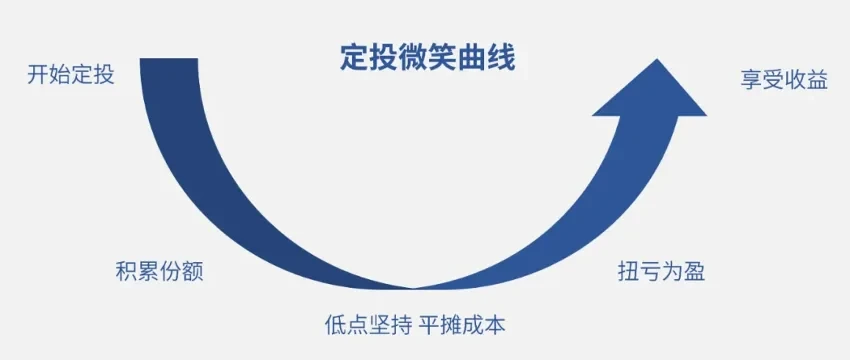
Dollar-cost averaging (DCA), as the name suggests, is a strategy of investing a fixed amount of money at regular time intervals into a selected portfolio of tokens. When the market is highly volatile, using a proper DCA strategy allows you to accumulate more tokens at lower prices with the same investment amount, helping users achieve more substantial returns.
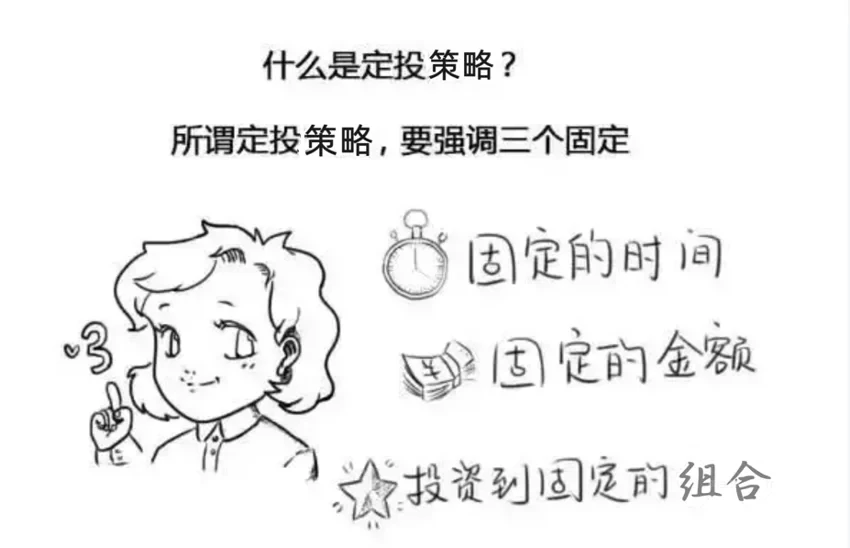
This strategy is simple to execute. Use idle funds, buy and hold for most of the time, then sell all positions at once for profit. It's suitable for users who don't have time to monitor the market, prefer low trading frequency, and are in it for the long term.
However, DCA is not a mindless buy-and-hold approach. Bitcoin in particular has clear bull and bear cycle characteristics. If you buy at a bull market peak, it could take 2–3 years to break even, or you might even exit at a loss — like Masayoshi Son, who held for a year only to lose over $100 million. Selecting the right timing for DCA is absolutely critical.
2. How to Select DCA Entry and Exit Timing
Due to Bitcoin's 4-year halving cycle, the digital assets market also exhibits a clear 4-year bull and bear cycle pattern. The ideal scenario is to DCA during bear markets and sell during bull markets.
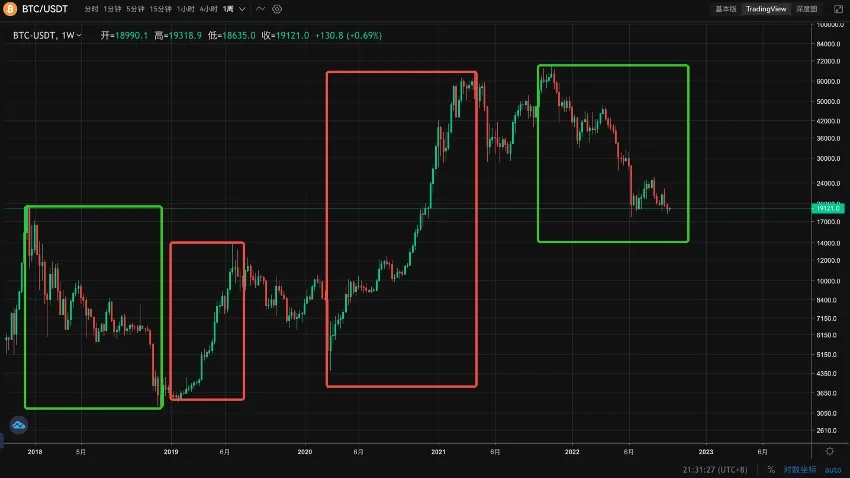
Bitcoin's market dominance and influence continue to rank first in the digital assets space, making it a benchmark for the entire industry. Therefore, we can use Bitcoin's bull and bear cycles to define the broader market direction. For instance, when Bitcoin enters a bear market, keep DCA-ing consistently. When it enters a bull market, exit your positions — and the returns will be quite impressive.
How to bottom-fish and top-sell Bitcoin?
It's impossible to buy at the absolute historical low or sell at the absolute all-time high, but you can refer to "03 | Bitcoin Bottom-Fishing and Top-Selling Indicators" and use indicators such as the ahr999 index (the "Nine Gods" indicator), MVRV ratio, and Bitcoin Rainbow Chart. Buy and DCA consistently when the price falls below the DCA line, selecting relatively favorable periods to accumulate. Then sell during bull markets for more favorable returns.
For example, the recent ahr999 index has fallen below the bottom-fishing line of 0.45 since July, indicating that this period is a relatively good time to DCA into Bitcoin.
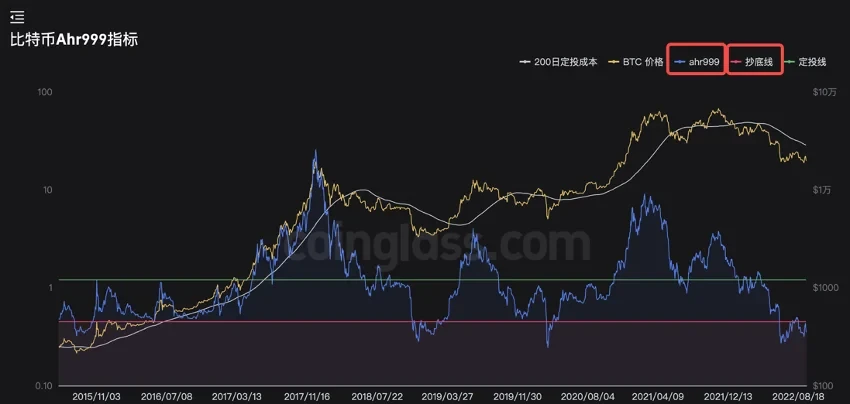
Exit timing is also a critical part of any DCA strategy. Only by actually selling can you lock in real profits.
Here are two exit methods:
Method 1: MA120 Bull-Bear Transition Line
The 120-day moving average is commonly regarded as the bull-bear transition line. You can continue DCA-ing through the bear market and sell when the price pulls back and drops below the MA120 during the bull market.
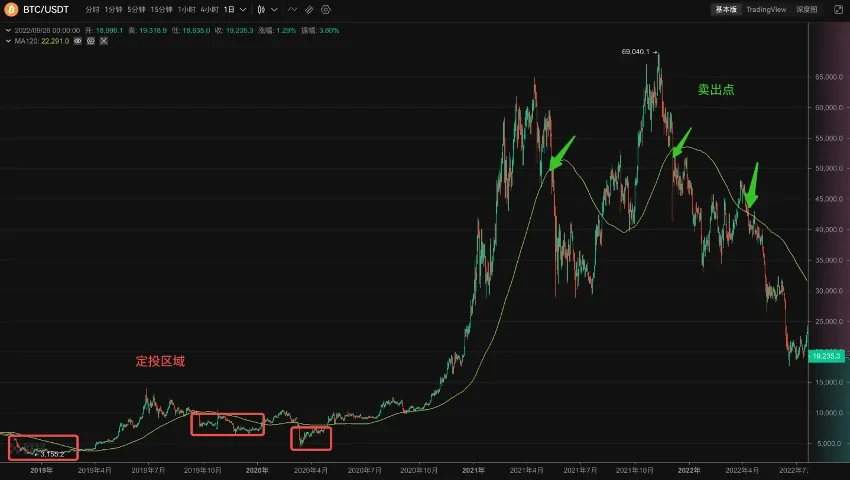
Method 2: Use Specific Bottom-Fishing and Top-Selling Indicators
For example, with the MVRV ratio: continue DCA-ing when MVRV is below 1, and be cautious and consider selling when MVRV exceeds 4.
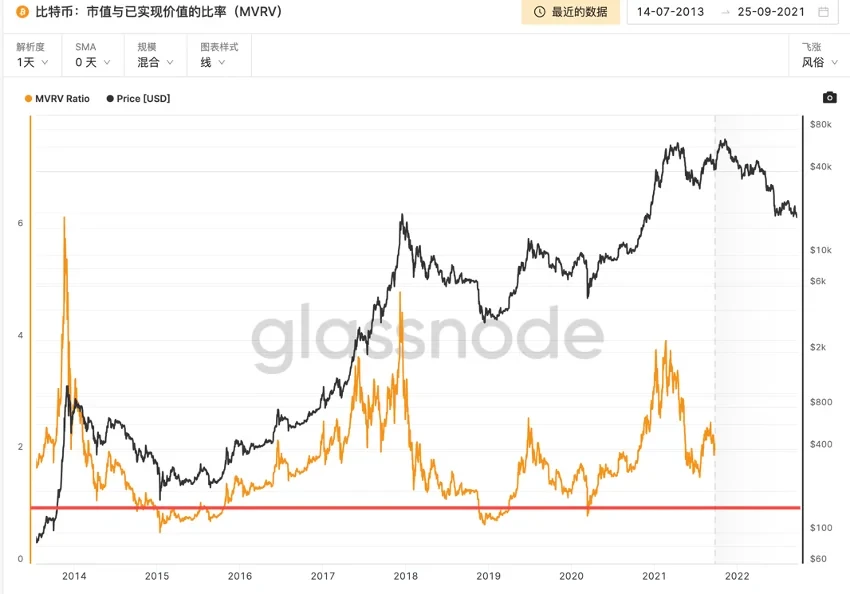
Alternatively, continue bottom-fishing with the ahr999 index below 0.45, but sell when ahr999 rises above 20.
Of course, no method guarantees selling at the absolute peak — but they do allow you to sell in major top zones.
3. How to Select Tokens for DCA
OKX currently only supports USDT for purchasing. If you divide your DCA funds into three portions:
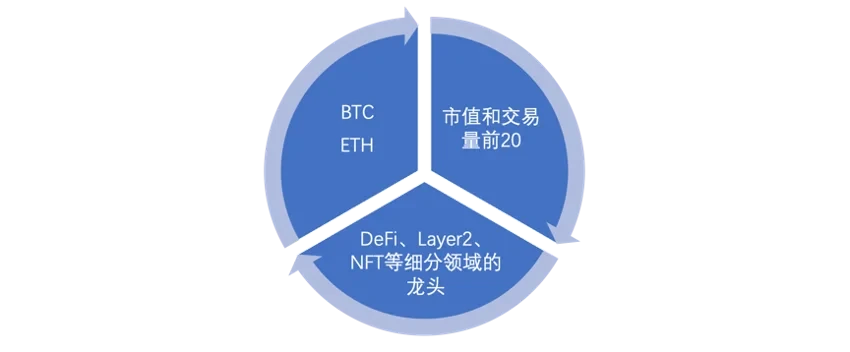
Prioritize DCA-ing into Bitcoin and ETH. These are the two most successful digital assets validated by the industry over the past decade, and they always reach new all-time highs in the next bull market. Bitcoin and ETH are the cornerstones of the digital assets industry and should be your primary allocations.
Next, DCA into a reserve pool. Tokens in the reserve pool should ideally have a large market cap — e.g., tokens ranked in the top 20 by market cap — and active trading volume — e.g., consistently ranked in the top 20 by 24-hour trading volume over several weeks.
Finally, consider digital assets you personally believe in, such as tokens from DeFi, Layer 2, Web3, or NFT sectors that you are bullish on. You can also add these to the reserve pool. However, it's best to select leading projects from each subsector, and keep this portion of your funds relatively small — for example, no more than 25% — because these digital assets tend to be more volatile. A smaller allocation ensures that volatility in any single token won't disproportionately impact the overall returns of your DCA portfolio.
The DCA strategy supports up to 20 tokens simultaneously. It's also important to pay attention to fund allocation ratios, which is a key part of any DCA strategy.
4. DCA Cycle and Fund Allocation
DCA is a long-term strategy. Significant results are hard to achieve in the short term, so users should be prepared for a long journey. As a long-term strategy, the DCA frequency should not be too high — monthly or weekly purchases work well.
Buy a fixed dollar amount each month (e.g., $2,000 in USDT) rather than a fixed quantity (e.g., 1 ETH). The advantage of this approach is clear: when the price drops, you buy more digital assets, which averages down your cost per unit.
For example, each time you invest $2,000. When ETH is at $2,000, you can only buy 1 ETH. But when ETH falls to $1,000, your $2,000 DCA investment buys 2 ETH, bringing your averaged cost down to $1,333 instead of $1,500. When ETH drops to $800, if you continue to DCA $2,000, you can buy 2.5 ETH, averaging your cost down to (2,000×3) / (1+2+2.5) = $1,091. When the price rises in the future, you'll recover your principal and start profiting much sooner.
DCA Count
DCA Amount (USDT)
ETH Price (USDT)
ETH Purchased
Total ETH HODLed
Total Invested (USDT)
Averaged Cost (USDT)
2,000
2,000
2,000
2,000
2,000
1,000
4,000
1,333
2,000
2.5
5.5
6,000
1,091
The investment period should ideally start from 1 year. Calculate your investment frequency and total planned amount, then determine how much to invest each time. It's recommended to use only idle funds to avoid affecting your daily life or other funding needs. The DCA strategy does not pre-occupy your DCA funds, but you must reserve sufficient funds before each scheduled DCA date to avoid failed purchases.
Since market changes are inherently uncertain, optimizing your DCA funds — such as adding to positions after crashes, continuously adjusting asset allocation ratios, or taking short-term trades on already-held digital assets — introduces more human bias, reverts you to manual trading habits, and goes against the original intent of the DCA strategy. These approaches are not advisable. In the long run, the returns may not even outperform fixed-amount investing. Minimize subjective decisions that could disrupt the execution of your DCA strategy.
5. Precautions for the DCA Strategy
1. Funds Reminder: Please reserve sufficient funds before each scheduled DCA date to avoid failed purchases.
2. Trading Account Risk Reminder: After DCA purchases, please monitor your trading account for changes in asset values and the associated liquidation risk.
3. Abnormal Circumstances Notice: If a token faces suspension, delisting, or other unforeseen abnormal circumstances during the operation of the DCA strategy, the strategy will automatically stop.
4. Risk Disclosure: It is recommended that you read the OKX DCA product documentation in full, carefully assess your own risk tolerance, and make rational decisions.
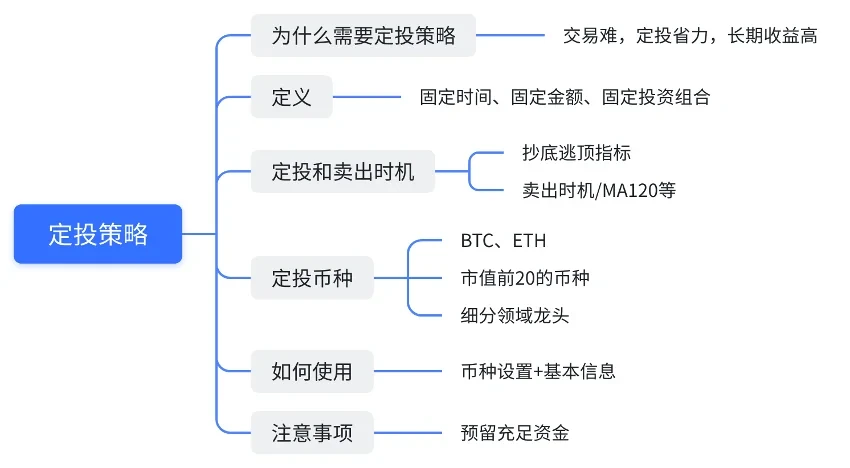
Key Takeaways:
Disclaimer
This article may contain product-related content not applicable to your region. This article is intended to provide general information only and does not accept responsibility for any factual errors or omissions. This article represents the author's personal views only and does not represent the views of OKX. This article is not intended to provide any advice, including but not limited to: (i) investment advice or investment recommendations; (ii) offers or solicitations to buy, sell, or hold digital assets; or (iii) financial, accounting, legal, or tax advice. Holdings in digital assets (including stablecoins) involve a high degree of risk and may fluctuate significantly, or even become worthless. You should carefully consider whether trading or holding digital assets is appropriate for you based on your financial situation. Please consult your legal/tax/investment professional regarding questions specific to your circumstances. The information contained in this article (including market data and statistical information, if applicable) is for general reference only. Although all reasonable precautions have been taken in the preparation of such data and charts, we accept no responsibility for any factual errors or omissions expressed herein. © 2025 OKX. This article may be reproduced or distributed in its entirety, or excerpts of 100 words or less may be used, provided that such use is non-commercial. Any reproduction or distribution of the full article must prominently state: "This article is copyright © 2025 OKX, used with permission." Permitted excerpts must cite the article title and include attribution, e.g., "Article Title, [Author Name (if applicable)], © 2025 OKX." Some content may have been generated or assisted by artificial intelligence (AI) tools. Derivative works and other uses of this article are not permitted.
Show More
Recommended Reading
Can You Profit Even When Bitcoin Falls? How to Trade Futures
As the cryptocurrency market represented by Bitcoin continues to expand, various forms of derivatives trading have emerged alongside spot trading as risk-hedging tools. Among them, futures trading has attracted the most attention. What is futures trading? Futures are the most common form of trading contract in the cryptocurrency derivatives market. Digital asset futures trading refers to an agreement between a buyer and a seller to trade a specific asset at a predetermined price at a future date.
January 16, 2026
Simpler Than Copy Trading? Follow Top Traders with One Click on OKX and Let Them Earn for You
Whether in traditional finance or the cryptocurrency market, strategy trading is a crucial and integral part of the trading ecosystem. When facing complex trading environments and extreme market conditions, even those with solid theoretical knowledge and extensive trading experience can easily miss trading opportunities or make poor decisions influenced by emotions. Strategy trading is precisely an effective tool to address these challenges. Once you have your trading tools, how do you use them to...
November 21, 2025

5. Strategic Trading Series — HODL宝
Introduction: We often find ourselves wondering: in a bull market, there are many digital assets that surge. If we could consistently catch tokens with large gains — for example, catching one token that doubles each month — after a year, your assets would become 2 to the 12th power, or 4,096 times your initial investment. That's incredible, though of course it's virtually impossible because it's extremely difficult to consistently catch surging tokens. This is a common problem many users face: during a bull market, although...
November 3, 2025
Which Countries/Regions Do Not Support Registration on OKX
OKX currently does not provide services to customers in the following regions: certain U.S. territories, such as New York, Texas, Puerto Rico, American Samoa, Guam, the Northern Mariana Islands, the U.S. Virgin Islands (St. Croix, St. John, and St. Thomas), Cuba, Iran, North Korea, Crimea, Malaysia, Syria, Bangladesh, and Bolivia. For more details, please refer to the OKX Terms of Service.
April 25, 2024
Quick Guide to OKX Products and Features
OKX (www.okx.com) is one of the world's leading digital asset service platforms, primarily serving global users with Bitcoin, Ethereum, and other digital asset spot and derivatives trading services. We also explore the world of DeFi, dApps, NFTs, and GameFi alongside our users. On OKX, you can enjoy smooth spot and futures trading experiences, access tokens in trending sectors and concepts in real time, and much more.
April 25, 2024

Zero Basics to Candlestick Charts | 5. The Importance of Candlestick Pattern Applications
Trends drive price movements; learn to read the language of price. Signals guide buying and selling; goodbye to gut-feeling trading. Part 1: Key Levels for Bullish Candlestick Patterns In the first two chapters of this section, we covered how to apply bullish and bearish candlestick combinations. However, these patterns aren't effective everywhere. In this section, we'll explain why the placement of these patterns matters so much. Where do bullish patterns work best? The first scenario: at a clear uptrend stage...
April 25, 2024