Digital Asset Options Beginner's Guide (Part 1): What Are Digital Asset Options
Cryptocurrency investors often have these questions:
Investor A: I want high leverage to increase returns, but I don't want to bear the risk of liquidation. Is there such a trading strategy or product? (High leverage + no/low risk)
Investor B: Every time there's a profit or loss, I struggle with whether to close my position. Setting take-profit and stop-loss in digital asset contract trading is too difficult. Is there a simple method to guarantee take-profit and stop-loss? (Automatic take-profit and stop-loss)
Investor C: Is there a trading strategy or product that can make money regardless of whether the market rises or falls in the future? Even if there's a loss, it's limited? (Dual-direction profit + low risk)
In the past, these ideas seemed like fantasy. However, with the introduction of options products in the cryptocurrency derivatives market, these wishes can be realized: Investor A can buy call or put options; Investor B can use bull or bear spread option combination strategies; Investor C can use straddle option combination strategies.
From the above, we can see that options products provide more trading choices and investment strategies for the market. If the creation of contracts completed the breakthrough of the cryptocurrency derivatives market from 0 to 1, then the emergence of options has achieved the leap of the cryptocurrency derivatives market from 1 to 10 in breadth and depth. Now, let's briefly discuss options products in the cryptocurrency derivatives market.
In the cryptocurrency derivatives market, what we often encounter is digital asset contracts. Compared to digital asset contracts, options products are more complex in design and more difficult to price. Generally speaking, options products can be divided into two basic types:
Call option—the holder has the right to buy a certain asset at a specific price at a specific time in the future
Put option—the holder has the right to sell a certain asset at a specific price at a specific time in the future
For convenience, we generally refer to call options as "call rights" and put options as "put rights." The specific price mentioned in the above definition is called the exercise price or strike price, generally represented by the capital letter K, and the specific time is called the expiration date or maturity, represented by the capital letter T.
Whether call rights or put rights, they can be divided into European Options and American options. American options mean the option holder can choose to exercise the right at any time before the expiration date; European options can only choose whether to exercise the right on the expiration date. Generally, we use the capital letter C to represent European option call rights, the capital letter P to represent European option put rights, the lowercase letter c to represent American option call rights, and the lowercase letter p to represent American option put rights.
The above terms are all key elements in options. To help readers better understand their meanings, we'll use a story from the Bible·Genesis to illustrate. According to the Bible, Jacob was the ancestor of the Israelites. He met Rachel, the youngest daughter of his uncle Laban from Haran, by a well and fell in love with her. To marry Rachel, Jacob signed a contract with Laban: Jacob would get permission to marry Rachel on the condition that he work for Laban for seven years. However, after Jacob worked for seven years, Laban said there was a rule that younger daughters couldn't marry first, and made Jacob work for him for another seven years. In the end, Jacob worked for a total of 14 years before marrying Rachel. In fact, the marriage permission contract Jacob signed can be seen as a simple option.

Now let's combine this story with options to analyze the important terms of options:
Option Underlying
A certain digital asset price index (such as BTC spot price index) [1]
Rachel (female lead)
Option Type
Currently mostly European digital asset options
Cannot obtain marriage permission in advance, belongs to European call right
Underlying Index
Same as the price index of contracts, compiled using real-time prices from multiple platforms
The male lead's affection for the female lead
Pricing Unit
Mostly priced in USD, settled in BTC
Priced in work amount
Option Contract Multiplier
The price represented by each index point. The option contract multiplier is 0.1, meaning each point of the spot index represents 0.1 USDT.
The work amount represented by each 1 point of affection for the female lead, for example, each 1 point of affection represents 20 days of work
Exercise Price (K)
The execution price at expiration. For example, if the exercise price of a Bitcoin call option is 20,000 index points, at expiration, if the Bitcoin price index is higher than 20,000 points, the option will be exercised; otherwise, it won't be exercised.
After seven years, if the male lead's affection for the female lead is higher than 90 points, then the male lead will choose to marry the female lead; otherwise, he won't marry.
Expiration Time (T)
The time point for option exercise. Like contracts, digital asset options are mainly divided into weekly options, bi-weekly options, and quarterly options.
Seven years. Of course, as a prospective father-in-law, to observe the son-in-law's performance, he can specify that after seven years of labor, you must wait another three years to exercise, making it a 10-year expiration time.
Option Premium
The fee to buy call rights or put rights
Seven years of work
Settlement Method
Cash settlement. Since there's no digital asset index for physical delivery, cash settlement is done through the method of netting.
Physical delivery. Excluding the seven years of work as the option premium, Jacob worked an additional seven years to marry Rachel (dowry fee).
After mastering the basic concepts of options, we need to understand what option positions are.
Many investors get confused by the complex positions of options when they first encounter them. Like the contract market, any option contract has two parties: one is the option long (the option buyer), and the other is the option short (the option seller or option writer [written the option]). However, unlike the contract market, in the contract market there are only two position forms: contract long (buy to open long) and short (sell to open short); but in the options market, there are four position forms:
(1) Call option long (buy call right)
(2) Call option short (sell call right)
(3) Put option long (buy put right)
(4) Put option short (sell put right)
Many investors get a headache when seeing these four positions and don't know how to distinguish and master them. In fact, understanding the above positions through option returns is most effective. Since options currently in the digital asset market are mainly European options, we'll use the return curves of European options to reflect the above four positions. According to the symbol notation in the first section, we use K to represent the exercise price of the option, S to represent the expiration price of the underlying asset, and f to represent the option premium.
In call options (call rights), the option holder will only choose to exercise when the expiration price S of the underlying asset is greater than K; otherwise, they won't exercise. If exercised, they'll obtain a return of S-K-f [2]; if not exercised, they'll incur a loss of f. That is, the return of call option long (buy call right) is:
max( S-K, 0)-f
As the seller of a call option (sell call right), the return is opposite to that of the buyer:
f-max ( S-K, 0)
That is
min (K-S, 0)+f
In put options, the option holder will only choose to exercise when the expiration price S of the underlying asset is less than K; otherwise, they won't exercise. If exercised, they'll obtain a return of K-S-f; if not exercised, they'll incur a loss of f. That is, the return of put option long (buy put right) is:
max( K-S, 0)-f
Similarly, the return of put option short (sell put right) is:
min( S-K, 0)+f
Summarized in the following table (S is the underlying price, K is the exercise price, f is the option premium):
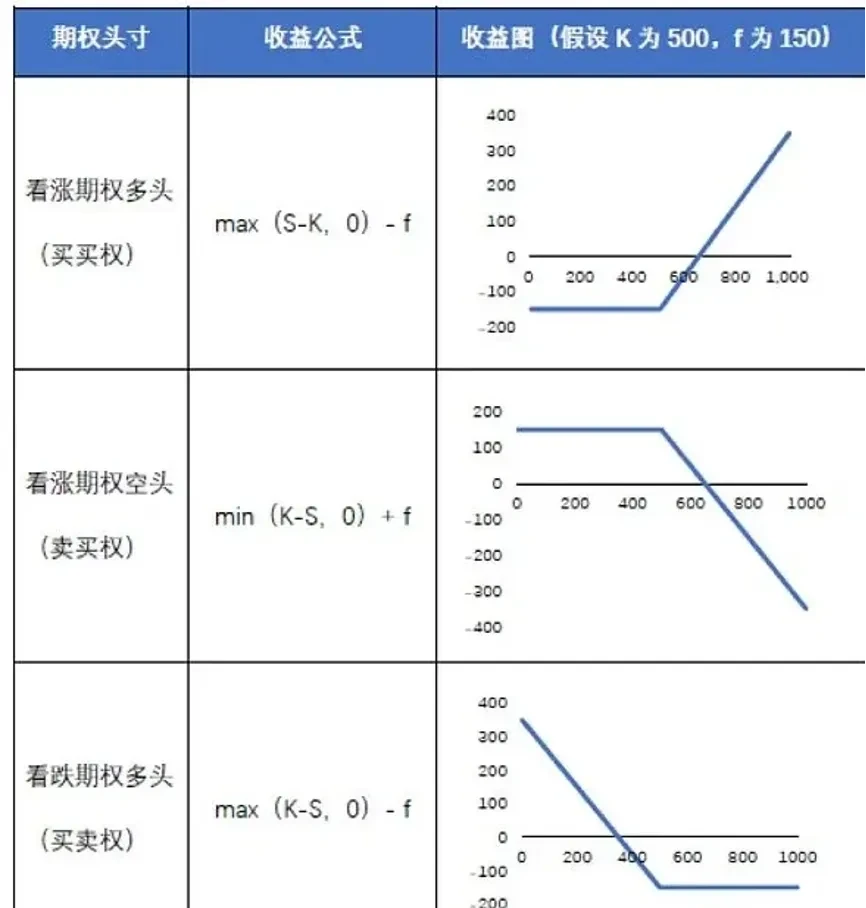
From the above chart, we can see that the return of an option is a折线, while the returns of digital asset spot and delivery/perpetual contracts that we're familiar with are a straight line. So why does this difference occur? This involves the essential difference between options and delivery/perpetual contracts. To learn more, please refer to "Digital Asset Options Beginner's Guide (Part 2) — Options VS Delivery/Perpetual Contracts"
[1] Price indices have no units. In the contract market, the contract multiplier happens to be 1, so many investors mistakenly think the unit of the index is 1 US dollar or 1 USDT. [2] The actual return formula for options is: option quantity × max (S-K, 0) × contract multiplier - f. Here for ease of understanding, we default the contract multiplier and option quantity values to 1.
Disclaimer
This article may contain product-related content that is not applicable to your region. This article is intended to provide general information only and is not responsible for any factual errors or omissions therein. This article represents only the author's personal views and does not represent the views of OKX. This article is not intended to provide any of the following advice, including but not limited to: (i) investment advice or investment recommendations; (ii) offers or solicitations to buy, sell, or hold digital assets; or (iii) financial, accounting, legal, or tax advice. Holding digital assets (including stablecoins) involves high risk, may fluctuate significantly, and may even become worthless. You should carefully consider whether trading or holding digital assets is suitable for you based on your financial situation. For questions about your specific situation, please consult your legal/tax/investment professional. The information appearing in this article (including market data and statistics, if any) is for general reference only. While we have taken all reasonable precautions in preparing these data and charts, we assume no responsibility for any factual errors or omissions expressed herein. © 2025 OKX. This article may be reproduced or distributed in its entirety, or excerpts of 100 words or less from this article may be used, provided such use is non-commercial. Any reproduction or distribution of the entire article must also prominently state: "Copyright © 2025 OKX. Used with permission." Permitted excerpts must cite the article name and include attribution, such as "Article Name, [Author Name (if applicable)], © 2025 OKX". Some content may be generated or assisted by artificial intelligence (AI) tools. Derivative works or other uses of this article are not permitted.
Show More
Recommended Reading
Can You Profit When Bitcoin Falls? How to Trade Contracts
With the continuous expansion of the cryptocurrency market scale represented by Bitcoin, various forms of derivatives trading have gradually emerged beyond spot trading as a tool to hedge risk, among which contract trading has received the most attention. What is contract trading? Contracts are the most common trading contract form in the cryptocurrency derivatives market. Digital asset contract trading refers to buyers and sellers agreeing to trade a certain asset at a specified price at a certain time in the future.
January 16, 2026
Simpler Than Copy Strategies? One-Click Follow the Best Strategy Traders on OKX, Let Traders Make Money for You
Whether in traditional finance or the cryptocurrency market, strategy trading is a very important and key method in the trading system. When facing complex trading environments and extreme market conditions, even with solid theoretical technical knowledge and rich trading experience, it's easy to miss trading opportunities or make wrong judgments and operations affected by emotions. Strategy trading is precisely an effective tool that can solve these problems. With trading tools available, how to use them
November 21, 2025

Five, Strategy Trading Series Courses — Asset Savings
Preface: We often have this conjecture: In bull markets, there are many digital assets with significant gains. If we can continuously capture digital assets with large increases, for example, catching a doubling digital asset every month, your assets will become 2 to the power of 12, that is, 4096 times, after one year. This is very amazing, of course, this is also almost an impossible thing to complete, because we find it difficult to continuously catch digital assets with large increases. This is also a problem many users encounter: In bull markets, although
November 3, 2025

Which Countries/Regions Do Not Support Registration to Use OKX
OKX currently does not provide services to customers in the following areas: Certain US territories, such as New York, Texas, Puerto Rico, American Samoa, Guam, Commonwealth of the Northern Mariana Islands, US Virgin Islands (St. Croix, St. John, and St. Thomas), Cuba, Iran, North Korea, Crimea, Malaysia, Syria, Bangladesh, and Bolivia. For details, please refer to the OKX Terms of Service.
April 25, 2024
Quickly Understand OKX Common Products and Features
OKX (www. okx. com) is one of the world's famous digital asset service platforms, mainly providing global users with Bitcoin, Ethereum, and other digital asset spot and derivatives trading services, while also exploring the world of DeFi, dApps, NFTs, and GameFi with users. On OKX, You can enjoy smooth trading experiences such as spot and contracts, keep up with token information in hot areas/concepts for the first time, and also
April 25, 2024

Zero-Based Candlestick Learning | 5 Importance of Candlestick Combination Applications
Price trends have directions; read the price language. Buy and sell have signals; say goodbye to feeling-based trading. I. Bullish Candlestick Combinations at Key Positions In the first two sections of this chapter, we explained the applications of bullish and bearish candlestick combinations, but these combinations are not effective when they appear at any position. In this section, we'll explain the importance of where combinations appear. In which positions can bullish combinations play a better role? The first situation: In a clear upward trend, near the previous
April 25, 2024