
What Role Will Bitcoin Play in the Metaverse?
Since entering 2021, with changes in the global economic and social environment, discussions about the metaverse have become increasingly heated both within and outside the crypto market. Within the crypto market, what undoubtedly gives us a close-up feel of the metaverse is GameFi. However, whether it's the recently popular Loot or the GameFi boom sparked by Axie Infinity, or the wave of art and sports circles embracing NFTs in the first half of this year, or last year's explosive DeFi Summer, in all these indispensable elements of the metaverse, we seem not to see Bitcoin's presence, while Ethereum and its competitors are actively involved.
From a data perspective, according to industry media statistics, among the top 20 NFT projects (including various games, etc.) with the highest sales volume across the entire network, 17 are issued based on Ethereum, accounting for 85%; among the top 100 projects, 84 are issued based on Ethereum, accounting for 84%. Moreover, most of these Ethereum-based projects currently use ETH for payment. Beyond that, the remaining NFT market share is divided by emerging public chain competitors like OKTC and Solana. In the DeFi field, according to OKLink statistics, among the 132 DeFi smart contracts included in OKLink's special section, over 70% are created based on the Ethereum network. In terms of total value locked (TVL) of assets, Ethereum's advantage is even more pronounced. As of 12:00 on September 6, 2021, the total value of assets locked in DeFi smart contracts across the entire network was $141.87 billion, while the value of assets locked on the Ethereum chain alone reached $128.38 billion, accounting for over 90.4%.
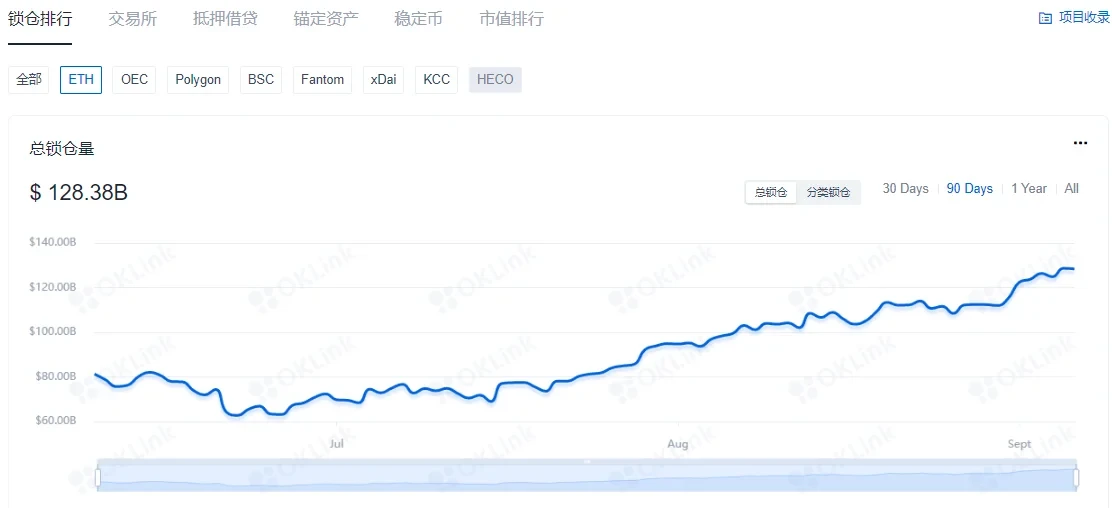
Total value of assets locked in Ethereum-based DeFi smart contracts, source: OKLink
In the process of finding the above data, it's clear at a glance that Ethereum is undoubtedly the most visible among the many concept segments covered by the metaverse. Competitors like OKTC, Polygon, and Fantom also show impressive performance, but only the leader of the crypto world is missing — Bitcoin.
Will Bitcoin Fall Behind in the Metaverse World?
Frankly speaking, starting from the current reality, before discussing the topic of what role Bitcoin will play in the metaverse, there's another topic that can't be avoided: will Bitcoin fall behind in the next era of transitioning from reality to virtual? Clearly, this topic directly addresses the comparison of advantages and disadvantages between Bitcoin and many new-generation public chains represented by Ethereum in multiple dimensions such as scalability, trading efficiency, and store of value.
First in terms of scalability, Bitcoin is temporarily at a disadvantage. Although Vitalik Buterin's inspiration for launching the Ethereum project came from Bitcoin, after several years of continuous development, Ethereum's advantage in scalability has become very obvious. According to OKLink statistics, the number of smart contracts built on the Ethereum network has currently exceeded 11,000.
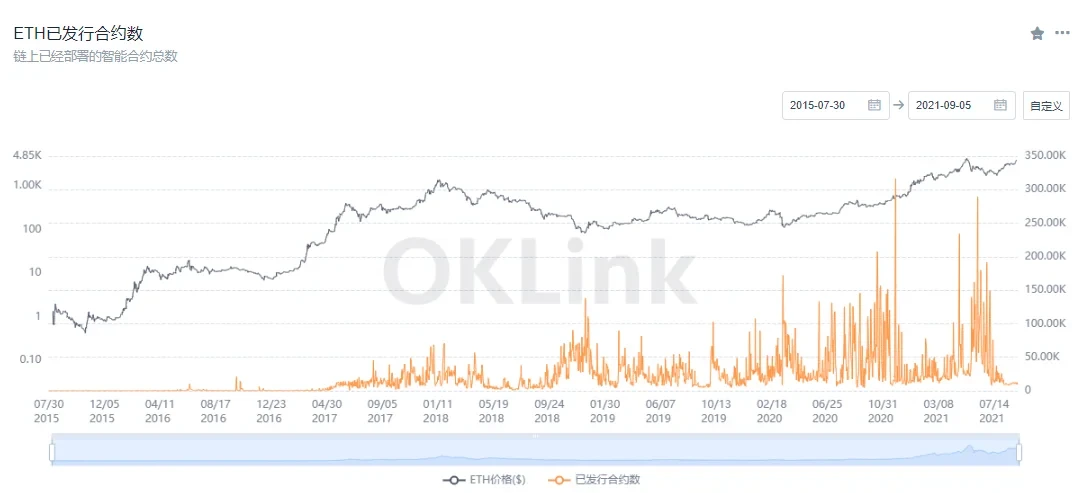
Number of issued contracts on Ethereum, source: OKLink
More importantly, in the past two years, Ethereum-based DeFi and NFTs have flourished, and the Ethereum ecosystem has grown day by day. From this perspective, Ethereum clearly has greater scalability than Bitcoin. On one hand, this is reflected in Ethereum providing more use cases including smart contracts. On the other hand, with the advancement of the ETH 2.0 upgrade, Ethereum is expected to soon shift to the Proof of Stake (PoS) consensus algorithm, which appears more environmentally friendly than Bitcoin's energy-intensive Proof of Work (PoW) protocol.
Secondly in terms of trading efficiency, according to btc.com data, Ethereum's current network TPS is 12.96, meaning it can process nearly 13 transactions per second; while Bitcoin's network TPS is 2.41, processing less than 3 transactions per second. Looking at the total number of daily transactions processed by Bitcoin and Ethereum over the past few years, the gap is also clearly visible.
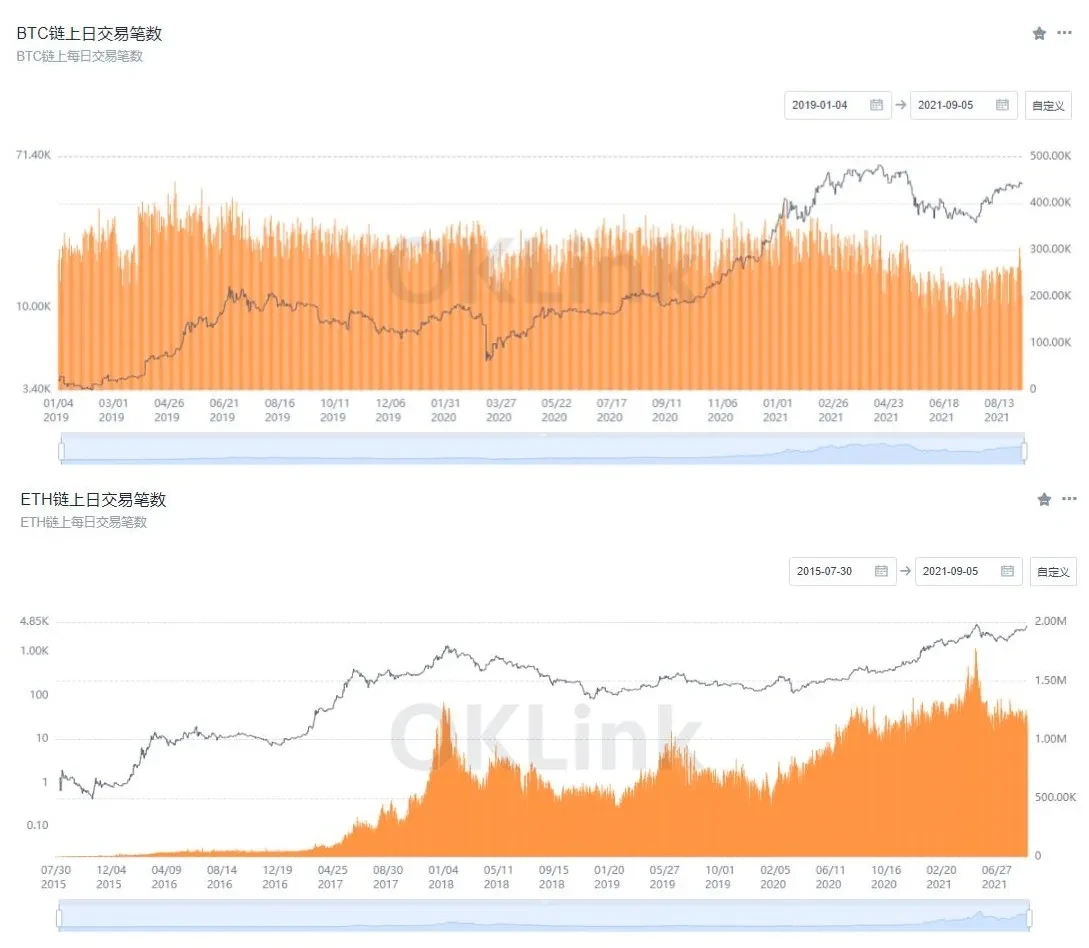
Comparison of total daily transactions processed by Bitcoin and Ethereum in recent years, source: OKLink
From OKLink's statistical data above, we can find that since entering 2021, Ethereum's average daily transaction processing has been over 1 million, with a peak reaching 1.78 million; while Bitcoin mostly fluctuates between 150,000 and 400,000, with a peak of 446,000. Such trading efficiency, if placed during the DeFi Summer period, would likely mean the Bitcoin network could not meet on-chain trading demands. And if we consider the potential efficiency improvements after Ethereum's complete transition to the PoS consensus mechanism following the completion of the ETH 2.0 upgrade, this gap will undoubtedly widen further.
So in terms of store of value, can Bitcoin make a comeback? In the article "Analysis of the Relationship Between Metaverse, NFTs, and GameFi" previously published by OKX Academy, we proposed a viewpoint: the metaverse is a virtual space mapped from the current real internet world to the future, and its scope will expand from pan-entertainment to every corner of the internet. Therefore, in the future metaverse, a medium equivalent to store of value in the real world will definitely be needed. As a store of value medium, it naturally needs a broader consensus foundation and a more secure operating mechanism. From this perspective, Bitcoin is more worth anticipating.
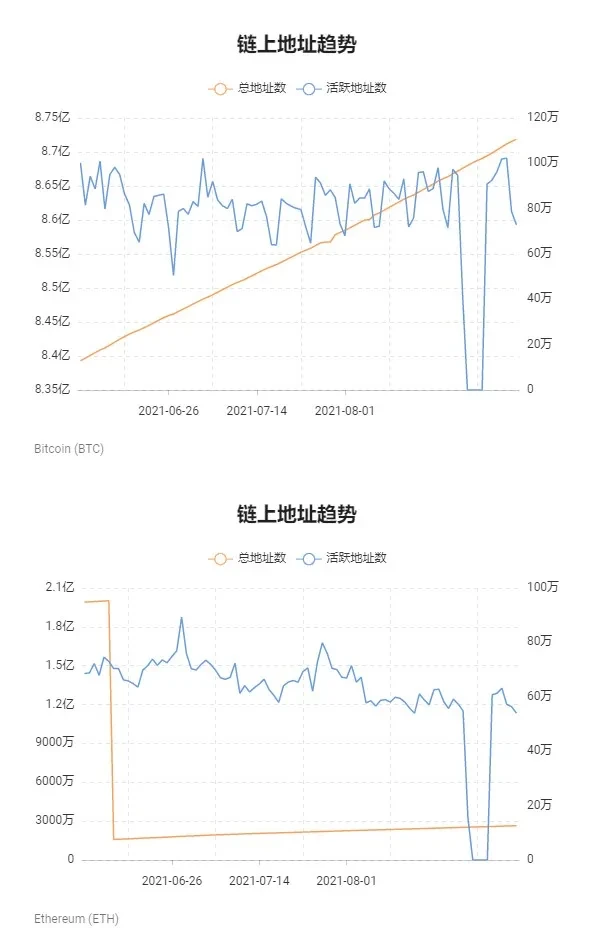
Comparison of total addresses and active addresses between Bitcoin and Ethereum, source: qkl123
From the statistical data provided by qkl123 above, Bitcoin's network has 872 million total addresses and 728,700 active addresses; in comparison, Ethereum has 26.4567 million total addresses and 540,000 active addresses. From a data perspective, Bitcoin has the advantage.
At this point, perhaps we can make a small summary of this section's sub-topic: if we view Bitcoin as a comprehensive infrastructure-like existence in the metaverse world, then it clearly doesn't have enough strength to compete with Ethereum and most other public chains; but if we view it as an important store of value medium in the metaverse, then it clearly has greater potential. Therefore, perhaps in the future metaverse, Bitcoin's presence may still not be as strong as it is now, but it will definitely be an indispensable and important part. The status of "digital gold" may become even more prominent by then.
What Role Might Bitcoin Play in the Metaverse?
Based on the discussion in the previous section, opening this topic will be easier. At this point, we can make a simple distinction between Bitcoin and public chains like Ethereum based on their different basic attributes. The first category is Bitcoin, which will assume more of a store of value role in the metaverse, similar to gold's role in the current economic society; the other category includes platform-type infrastructure like Ethereum and OKTC, which exist as the cornerstone for numerous applications such as Web 3.0, DeFi, and NFTs.
If we make such a distinction, Bitcoin's first-mover advantage may be further amplified. In the book "Antifragile," author Nassim Taleb first introduced the concept of the "Lindy Effect." Later, mathematician Mandelbrot further summarized the "Lindy Effect" using mathematical methods in his book "The Fractal Geometry of Nature": "For things that die naturally, each additional day of life shortens their expected lifespan. For things that don't die naturally, each additional day of life may mean a longer expected remaining life." Specifically within the crypto market, as the crypto asset with the longest issuance time, Bitcoin doesn't die naturally, and has built the broadest consensus foundation over more than a decade. In the future, it will inevitably attract more and more investors to choose to hold Bitcoin. This is something no other crypto asset can compare to.
Additionally, from the perspective of technical updates, although Bitcoin's upgrade frequency is not as high as Ethereum's, it hasn't stagnated. In the article "Bitcoin Taproot Upgrade Has Been 'Locked,' Officially Launching This November", we introduced the Bitcoin Taproot upgrade launching this November. After completion, it will greatly enhance Bitcoin's efficiency, privacy, and network flexibility. Once the effects of the Taproot upgrade become prominent, at a technical level, it will provide the possibility for developers to build a DeFi ecosystem around the Bitcoin network. Of course, whether this can ultimately be realized remains to be further observed. However, in terms of current DeFi ecosystem construction, Bitcoin hasn't been absent either. According to defipulse statistics, as of September 6, 2021, the amount of Bitcoin locked in DeFi smart contracts has exceeded 200,000, accounting for about 1.1% of total circulation.
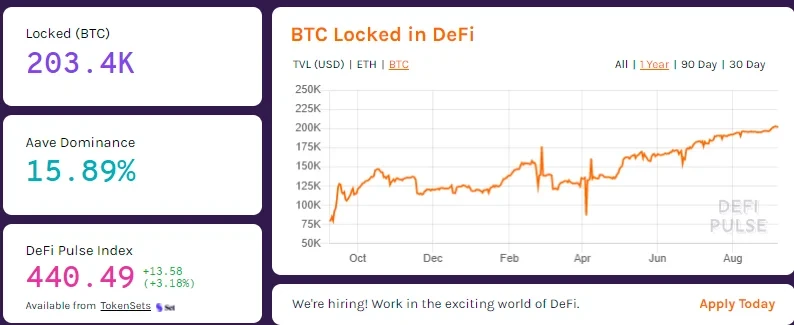
Amount of Bitcoin locked in DeFi smart contracts, source: defipulse
Imagining the Metaverse Requires Richer Imagination
So far, all our concepts and scenarios of the metaverse are mostly generated based on imagination. Although we once gave a simple and straightforward definition — the metaverse is standing on the position of most ordinary people today, thinking about the origin of human development, exploring the ultimate scenario of future society, a process from reality to virtual, then from virtual complementing reality, and finally the mutual generation of reality and virtual. But how exactly to explore? How to achieve the mutual generation of reality and virtual? Giving further answers requires richer imagination. The same applies to the possible role Bitcoin may play in the future metaverse. Based on what we can currently foresee, Bitcoin will at least become an important store of value medium in the metaverse. However, with technological development and conceptual advancement, or with the continuously rising prices of Bitcoin and other crypto assets, it's also unknown whether Bitcoin may derive new concept collectibles similar to current NFT fragmentation.
Disclaimer
This article may contain product-related content not applicable to your region. This article is intended to provide general information only and does not assume responsibility for any factual errors or omissions therein. This article represents only the author's personal views and does not represent OKX's views. This article is not intended to provide any of the following recommendations, including but not limited to: (i) investment advice or investment recommendations; (ii) offers or solicitations to buy, sell, or hold digital assets; or (iii) financial, accounting, legal, or tax advice. Holding digital assets (including stablecoins) involves high risk, may fluctuate significantly, and may even become worthless. You should carefully consider whether trading or holding digital assets is suitable for you based on your financial situation. For questions about your specific situation, please consult your legal/tax/investment professional. The information appearing in this article (including market data and statistics, if any) is for general reference only. Although we have taken all reasonable precautions in preparing these data and charts, we assume no responsibility for any factual errors or omissions expressed herein. © 2025 OKX. This article may be reproduced or distributed in its entirety, or excerpts of 100 words or less from this article may be used, provided such use is non-commercial. Any reproduction or distribution of the entire article must also prominently state: "Copyright © 2025 OKX, used with permission." Permitted excerpts must cite the article name and include the source, such as "Article Name, [Author Name (if applicable)], © 2025 OKX". Some content may be generated or assisted by artificial intelligence (AI) tools. Derivative works or other uses of this article are not permitted.
Show More
Recommended Reading

2025 KOLs' Most Used OKX Products: A Comprehensive Roundup
In the cryptocurrency industry, professional players' choices are always direct and pure. In 2025, KOLs cast their most genuine votes for industry tools and ecosystem development with a full year of fund investment and time accumulation. Around four core questions — "What was the biggest achievement this year?", "Given the achievements, what OKX products did you use most and like best in 2025?", "Why do you like it?", and "This
January 5, 2026

2026 Investment Outlook: Asset On-Chain, Intelligence and Privacy | OKX Annual Record
Three major trends in crypto's future: asset transformation, entity transformation, and rule transformation. As we're about to enter 2026, saying goodbye to the past four years of infrastructure-focused "road building," the crypto industry is welcoming a profound paradigm shift. OKX Ventures defines this as the opening of the "Kinetic Finance" era, where the core is no longer how fast the network is, but the flow of on-chain assets and making money
December 31, 2025

Voting with Data: Insights into 2025's Hot Trading Products | OKX Annual Record
If you only look at market trends, it's hard to explain the return differences among trading users in 2025. What truly determines returns also depends on account-level operational methods, not just market volatility itself. OKX's annual statement shows that mainstream coins remain the core of fund turnover and return bearing, supporting trading and strategy execution; emerging coins are more used to amplify volatility and provide phased opportunities, but are not a stable, long-term source of returns. What truly consistently contributes returns is,
December 30, 2025
Fusaka in Practice: What Does Ethereum's Latest Upgrade Mean for L2, Nodes, and Users?
The Ethereum mainnet has completed the Fusaka fork. From a protocol perspective, this upgrade mainly includes four components. The full text presents the core views and first-hand experience of three guests in Q&A format: Ahmad (@smartprogrammer) – Nethermind execution client / Ethereum core developer Manu (@manunalepa) – Prysm / Of
December 16, 2025

OKX Research | Why Did RWA Become a Key Narrative in 2025?
RWA (Real World Assets) is becoming a global capital "favorite." Simply put, RWA means taking valuable, ownership-based things from the real world — such as houses, bonds, stocks and other traditional financial assets, or even art, private lending, carbon credits and other assets that are usually not easily tradable — onto the blockchain, turning them into tradable, programmable crypto assets. This way, no
November 20, 2025
Claude Takes the Championship, Truth About 6 Major AI Grid Strategy Showdown | OKX & Ai Coin Live Trading Review
Short-term trading champion Qwen3, is it also king in grid strategies? The first season of the "AI Trading Live Arena" launched by NOF1 finally concluded at 6 AM on November 4, 2025, whetting the appetite of the crypto, tech, and finance circles. But the ending of this "AI IQ public test" was somewhat unexpected. The six models' total principal of $60,000 was only $4.3 left at the end
November 6, 2025