GameFi's Strong Comeback: Opportunity or Bubble?
This summer's red-hot GameFi has once again seen a new wave of momentum, with various metrics repeatedly hitting record highs. According to dappradar data, in October, the number of active wallets related to gaming accounted for 55% of the total blockchain industry.
As November began, GameFi continued to gain traction driven by concepts like the metaverse and Web3.0. Its total market capitalization broke through $25 billion at the beginning of the month, reaching an all-time high. OKX platform data shows that leading GameFi project tokens such as AXS, ENJ, and MANA saw maximum gains of 131%, 181%, and 642% respectively over the past month or so.
Facing this surge, we can't help but ask: What are the characteristics and advantages of GameFi compared to traditional gaming? Can it genuinely create real value, or is it merely a mirage weaving dreams?
How Does GameFi Create Addiction?
GameFi combines the characteristics and advantages of blockchain technology with gameplay, allowing users to not only enjoy the fun of gaming but also play to earn in the process. As early as late 2017, Crypto Kitties opened the blockchain gaming track, and the GameFi that emerged this year has completely ignited it. By combining DeFi with gaming, gamifying financial mechanisms, and tokenizing in-game assets as NFTs, it has achieved asset ownership confirmation and provided appropriate monetization methods for gaming.
Current GameFi can generally be divided into two types: one gamifies traditional liquidity mining, usually requiring users to stake assets before they can start playing; the other directly turns the gaming process into a mining process, where in-game items or equipment can be sold as NFTs for profit. GameFi games feature various gameplay styles including role-playing, virtual space,养成战斗类 (breeding and combat), card collection, multiplayer building, and more. Compared to DeFi, they offer stronger interactivity and fun, lower barriers to entry for players, and deeper immersive experiences, which can also extend the game's lifecycle.
So how exactly does GameFi gamify DeFi? This requires a closer look at the internal economic model of GameFi games: Generally speaking, tokens issued by the game exist as the vehicle for economic circulation. Some GameFi games (such as Axie Infinity) issue two types of in-game asset tokens — one serves as the medium of exchange within the game, simulating economic cycles through issuance, consumption, and inflation; the other is the project's platform token, which can be traded on secondary markets and serves as a bridge between in-game and real-world economies.
In addition, GameFi games also set up in-game characters or equipment to serve as productive tools and consumption mechanisms, driving the dynamic development of the economy, possibly with some bubble-absorption mechanisms to prevent crashes. Most characters or equipment fulfilling these functions are NFTs, which can also be traded and appreciated in value. From this perspective, GameFi's economic circulation is similar to that of a real-world economy, with strong regulatory flexibility to promote healthy game development. The complex yet sophisticated GameFi economic logic also makes the game's worldview grander, storylines more complete, playability further enhanced, and gives rise to rich ecosystems including social interactions and community culture.
Such game design正好对应一个完整的"上瘾模型" (the Hook Model), meaning that GameFi players go through a closed loop of "trigger, action, reward, investment." Many players outside the crypto space are now attracted by GameFi's returns. The gamification of financial mechanisms lowers their barrier to understanding, while the emergence of gaming guilds like YGG provides players with one-stop assistance including asset leasing, greatly reducing the upfront costs of participating in GameFi games.
It can be said that the logic from trigger to action is very smooth. The subsequent reward and investment phases are precisely where GameFi, inherently endowed with both financial and gaming attributes, excels. The complex and exquisite economic circulation systems built by various games continuously provide feedback and incentives for players. While playing to earn, they constantly create new demands and stimulate further investment from players, making it difficult for them to quit and triggering continued action.
Is Current GameFi an Investment Wind Vane?
Well-conceived and meticulously crafted GameFi had already experienced a comprehensive breakout this summer. After a brief consolidation period, it has repeatedly hit new highs recently and returned to center stage on its own merits.
Looking at the data, GameFi leader Axie Infinity saw significant growth in November, with daily trading volume, total number of traders, and AXS market cap all hitting record highs. Various GameFi ecosystem projects, such as development platform Enjin, social platform Gala, and gaming guild Yield Guild Games, also saw their tokens rise to varying degrees in November.
Metaverse-themed GameFi has also attracted countless的目光 with high-freedom, high-realism gaming worlds. Decentraland and The Sandbox successively topped the popularity charts. Compared to traditional sandbox online games like Second Life and Minecraft, metaverse GameFi offers higher realism, more complex ownership and economic systems, and more decentralized governance, already showing the雏form of a metaverse.
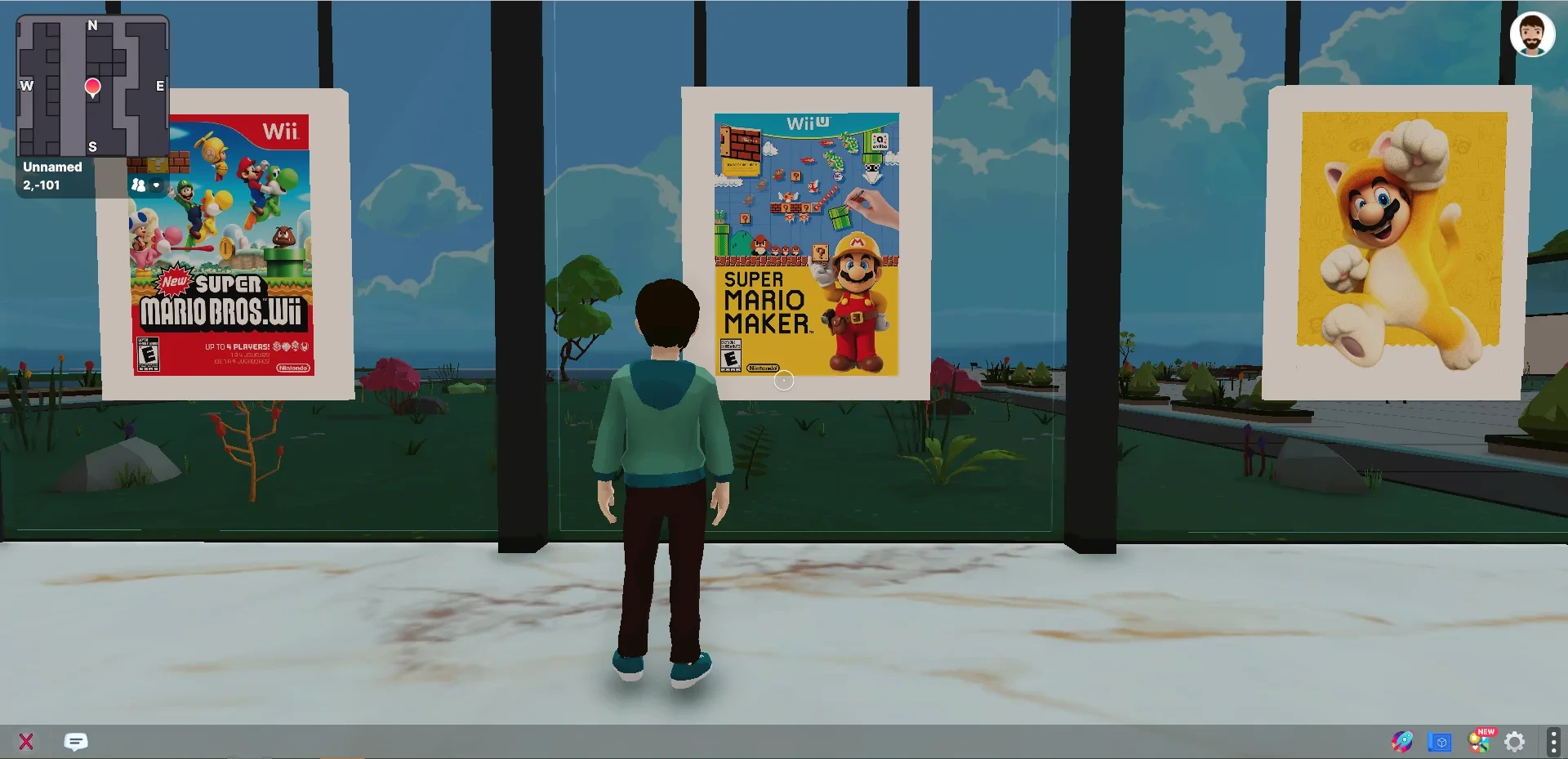
Player-organized exhibitions within the gaming world Source: Decentraland
The metaverse envisions a social form built on blockchain and other technologies that blends virtual and real worlds, with gaming serving as one of its important entry points and the most advanced field among all current metaverse applications. Recently, traditional internet companies like Facebook, Microsoft, and Tencent have all announced full-scale entry into the metaverse, sparking increasingly heated discussions and adding fuel to the GameFi fire. Driven by the metaverse's clearly defined development direction and incremental overseas markets, GameFi's potential should not be underestimated.
GameFi's performance and potential have also attracted the attention of many professional investors and institutions. According to dappradar data, in October, VCs invested at least $127 million in GameFi-related projects, with over 20 blockchain gaming projects announcing financing rounds. Traditional capital is also betting on this emerging field — Sequoia China, Rothschild Trust Capital, and Samsung Risk Investment have all begun making moves recently. GameFi seems to be gaining increasing mainstream acceptance.
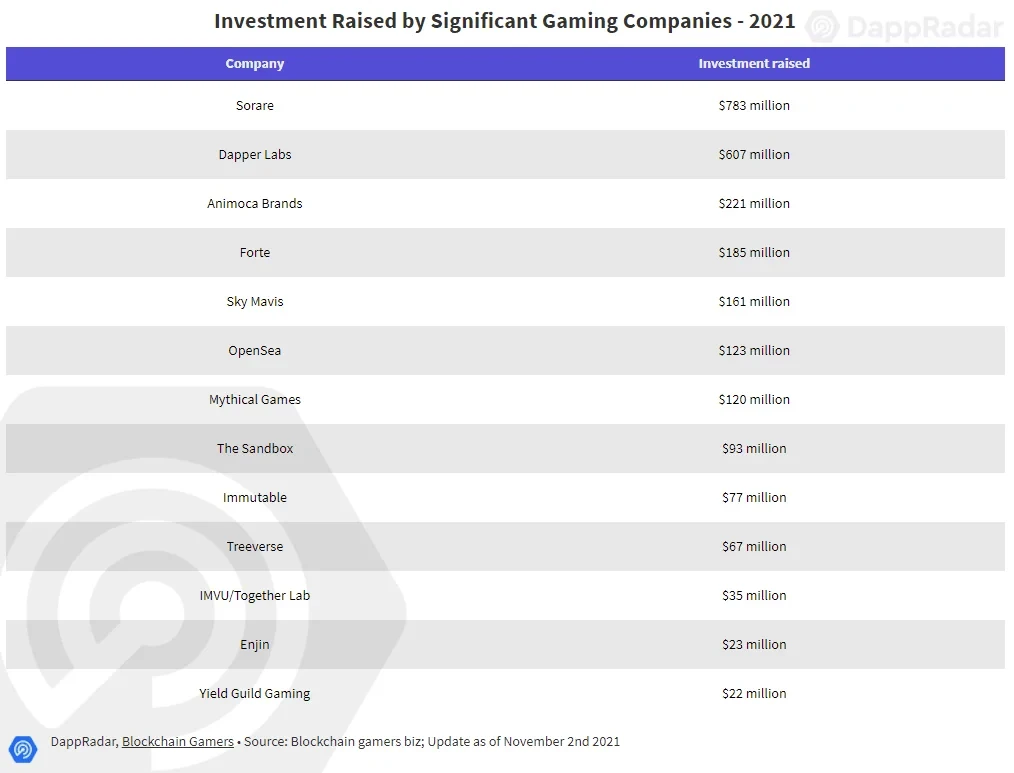
Major GameFi Companies' Investments in 2021 Source: dappradar
GameFi has experienced explosive growth over the past six months, but if we take a comprehensive look at the entire gaming industry, where does GameFi stand, and how much room for development does it have?
According to Newzoo statistics, the global gaming market reached $177.8 billion in 2020, a 23% increase from 2019, and is expected to exceed $200 billion in 2023. In comparison, GameFi is still just a young sapling, but the enormous demand in the gaming market means it will have vast soil and sky ahead. At the same time, P2E GameFi games are no longer pure consumer products — their financial attributes will bring them more capital flow and use cases than traditional gaming. Sfermion founder Andrew Steinwold once stated that if half of the world's 2.7 billion gamers can be attracted in, it would form a free-trading economic system, which would not only unlock billions of dollars and create entirely new economic entities, but also provide millions of people with new economic opportunities.
What Other Problems Does GameFi Still Need to Solve?
However, will traditional gaming simply sit by and let GameFi take their place? On October 16, Steam, the world's largest digital game distribution platform, banned the publishing of blockchain-based games on its platform. Traditional gaming platforms' counterattack is just one aspect — there are still various endogenous obstacles on GameFi's development path that need to be cleared.
The most fundamental issue is infrastructure. GameFi carries massive high-concurrency data from numerous players, requiring high TPS along with various plugins for data security, distributed storage, and more. The current state of mainstream public chains and other underlying technology development has become a ceiling limiting GameFi's growth. Public chain performance and fee issues on one hand reduce players' gaming experience, while on the other hand constraining GameFi's economic model. Some projects, in pursuit of efficiency, have had to move partial computing power off-chain, leaving these projects severely lacking in decentralization. Once fund security issues arise, the entire gaming ecosystem could collapse.
Another set of problems GameFi faces stems from the essential characteristics of blockchain technology and is difficult to eliminate — such as asset security issues caused by code vulnerabilities, unclear responsibilities among multiple parties due to decentralization, and governance lag.
For example, on November 7, at around midnight Hong Kong time, a large-scale account theft occurred among Chinese players in Farmers World. Upon investigation, hackers exploited a code vulnerability to change users' staking addresses. Farmers World later stated, "We are helpless against this, because this is blockchain, and this is the crypto market."
Blockchain technology has enabled games to achieve digital asset ownership confirmation, returning the主导权 of game assets from developers to players. However, without the endorsement of centralized institutions, asset security issues require redesigning a complete solution and clarifying responsibilities among multiple parties. The establishment of new rules requires time, case studies, and the accumulation of consensus, all of which need to be摸索 in the阵痛 of transformation.
Additionally, some recent恶性events have also sounded the alarm: A game based on a trending web drama's storyline saw its token surge thousands of times before lightning crashing, with large amounts of assets being taken by the developers. Overall, building blockchain games around popular IPs is becoming an effective means of quickly attracting traffic, but this niche sector also has overheating issues. Some projects may not yet be完善的 in development, operations, and related processes; furthermore, some games using popular IPs may also face infringement issues and need to be regulated and standardized.
Conclusion
As a project format with both financial and gaming attributes, GameFi interacts with concepts like NFTs and the metaverse, jointly leading the trend in the crypto market. However, as of now, its infrastructure still has significant room for improvement, and relevant regulations have not yet been fully established. Investors should proceed with caution.
Disclaimer
This article may contain product-related content not applicable to your region. This article is only committed to providing general information and does not responsible for any factual errors or omissions. This article represents only the author's personal views and does not represent the views of OKX. This article does not intend to provide any advice, including but not limited to: (i) investment advice or investment recommendations; (ii) offers or solicitations to purchase, sell, or hold digital assets; or (iii) financial, accounting, legal, or tax advice. Holdings of digital assets (including stablecoins) involve high risk and may fluctuate significantly or even become worthless. You should carefully consider whether trading or holding digital assets is suitable for you based on your financial situation. For questions about your specific circumstances, please consult your legal/tax/investment professional. The information in this article (including market data and statistics, where applicable) is provided for general reference purposes only. Although we have taken all reasonable precautions in preparing this data and these charts, we assume no responsibility for any factual errors or omissions expressed herein. © 2025 OKX. This article may be reproduced or distributed in its entirety, and excerpts of 100 words or less may be used, provided that such use is non-commercial. Any reproduction or distribution of the full article must prominently state: "This article is copyrighted © 2025 OKX, used with permission." Permitted excerpts must cite the article title and include attribution, for example "Article Title, [Author Name (if applicable)], © 2025 OKX." Some content may have been generated or assisted by artificial intelligence (AI) tools. Derivative works or other uses of this article are not permitted.
Show More