After DeFi and NFTs, Will Layer2 Become Ethereum's Next Breakthrough? (Part 1)
Preface: With the rise of dYdX, we've noticed that projects based on Layer2 have shown remarkable performance in both quantity and quality. To provide OKX users with a more comprehensive view of Layer2 development, we will be conducting a series of discussions covering important developments from the recent Ethereum EIP-1559 upgrade and record-high hashrate to Layer2 topics. Based on data, we strive to objectively and accurately present these industry trends to our readers. This series is divided into two parts - this is Part 1. Should there be any errors or omissions, we welcome feedback and corrections.
Recent Ethereum Developments:
September 3, 2021, may well become a day to be remembered in Ethereum's history. On this day, Ethereum welcomed its first deflationary day, with a net reduction of 352 ETH.
According to ETH Burn Bot statistics, on September 3rd, the Ethereum network burned a total of 13,838.3 ETH, while block rewards issued were 13,485.5 ETH. For the first time, burn volume exceeded issuance, with a net burn of 352.8 ETH and an annual inflation rate of -0.11%. Looking at a longer cycle, Ethereum's recent inflation rate is at its lowest level since January 2020. If calculated from the historical high inflation rate of 18.35% recorded on September 17, 2020, to the present (approximately 4.65%), Ethereum's inflation rate has dropped by about 75%.
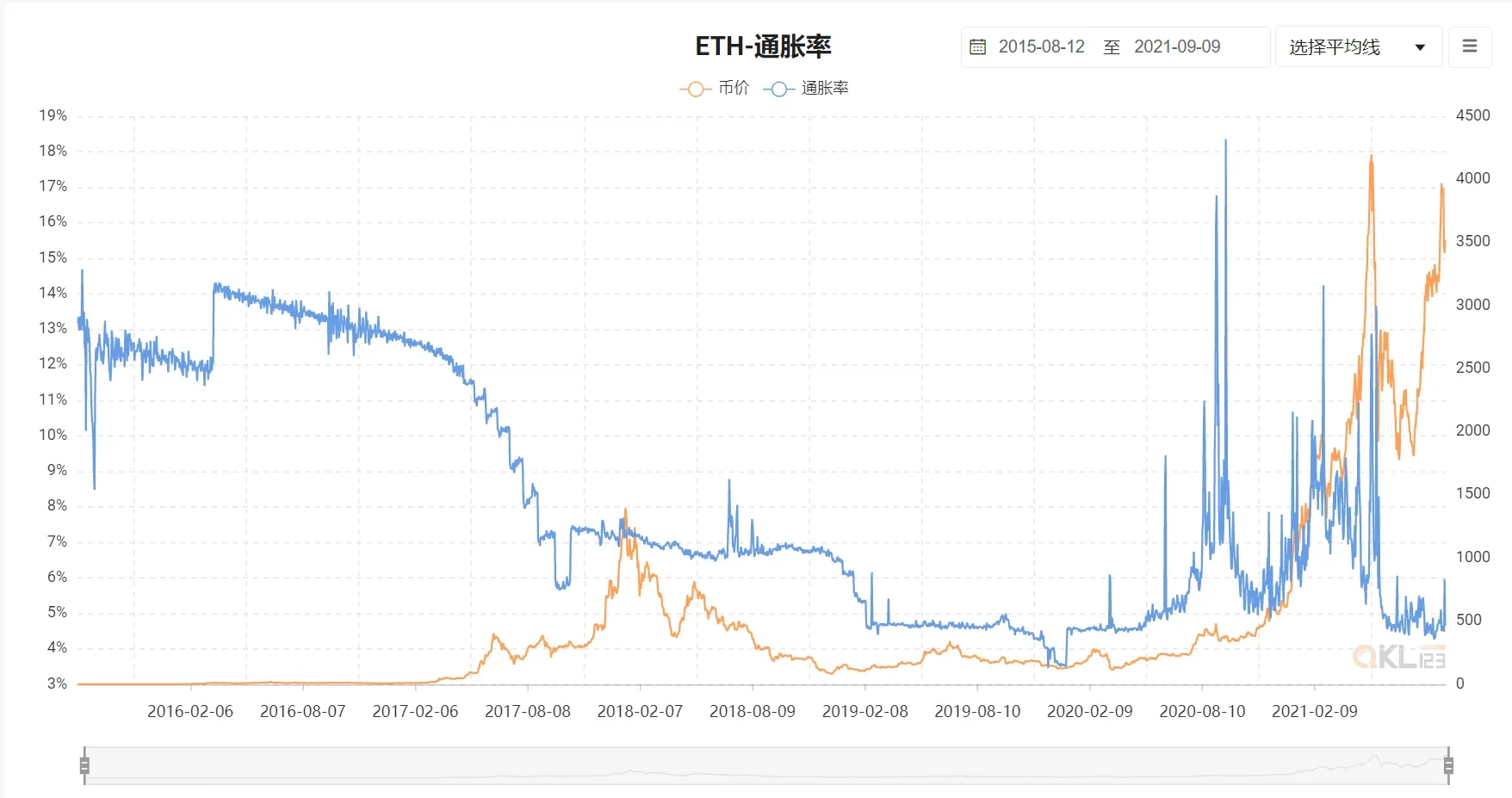
Ethereum Historical Inflation Rate Changes, Source: qkl123
We know that although Ethereum has achieved remarkable success to date, it remains imperfect. For instance, inflation has long been a focal point of community concern. Due to ETH's role as gas fuel in the Ethereum network, ETH and Bitcoin have distinctly different economic models. Unlike Bitcoin, ETH has no cap on total issuance. According to established rules, approximately two new ETH enter circulation with each new block created (excluding uncle block rewards for now). This means that over time, the circulating supply of ETH will continue to increase. Specifically for investors, this means that the ETH assets held by investors are continuously diluted. Meanwhile, from an economic perspective, high inflation rates also mean increased financing risk. Although in 2018, Ethereum co-founder Vitalik Buterin proposed setting the total ETH supply at 120 million, this was ultimately not implemented due to various reasons. The deflationary effects and facts brought about by EIP-1559 undoubtedly bring greater confidence to investors while maintaining ETH's fuel属性.
In addition, another noteworthy data point on the Ethereum network recently is the increase in Ethereum hashrate. According to qkl123 statistics, on August 25, the Ethereum network's average hashrate reached 646.71 TH/s, surpassing the previous high of 643.82 TH/s set on May 20.
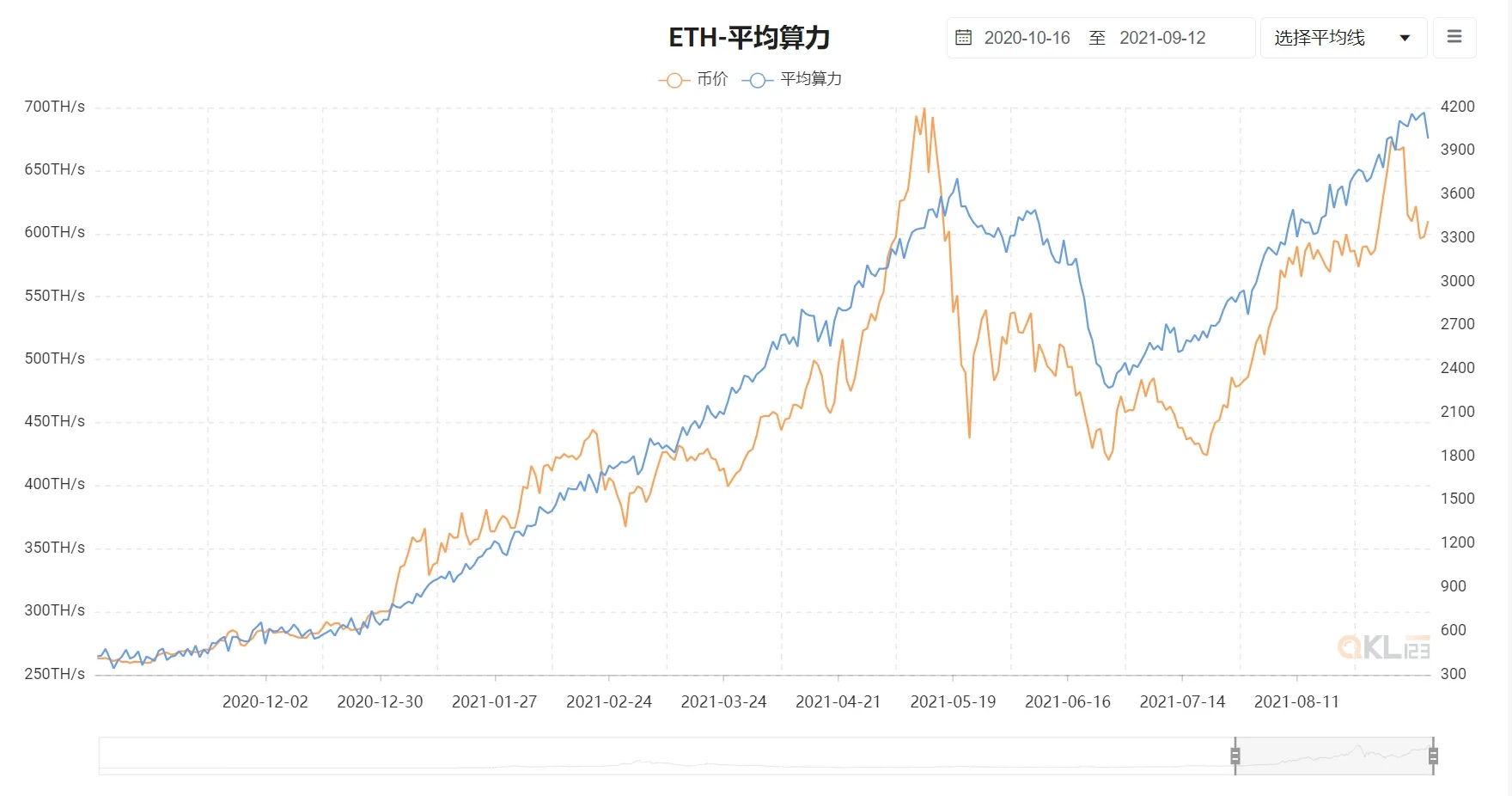
Recent Ethereum Network Average Hashrate Changes, Source: qkl123
Comparing Ethereum network hashrate changes over the past week with ETH price volatility, we can observe an interesting phenomenon: although on September 7, ETH price experienced volatility exceeding 20%, network hashrate increased rather than decreased; yesterday saw a slight decline, but compared to the price drop, it was much smaller. This indirectly suggests that the market heat driven by the NFT sector boom and rising gas fees has not yet shown clear signs of cooling.
Layer1**** and Layer2
Before discussing Layer2, let's briefly review what Layer1 and Layer2 are, and their relationship and differences.
First, it's important to clarify that the concepts of Layer1 and Layer2 don't refer solely to the Ethereum network. The industry has adopted the OSI model (Open System Interconnection Reference Model) from computer network communication architecture to divide blockchain logical architecture into three layers - Layer0, Layer1, and Layer2.
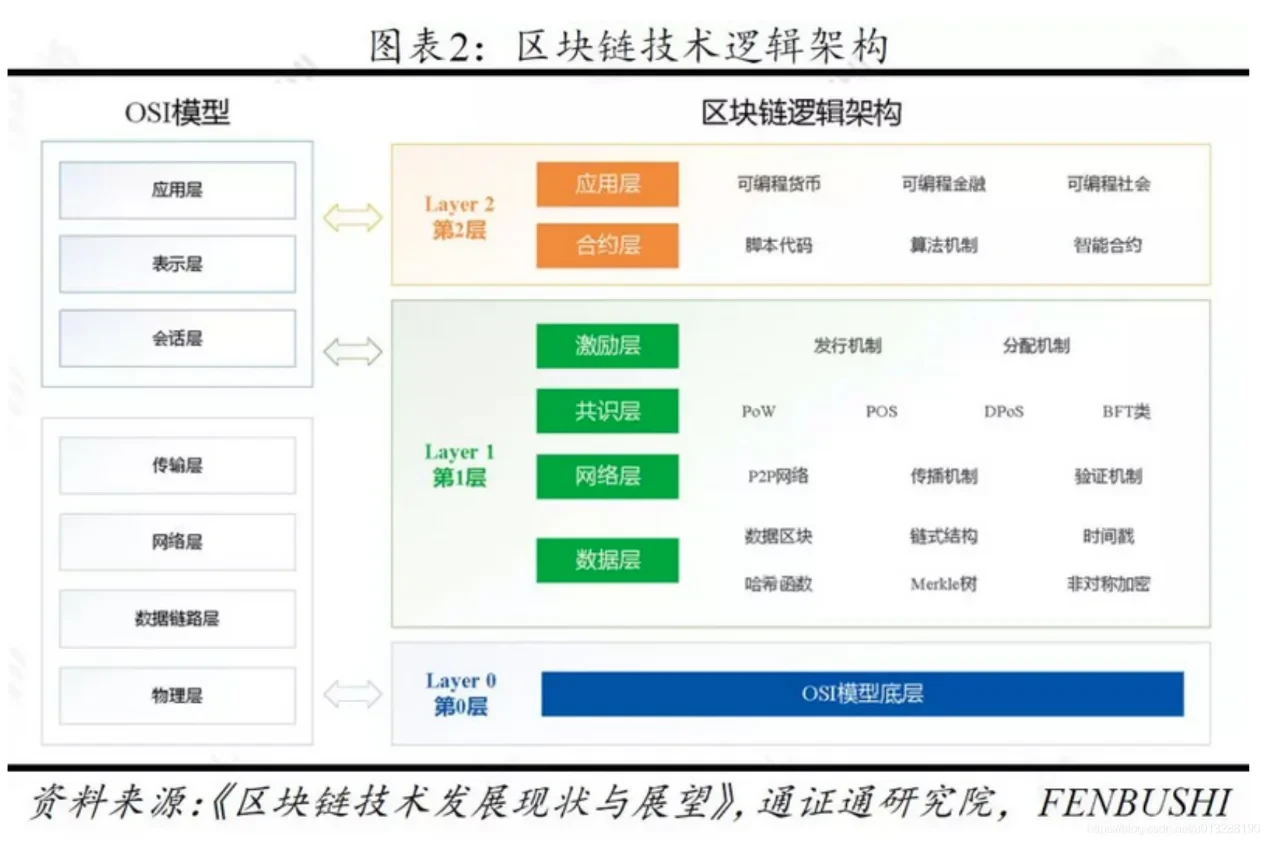
Blockchain Technology Logical Architecture Diagram, Source: Token Tong Research Institute, Image from internet
Here, "Layer" refers to its most common meaning - "layer." So Layer1 and Layer2 simply mean the first layer and second layer. Looking at the diagram above, Layer0 corresponds to the underlying protocols of the OSI model, roughly including the physical layer, data link layer, network layer, and transport layer. Layer 1 roughly includes the data layer, consensus layer, and incentive layer. Layer 2 mainly includes the contract layer and application layer.
By this classification, mainstream public chains we're familiar with, such as the Bitcoin network and Ethereum mainnet, fall under the Layer 1 category. However, among numerous public chain projects today, Ethereum runs the most smart contracts and DApps, and has the highest total value locked and daily trading volume. Therefore, discussions about different Layer1 and Layer2 scaling solutions for Ethereum are also the most extensive. In this article, unless otherwise specified, references to Layer1 and Layer2 generally refer to Ethereum. Simply put, in the Ethereum network, Layer 1's main role is ensuring network security, decentralization, and final state confirmation - achieving state consensus and serving as a trusted "crypto court" in the public chain network. Through rules designed in smart contracts, it arbitrates and transfers trust to Layer2 through economic incentives. Layer2, on the other hand, pursues higher efficiency as its ultimate goal. From the blockchain technology logical architecture diagram above, we can see that as a second-layer network, it can handle most computational work for Layer1. In recent years, many projects have been built on Layer2, separating trading activities from the main chain to reduce the burden on the first-layer network and improve business processing efficiency, thereby achieving scaling. In this process, although Layer2 only achieves local consensus, it can basically meet the needs of various scenarios.
Currently, the most fitting industry analogy compares Layer1 and Layer2 to the relationship between central banks and commercial banks: Layer1 serves as the central bank, while Layer2 represents various commercial banks. In today's mainstream financial systems, all assets must be settled at the central bank, but specific circulation processes can occur simultaneously at both central and commercial banks. If everyone went to the central bank for settlement, business congestion would be inevitable. A better solution is for commercial banks to first handle large volumes of trading business, then each commercial bank settles overall business with the central bank once. This allows the entire financial system to operate more efficiently and orderly. The insight we gain from this is that for trading congestion and high transaction fees in the Ethereum network, a viable solution emerges - deposit Ethereum assets into Layer2, then conduct subsequent asset flow and trading on Layer2, placing only the final settlement process on Layer1.
The Quiet Rise of Layer2
From the above discussion, it's not hard to see that debates about Layer1 or Layer2 ultimately return to the topic of scaling. Layer2-based scaling solutions, also known as off-chain scaling, primarily aim to expand blockchain performance while preserving the decentralization advantages of distributed protocols. Currently, mainstream solutions include sidechains, state channels, Plasma, and Rollup. Upon closer examination, these solutions are essentially similar in nature - essentially establishing a more diverse commercial banking system. Therefore, we won't elaborate on the details of these Layer2 scaling solutions here. Let's instead look at recent changes in Layer2's core data.
According to recent data statistics from L2BEAT.com, the total value locked (TVL) across all Layer2 solutions on Ethereum has exceeded $1 billion. Among them, the dYdX protocol based on Stark Ex has a TVL approaching $290 million, Nahmii 1.0 has $159 million locked, and Optimism has $157 million locked. Meanwhile, Arbitrum One mainnet, which launched just a week ago, has already reached over $66 million in TVL.
Particularly noteworthy is the dYdX protocol. As we know, dYdX is a decentralized exchange on Ethereum focused on derivatives trading. In the first quarter of this year, the dYdX team announced migrating some of its products to Layer2, while also announcing several important product update plans following the Layer2 migration, including increasing maximum leverage for contract trading from 10x to 25x and adding more trading assets. No gas fees are required during trading - only transaction fees. From this, we can see that the dYdX team is quite optimistic about expectations after migrating products to Layer2, both in terms of improved trading efficiency and reduced trading costs.
In fact, dYdX protocol's subsequent performance in trading volume has confirmed the team's optimistic expectations. According to Metabase data, by the end of April, dYdX's cumulative trading volume on Layer2 was $580 million. By the end of July, cumulative trading volume reached $3.4 billion. In August alone, trading volume hit a record $14 billion, a 20x increase month-over-month. Currently, cumulative trading volume has reached $18 billion.
Of course, dYdX protocol is just one representative project on Layer2. There are many other promising seed projects on Layer2 with similar potential. Looking at the broader competition between public chains, Ethereum's internal Layer1 congestion and high transaction fee problems remain unresolved, and ETH 2.0 is still some time away. Externally, emerging public chains like Solana, Terra, and Avalanche are encircling. From a longer-term perspective, although Layer2 may well be just a transitional period in Ethereum's development, at present, Layer2 is more likely to become Ethereum's weapon against encroachment by emerging public chains. For more discussions on Layer2 topics, please stay tuned for "After DeFi and NFTs, Will Layer2 Become Ethereum's Next Breakthrough? (Part 2)."
Disclaimer
This article may contain product-related content not applicable to your region. This article is intended to provide general information only and does not take responsibility for any factual errors or omissions contained herein. This article represents only the author's personal views and does not represent the views of OKX. This article is not intended to provide any recommendations, including but not limited to: (i) investment advice or investment recommendations; (ii) offers or solicitations to buy, sell, or hold digital assets; or (iii) financial, accounting, legal, or tax advice. Holding digital assets (including stablecoins) involves high risk, may fluctuate significantly, and may even become worthless. You should carefully consider whether trading or holding digital assets is suitable for you based on your financial situation. For questions regarding your specific situation, please consult your legal/tax/investment professional. The information appearing in this article (including market data and statistics, if any) is for general reference only. Although we have taken all reasonable precautions in preparing these data and charts, we accept no responsibility for any factual errors or omissions expressed herein. © 2025 OKX. This article may be reproduced or distributed in its entirety, or excerpts of 100 words or less from this article may be used, provided such use is non-commercial. Any reproduction or distribution of the entire article must prominently state: "Copyright © 2025 OKX. Used with permission." Permitted excerpts must cite the article name and include attribution, for example "Article Name, [Author Name (if applicable)], © 2025 OKX". Some content may be generated or assisted by artificial intelligence (AI) tools. Derivative works or other uses of this article are not permitted.
Show More
Recommended Reading

2025 KOLs' Most Used OKX Products Ranking
In the cryptocurrency industry, professional players' selections are always direct and pure. In 2025, KOLs cast the most genuine votes for industry tools and ecosystem development with a full year of capital investment and time dedication. Centered around four core questions - "What was your biggest achievement this year?", "Given your achievements, what OKX product did you use most and like best in 2025?", "Why do you like it?", and "This
January 5, 2026

2026 Investment Outlook: Assets On-Chain, Intelligence and Privacy | OKX Annual Review
Crypto's three major trends: asset transformation, entity transformation, and rule transformation. As we approach 2026, bidding farewell to the past four years of infrastructure-focused "road building," the crypto industry is welcoming a profound paradigm shift. OKX Ventures defines this as the dawn of the "Kinetic Finance" era, where the core is no longer how fast the network is, but rather the flow and earnings of on-chain assets
December 31, 2025

Voting with Data: Insights into 2025 Hot Trading Products | OKX Annual Review
Looking only at market conditions, it's hard to explain the return differences among exchange users in 2025. What truly determines returns also depends on account-level operational methods, not just market volatility itself. OKX's annual statement shows that mainstream coins remain the core of fund turnover and return generation, supporting trading and strategy execution; emerging coins are more used to amplify volatility and provide phased opportunities, but are not stable, long-term sources of returns. What truly consistently contributes returns is
December 30, 2025
Fusaka in Practice: What Does Ethereum's Latest Upgrade Mean for L2, Nodes, and Users?
Ethereum mainnet has completed the Fusaka fork. At the protocol level, this upgrade mainly includes four components. The full text presents the core viewpoints and frontline experience of three guests in Q&A format: Ahmad (@smartprogrammer) - Nethermind execution client / Ethereum core developer Manu (@manunalepa) - Prysm / Of
December 16, 2025

OKX Research Institute | Why Did RWA Become a Key Narrative in 2025?
RWA (Real World Assets) is becoming a global capital "favorite." Simply put, RWA involves bringing valuable, ownership-bearing items from the real world - such as traditional financial assets like houses, bonds, stocks, and even assets that are normally difficult to trade directly like artworks, private lending, and carbon credits - onto the blockchain, turning them into tradable, programmable crypto assets. This way, no
November 20, 2025
Claude Takes Championship, 6 Major AI Grid Strategy Showdown Truth | OKX & Ai Coin Live Trading Review
Short-term trading champion Qwen3, is it also king in grid strategies? The first season of NOF1's "AI Trading Live Arena" finally concluded at 6 AM on November 4, 2025, whetting the appetite of the crypto, tech, and finance circles. But the ending of this "AI IQ public test" was somewhat unexpected - six models with a total principal of $60,000 were left with only $4.3
November 6, 2025